
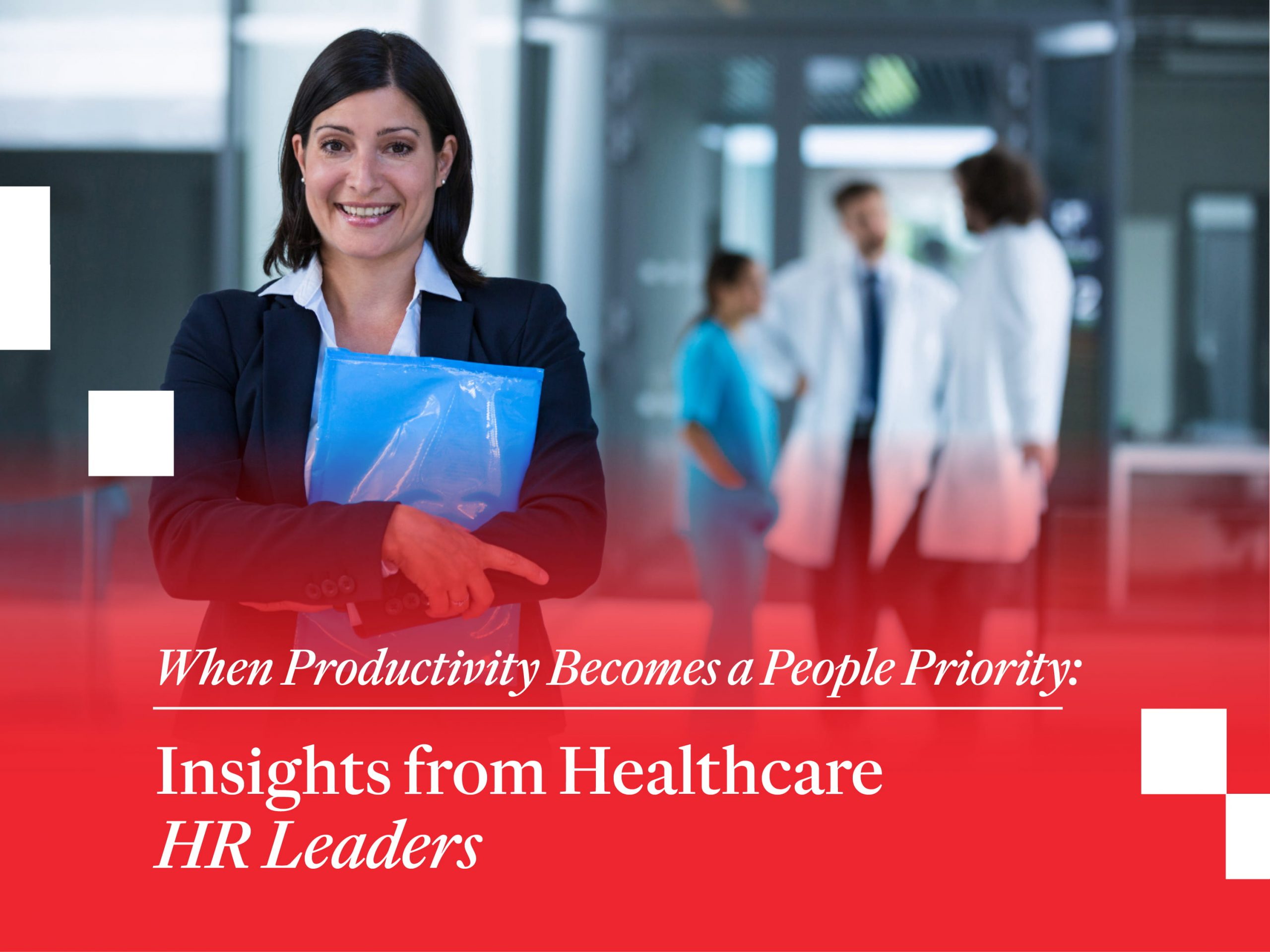
For healthcare, pharmaceutical and biotechnology organizations, employee productivity has emerged as an important people priority.
Key HR Priorities in Healthcare
When asked to identify their top three HR priorities in healthcare for the year ahead, 62% of HR leaders surveyed by us, cited improving productivity and output per employee, making it the most frequently selected strategic priority. AI-led transformation followed at 54%, while future-ready capability building and retention of critical talent were each selected by 46% of respondents. Leadership effectiveness and change resilience (38%) and people analytics (23%) featured further down the list.
At first glance, this may indicate a shift away from employee-centric priorities. However, the findings suggest something different.
What is emerging is not a choice between people and performance. Rather, healthcare organizations are increasingly viewing productivity, capability-building, retention and AI adoption as interconnected levers. The focus is lesser on employee experience as a standalone outcome and more on employee experience as an enabler or input-driver of business performance.
The prominence of AI in the findings reinforces this shift. More than half of organizations identify AI-led transformation as a strategic priority, while strengthening workforce capabilities for an AI-enabled future ranks alongside talent retention as a critical focus area. At the same time, healthcare organizations are directing AI investments toward stronger data foundations, customer and service innovation, and redesigned ways of working.
Yet the pursuit of productivity is not without challenges.
AI as a Differentiator for the Best Versus the Rest
The study reveals that AI is already creating cultural and workforce tensions. Nearly half (46%) of HR leaders report that high performers are leveraging AI to pull further ahead, creating a widening performance gap within teams. Others point to concerns around trust in AI-generated outputs and resistance from employees who see AI as a threat to established expertise.
The findings also suggest that managers may be among the least prepared stakeholders in this transition. While organizations are investing in technology and rethinking work, managerial expectations remain largely undefined. Only a minority report having adapted manager expectations, while 38% acknowledge that expectations need to evolve but have not yet clearly defined how. Another 15% say expectations have shifted informally, leaving managers to navigate the changes on their own. Notably, none of the organizations surveyed reported having formally updated and clearly communicated manager expectations in response to AI.
Role of Managers in Driving Employee Experience
This gap matters because managers remain one of the strongest drivers of organizational outcomes. Elsewhere in the study, relationship with the direct manager emerged as the most effective lever for reducing attrition and improving retention, cited by 85% of respondents.
Taken together, the findings point to a broader evolution of the healthcare sector. Faced with rising cost pressures, talent shortages, increasing service expectations and rapid advances in AI, organizations are elevating productivity from an operational metric to a strategic people agenda.
The question is no longer whether organizations should focus on productivity. The real challenge is how they do so.
Drivers of Success for Healthcare Organizations
The organizations that succeed will be those that view productivity not as a mandate to do more with less, but as an outcome of equipping people with the right skills, technology, data and managerial support. In that sense, the future belongs not to organizations that choose between performance and people, but to those that recognise that sustainable productivity is ultimately built through people.
Frequently Asked Questions
What is the top HR priority for pharmaceutical and healthcare organizations this year?
Improving productivity and output per employee are the leading priorities, cited by 62% of HR leaders in healthcare, pharma, and biotech organizations – ahead of AI-led transformation and talent retention.
How are healthcare organizations balancing productivity with employee experience?
Rather than treating productivity and people-centricity as contrasting goals, leading organizations are linking productivity to capability-building, retention, and AI adoption – treating employee experience as an enabler of business performance, not a separate initiative.
How prepared are managers for AI-driven changes in the workplace?
Managers appear to be among the least prepared stakeholders, where only a minority have adapted expectations, 38% say expectations need to change but haven’t been defined, and none have formally communicated updated expectations.
What drives retention amongst pharmaceutical & healthcare employees?
A strong relationship with their direct manager is the number one factor in driving retention, according to 85% of HR leaders surveyed.