
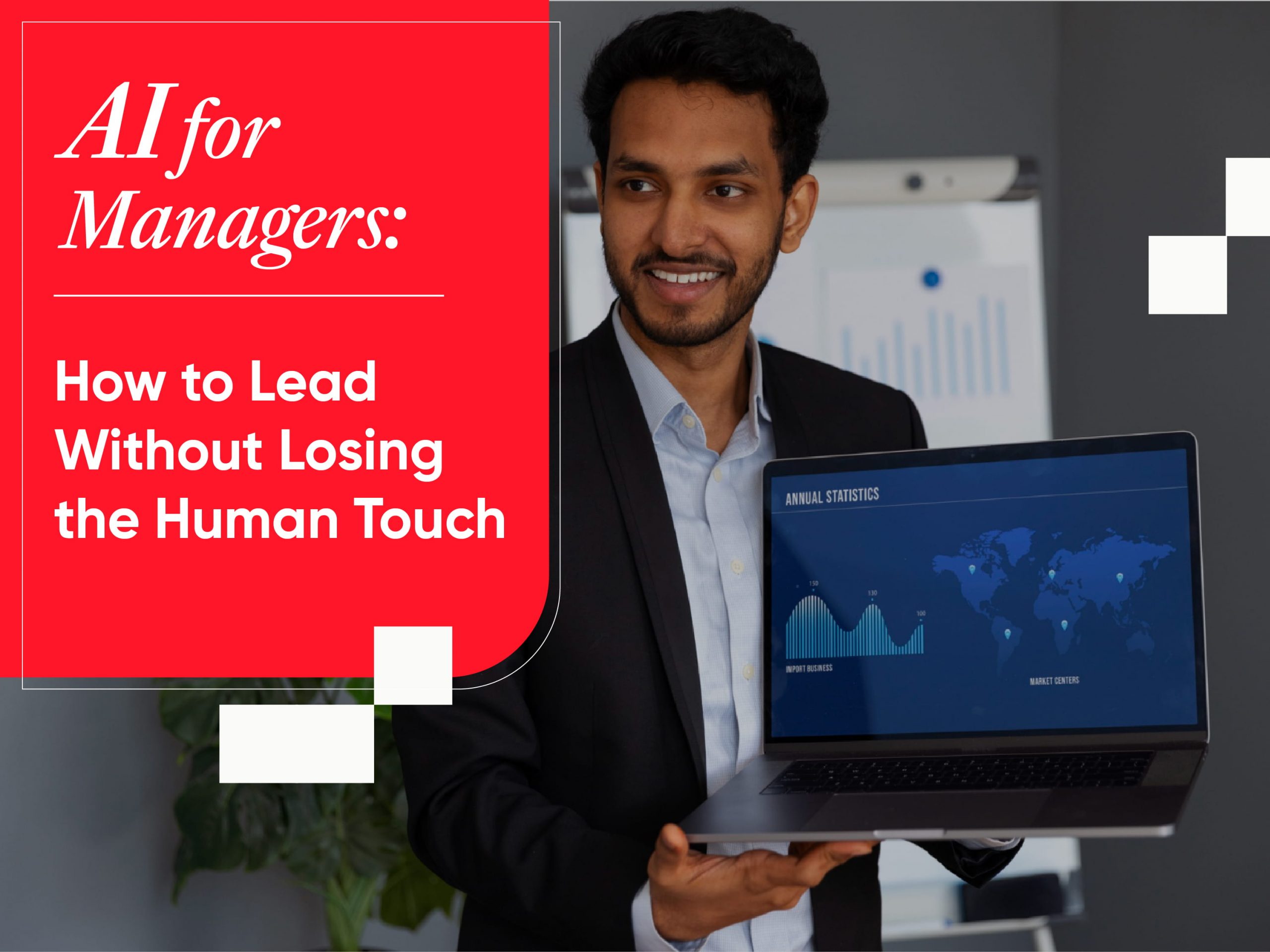
Walk into almost any organization in India today and you will find the same quiet experiment happening at every level of management. A team lead is using AI to draft a project update faster. A department head is using it to spot patterns in attrition data. A first-time manager is using it to prepare for a tough performance conversation. None of them were handed a manual. Most of them are figuring it out in real time, between meetings, while still trying to lead their teams the way they always have with attention, fairness, and trust.
This is the real story of AI for managers in Indian workplaces right now. It is not a story about robots replacing them. It is a story about managers rewriting what good leadership looks like, one decision at a time, often faster than their own organizations can formally keep up with.
Great Place To Work® India’s Voice of CHRO research on AI, spanning 2025 and 2026, captures this shift with unusual clarity. It shows that while technology is moving quickly, the definition of good management is still being written. CHROs across industries admit that expectations of managers are changing because of AI, but very few organizations have actually caught up and formalized what that change should look like. Into that gap have stepped a set of managers who are, in effect, becoming the playbook themselves.
This blog looks closely at how India’s smartest managers are using AI, not as a replacement for leadership, but as a way to become better at the parts of leadership that were always the hardest: judgment, fairness, growth, and trust. In other words, this is what good AI for managers looks like in practice, not in theory.
What Does AI for Managers Actually Mean?
Leading with AI does not imply giving up choices to a dashboard. It does not imply replacing one-on-one meetings with automated summaries or performance discussions with generated scorecards. For managers that get this right, AI is getting closer to a very fast, extremely capable assistant that handles the mechanical aspects of the work, freeing up more energy for the human elements.
In practical terms, this means utilizing AI to help managers produce the first version of a report, then applying judgment to determine what it missed. It entails applying AI to identify patterns in team performance and then having a conversation with the employee about what those patterns indicate for their development. It means using AI to prepare faster, not to lead colder.
The managers who are doing this well share one instinct in common that they treat AI as something which changes how work gets done, not something that changes why people matter. That distinction sounds simple, but it is exactly where most companies are struggling to keep pace, and exactly where individual managers are quietly getting ahead of their own companies.
How India’s Smartest Managers Are Leading With AI?
Across industries, a clear pattern is emerging among managers who are adapting well to AI. They are not waiting for perfect policies. They are not waiting for certainty. They are leading through ambiguity in ways that keep their teams engaged, supported, and growing. Here is what AI for managers looks like in practice.
1. They Are Writing the Rulebook As They Go
Most managers in India are learning to lead in an AI-enabled workplace without a formal guide to follow. According to Great Place To Work India’s Voice of CHRO research, 36% of CHROs say they know manager expectations need to change because of AI, but they have not yet defined what those new expectations should be. Only 21% of CHROs say they have formally updated and communicated manager expectations to their teams.
That gap between recognizing change and formalizing it is significant. It means that for the vast majority of managers, there is no official document explaining what “good AI-enabled leadership” looks like at their organization. And yet, many managers are not waiting around for one.
The smartest managers are treating this ambiguity as an opportunity rather than an obstacle. They are experimenting cautiously, observing what works for their team, and adjusting their own leadership style before their organization gets around to writing it down formally. They are having informal conversations with their own teams about how AI is changing daily work, setting expectations on the fly, and course-correcting when something does not land well.
This matters because employees are watching closely. When a manager can speak honestly about what is still uncertain, while still providing enough direction to feel supported, it builds a different kind of trust than a polished policy document ever could. Confidence, in this early stage of AI adoption, is not about having every answer. It is about being present and responsive while the answers are still being worked out.
For CHROs and HR leaders, this points to an immediate opportunity: capture what these early-adopting managers are already doing well, and use it as the foundation for the formal manager expectations that the rest of the organization is still waiting for. The playbook for AI-enabled management does not need to be written from scratch. It is already being tested, informally, on the ground.
2. They Make Sure No One Gets Left Behind
One of the most significant discoveries from the Voice of CHRO study is also the most uncomfortable. 44% of CHROs believe that great performers are leveraging AI to pull ahead of their peers, while others on the same team are falling behind, and that this disparity is becoming the most evident cultural friction point across businesses today. Separately, 29% of CHROs believe employees do not fully comprehend the value and impact of AI in their current employment.
Together, these two numbers describe a subtle but significant risk. AI is not causing one evident problem that is simple to identify and resolve. It is creating an uneven playing field in which one segment of the workforce accelerates while another quietly disengages, unsure how or not they fit into the new way of working.
Managers who get this right recognize that their objective is not to encourage their fastest adopters accelerate even further. Its purpose is to ensure that the entire team benefits from AI, not just the two or three people that picked it up instinctively. That involves actively observing who in the team has not yet begun experimenting with AI technologies and asking why, rather than assuming apathy.
In reality, this appears to be managers allowing space in team meetings for colleagues to share how they use AI in their own work, normalizing queries rather than presenting AI as something people should already know. It appears that confident early adopters are put together with hesitant coworkers as a natural aspect of how the team operates, rather than as part of a systematic mentorship program. Managers appear to be openly stating, aloud, that utilizing AI successfully is a talent like any other, requiring practice and the freedom to make mistakes before doing it right.
This is where good management becomes a genuine equalizer. Left unmanaged, AI adoption will naturally favor employees who are already comfortable with technology, curious by disposition, or simply have more bandwidth to experiment. A manager who actively works against that default is doing something that no company-wide AI policy can fully replicate: paying attention to who is being left behind, in real time, and doing something about it.
3. They Lead With Judgment, Not Just Answers
As AI becomes faster and more capable, one might expect the value of human judgment to shrink. The data suggests the opposite is happening. According to the Voice of CHRO research, 17% of CHROs are concerned about employees over-relying on AI instead of exercising their own judgment, and 32% of CHROs say employees struggle to know which AI outputs should be trusted and which ones need to be checked more carefully.
That second number is worth sitting with. Nearly one in three CHROs believe their employees cannot confidently tell the difference between an AI output that is ready to use and one that needs a closer look. That is not a technology problem. It is a judgment problem, and judgment has always been one of the core responsibilities of good management.
The managers who are handling this well have stopped treating AI-generated work as automatically finished. Instead, they are modeling a habit of checking, questioning, and contextualizing before anything gets used or shared further. They ask their teams simple but pointed questions: What does this output assume that might not be true here? What context does the AI not have? Would this decision look different if a client, a regulator, or a competitor saw it?
This kind of questioning is not about slowing teams down or being suspicious of the technology. It is about restoring a habit that faster tools can accidentally erode: the pause before action. Managers who build this pause into their team’s normal workflow are protecting their organizations from a specific and growing risk, output that looks polished and confident but has not actually been thought through by a human being who understands the stakes.
In many ways, this is the clearest evidence that AI has made human leadership more important, not less. Technology can generate an answer in seconds. Only a manager, with context, accountability, and experience, can decide whether that answer is actually right for the situation in front of them.
4. They Help Their Whole Team Grow Alongside AI
The final pattern among India’s most effective managers is perhaps the most optimistic one. According to the research, 57% of CHROs say reskilling and internal mobility is their organization’s preferred response to AI-driven workforce change, and 56% are prioritizing building workforce capability to work alongside AI rather than around it. Encouragingly, 73% of CHROs say employees are already positive about using AI at work.
That last figure deserves attention. Despite all the uncertainty around expectations, fairness, and judgment, a strong majority of employees are approaching AI with a fundamentally positive attitude. That is a significant asset, and the managers who are using AI well are not wasting it.
Rather than treating AI capability as something employees either have or do not have, these managers treat it as a skill to be built deliberately, the same way they would approach any other capability gap on their team. They are creating small, low-pressure opportunities for team members to practice using AI tools on real work, rather than sending people to a generic training module and hoping it translates. They are connecting AI fluency to visible career growth, making it clear that learning to work well alongside AI is not a side skill but a genuine part of how someone advances in the organization.
This is where reskilling stops being an abstract HR initiative and becomes something employees can feel in their day-to-day experience of work. When a manager takes the time to help a hesitant team member get comfortable with a new tool, celebrates the first time someone uses AI to solve a real problem well, and openly discusses how roles are evolving, employees stop experiencing AI as a threat to their relevance. They start experiencing it as an extension of their own growth.
The organizations that get this right are not the ones with the most sophisticated AI tools. They are the ones where managers have made it safe, normal, and rewarding for every employee, not just the naturally curious ones, to build this new capability alongside their existing strengths.
Common Challenges and How to Overcome Them
Managers Are Improvising Without Formal Guidance
With only 21% of CHROs having formally updated and communicated manager expectations around AI, most managers are left to interpret what good leadership looks like on their own. Organizations can close this gap by observing what their strongest managers are already doing informally and turning those real behaviors into the basis of formal guidance, rather than starting from a blank page or an untested framework.
AI Adoption Is Creating Visible Inequality Within Teams
When 44% of CHROs report that high performers are pulling ahead while others fall behind, the risk is not just a skills gap, it is a trust and morale gap. Managers should be equipped and encouraged to actively track who on their team has not engaged with AI tools yet, and to create structured, low-pressure ways for those employees to build confidence rather than being left to catch up on their own.
Employees Cannot Always Tell When to Trust AI Output
With 32% of CHROs noting that employees struggle to judge which AI outputs are reliable, organizations need to build a simple, repeatable habit of verification into everyday workflows. This does not require complex governance frameworks. It requires managers consistently modeling the pause-and-check habit until it becomes second nature for their teams.
Reskilling Needs to Feel Personal, Not Generic
While 57% of CHROs favor reskilling and internal mobility as their response to AI-driven change, generic, one-size-fits-all training rarely builds real confidence. The organizations seeing the strongest results are the ones where managers translate broad reskilling strategies into specific, individual opportunities that connect directly to each employee’s actual role and career path.
Conclusion
The real story of AI for managers in India is still being written, and right now, much of it is being authored not by policy documents or technology vendors, but by managers making good decisions in real time. They are filling the gap between what organizations know needs to change and what has actually been formalized. They are noticing who is being left behind and doing something about it. They are protecting the value of human judgment even as machines get faster. And they are turning reskilling from an HR initiative into something employees genuinely experience as growth.
What makes these managers effective is not that they have mastered every AI tool available to them. It is that they have not let the tools change what leadership is fundamentally for: helping people do their best work, feel valued while doing it, and grow because of it. Great Place To Work India’s research makes clear that the organizations getting this right are not the most technologically advanced ones. They are the ones where managers have kept the human side of leadership intact while building genuine fluency with AI alongside it.
For CHROs and HR leaders watching this unfold, the opportunity is clear. The best practices are not hypothetical, they already exist inside your organization, in the way your strongest managers are quietly leading their teams through this transition. The work now is to notice them, learn from them, and give every manager the support to lead the same way.
Frequently Asked Questions
How is AI changing the role of managers in India?
AI is shifting managers away from repetitive, administrative tasks and toward judgment-heavy work like coaching, verifying AI outputs, and helping teams build new skills. Most organizations are still formalizing what this shift means, so many managers are adapting ahead of official guidance.
What is the biggest risk of AI adoption at work, according to CHROs?
According to Great Place To Work India’s Voice of CHRO research, the biggest visible risk is not job loss but an internal gap, where high performers use AI to pull further ahead while other employees fall behind, creating friction within teams.
How can managers help employees trust AI outputs appropriately?
Managers can build a habit of checking and contextualizing AI-generated work before it is used, asking what assumptions the AI made and what context it may be missing, rather than treating outputs as automatically finished.
What should CHROs prioritize to support managers leading through AI change?
CHROs should prioritize reskilling and internal mobility, formalize manager expectations around AI use, and ensure every employee, not just early adopters, has structured opportunities to build AI capability.
Is AI reducing the need for human leadership?
The answer is no. Research shows human judgment is becoming more important as AI adoption grows, since employees increasingly need managers to provide context, accountability, and direction that AI cannot supply on its own.