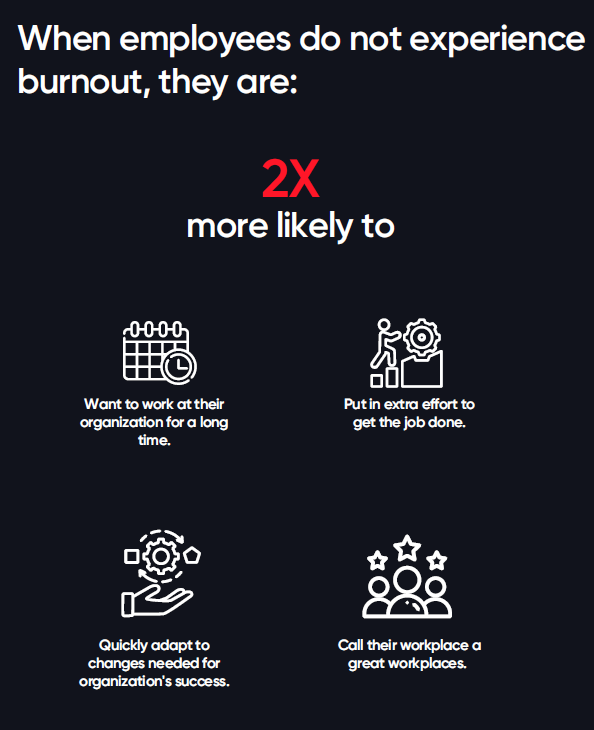
The business landscape is in a significant transformation. Environmental, Social, and Governance (ESG) initiatives are no longer a mere regulatory requirement; they are now a fundamental value for many companies. At Great Place To Work® India, we firmly believe that the key to long-term success and true sustainability lies in creating a workplace that values all its employees.  

From Policy to People: The Power of a “For All” Workplace Culture
ESG is often seen as a policy dictated by the government. However, the landscape is changing. We are witnessing a significant shift, with ESG evolving into a people-centric and workplace-driven necessity.

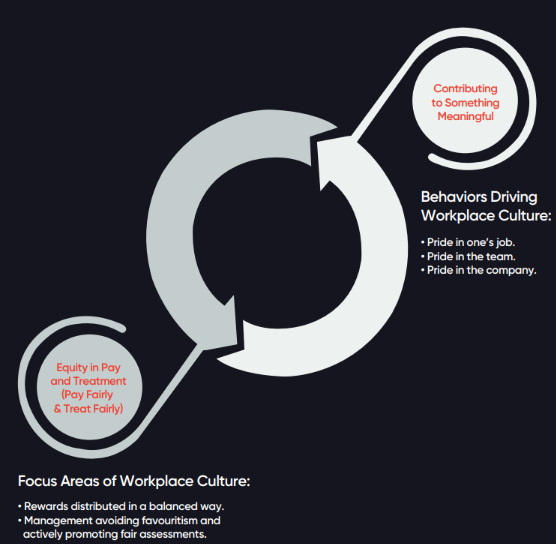
ESG is often seen as a policy dictated by the government. However, the landscape is changing.  We are witnessing a significant shift, with ESG evolving into a people-centric and workplace-driven necessity. Our research report supports this trend. Companies with a ‘For All’ workplace culture consistently outperform others on ESG scores by a substantial 8%. This underscores the importance of a culture that values diversity, equity, and inclusion as a strong foundation for sustainable initiatives. 
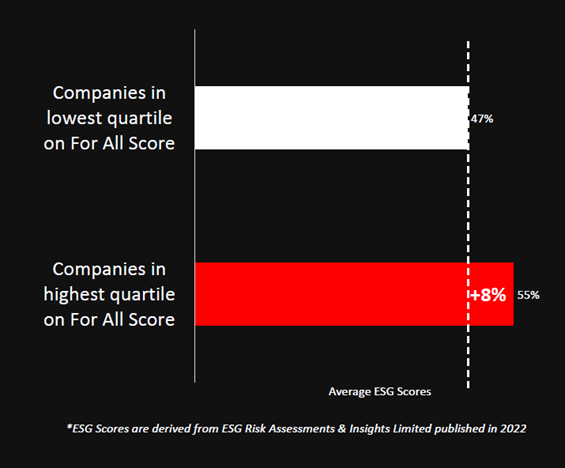
TOP RANKED COMPANIES WITH FOR ALL WORKPLACE CULTURE OUTPERFORM OTHERS ON ESG SCORES BY 8%.

The Employee Connection: Motivation and Brand Advocacy 

Employees are not just cogs in the machine; they are the driving force behind an organization’s success.  When workplaces actively contribute to society, it leads to a more motivated and brand-loyal workforce. Our ESG report establishes a direct link between employee experience and a company’s social impact. Employees who are proud of their company’s social impact are:  

  • 3.5 times more likely to say people look forward to coming to work.  
  • 3 times more likely to endorse the company as a great place to work.   
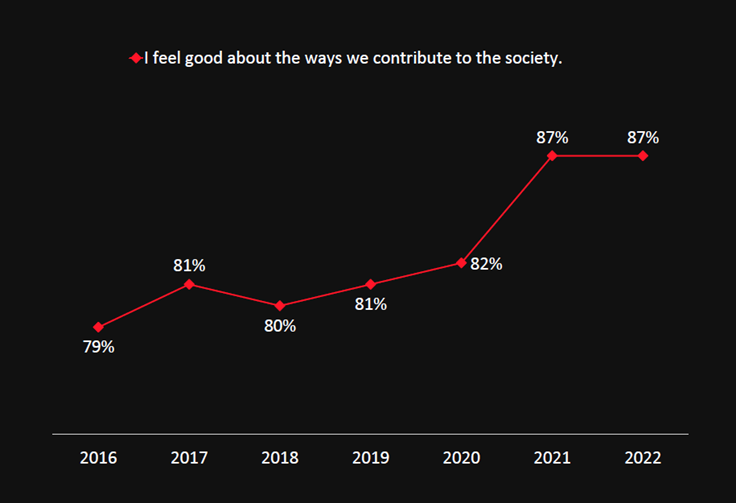
WORKPLACES CONTRIBUTING TO SOCIETY
EXPERIENCE INCREASED MOTIVATION AND BRAND ENDORSEMENT.

This results in a happier, more engaged workforce that becomes vocal advocates for the company’s positive contributions.

Building a Sustainable Future: The Business Case for Great Workplaces 

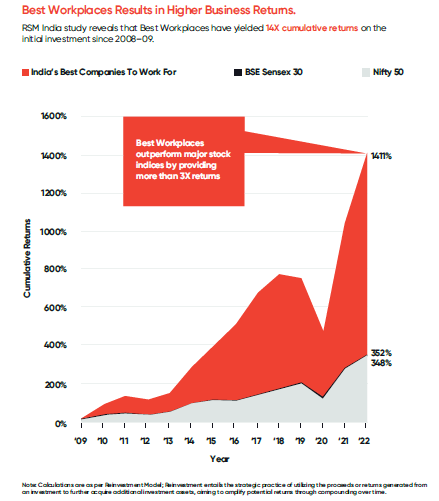
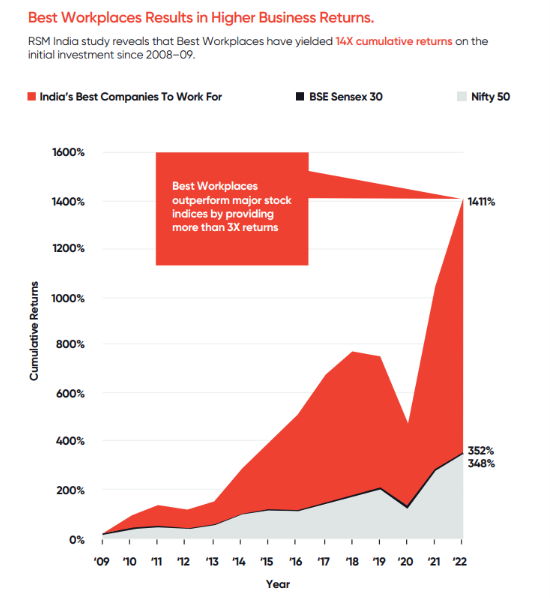
Creating a Great Place To Work isn’t solely about employee satisfaction; it unequivocally leads to higher stakeholder returns. A study by RSM India unveiled that Best Workplaces have generated an impressive 14X cumulative return on the initial investment since 2008-09. This underscores the tangible financial gain of prioritizing employee experience. Companies with a positive and empowering work environment witness increased productivity, reduced absenteeism, and lower employee turnover, all of which contribute to a healthier bottom line. 

Beyond ESG Scores: The Power of Culture for Environmental Sustainability 
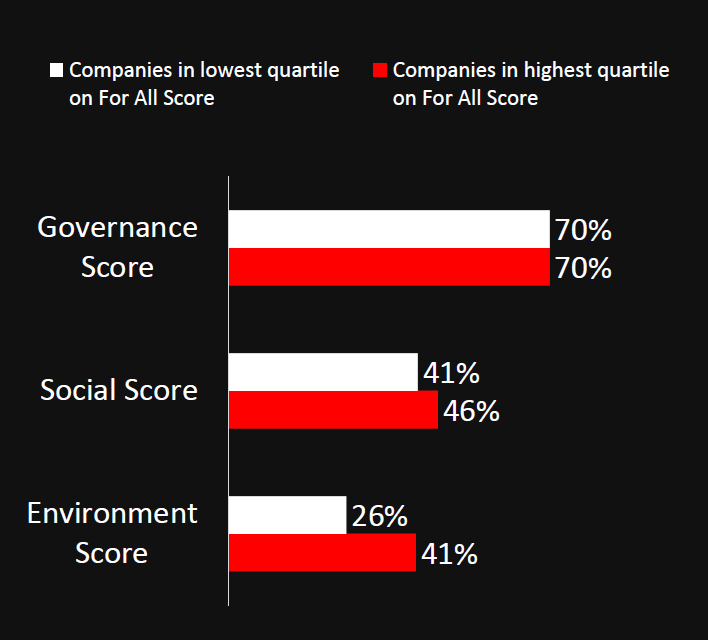
Top-ranked companies with For All Workplace Culture differentiate on environment scores by 3X compared to social aspects.

Our data shows a nuanced trend within ESG performance.  Top-ranked companies with a “For All” workplace culture show a 3Xdifferentiation in environmental scores compared to social aspects. This suggests that a strong culture fosters a deeper commitment to environmental responsibility within the organization. 

A Culture of Sustainability: From Values to Everyday Actions 

Building a sustainable future requires more than just grand pronouncements.  A company culture that prioritizes sustainability translates into everyday behaviors and practices. Here are some ways a great workplace culture can empower employees to be environmentally responsible: 

  • Transparency and Education: Companies should be transparent about their environmental goals and provide employees with the necessary training and resources to understand how their actions contribute to broader sustainability efforts.
  • Empowerment and Recognition: Encouraging employees to suggest and implement sustainable practices demonstrates trust and fosters a sense of ownership. Recognize and reward employees who champion sustainable initiatives within the organization.
  • Leading by Example: Leadership is crucial in setting the tone. When senior management actively participates in and promotes sustainable practices, it sends a powerful message to the rest of the workforce.

Attracting and Retaining Talent for Sustainability Success 

Companies with strong values and a positive culture are more likely to attract talent committed to making a positive impact. These employees are intrinsically motivated by the company’s mission and are likelier to stay with the organization long-term.  A stable and engaged workforce is essential for sustainable growth, as employee turnover disrupts operations and hinders long-term planning. 

Employee Engagement: Aligning Actions with Values for Sustainability 

Creating a sustainable work environment goes beyond just recycling and energy-efficient lighting. A company culture that encourages sustainable behavior empowers employees to take actions that align with the company’s ESG goals and values. This could involve encouraging carpooling, reducing paper consumption, or participating in community clean-up efforts. When employees feel like their daily actions contribute to a larger purpose, it fosters a sense of ownership and commitment to sustainability initiatives. 

Fostering Innovation for a Sustainable Future 

A great workplace culture doesn’t just encourage adherence to existing sustainability practices; it fosters an environment where innovation thrives.  Employees who feel valued, heard, and empowered are more likely to come up with creative solutions for tackling environmental challenges.  Companies can create innovation labs or run internal competitions specifically focused on developing sustainable solutions, encouraging collaboration across departments, and leveraging the diverse skillsets of their workforce. 

Building a Sustainable Supply Chain 

A company’s commitment to sustainability extends beyond its own walls. Partnering with suppliers who share similar values is crucial for creating a truly sustainable ecosystem.  Companies with a great workplace culture are more likely to prioritize ethical sourcing and fair labor practices throughout their supply chain.  This not only strengthens their ESG profile but also fosters trust and loyalty with key partners. 

Measuring Progress and Communicating Impact 

Sustainability is a continuous journey, not a destination. It’s essential to track progress and measure the impact of your employee-driven sustainability initiatives.  This data can be used to adjust strategies, celebrate successes, and keep employees engaged in the long term. Regularly communicate your sustainability goals and achievements to both employees and external stakeholders.  Transparency builds trust and demonstrates your commitment to creating a positive impact. 

The Future of Work: Sustainability as the Cornerstone of Success 

The future of business belongs to companies that prioritize both environmental responsibility and social good.  By creating great workplaces, companies can empower their employees to be sustainability champions, fostering innovation, collaboration, and a shared commitment to a better future.  This approach not only benefits the environment and society at large but also creates a strong foundation for long-term financial success and a competitive edge in the evolving marketplace. 
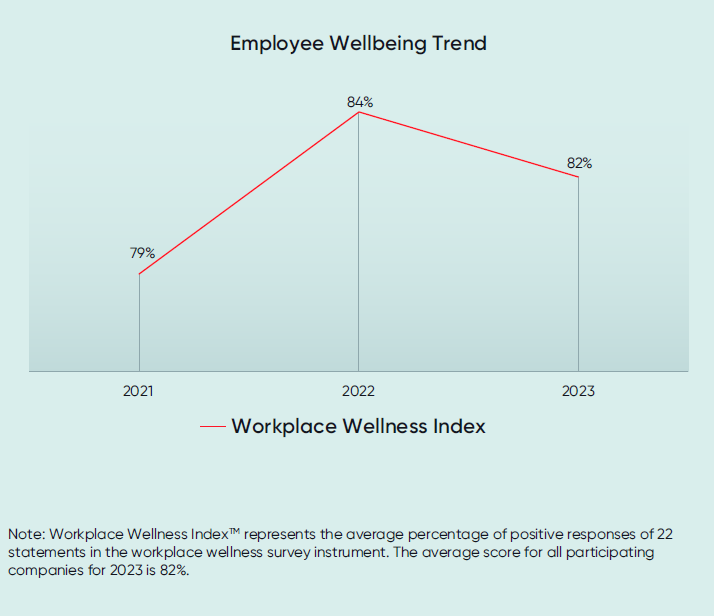
J.W. Marriott, Jr., Executive Chairman at Marriott, famously stated, “Take good care of the people, they’ll take good care of the customer, and the customer will come back.” This statement rings truer than ever in today’s competitive landscape. While many organizations witnessed a surge in their Workplace Wellness Index in 2023, a recent dip of 2 points signals a pressing need to elevate employee wellbeing from a fleeting trend to a sustained priority.

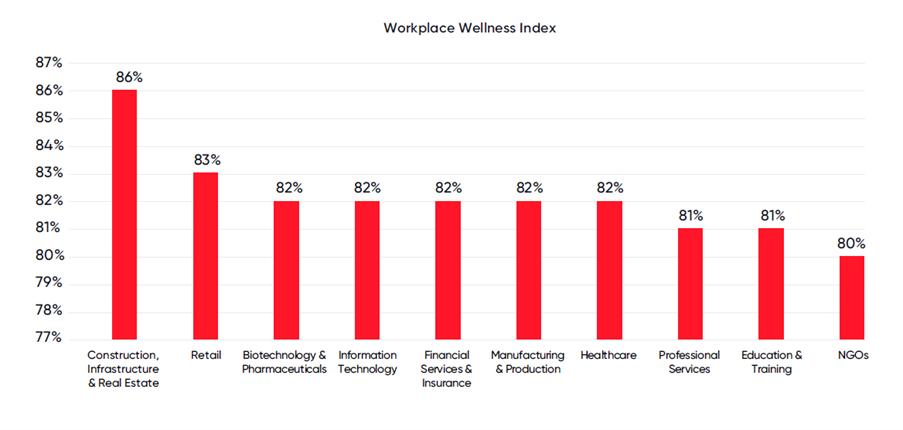
Workplace Wellness Index

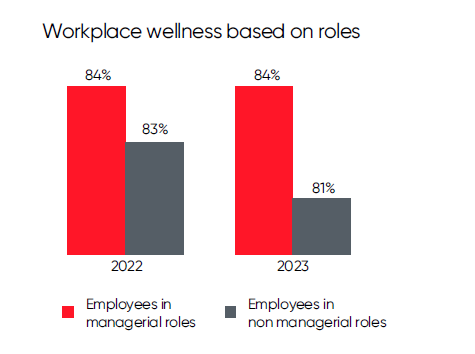
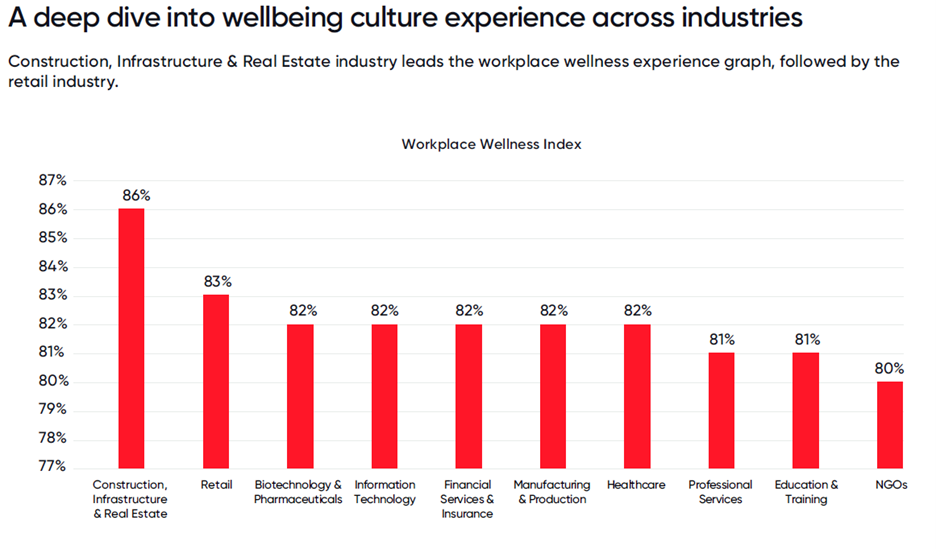
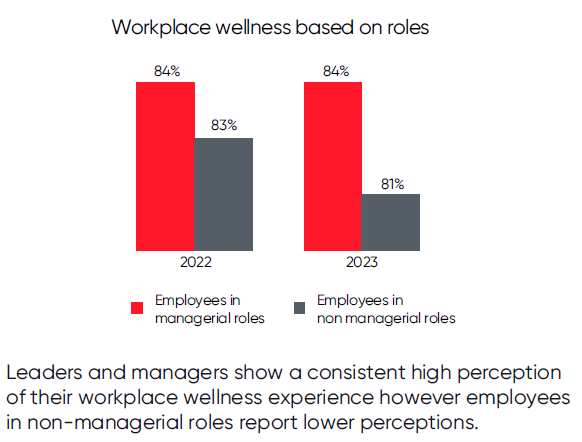
The good news? Industries like Construction, Infrastructure & Real Estate, followed by Retail, are demonstrating leadership in workplace wellness. But the gap between leaders and non-managerial staff paints a concerning picture. A drop in employee wellbeing scores from 83% to 81% for non-managerial roles in 2023 is a call to action for leaders to walk the talk when it comes to wellbeing initiatives.

Wellbeing culture experience across industries.

Healthy Workforce: The Foundation

A healthy workforce forms the bedrock of a thriving organization. Employees are more engaged, productive, and unlikely to burn out when they feel appreciated, supported, and empowered. This translates into improved decision-making, innovation, and problem-solving – all vital ingredients for success.

Leading by Example: Fostering Wellbeing in Leaders

Workplace wellness based on roles.

Workplace culture is greatly influenced by leaders. A strong signal is sent to the entire company when executives support and actively engage in wellness programs. Imagine the impact of senior leaders participating in a Women’s Sponsorship Program—a program that fosters leadership growth through mentorship and experiential learning. In addition to helping female leaders, this fosters a more welcoming and encouraging atmosphere for everyone.

Creating Space to Recharge: No-Meeting Days

Imagine a day free from the relentless ping-pongs of emails and back-to-back meetings. No-meeting days are a proactive measure that organizations can take to minimize burnout, and they are beneficial to both leaders and employees. Leaders who actively participate these days not only demonstrate their commitment to wellbeing but also encourage their teams to disconnect and recharge. These wellness practices can be strategically woven into OKRs (Objectives and Key Results), ensuring continuous focus and progress.

Beyond the Basics: Building a Holistic Wellbeing Strategy 

While a Women’s Sponsorship Program and no-meeting days are great starting points, a holistic wellbeing strategy encompasses a wider range of initiatives. Here are some additional ways to foster employee wellbeing:

  • Financial Wellness Programs: Offer financial literacy workshops, employee discounts, and access to financial advisors to help employees manage their finances effectively.
  • Mental Health Support: Provide access to Employee Assistance Programs (EAPs) with confidential counseling services, mental health resources, and awareness campaigns to address the stigma surrounding mental health.
  • Physical Wellbeing Initiatives: Encourage physical activity through on-site fitness centers, subsidized gym memberships, or healthy workplace challenges. Promote healthy eating habits by offering healthy snacks in cafeterias or partnerships with healthy meal delivery services.
  • Work-Life Balance Initiatives: To assist employees in successfully juggling their personal and professional lives, provide extensive parental leave policies, remote work options, and flexible work schedules.

The Power of Metrics: Measuring the Impact of Wellbeing Initiatives

Investing in employee wellbeing requires a data-driven approach. It’s crucial to track the impact of your initiatives through surveys, focus groups, and employee engagement metrics. Regularly monitor employee wellbeing scores, absenteeism rates, and turnover rates to assess the effectiveness of your programs and identify areas for improvement.

The Wellbeing Chain Reaction in Action

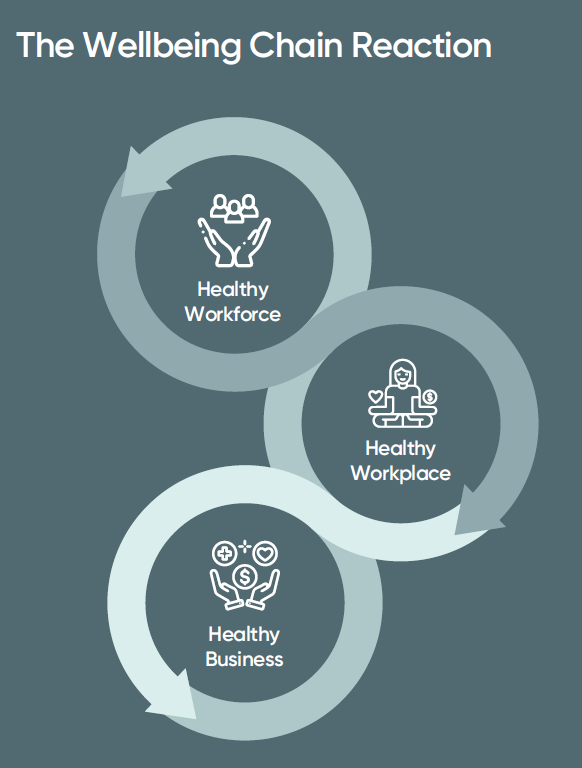
Wellness Chain Reaction.

Investing in a healthy workforce has a ripple effect throughout the organization, creating a Wellbeing Chain Reaction:

  • Healthy Workforce: When employees feel supported and empowered, their wellbeing improves.
  • Healthy Workplace: A culture that prioritizes wellbeing fosters collaboration, productivity, and innovation.
  • Healthy Business: A healthy workplace translates into better customer service, improved brand reputation, and, ultimately, a thriving business.

The Business Case for Wellbeing

Beyond the ethical imperative of caring for your employees, there’s a strong business case for investing in employee wellbeing. Studies have shown that companies with strong wellbeing programs experience:

  • Reduced absenteeism and presenteeism: When employees feel healthy and supported, they’re less likely to miss work or be unproductive while at work.
  • Increased employee engagement and productivity: Employee engagement increases productivity and innovation because engaged workers are more committed to their jobs.
  • Improved employee retention: Companies with strong wellbeing programs experience lower turnover rates, saving them significant time and resources associated with recruitment and onboarding.
  • Enhanced employer brand: Organizations known for their commitment to employee wellbeing attract and retain top talent in a competitive market.

Conclusion: A Sustainable Investment

Investing in employee wellbeing is not an expense but a strategic investment in the future of your organization. By creating a Wellbeing Chain Reaction, you can cultivate a thriving workforce, a healthy workplace, and, ultimately, a successful business. Let’s move beyond short-lived trends and build a culture of wellbeing that empowers employees, fosters innovation, and ensures long-term success. It’s important to keep in mind that a happy and healthy workforce translates into a profitable and productive company.

In today’s competitive job market, attracting top talent requires more than just offering a competitive salary and a good benefits package. Job seekers are increasingly discerning, seeking out workplaces that offer a positive and fulfilling work environment. According to our recent studies, job seekers are 15 times more likely to choose certified Great Workplaces over those that are not. This trend highlights the growing importance of workplace culture, employee satisfaction, and organizational values in the decision-making process of potential employees. Certified Great Workplaces stand out by fostering environments where employees feel valued, engaged, and inspired. In this blog, we’ll explore why job seekers are gravitating towards these certified workplaces and how organizations can leverage this trend to attract and retain the best talent in the industry.

The role of trust in great workplaces

Before we delve into the impact of trust on workplace dynamics, it’s essential to understand its significance in earning the Great Place To Work Certification. Our model is founded on the principle that trust is the cornerstone of an exceptional workplace. This is the key factor we evaluate when assessing companies for Certification. Through our Trust Index™ Survey, we gauge employees’ trust in their leaders, their sense of respect, and their overall workplace satisfaction.

Our research consistently shows that trust creates a pleasant work environment and drives substantial business success. Employees who trust their company are more engaged, productive, and loyal. Consequently, companies that achieve our Certification excel in trust, giving them a competitive edge.

Our research consistently shows that trust creates a pleasant work environment and drives substantial business success.

How companies Certified by Great Place To Work eclipse the typical workplace

Our research indicates that Certified (high-trust) companies distinguish themselves by having better leadership, more equitable promotion processes, and higher levels of employee engagement, with a significant number of employees expressing excitement about coming to work. These companies excel in retaining and engaging employees and promoting adaptability more effectively than the average workplace:

  • 39% more employees express their intention to stay with the organization.
  • 37% more employees feel capable of adapting to changes within the business.
  • 48% more employees are willing to go above and beyond in their roles.

Achieving Certification has become a national benchmark for a positive company culture. For a company to be certified, at least 70% of its employees must affirm it’s a great workplace. 

Companies that cultivate trust-based workplaces fundamentally transform the landscape. They create environments where employees genuinely want to be, which in turn drives business success. When trust is at the core of a workplace, it leads to higher employee satisfaction, engagement, and productivity, ultimately resulting in flourishing businesses.

Certified great workplaces pay and promote their people fairly 

Certified Great Workplaces are distinguished by their commitment to fair pay and equitable promotion practices. They ensure that all employees are compensated fairly for their contributions and have clear, unbiased paths to career advancement. This focus on fairness fosters trust and loyalty and contributes to a more motivated and engaged workforce.

Great workplaces provide a sense of purpose and pride

Our research into top employee retention strategies has revealed that purpose and pride are the most critical factors influencing an employee’s decision to remain with an organization. Employees are:

  • 2.7 times more likely to stay when they feel a sense of purpose
  • 2.2 times more likely to stay when they feel a sense of pride

When leaders inspire their employees to take pride in their work and find meaningfulness in their roles, they cultivate a happier and more motivated workforce. At Certified Great Workplaces, employees experience these empowering conditions, leading to higher retention rates and a more engaged team.

Employer brands that stand out from the crowd 

Certified companies have employer brands that truly stand out from the crowd. These organizations are recognized for their commitment to creating exceptional workplace environments characterized by trust, fairness, and respect. By prioritizing employee well-being, fair compensation, and clear career advancement paths, certified companies attract top talent and foster loyalty and engagement among their workforce. This strong, positive employer brand sets them apart in a competitive job market, making them desirable workplaces and driving their overall success.

Great workplaces offer more opportunities for innovation

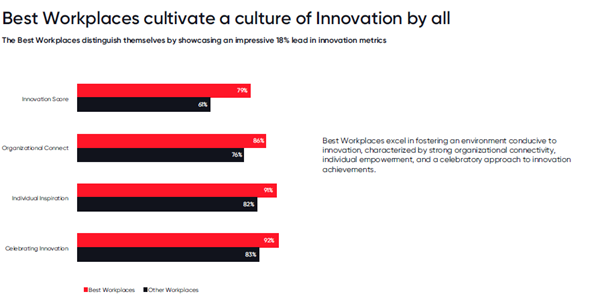
Great workplaces offer more opportunities for innovation by fostering an environment where creativity and new ideas are encouraged and valued. These workplaces cultivate a culture of trust and open communication, where employees feel safe to take risks and experiment without fear of failure. By providing resources, support, and recognition for innovative efforts, great workplaces empower their employees to think outside the box and contribute to the company’s growth and success. This emphasis on innovation drives business advancements and enhances employee engagement and satisfaction, making the organization a dynamic and forward-thinking place to work.

The Best Workplaces distinguish themselves by showcasing an impressive 18% lead in innovation metrics.

For both job seekers and HR managers, opting for Great Place To Work Certification proves to be a wise choice. It results in enhanced job satisfaction, heightened employee engagement, and a sustained positive work atmosphere. Embracing workplace certification boosts job seekers’ prospects of encountering excellent leadership and enables HR managers to utilize this certification as a powerful tool for attracting and retaining top talent within their respective industries. Visit here to learn more.

Innovation is the lifeblood of any organization, propelling it forward in a dynamic landscape. But fostering a culture of creativity and innovation isn’t magic. It requires deliberate effort, supportive leadership, and a nurturing environment. This article explores best practices for nurturing creativity and fostering innovation across various industries, drawing inspiration from leading companies like Juniper Networks, Cadence Design Systems, Reliance Nippon Life Insurance Company (RNLIC), Mahindra, and Flipkart.

Cultivating Creative Confidence: Examples Across Industries

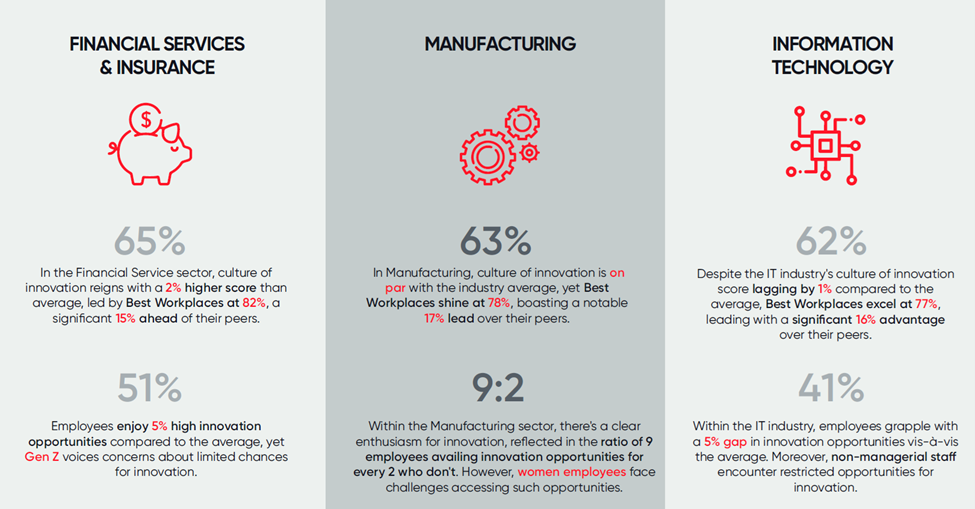
In the Financial Service sector, innovation reigns with a 2% higher score than average, led by Best Workplaces at 82%, a significant 
15% ahead of their peers. Employees enjoy a 5% surplus in innovation 
opportunities compared to the average, yet Gen Z voices concerns about limited chances for innovation. In Manufacturing, innovation on par with the industry average, yet Best Workplaces shine at 78%, boasting a notable 17% lead over their peers. Within the Manufacturing sector, there's a clear enthusiasm for innovation, reflected in the ratio of 9 
employees availing innovation opportunities for every 2 who don't. However, women employees face 
challenges accessing such opportunities. Despite the IT industry's innovation score 
lagging by 1% compared to the average, Best Workplaces excel at 77%, leading with a significant 16% advantage over their peers. Within the IT industry, employees grapple with a 5% gap in innovation opportunities vis-à-vis the average. Moreover, non-managerial staff 
encounter restricted opportunities for innovation.

Information Technology (IT):

  • Juniper Networks:
    • Hard Sell Your Idea: This initiative empowers employees to showcase and pitch innovative ideas with the potential to impact the business. Through a structured process, employees submit concepts, receive feedback, and compete for resources to develop promising ideas. This fosters a sense of ownership and encourages employees to think beyond their day-to-day tasks. The initiative also injects a healthy dose of competition, motivating employees to refine their ideas and present them persuasively.
    • GBS Innovent Program: This program focuses on continuous improvement by encouraging employees to identify and address challenges within processes. Selected ideas are implemented using automation tools, leading to efficiency gains and cost savings. The GBS Innovent program tackles the innovation challenge from a different angle. It focuses on internal processes, empowering employees to streamline operations and identify areas for automation. This not only leads to cost savings and efficiency gains but also boosts employee morale by demonstrating that their ideas are valued and can have a tangible impact on the organization.
  • Cadence Design Systems:
    • Wave of Change: This initiative leverages employee-driven innovation to address challenges across various areas like facilities and professional development. A diverse team empowered with resources identifies opportunities and proposes solutions, fostering a culture of continuous improvement. The Wave of Change initiative goes beyond product development and innovation. It empowers employees to improve the overall work environment, including facilities and professional development opportunities. This holistic approach demonstrates that Cadence recognizes the importance of employee well-being and satisfaction in fostering a culture of innovation.
    • Digital Garage and Idea Maker Labs: These programs provide employees with platforms to nurture creativity and develop groundbreaking products or optimize existing processes. Selected proposals receive support, mentorship, and resources, turning ideas into tangible solutions. Programs like Digital Garage and Idea Maker Labs create dedicated spaces for employees to experiment and explore new ideas. This not only fosters creativity but also reduces the risk associated with experimentation by providing a supportive environment where failures can be learning experiences.

Banking, Financial Services and Insurance (BFSI):

  • Reliance Nippon Life Insurance Company (RNLIC):
    • CEO’s Challenge: This initiative encourages employees to propose solutions beyond their core responsibilities. Promising ideas are selected for sponsorship, with cross-functional teams formed to execute the projects. This fosters ownership and facilitates successful implementation. The CEO’s Challenge directly engages leadership in the innovation process. This not only sends a strong message about the importance of innovation but also ensures that promising ideas have the support and resources needed to be successful.

Manufacturing:

  • Mahindra:
    • Mahindra Innovation Method (MIND): This unified framework integrates various innovation methodologies like Design Thinking and TRIZ. It standardizes practices, fosters collaboration, and equips employees with structured problem-solving tools, leading to disruptive innovations and improved performance. The Mahindra Innovation Method (MIND) provides a structured approach to innovation, ensuring consistency and reducing the risk of reinventing the wheel. By integrating various methodologies, MIND offers employees a diverse toolkit for tackling challenges and developing innovative solutions.

E-commerce:

  • Flipkart:
    • Flipkart Labs: This dedicated team focuses on pioneering innovations in e-commerce. Through a structured approach, they develop and implement solutions that enhance customer experience, operational efficiency, and Flipkart’s competitive edge. The program also encourages collaboration through internal volunteer programs and partnerships with external entities. Flipkart Labs takes a future-oriented approach to innovation. By focusing on pioneering “first-in-India” solutions, they ensure Flipkart stays ahead of the curve and maintains its competitive edge. The collaboration with external entities allows them to tap into a wider pool of knowledge and expertise, accelerating the innovation process.

Key Takeaways for Building a Culture of Innovation

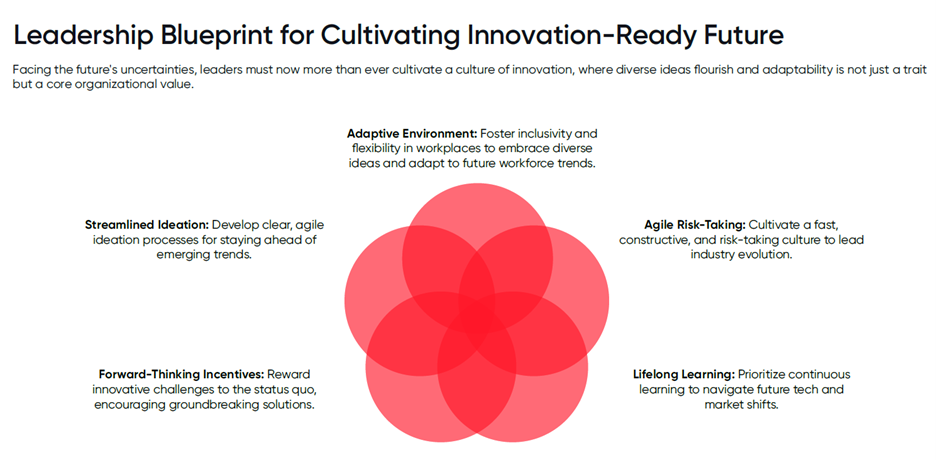
Adaptive Environment. Agile Risk-Taking. Lifelong Learning. Forward-Thinking Incentives. Streamlined Ideation.

These industry-specific examples highlight some key takeaways for building a culture of innovation:

  • Empowerment: Provide employees with platforms and resources to submit ideas and contribute to the innovation process. This could involve creating online idea submission platforms, hosting hackathons, or establishing dedicated innovation centers.
  • Structured Programs: Implement frameworks and initiatives that guide the ideation, development, and implementation of innovative ideas. These programs should provide clear guidelines, milestones, and resources to help employees navigate the innovation process.
  • Cross-functional Collaboration: Foster collaboration between teams from different departments to leverage diverse perspectives and expertise. This can be achieved by forming cross-functional innovation teams, encouraging open communication channels, and organizing brainstorming sessions that bring together employees with different skillsets.
  • Supportive Leadership: Leaders must champion innovation, provide resources, and create a safe space for experimentation and failure. This involves actively seeking out employee ideas, allocating budget for innovation projects, and tolerating calculated risks. Leaders should also celebrate successes and learn from failures to continuously improve the innovation process.
  • Continuous Improvement: Regularly evaluate and refine innovation processes to ensure their effectiveness and alignment with organizational goals. This involves gathering feedback from employees, measuring the success of innovation initiatives, and adapting programs based on the learnings.

Fostering a Growth Mindset

In addition to the key takeaways mentioned above, nurturing a growth mindset is crucial for fostering a culture of innovation. A growth mindset encourages the belief that skills and abilities can be developed through effort and learning. This is essential for innovation because it allows employees to embrace challenges, persevere through setbacks, and continuously learn and improve. Organizations can promote a growth mindset by providing opportunities for professional development, encouraging experimentation, and rewarding employees for their effort and learning, not just for achieving perfect results.

The Road to Innovation: A Continuous Journey

Building a culture of innovation is not a one-time event; it’s an ongoing process that requires continuous effort and dedication. By implementing the best practices highlighted in this article and fostering a growth mindset within the organization, companies across all industries can empower their employees, cultivate creativity, and unlock the power of innovation to achieve sustainable success in a dynamic and ever-evolving world.

Beyond the Examples: Universal Strategies for Innovation

While the previous sections focused on specific industry examples, several key strategies can be applied universally to foster a culture of innovation:

  • Embrace Diversity and Inclusion: A diverse workforce brings a wider range of perspectives and experiences to the table, leading to more creative solutions. Organizations should actively promote diversity and inclusion initiatives to create an environment where everyone feels comfortable sharing their ideas.
  • Recognize and Reward Innovation: Acknowledge and reward employees who contribute to the innovation process, both for successful ideas and for their efforts in exploring new possibilities. This reinforces the value of innovation and motivates employees to continue contributing.
  • Celebrate Failures: View failures as learning experiences rather than punishments. Encourage employees to openly discuss their mistakes and use them to refine their ideas and improve future innovations.
  • Create a Culture of Open Communication: An open and transparent communication culture allows employees to freely share ideas and concerns without fear of judgment. This fosters collaboration and ensures that everyone is on the same page regarding the organization’s innovation goals.
  • Stay Informed About Industry Trends: Leaders and employees should stay up-to-date on industry trends and emerging technologies. This knowledge can spark new ideas and help organizations identify areas where innovation is most needed.

By adopting these universal strategies alongside industry-specific best practices, organizations can create a thriving innovation ecosystem that propels them towards long-term success.

In Conclusion:

Innovation is the key to surviving and thriving in today’s competitive landscape. By fostering a culture of creativity, empowering employees, and implementing effective innovation programs, organizations can unlock their full potential and drive positive change. The journey towards a truly innovative organization is continuous, but the rewards of a successful innovation culture are undeniable. So, take the first step today, nurture creativity within your teams, and embark on the path to a brighter and more innovative future.

In today’s whirlwind of deadlines and demands, employee well-being and resilience are no longer just buzzwords; they’re the cornerstones of individual success and organizational strength. Well-being allows individuals to bring their best selves to work every day, while resilience equips them to bounce back from setbacks. When both are nurtured, employees can truly flourish. Our India’s Best WorkplacesTM in Health and Wellness 2023 report underlines this very notion, highlighting the significance of prioritizing employee self-care and resilience in fostering a healthy workplace culture.

The Power of Feeling Safe

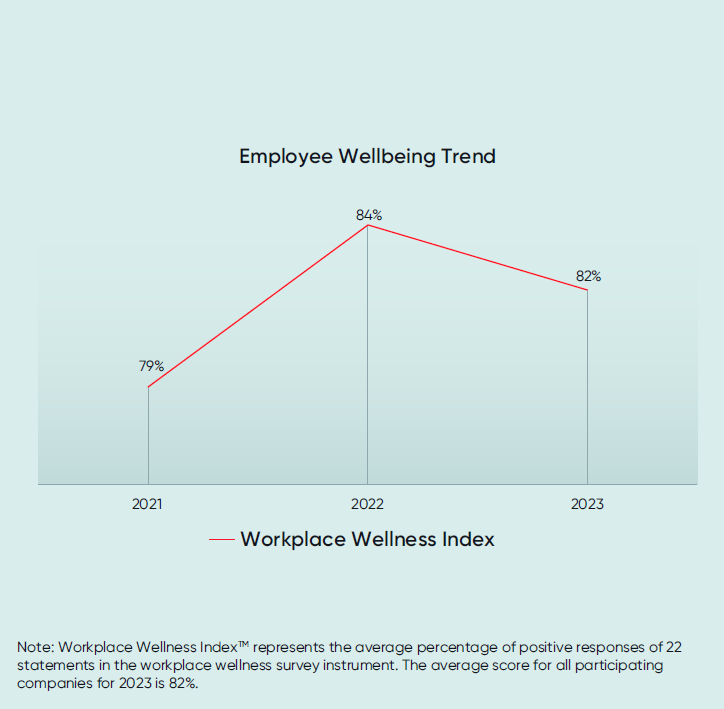
The Workplace Wellness Index showing an upward trend from 79% in 2021 to 84% in 2022. Then a dip to 82% in 2023.

Imagine a workplace where psychological safety reigns supreme. Employees feel comfortable taking risks, voicing their opinions, and admitting mistakes without fear of judgment. This sense of security is a game-changer. According to our research report, employees who experience psychological safety are three times more likely to be committed to their organization for the long haul and twice as likely to go the extra mile. This translates into a more engaged workforce, willing to invest their creativity and energy into achieving organizational goals.

The Cost of Neglecting Well-being

The graphs shows Construction, Infrastructure & Real Estate leading the workplace wellness index at 86%. Retail is at 83%. Biotechnology & Pharmaceuticals, Information Technology, Financial Services & Insurance, Manufacturing & Production and Healthcare at 82%. Professional Services and Education & Training at 81% and NGOs at 80%.

Empowering Your Workforce: 5 Actionable Tips

So, how can you empower your employees on their journey towards self-care and resilience building? Here are five practical tips to get you started:

  • Champion Work-Life Balance: A healthy balance between work and personal life is the bedrock of overall well-being. Encourage employees to establish boundaries between their professional and personal spheres. Consider offering flexible work arrangements, such as remote work options, flexible hours, and generous paid time off policies. This empowers employees to manage their responsibilities outside of work effectively, preventing burnout and fostering a sense of control. Furthermore, consider implementing core work hours where emails and non-urgent messages are discouraged, allowing employees to truly disconnect and recharge during their off time.
  • Cultivate a Workplace Community: A staggering 83% of employees thrive in workplaces where they can be their authentic selves, feel valued, and rely on colleagues for support. Activities like employee resource groups, hobby clubs, and CSR initiatives foster a strong sense of community, nurturing the social well-being of your workforce. Encourage informal connections through virtual coffee breaks or team-building events. Consider incorporating team lunches or after-work social gatherings to create opportunities for employees to connect outside of a work setting. By building a supportive environment where employees feel connected and appreciated, you equip them to better navigate challenges and setbacks.
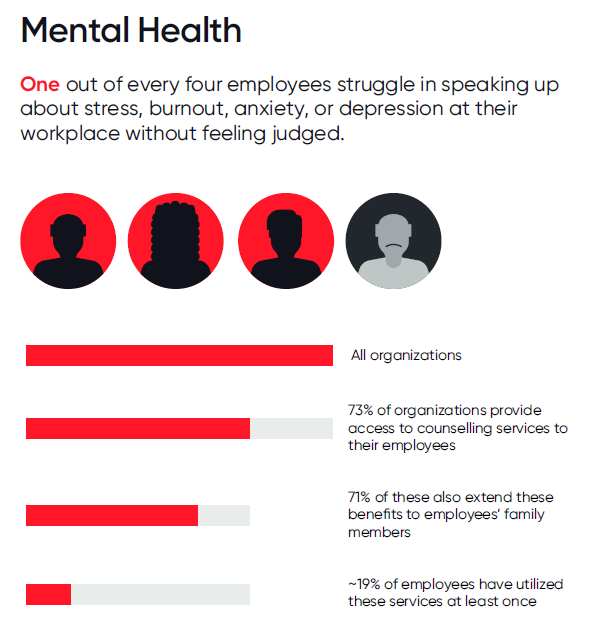
  • Embrace Open Conversations About Mental Health: Mental health issues are a growing concern in today’s workplaces, impacting both employee well-being and productivity. One in four employees hesitate to speak up about stress, burnout, anxiety, or depression for fear of judgment. The time has come to normalize conversations about mental health and encourage employees to seek help when needed. This can be achieved by providing access to Employee Assistance Programs (EAPs) with qualified mental health professionals. Additionally, consider offering mental health awareness workshops to educate employees about common mental health challenges and available resources.
Image showing one out of every four employees struggle in speaking up about stress, burnout, anxiety, or depression at their workplace without feeling judged. 73% of organizations provide access to counselling services to their employees. 71% of these also extend these benefits to employees’ family members. ~19% of employees have utilized these services at least once.
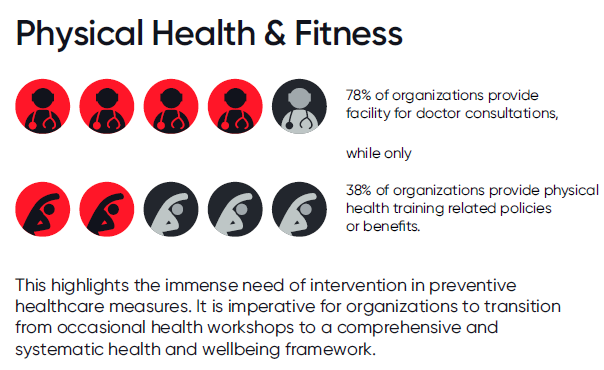
  • Promote a Proactive Approach to Health: Physical well-being is intricately linked to overall well-being and resilience. Many organizations provide health insurance and treatment benefits, but proactive initiatives aimed at promoting healthy lifestyles are often lacking. Our research shows that while 78% of organizations offer access to doctor consultations, only 38% provide programs or benefits related to physical health and fitness. Consider incorporating fitness challenges, health screenings, nutrition workshops, or mindfulness sessions into your well-being infrastructure. A proactive approach to health empowers employees to take charge of their well-being and build resilience. You can also partner with local gyms or fitness centers to offer discounted memberships for employees.
78% of organizations provide
facility for doctor consultations,
38% of organizations provide physical health training related policies or benefits.
  • Lead by Example: Leaders play a pivotal role in shaping workplace culture, and this extends to employee well-being and resilience. Our study reveals that employees in managerial positions report a more consistently positive well-being experience compared to their non-managerial counterparts. This calls for a leadership shift. Leaders need to actively prioritize and champion well-being initiatives. Walking the talk and being open about their own well-being journeys can significantly enhance the experience for all employees. For example, leaders can encourage breaks throughout the workday, model healthy work-life boundaries, and participate in company-sponsored wellness initiatives. By leading by example, you can ensure that a culture of well-being permeates every level of your organization.
Leaders and managers show a consistent high perception
of their workplace wellness experience however employees. In 2022 and 2023 Employees in managerial roles were at 84% and Employees in non managerial roles at 83% in 2022 and 81% in 2023.

The Ripple Effect of Well-being

Investing in employee well-being isn’t just about fostering a positive work environment; it’s about creating a supportive ecosystem where employees can thrive. Happy, healthy, and resilient employees are more engaged, productive, and innovative. They are also more likely to stay with your organization for the long haul, reducing costly turnover rates.

Furthermore, a positive workplace culture spills over into employees’ personal lives, creating a ripple effect that benefits their families and communities. In essence, by prioritizing employee well-being, you’re not just investing in your workforce; you’re investing in the overall well-being of your organization and the wider community. So, act today. Implement these tips, prioritize your employees’ well-being, and watch your organization flourish.

India’s economic rise in recent years is undeniable. A young and energetic workforce, a flourishing startup ecosystem, and government initiatives promoting business, investment, and sustainable development have all been instrumental in this growth story. However, the future holds both challenges and opportunities. A potential global slowdown, geopolitical uncertainties, and rapid technological advancements paint a volatile external environment. Despite these hurdles, studies project India’s resilience, with projections placing it on track to become the world’s third-largest economy, up from its current fifth position. This ambition is further solidified by India’s leadership of the G20 this year, focusing on technological transformation, inclusive development led by women, innovation, and strengthened international cooperation.

But true transformation demands more than just economic prowess. To achieve greatness, India needs to become a Great Place To Work® For All™. This necessitates a collective effort by India Inc. leaders to ensure a virtuous cycle – a positive employee experience fuels organizational growth, which in turn benefits society. While seemingly daunting, research reveals a timeless approach: leveraging Talent, Technology, and Trust to build a High-Trust, High-Performance Culture.

The Trust Deficit: A Challenge and an Opportunity

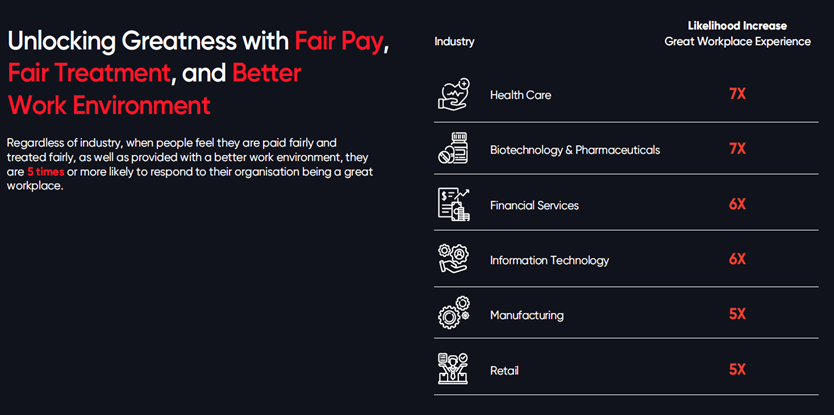
Fair Pay, Fair Treatment, and Better Work Environment in great workplaces.

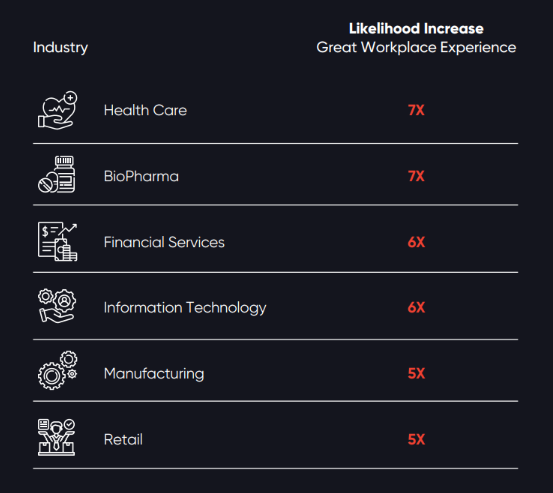
Industry trust levels reveal a significant potential for cultural enhancement. Regardless of industry, when employees feel fairly compensated, treated with respect, and offered a superior work environment, they are 5 times or more likely to report their organization as a great workplace. This highlights the importance of fostering trust as a cornerstone of a thriving workplace.

Tech Synergy and Strong Leadership: Fueling Innovation

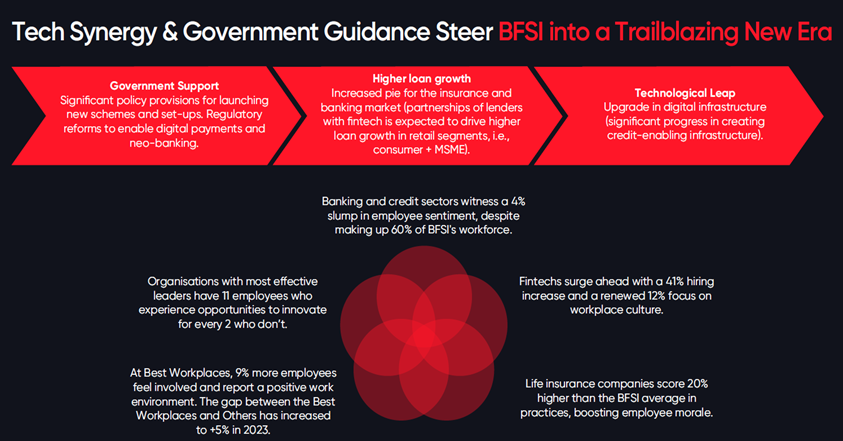
Tech Synergy and Government Guidance Steer BFSI into a Trailblazing New Era

Technology plays a crucial role in building trust and empowering a high-performance culture. The BFSI sector exemplifies this synergy. Here, technology advancements combined with effective leadership have ushered in a new era of innovation. Organizations with most effective leaders have 11 employees who experience opportunities to innovate for every 2 who don’t. Technology empowers organizations to create a superior employee experience through:

  • Personalized Learning and Development: Platforms that cater to individual learning styles and career aspirations.
  • Streamlined Workflows: AI-powered tools that automate mundane tasks, freeing up employee time for more strategic endeavors.
  • Enhanced Collaboration: Communication platforms that bridge geographical divides and foster a sense of belonging.
  • Work-Life Balance: Technology enables flexible work arrangements, catering to diverse needs and promoting work-life balance.

Building Psychological Safety and Fostering Inclusion

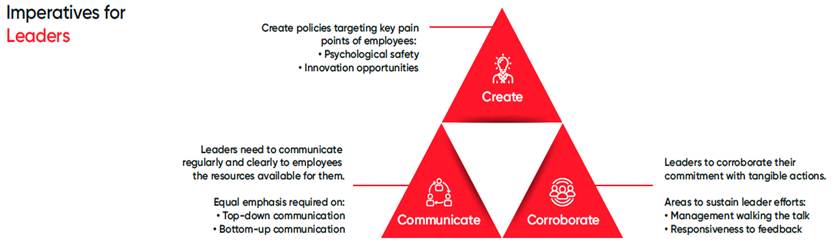
Create, Communicate and Corroborate Imperatives for Leaders

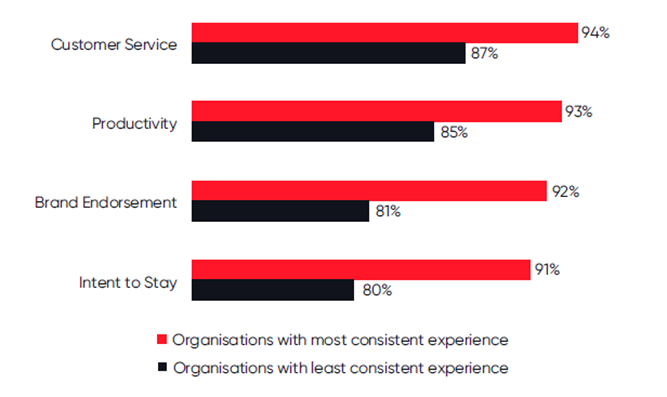
While workplaces today prioritize physical safety, ensuring psychological safety – where employees feel comfortable taking risks, admitting mistakes, and offering ideas without fear of retribution – remains a challenge. This is critical for fostering innovation, as evidenced by the 4-point drop in the percentage of employees who believe they have opportunities to innovate at work from 2022.

Creating a Great Place To Work for All: An Imperative

Graph about organizations with most vs least experience

Building a Great Place To Work For All goes beyond just physical safety and basic needs. It necessitates a commitment to diversity, equity, and inclusion. Organizations should strive to create welcoming and beneficial workplaces that:

  • Offer consistent high-trust experiences across all demographics.
  • Embed inclusivity in programs and practices.
  • Dedicate efforts to equity, ensuring fairness and opportunity for all.
  • Build a sense of belonging, value diversity, and recognize individual contributions.
  • Strategically nurture a diverse range of leaders, fostering an inclusive culture.

The Business Case for a High-Trust Culture

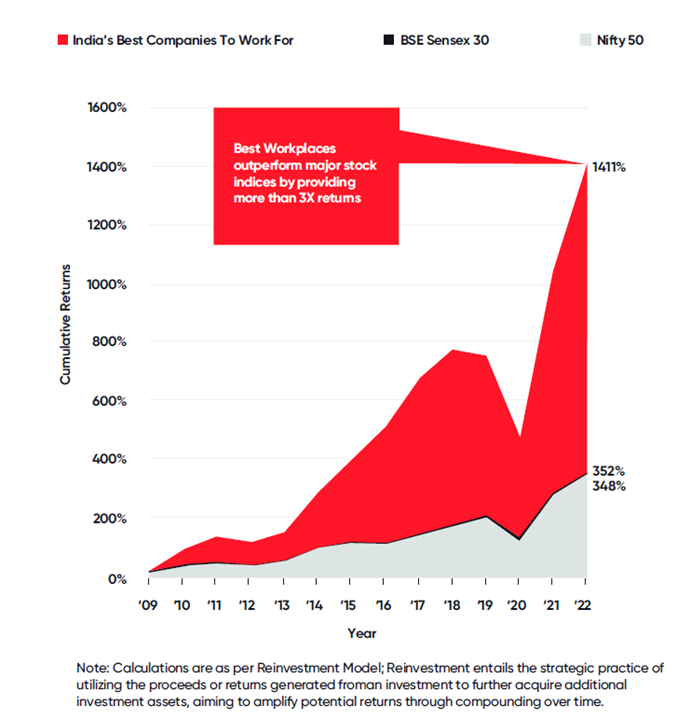
Best Workplaces outperform major stock indices by providing more than 3X returns

The benefits of a High-Trust, High-Performance Culture extend far beyond employee satisfaction. A study by RSM India reveals that Best Workplaces™ have yielded a staggering 14X cumulative return on investment since 2008-09. This demonstrates the clear link between a positive work environment and strong financial performance.

Innovation: A Catalyst for Growth

Workplace innovation is a catalyst for growth, driving benefits across three key areas:

  • Better for People: Innovation fosters personal development, strengthens leadership confidence, and enhances the overall work environment.
  • Better for Business: It cultivates agility, operational excellence, and fosters pride among employees, leading to increased productivity and a stronger market position.
  • Better for the World: Innovation uplifts morale and efficiency, granting organizations a strategic advantage and nurturing a dynamic, inclusive environment with a global impact.

Conclusion: The 3Ts – A Roadmap to the Future

By harnessing the power of Talent, Technology, and Trust (the 3Ts), India can not only solidify its position as the world’s third-largest economy but also become a Great Place To Work For All.

Being ahead of the curve in the changing global innovation landscape demands more than just keeping up. In a world where disruption reigns supreme, Innovation isn’t just a buzzword; it’s the lifeblood of any organization seeking to thrive. While India’s 40th rank in the 2023 Global Innovation Index, published by the World Intellectual Property Organization, paints a promising picture, the true potential for groundbreaking advancements lies within the untapped reserves of creativity and ingenuity residing within your very own workforce. It’s time to unleash the intrapreneur within your employees and cultivate an ecosystem where groundbreaking ideas can blossom and flourish.

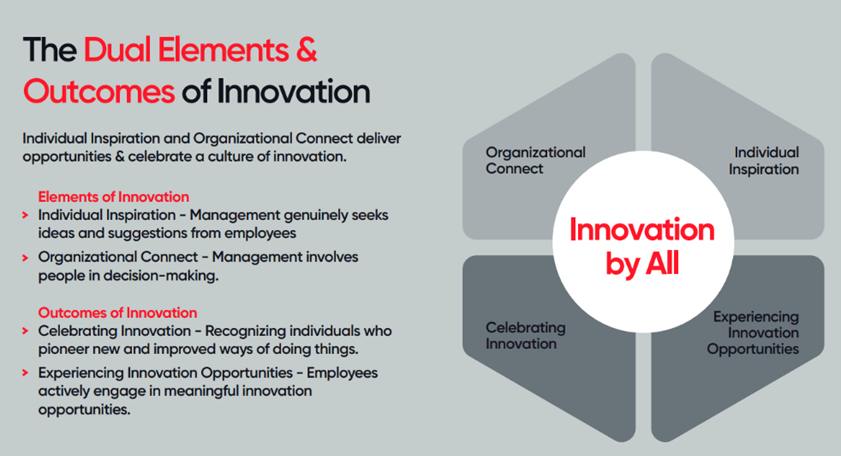
The Dual Elements & Outcomes of Innovation

Individual Inspiration:

Imagine a company where employees aren’t cogs in a machine but valued contributors whose ideas are actively sought and nurtured. This is the power of individual inspiration. Ditch the rigid hierarchies and stifle the “yes-sir” culture that often blocks the scope of Innovation in any organization. Instead, implement open-door policies, create suggestion boxes, and conduct regular brainstorming sessions. Remember, even seemingly insignificant ideas can morph into game-changing solutions. Encourage employees to attend industry conferences, participate in external workshops, and connect with thought leaders. Expose them to diverse perspectives and ignite the spark of curiosity that fuels Innovation. This aligns perfectly with the Individual Inspiration element, as outlined in our Innovation report, where management genuinely seeks ideas and suggestions from employees, encouraging an environment of open discussion and active collaboration.

Organizational Connect:

Innovation thrives in collaboration, not isolation. Break down the proverbial silos that separate departments and foster a culture of organizational connection. Encourage cross-functional teams to tackle challenges together. Organize interdepartmental hackathons where diverse skill sets come together to create unique solutions. Implement knowledge-sharing platforms where employees can exchange ideas, learn from each other’s experiences, and build upon each other’s successes. Remember, the sum is often greater than its parts, and by fostering collaboration, you create a synergy that fuels groundbreaking Innovation. This directly addresses the Organizational Connect element, where management involves people in decision-making and fosters a collaborative environment, as highlighted in our research report.

Celebrating Innovation:

Recognition is the oxygen that keeps the fire of Innovation burning bright. Publicly acknowledge and reward employees who take calculated risks, experiment with new approaches, and challenge the status quo. Celebrate not just the final product but also the journey itself. Recognize the courage to try, the resilience to overcome setbacks, and the valuable lessons learned along the way. Highlight these stories through internal newsletters, company-wide events, and even social media recognition. By celebrating Innovation in all its forms, you send a powerful message: We value your ideas, we appreciate your efforts, and we believe in your potential to make a difference. This directly contributes to the Celebrating Innovation outcome, where individuals who pioneer new and improved ways of doing things are recognized and appreciated.

Experiencing Innovation Opportunities:

Action speaks volumes more than just empty talk. Don’t just talk about Innovation; make it a tangible experience for your employees. Provide them with dedicated time and resources to pursue their ideas. Establish innovation labs where they can experiment freely without the constraints of day-to-day operations. Organize internal hackathons with specific challenges and well-defined goals. Partner with external organizations to provide employees with access to cutting-edge technology and mentorship opportunities. Remember, by giving them a platform to experiment, learn, and fail forward, you empower them to become the true intrapreneurs who drive your company’s future success. This aligns with the Experiencing Innovation Opportunities outcome, where employees actively engage in meaningful innovation initiatives.

The Power of Consistency:

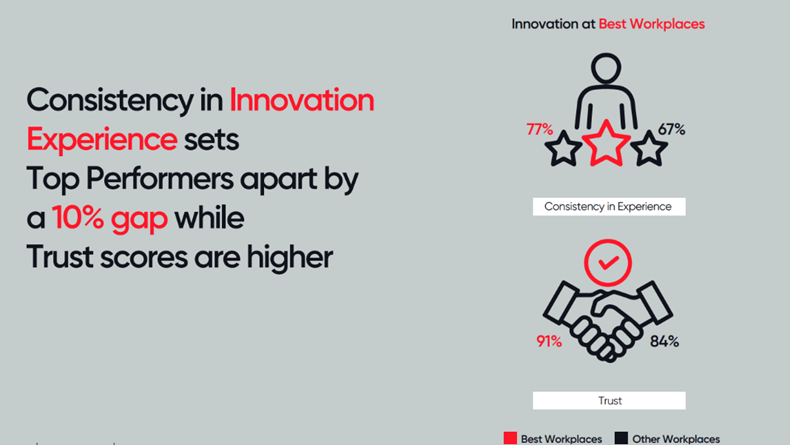
Innovation at Best Workplaces

Building a thriving intrapreneurial ecosystem isn’t a one-time event; it’s a continuous journey that demands consistency. Regularly assess your progress through employee surveys, track key metrics like idea generation and implementation rates, and mould your strategies based on the feedback you receive. Remember, creating a culture of Innovation is a marathon, not a sprint. Be patient, be persistent, and celebrate even small wins along the way. Studies show that consistency in the innovation experience sets top performers apart by a 10% gap, while trust scores are also higher in organizations that prioritize continuous innovation efforts. This aligns with the emphasis on consistency mentioned in our report, where it is highlighted that successful innovation ecosystems require ongoing commitment and adaptation.

The Rewards of Trust and Fairness:

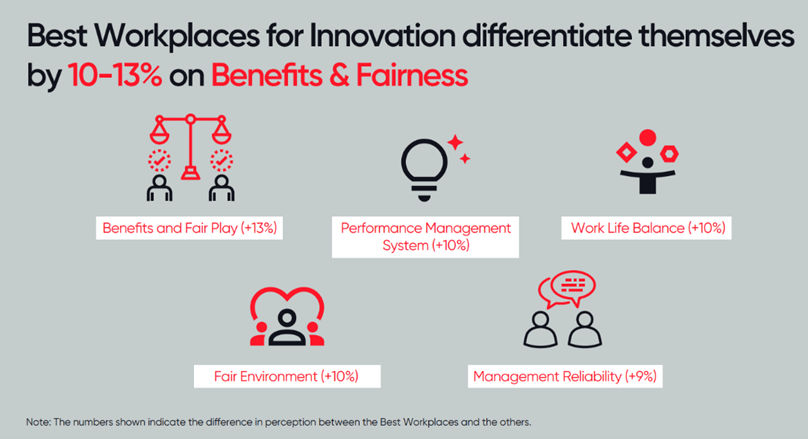
Best Workplaces for Innovation differentiate themselves by 13% on Benefits and Fariness

Remember, trust and fairness are the cornerstones of any successful relationship, and the employer-employee dynamic is no exception. Best workplaces for Innovation differentiate themselves by 10-13% on Benefits & Fairness. When employees feel valued, respected, and secure in their jobs, they’re more likely to invest their energy and creativity into the company’s success. Invest in extensive training and development programs that will ensure your creative employees growth. Provide opportunities for career advancement and internal mobility to keep employees engaged and motivated. Create a work environment where open communication and constructive criticism are encouraged, fostering a sense of psychological safety essential for taking risks and exploring new ideas. By prioritizing trust and fairness, you create fertile ground where Innovation can flourish and contribute to India’s rise in the global innovation landscape.

Ignite the spark of individual inspiration, fuel the fire of organizational collaboration, celebrate the flames of Innovation, and provide opportunities for employees to actively experience the thrill of bringing new ideas to life. With consistency, trust, and a commitment to fairness, you can transform your company into a thriving ecosystem where intrapreneurs blossom and Innovation becomes the driving force behind your success. As India strives to solidify its position as a global innovation leader, remember that the key lies not just in external initiatives but in unlocking the immense potential within your own workforce.

In the dynamic landscape of today’s business world, where change is constant, and growth is the ultimate objective, the role of talent cannot be overstated. A company’s ability to succeed depends not just on the quality of its goods and services but also on its employees. As businesses strive to scale and expand, cultivating a high-performing team capable of supporting growth becomes imperative. In this blog, we delve into the critical aspects of talent transformation and explore strategies for recruiting, developing, and retaining top talent to fuel business growth.

The Value of Talent Transformation

Recent studies, such as the RSM India study, underscore the profound impact of investing in talent. Best workplaces have yielded remarkable returns, with a staggering 14X cumulative returns on the initial investment since 2008–09. This highlights the undeniable correlation between creating an enriching work environment and achieving tangible business success.

Best Workplaces Returns Graph, Cumulative Returns Vs Year

Moreover, in a high-growth phase of the Indian economy, enabling employees to maximize their potential becomes paramount. Organizations that prioritize talent development witness a significant uptick in productivity and innovation. According to the Best Companies To Work For 2023 research report, companies embracing a “For All Leadership” approach experience an 8% boost in productivity and a 10% increase in workplace innovation. These figures highlight how developing talent and promoting an inclusive and empowered culture can have a profoundly positive impact.

Adapting to Changing Employee Expectations

Workplace Culture Insights

In the wake of the pandemic and economic upheaval, employee expectations have evolved rapidly. Today’s workforce seeks more than just competitive salaries; they crave a supportive work environment that fosters growth, creativity, and work-life balance. As organizations navigate this shifting landscape, strategic cohesion among management and a commitment to fairness and inclusivity have become indispensable.

Great Workplace Experience

According to recent findings, irrespective of industry, employees are five times more likely to perceive their organization as a Great Place To Work® when they feel they are paid fairly, treated equitably, and provided with a conducive work environment.

Strategies for Talent Transformation

1. Strategic Recruitment:

  • Look for applicants who share the company’s values and goals in addition to having the necessary abilities.
  • Leverage diverse recruitment channels to attract a wide pool of talent.
  • Implement rigorous screening processes to ensure the right fit for the organization.

2. Continuous Learning and Development:

  • Offer comprehensive training programs to enhance skills and competencies.
  • Provide opportunities for mentorship, coaching, and cross-functional learning.
  • To remain competitive in a market that is changing quickly, promote a culture of ongoing learning and innovation.

3. Foster Inclusivity and Diversity:

  • Create an inclusive work environment where every voice is heard and valued.
  • Promote diversity in hiring practices to harness a range of perspectives and experiences.
  • Implement policies and initiatives that support the advancement of underrepresented groups within the organization.

4. Promote Work-Life Balance:

  • To meet the demands and lifestyles of a varied workforce, provide flexible work options.
  • Encourage employees to prioritize self-care and mental well-being.
  • Foster a culture that values results over hours worked, promoting efficiency and productivity.

5. Recognition and Rewards:

  • Acknowledge and celebrate employee achievements and contributions regularly.
  • Implement a fair and transparent rewards system that recognizes merit and performance.
  • Provide opportunities for career advancement and upward mobility within the organization.

In the quest for business growth and sustainability, talent transformation emerges as a cornerstone of success. Businesses may realize their full potential and increase innovation, production, and profitability by investing in attracting, training, and keeping outstanding talent. As the business landscape continues to evolve, it is imperative for companies to adapt to changing employee expectations and cultivate a workplace culture that fosters inclusivity, fairness, and continuous learning. Ultimately, building a scalable team capable of navigating challenges and seizing opportunities is key to achieving long-term success in today’s competitive market.

An organization that embraces talent transformation benefits its people as well, allowing them to fulfill their potential and make a significant contribution to the company’s objective. Through cultivating a culture that prioritizes excellence, inclusivity, and constant improvement, companies may establish a positive feedback loop wherein empowered staff members propel innovation and achievement. Developing talent and cultivating an inclusive, high-achieving culture are the first steps in creating a scalable team.

To sum up, talent transformation is more than just a catchphrase for companies hoping to prosper in the cutthroat and competitive business environment of today. It is a strategic necessity. By prioritizing the recruitment, development, and retention of top talent, organizations can build a high-performing team capable of driving sustainable growth and achieving long-term success. It’s time for businesses to invest in their most valuable asset—their people—and unleash the full potential of their workforce.

In the pursuit of organizational excellence, businesses must prioritize the needs of their workforce. Employee satisfaction, retention, and discretionary effort are indicators of a healthy workplace culture and are crucial to overall success. This article delves into the insights from our recent manufacturing report that highlight the key areas that matter most to employees and explores how aligning strategic priorities with these needs can lead to enhanced performance and employee engagement. 

Prioritising Workplaces Needs

Understanding what matters most to employees is essential for improving satisfaction and retention.  

Once employee priorities are identified, organizations must align their strategic priorities accordingly. This alignment involves implementing policies, initiatives, and programs that effectively address employees’ needs and concerns. This, in turn, leads to higher levels of employee engagement, productivity, and discretionary effort, ultimately driving improved organizational performance, profitability, and sustainable growth. 

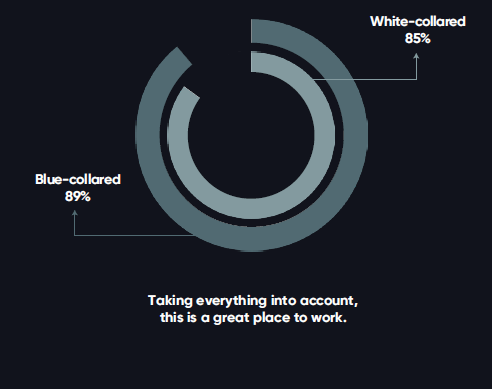
Employee Perceptions in Blue-Collar and White-Collar Roles 

Recent trends indicate a positive shift in the perception of employers among both blue-collared and white-collared employees, with a year-on-year improvement of 2% and 1%, respectively. However, it’s noteworthy that blue-collared employees generally report higher satisfaction with their employers than their white-collared counterparts. This disparity underscores the importance for organizations to recognize and address each employee group’s specific needs and concerns to foster a more inclusive and supportive work environment conducive to overall satisfaction and productivity. 

Perceptions in Blue-Collar and White-Collar Roles

Factors Behind Best Workplaces’ Continued Success in Manufacturing

India’s manufacturing sector have successfully maintained a 7% gap in the Grand Mean Trust Index compared to other organizations. Remarkably, this margin remains consistent across both blue-collared and white-collared employees. The question arises: how do they achieve and sustain this lead? 

Their commitment to fostering a positive workplace culture and prioritizing employee satisfaction is the answer. Best Workplaces ensure fairness and equity in all aspects of employee treatment. Moreover, they uphold the principle of just rewards, offering competitive pay, comprehensive benefits, and transparent promotion processes. By prioritizing integrity, fairness, and employee well-being, Best Workplaces cultivate an environment where trust thrives, enabling them to maintain a distinct advantage over their counterparts and secure the loyalty and commitment of their workforce.

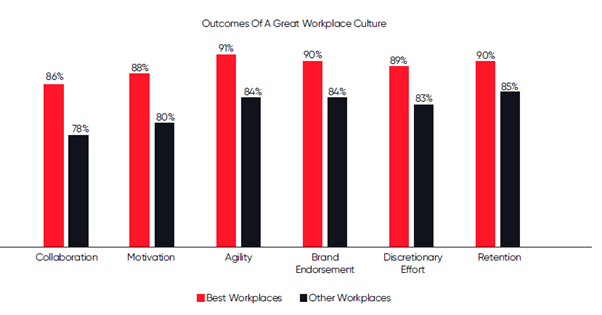
The business outcome of becoming a Great Place To Work

Becoming a Great Place To Work® yields significant business outcomes. With higher satisfaction and morale, employees at Best Workplaces are more motivated, productive, and likely to stay longer. This positive culture becomes a competitive advantage, attracting top talent and driving business success.

Outcomes of a Great Workplace Culture

Best Practices from Top Manufacturing Workplaces

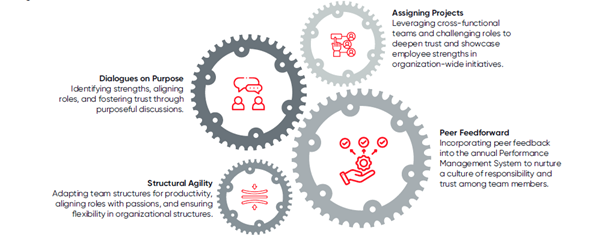
Empowering Talent: Forbes Marshall’s Holistic Employee Development

Here’s how Forbes Marshall takes a proactive approach to nurturing the support and competence of its employees, emphasizing dialogue, structural adaptability, project assignments, and peer feedback to create a dynamic and trusting work environment.

A proactive approach for Employee Development

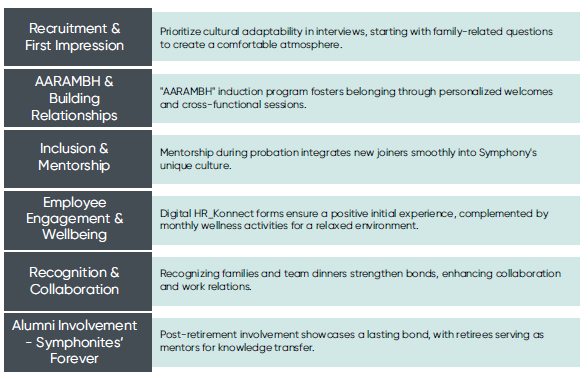
The Symphony Experience: Crafting Hospitality in the Workplace

With over 35 years of experience, Symphony recognizes that its most significant asset lies in its people. By embracing hospitality, Symphony creates a unique and enjoyable work atmosphere, fostering productivity, a sense of belonging, and camaraderie among its employees, known as Symphonies.

Research indicates that the onboarding experience at Symphony ensures a welcoming atmosphere for new members, with 91% of employees at Best Workplaces expressing satisfaction in this regard. When employees feel welcomed upon joining the organization:

– They are four times more likely to describe the workplace as fun.

– They are three times more likely to enthusiastically recommend the company to friends and family as a great place to work.

– They are three times more likely to perceive the workplace as great. This emphasis on hospitality during onboarding not only sets a positive tone for new employees but also contributes to a vibrant and inclusive workplace culture, where every Symphonite feels valued and motivated to contribute their best.

Hospitality in the Workplace

Equity at Work: Kumar Equipment’s Commitment to Fairness

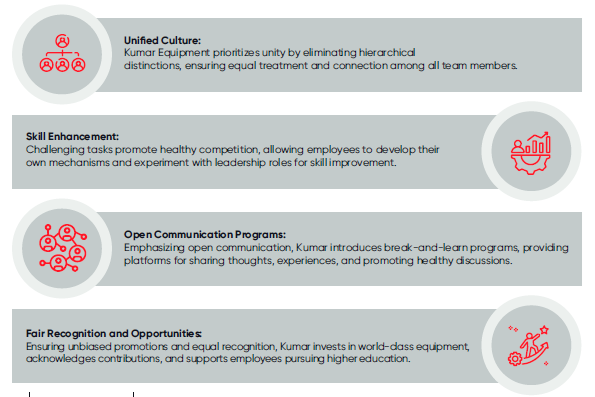
At Kumar Equipment, prioritizing people over categories is not just a philosophy; it’s a way of life. The company is committed to fostering a workplace where unbiased promotions, equal recognition, and open communication prevail, defining a unique and inclusive atmosphere for all employees.

Research reveals that this commitment resonates strongly with employees, with 90% of those at Best Workplaces affirming that they feel fully recognized as integral members, regardless of their positions within the organization. When employees experience such inclusivity:

– They are three times more likely to feel they make a difference with their work.

– They are three times more likely to describe the workplace as psychologically healthy.

– They are three times more likely to perceive the workplace as great.

This emphasis on treating every employee as a valued member, irrespective of hierarchy, fosters a sense of belonging and contributes to a more engaged, motivated, and productive workforce. At Kumar Equipment, inclusivity isn’t just a goal; it’s the foundation of a thriving workplace culture.

Equity at Work

Prioritizing employee needs and nurturing a supportive work environment are critical for organizational success. By understanding and aligning with employee priorities, implementing best practices, and embracing inclusivity and fairness, businesses can create a workplace where employees feel valued, motivated, and empowered to excel. Visit us here to learn more. 

In the age of rapid technological progress, where artificial intelligence (AI) is reshaping industries and revolutionizing the way we work, It is more important than ever to keep in mind that people are the foundation of all organizations. As businesses embrace AI technologies to streamline processes, boost efficiency, and drive innovation, they must not overlook the well-being of their most valuable asset – their employees. Prioritizing employee well-being not only fosters a positive workplace culture but also plays a pivotal role in building trust and ensuring the successful integration of AI systems. Let’s delve into why putting people first is essential in the age of AI and explore actionable strategies for creating a workplace environment that promotes holistic well-being.

The Human Development Index (HDI) and Global Wellness Index Insights

Before delving into the discussion, let’s take a moment to understand the context. As per the global Human Development Index (HDI) of 2021, India ranks 132 out of 191 countries. Similarly, the Global Wellness Index 2020 reveals that India ranks 120 out of 151 countries, with an overall wellness score of 47.8 out of 100. These figures highlight how urgent it is to address issues related to well-being, especially at work.

Government Initiatives and Organizational Commitment

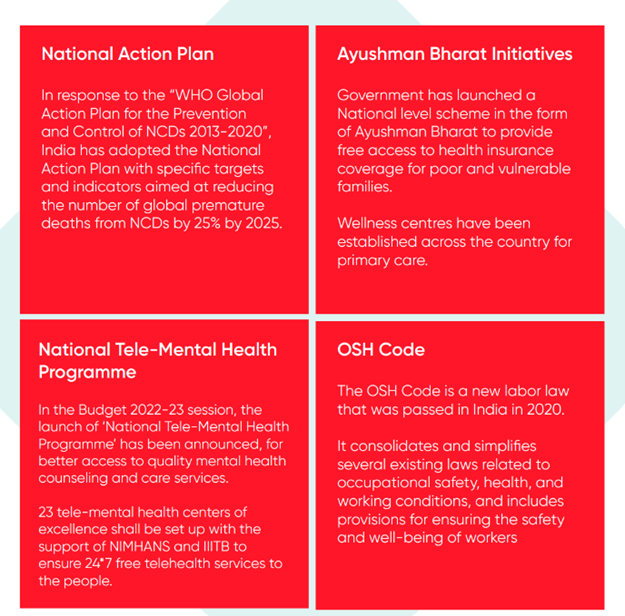
Government Initiatives and Organizational Commitment

Recognizing the importance of employee well-being, the Government of India has initiated several programs focusing on wellness, such as the National Action Plan, Ayushman Bharat Initiatives, the National Tele-Mental Health Programme, and the Occupational Safety and Health (OSH) Code. However, fostering a culture of well-being isn’t solely the responsibility of the government. When it comes to fostering work environments where employees flourish, organizations are essential.

Understanding the Levers of Holistic Well-Being

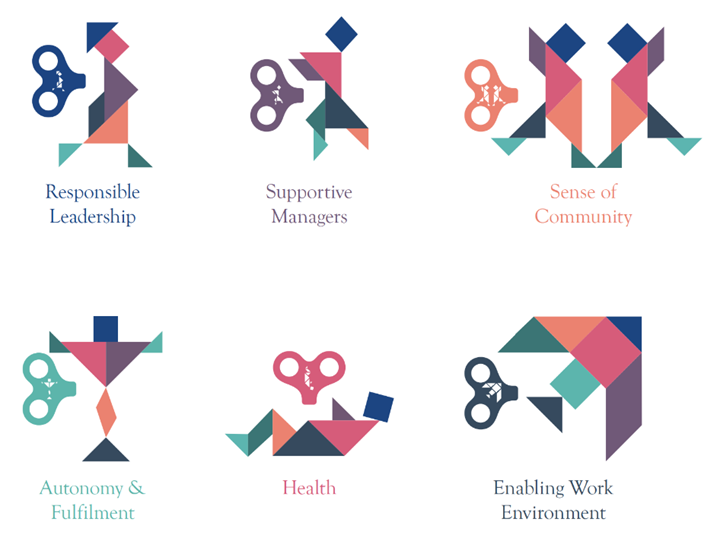
Levers of Holistic Well-Being

Organizations that prioritize employee well-being understand that it is an integral part of workplace culture. They see to it that workers receive possibilities for growth and development, psychological safety, inclusion, and true caring.

According to our Wellness Report, there are six key levers that drive holistic well-being at the workplace:

1. Responsible Leadership: Leaders who prioritize well-being set the tone for the organization. By demonstrating empathy, transparency, and a commitment to employee welfare, they inspire trust and loyalty.

2. Health: Promoting physical and mental health through wellness programs, access to healthcare resources, and stress management initiatives is essential for employee well-being.

3. Supportive Managers: Managers play a crucial role in employee experience. Those who prioritize well-being foster open communication, provide mentorship, and offer support during challenging times.

4. Sense of Community: Creating a friendly workplace where people feel appreciated and connected is achieved through fostering a sense of camaraderie and belonging among staff members.

5. Autonomy and Fulfillment: Empowering employees with autonomy over their work and opportunities for personal and professional growth enhances job satisfaction and overall well-being.

6. Enabling Work Environment: Creating a workplace that is conducive to well-being involves factors such as flexibility, work-life balance, ergonomic design, and a culture that values diversity and inclusion.

The Role of AI in Employee Well-Being

Although AI has the power to spur innovation and change industries, its application must put human-centric principles first. Organizations should leverage AI technologies to augment human capabilities, streamline repetitive tasks, and create opportunities for employees to focus on meaningful work. By automating mundane tasks, AI can reduce employee burnout and free up time for personal development and creativity.

Furthermore, AI can be utilized to enhance employee well-being by analyzing data to identify patterns related to stress, productivity, and engagement. This data-driven approach enables organizations to proactively address issues, tailor interventions, and create personalized experiences for employees.

Building Trust Through People-Centric Practices

In the age of AI, building trust between employees and technology is paramount. Employees must feel confident that AI systems are designed with their well-being in mind and that their jobs are not at risk of automation without adequate support and upskilling opportunities.

Transparent communication about AI implementation, its intended impact on employees, and the measures in place to ensure their well-being is essential for building trust. Companies should ask for input from staff members, address issues honestly, and involve them in decision-making.

Employees that participate in training and upskilling programs are also more equipped to adjust to technology advancements and stay competitive in the job. Organisations cultivate a culture of perpetual learning and advancement by exhibiting a dedication to staff development.

As organizations navigate the complexities of AI implementation, it is imperative to prioritize employee well-being as a foundational principle. By putting people first, organizations not only create a positive workplace culture but also build trust and resilience in the face of technological disruption. By leveraging AI to enhance rather than replace human capabilities, organizations can create environments where employees thrive, innovate, and contribute to the long-term success of the organization. In the age of AI, let’s remember that the true measure of success lies in the well-being and fulfillment of our employees.

Camera red icon

LIVE WEBINAR WITH Q & A

certification-badge-2026-rhc4efc9ny04x7lz17jff7guyhsup5b0yvrou4vd72

The Certification Advantage: Why Partner with Great Place To Work®

How partnering with Great Place To Work can strengthen your people strategy, and drive business outcomes through data-driven insights and Certification.

prasad-kachraj

Prasad Kachraj

Managing Director, Great Place To Work, India

23rd September 2026  |  4.00 PM - 4.30 PM IST

Register Now