
Gen Z employees often have higher expectations in the workplace. They are also seen as less connected to traditional work standards and discipline.
Findings from the Great Place To Work Study 2026 reveal a surprising truth. Women on the shopfloor, Gen Z in frontline roles, and mid-career employees provide important insights about the future of manufacturing culture. These patterns show that improving workplace culture is not just about making it better across the board. It requires understanding where culture is effective, who it benefits, and what this means for the upcoming workforce.
For decades, manufacturing culture has been shaped from the top down, grounded in corporate values and layered through management. The Great Place To Work Study 2026 indicates a shift is happening.
When it comes to trust, pride, and camaraderie, the shopfloor outperforms the office.
For CXOs and CHROs, this means a clear message: the next cultural advantage will come from where leaders decide to learn, not just from where they lead.
The shopfloor may be becoming manufacturing’s strongest culture driver
The study shows that shopfloor employees exhibit 4 points higher employee engagement than managerial staff. Even more notably, women on the shopfloor — though they make up only 11% of the workforce — are 8 points more engaged than women in staff or executive roles.
The shopfloor women employees feel the workplace is more fair, supportive, and enjoyable. They believe they get better benefits, have a better work-life balance, face less politics, and are treated more equally by managers—especially when it comes to pay, rewards, and promotions.
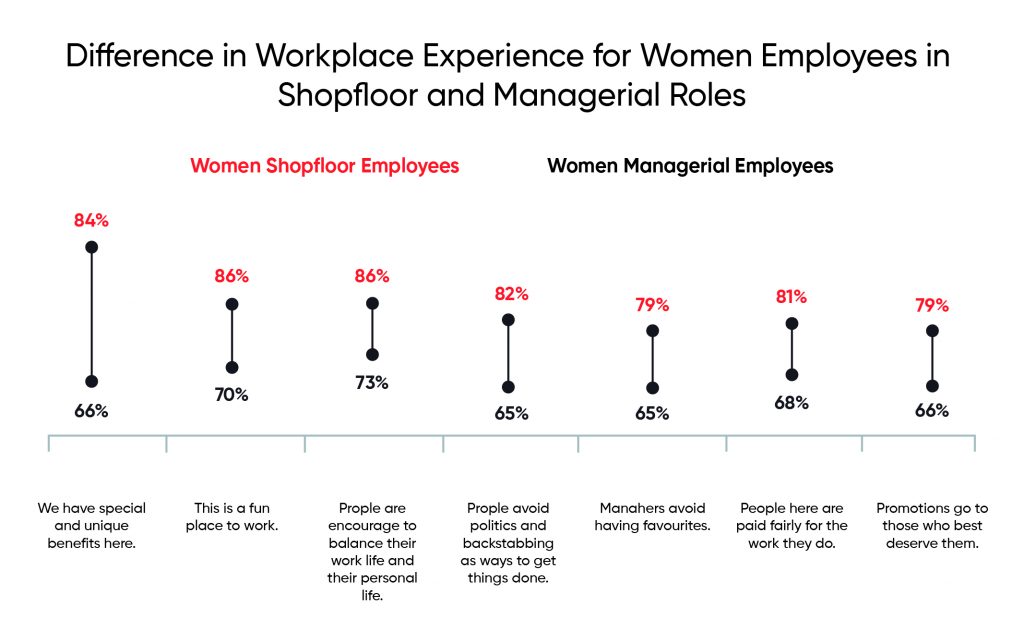
This trend reveals a deeper insight: culture is not just about what policies are — it is felt through everyday interactions, visible fairness, team bonding, and how managers behave.
For leaders, the message is clear: you can not build future workplace culture solely from corporate offices. The shopfloor may already hint at what great culture looks like — visible fairness, effective collaboration, and more transparent leadership.
For Gen Z, the shopfloor appears to provide clearer leadership than the headquarters
The study finds that Gen Z employees connect more emotionally and feel more positive on the shopfloor than their HQ-based peers in key leadership areas, such as – setting clear expectations, linking individual roles to company goals, encouraging two-way communication and fostering empowerment.
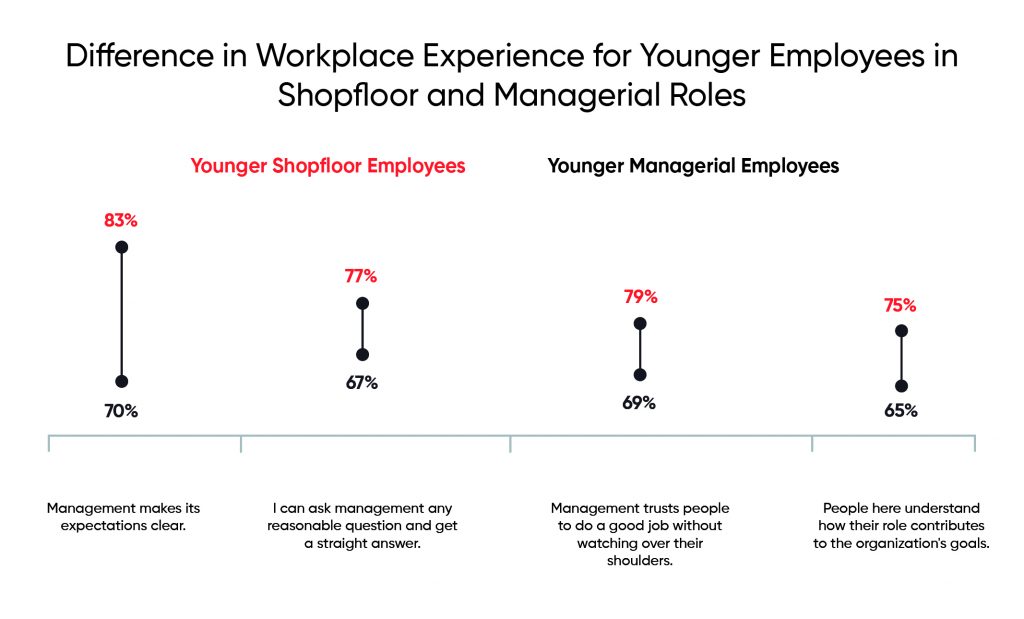
This finding challenges the common belief that younger employees naturally prefer corporate environments for growth and engagement. Instead, data suggests Gen Z responds better to direct, clear leadership that is closer to the work.
For a generation seeking purpose, feedback, and transparency, the shopfloor may provide a surprisingly solid leadership environment, not in spite of its intensity, but because of it.
This is an important signal for leaders reevaluating their manufacturing talent branding. If frontline roles give a better leadership experience than office jobs for younger employees, the concern lies not just in attracting talent but also in how various parts of the organization facilitate leadership quality.
Career maturity alters the cultural equation and reduces differences based on roles
Employees in their second decade of their stint tend to feel more positive than their younger colleagues. However, unlike early-career employees, they don’t show as much variation in workplace experience based on whether they work on the shopfloor or in managerial roles.
Data suggests that the divide between shopfloor and managerial roles stabilizes after 10+ years of employment, while in the first five years, it is distributed in a 3:7 ratio.
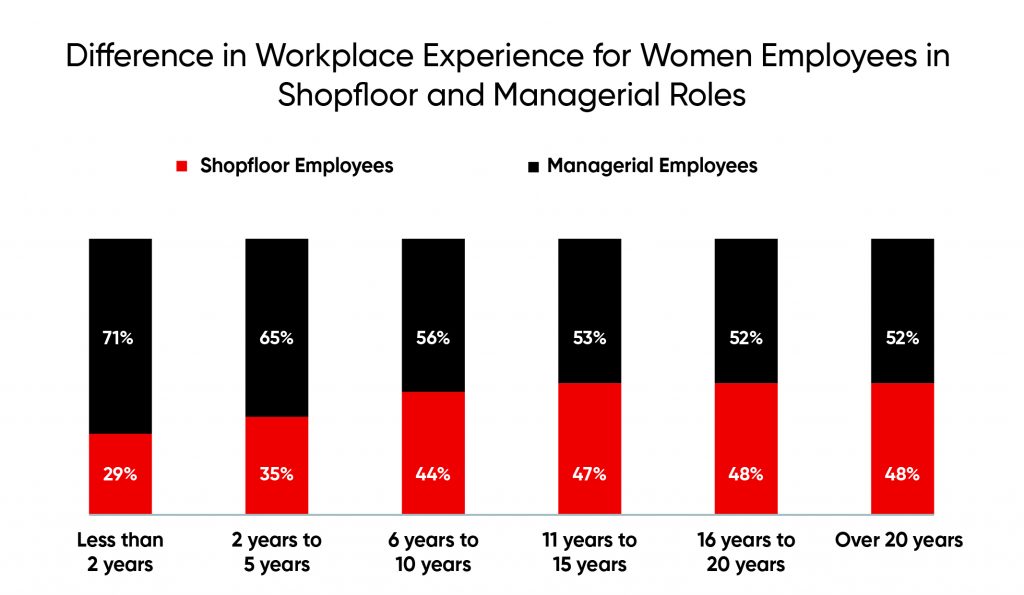
This trend implies that career stage is just as important as role type in understanding workplace experience. Early on, employees are still figuring out the organization — its pathways, politics, fairness, and growth signals. During this time, differences based on roles may be more pronounced.
This is a critical insight for talent strategy. If role-based culture gaps are widest in the early employee lifecycle, then the first five years are critical. That is when perceptions of fairness, growth, and inclusion are likely to diverge — and where retention risk can quietly build.
Rather than treating culture as a generic employee value proposition, manufacturing organizations may need to be more specific: different career stages require tailored cultural interventions. Failing to address early-career experiences often leads to long-term disengagement starting within the first 24 months.
The Generational Handoff: A Key Cultural Turning Point
- Gen X constitutes 90% of the workforce with over 20 years of experience.
- The 16–20 years group is where Gen X and Millennials share almost equally.
- Millennials are increasingly present in entry and mid-level positions.
- This is an ongoing transition, not a future scenario.
- The 16–20 years group reflects the shift of leadership influence — where established practices meet new expectations.
This has two important implications:
- Institutional knowledge is heavily held by Gen X
- Cultural expectations are increasingly shaped by Millennials
This is not just about succession planning; it is about managing culture continuity.
Organizations must ensure that:
- Strengths of legacy leadership (discipline, resilience, operational rigor) are maintained
- Modern expectations (transparency, inclusion, dialogue, growth focus) are embraced
The risk lies not in the transition itself but in cultural dilution during it.
The Strategic Imperative for CHROs and CXOs
Through these trends, one ground reality is clear:
Manufacturing organizations are not experiencing a single culture; they are managing various micro-cultures based on roles, tenure, gender, and generations.
The competitive edge will come from the ability to:
- Identify where culture is strongest
- Understand where it breaks down
- Create consistency without sacrificing contextual strengths
Five Strategic Actions for Leadership Teams
1. Institutionalize “Culture Mining” from the Shopfloor
- Identify repeatable behaviors that foster fairness, trust, and camaraderie.
- Translate these behaviors into leadership expectations across management levels.
- Establish cross-learning connections between frontline and corporate teams.
2. Make Fairness Measurable and Visible
- Move beyond policy frameworks to track perceptions.
- Review promotions, pay, and recognition equity across different groups.
- Introduce fairness metrics and accountability at the manager level.
3. Redefine Leadership Capability Around Clarity and Credibility
- Standardize the clarity of goals across roles.
- Embed regular, structured check-ins between managers and employees.
- Train leaders on honest, two-way communication, not just top-down messaging.
4. Prioritize the First Five Years as a Key Intervention Period
- Create unique experiences for early-career employees.
- Strengthen management skills for dealing with first-time workforce employees.
- Track engagement in the early tenure as an indicator of future turnover and cultural well-being.
5. Actively Manage the Generational Handoff
- Develop reverse and cross-generational mentoring systems.
- Document institutional knowledge before it is lost.
- Align leadership development with a shared culture framework that transcends generations.
Conclusion
The manufacturing sector has traditionally excelled in optimizing systems, processes, and assets. However, future competitive differentiation will rely on something more subtle: effectively managing culture with the same precision as operations.
The Great Place To Work Study 2026 makes it clear — culture is no longer evenly distributed in organizations. It is experienced differently among workforce segments, and those differences provide valuable strategic insights.
For the C-suite, the goal is not just to improve culture but to learn from what works, correct what doesn’t, and create a more cohesive, fair, and leadership-driven workplace experience across the entire organization.
In the next era of manufacturing, culture will continue to be For All to support cultural differences and fuel performance.
Frequently Asked Questions:
What does the Great Place To Work® Study 2026 reveal about workplace culture in manufacturing?
The study finds that shopfloor employees experience higher levels of trust, pride, camaraderie, and engagement than many office-based employees. These findings suggest that strong frontline cultures can be a significant competitive advantage for manufacturing organizations.
Why is Gen Z engagement stronger on the shopfloor than in corporate roles?
According to the study, Gen Z employees on the shopfloor benefit from clearer expectations, stronger connections between their work and business goals, better communication, and more visible leadership support. These factors contribute to a more positive and meaningful employee experience.
How can manufacturing companies improve employee retention during the early years of employment?
The research highlights the first five years as the most critical period for shaping workplace experiences. Organizations can improve retention by strengthening manager capabilities, creating clear growth pathways, ensuring fairness, and closely monitoring engagement among early-tenure employees.
What can manufacturing leaders learn from women’s experiences on the shopfloor?
The study shows that women on the shopfloor report higher engagement and more positive experiences related to fairness, support, work-life balance, and managerial treatment than women in staff and executive roles. These insights can help organizations strengthen inclusion and equity practices across the workforce.
How should manufacturing organizations manage evolving workforce expectations across generations?
As Gen X employees continue to hold valuable institutional knowledge and Millennials increasingly influence workplace expectations, organizations need deliberate strategies such as cross-generational mentoring, knowledge transfer programs, and leadership development initiatives that balance tradition with evolving employee needs.