
 Listen on Spotify
 Listen on Apple
 Watch on YouTube
Leadership Lessons on Trust, Culture, and Building Enduring Organizations
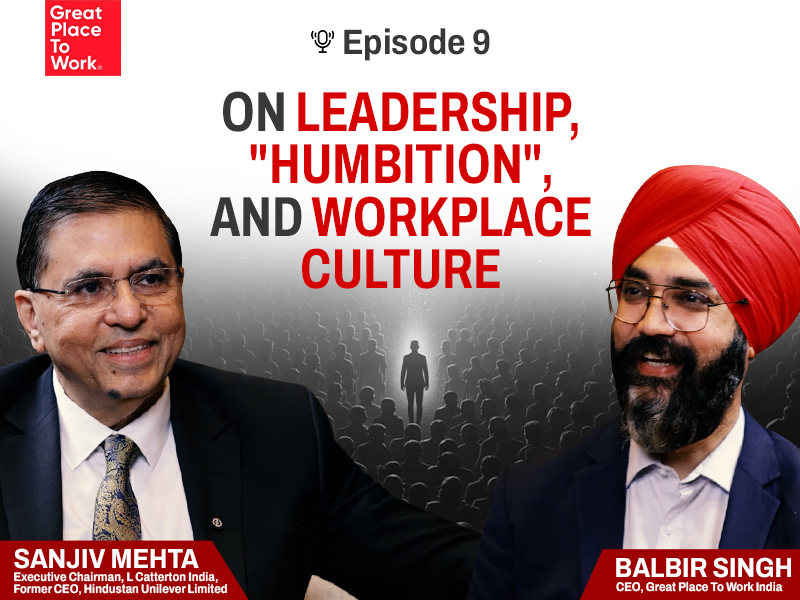
In this episode of the For All Podcast, Balbir Singh, CEO of Great Place To Work® India, speaks with Sanjiv Mehta, Executive Chairman of L Catterton India and former CEO and Chairman of Hindustan Unilever, about leadership, workplace culture, and the future of work. Drawing on more than three decades of global leadership, Sanjiv shares how pivotal moments shaped his approach to trust, ownership, innovation, and long-term value creation.
From navigating global crises to leading one of India’s most respected companies, his journey offers practical lessons for leaders building high-trust workplaces where people and business grow together.
From Crisis to Corporate Leadership
Sanjiv Mehta‘s leadership journey began at Union Carbide Corporation, during the time of the Bhopal gas disaster, an experience that had a big impact on his perception of leadership. It showed him that companies have responsibilities that extend beyond profit, and that during uncertain times, leaders should always act to protect people, give help to their communities, and earn their trust.
His career with Unilever took him across Bangladesh, the Philippines, North Africa, the Middle East, and India. After leading businesses in diverse markets, he served as CEO and Chairman of Hindustan Unilever for a decade. Today, as Executive Chairman of L Catterton India, he partners with founders to build businesses designed for long-term growth.
Leadership Is Forged in Fire
For Sanjiv, leadership is forged in moments of trials, not in times of peace and prosperity. The Bhopal disaster, the Arab Spring, and the COVID-19 pandemic showed him that people are always more important than having great business results. His mantra stands in the statement ‘take care of your people, and they will take care of business.’
He defines sound leadership in times of uncertainty as ‘brutal optimism.’ He thinks that leaders must be realistic about what is hard to accept, yet inspire their teams to believe in the organization’s ability to move on. This combination of openness and hope creates resilience.
From Operating Businesses to Building Founders
Moving from running Hindustan Unilever to advising entrepreneurs at L Catterton required a new perspective. As CEO, Sanjiv focused on strategy and execution. Today, he helps founders think strategically and unlock long-term value.
The key difference lies in execution. Investors provide experience and advice while founders create the actual business. Outstanding leaders give people the freedom to make decisions, grow, and succeed.
Building Culture Through Ownership, Trust, and Fairness
Sanjiv defines workplace culture as a ‘behavior at scale’. Values matter only when they shape everyday actions. According to Sanjiv, organisations that achieve great success in the world of business and commerce live by four principles: an ownership mindset, a growth mindset, psychological safety, and trust.
When employees of an organization think like an owner’s, get engaged in continuous learning, and are allowed to take risks without fear of possible negative consequences, they contribute the best of their abilities to the success of the company. Trust is achieved through demonstration of consistent behavior and honesty, whereas fairness contributes to employee confidence in the leaders of the organization. Together, these qualities create a workplace culture that drives innovation, engagement, and long-term business success.
Think Like Founders, Fail Like Owners
One of Sanjiv’s strongest leadership principles is, “Think like founders. Fail like owners.” Innovation occurs when employees take ownership, start questioning the norm, experiment with new ideas and try different things. Failure is a key element of progress. Leaders should motivate others to take risks and view failures as chances to acquire knowledge. Trusting people makes them more self-sufficient and ingenious.
Leading Across Generations and Cultures
Having led businesses across Asia, Africa, and the Middle East, Sanjiv believes leadership starts with understanding people. Across generations and geographies, employees seek fairness, purpose, respect, and opportunities to grow.
Inclusive workplaces embrace diverse perspectives and create an environment where people can contribute without compromising their individuality.
Business Growth Powered by People, Purpose, and Values
At Hindustan Unilever, Sanjiv introduced Big Q to redefine quality across every business function, from innovation to customer experience. Project Symphony encouraged employees across the organization to contribute ideas that improved productivity and created business value.
These initiatives reinforced a culture of ownership, continuous improvement, and innovation, proving that lasting business transformation begins with people.
Sanjiv evaluates leaders through the Three Cs: Character, Competence, and Contribution. ‘Character’ comes first. Integrity, accountability, humility, and authenticity build trust. ‘Competence’ drives continuous learning, while ‘Contribution’ reflects the ability to create meaningful impact. Together, these qualities define leaders who inspire confidence and deliver sustainable results.
Sanjiv believes businesses create lasting value when they serve all stakeholders. His philosophy of compassionate capitalism balances growth with social responsibility, sustainability, and community impact. Programs supporting water conservation, women entrepreneurs, rural livelihoods, and plastic waste management demonstrate that purpose and performance can grow together.
Preparing People for the AI Era
AI is reshaping the workplace, but Sanjiv sees it as an opportunity. Organizations should invest in upskilling while strengthening human capabilities such as empathy, creativity, judgment, and trust. The future of work belongs to people who learn continuously and use AI to amplify their potential.
Leadership Lessons That Endure For Sanjiv, great workplaces are built on trust, fairness, psychological safety, and a growth mindset. Leaders who put people first create resilient organizations prepared for the future.
Listen in to the full episode now!
Show Transcript
Balbir Singh (Host): 00:00
Hello and welcome to For All Podcast by Great Place to Work India. I am Balbir Singh, CEO of Great Place to Work in India. And today I have the honor of welcoming Mr. Sanjeev Mehta to this podcast. Sanjeev led Unilever for more than three decades and was the CEO of Hindustan Unilever for the last 10 years. And now he took over the reins as executive chairman of L Catterton and Investment Fund. Sanjeev is someone who is known in the industry circles for being honest and a leader with a heart. Today we listen to Sanjeev in this heart-to-heart talk on what makes great leaders and how do you create great organizations centered around trust, fairness, and equity. Before I begin, thank you again. Pleasure, Balbeer. Thank you for inviting me. And sharing your corporate wisdom with all our listeners.
Balbir Singh (Host): 01:03
Before I get started, I just want to know from you a brief premise of your career journey. You have been in this industry for more than three decades, probably much more than that.
Sanjiv Mehta: 01:14
That’s right.
Balbir Singh (Host): 01:14
So just give us a glimpse into your career journey.
Sanjiv Mehta: 01:17
Thank you, Balbeer. I’m a chartered accountant by training. And uh once I finished my CA, my first job was with Union Carpide. So I was with them during the period when the Phopal crisis happened. Okay. And uh I look back very fondly with my time in Union Carbide. That is where I learned about crisis management. That is where I moved into sales and marketing. That is where I understood the role of a corporation in society. And when Union Carbide decided to leave India, I joined Unilever. I joined Unilever outside India. Okay. So I worked in Unilever for over three decades, to be precise, 32 years. And for 21 years, I had the privilege and honor of being a CEO and chairman of different companies, from Bangladesh to the Philippines, then leading a region, North Africa, Middle East, and then coming to India and running for a decade India and South Asia. Now India is the crown jewel of Unilever. And after I finished my innings with Unilever, I have joined hands with El Caterton. El Cateritan is an investment company, private equity. It is the largest global company focused on consumers. And in India, we have a joint venture between me and them. I’m also the chairman for Aisa Fund. And this is a journey we commenced about two years back. It’s an exciting journey. And here I am with a great place to work.
Balbir Singh (Host): 03:18
Thank you. And uh it’s a privilege for us to be, you know, chatting with you and taking life lessons that you have had through this 35 plus years of your career journey. Every leader has those moments which define their career. And if I were to, you know, ask you to go back in your career journey and share some of those moments with us which you think defined you as a leader. And I know it’s a long phase, so you keep learning, you keep learning, you keep uh discovering yourself through this journey. But what are those one or two initial career lessons that you have that have stayed with you?
Sanjiv Mehta: 04:00
Certainly, Balveer. If I reflect on my career, there have been certain defining moments. And I come from a school of thought that leadership is forged in fire and not in placid waters. So my first big learning experience was when I was sent to Bhopal to be a member of the crisis team. I was a young 24-year-old. And I look back and say, that’s when a boy became a man. That is where I understood what is the role of a corporation. It goes beyond making profits. It is about how do you impact people and communities and the society at large. The next big moment for me, I’m a finance professional by training, I’m a chartered accountant by training, was when I moved to sales and marketing. That’s the coal face of business. That’s where I understood what it entails to inspire large teams.
And if you are able to do that, how they can make a difference for you. They’ll walk on water for you. Then the big moments for me was after I became a CEO, was when Arab Spring happened, when I was running North Africa, Middle East, the whole region was up in flames. That is where I imbibed and then coined the phrase: look after your people, and the people will look after your business. The next big moment I would say was during the COVID crisis. When you’re hit by crisis of that magnitude, be it Adam Spring or COVID, then the corporate playbook becomes worthless. They’re completely uncharted waters. And that is where the principle of brutal optimism comes in. Where you have to show the reality to your people, but at the same time, people crave for leadership and you have to show them the way out. So it is brutal, but at the same time, a bit of paradoxical that you show them the light at the end of the tunnel. So blood, toil, sweat, and tears, but ultimately we shall prevail. The Cherchilian paradox. So those are some of the key moments which have helped build my leadership muscles.
Balbir Singh (Host): 07:05
Awesome, great. I think there’s a lot of uh hidden depth in each of those, and we could spend you know a lot of time on all of those.
Balbir Singh (Host): 07:14
But transitioning from what you were doing at Unilever to the fund that you’re managing right now at El Catterton, from operating a business to partnering with founders, startups. So, how’s the transition been like? And what is what are some of the differences that you see uh in these two different worlds? That’s a good question, Valbeer.
Sanjiv Mehta: 07:39
You know, if I look at my role as a chairman CEO, running a well-structured organization like Hindustan Unilever, and uh now in the world of private equity, there are similarities but also a lot of differences. Yeah, the similarities it still boils down to creating value. Yeah. Yeah, we invest in companies with a very clear idea that we will be able to enhance the value when we exit. So the principles of value creation remain very similar. But the time dimension is very different. When we would acquire a brand, say in Hindustan Unilever, it would be with an intent to make it into a timeless brand. But in private equity, when you invest, you also have an exit in mind. Yeah, you normally keep an asset for about five years and then you exit. So you have to look at it from that lens. The other important bit is when you were running in an institution like HUL, the buck stopped at you. And as a chairman CEO, you were responsible for determining together with your team the fate of the company and creating value. Now the role has changed. Now it is about identifying great founders, entrepreneurs, helping and assisting them, but they have to do the hard work. We act as catalysts and help them move to the next horizon. Yeah, but we are not the doers. It’s the founders and entrepreneurs who are the doers. We help them. So that’s the big difference. Okay. It’s an exciting world.
Balbir Singh (Host): 10:02
Yeah, yeah, definitely.
Balbir Singh (Host): 10:03
So if I were to ask from um a lens of a leader, what are those cultural aspects that make a great organization? In your Unilever journey, what are some of those binding principles that you think were the reason that this institution, which is Unilever, has stood for so many years strongly?
Sanjiv Mehta: 10:28
Again, a good question, Balbir. If I first go back to culture, yeah, culture is in at its essence behavior at scale. That’s what culture is. Yeah. When a few people practice a certain behavior, it doesn’t become a culture. When that is adopted and practiced across the length and breadth of the organization, that is where you can start calling it, yeah, that’s the culture of the company. Now, when you look at culture, I think the first most important bit is, and much more relevant in a professional organization than in, say, a promoter-driven organization, is what I call as the owner’s mindset. You want your people not to rent time, but to behave like owners. That is where you can get the best out of that. The second important it’s really a mindset again, is the growth mindset. Whatever be the circumstances, you will hunt for growth. And what you call as the divine discontent, you are never happy with the status quo. The third important bit, if you want to get the best out of your people, you have to provide the psychological safety for the people to experiment, for people not to fear failure, and think like founders and fail like owners. Now, the very important bit which binds it all together is trust and fairness. A trust, it doesn’t happen overnight. It comes walking, but could go on horseback. It takes years to build, you could destroy it in seconds, and it takes eternity to repair. So trust happens when there is intellectual integrity, when people say what they mean and mean what they say, when there is consistency of behavior.
It is not that one when the sun is shining, you behave in a certain manner, but when there are dark clouds, your behavior changes. Yeah. You’ll never be able to earn trust. And the fairness quotient in an organization is extremely important. You know, take an extreme example where a person has not done well, and you got to give them a poor rating. If an employee knows that, yes, it is tough love, deep down they know that it’s been done in a fair manner, they’ll accept it, and they’ll change their behavior. So these are some very important principles. And never to forget the values of ethics and integrity. Now, the important bit about whether it’s values or the culture that I’ve described, it is not something that you would frame on a nice piece of paper and hang it in your boardroom or treat it as an HR activity. Culture, you set the tone from the top. If you want an organization where people are free to express themselves, where people understand the diversity of counsel is appreciated, that is when you build an enduring organization, an high-performing organization, where people are able to give the best.
Balbir Singh (Host): 15:22
Sanjeev, uh, you made a reference to think like a founder and feel like an owner. Could you please describe that and what exactly does that mean in action?
Sanjiv Mehta: 15:34
You know, when you’re a founder, you come, you’re brimming with ideas. Right? You want to come and disrupt your dream in your eyes, passion in your heart. That’s what a founder does. Huge amount of energy. You know, the fire of ambition, what I call. That’s what they have. But business entails risk, and risk entails failure. An owner understands that if they have to grow the business, they have to take risk, and risk entails failure. And you have to create that psychological safety that if you bring about ideas, if you want to experiment with, the organization allows you to do that. And at the same time, understanding that not everything will work. If you fail, you should not hang a person by the nearest lamppost. Otherwise, you will kill initiators if you do that. So always say, think like founders, fail like owners.
Balbir Singh (Host): 16:46
It makes sense. Uh you can also see some of this playing out in my own organization. And you know, how do you get the best out of your people? Moving ahead.
Balbir Singh (Host): 16:55
Sunji, you have led uh teams across different geographies, different um demographies. Like one of the hottest topics at GatePlace to Work that we are talking about is how do you manage a multi-generational talent? And how do you lead a team which is spread globally as a leader to get consistent results and send a clear, very clear, same message in spite of there being differences.
Sanjiv Mehta: 17:21
That’s right. So, Balbir, if you look at it, there are certain human truths which cut across generations and cut across countries and cultures. You will never come across a mother who doesn’t want a life for their children better than theirs. This is a universal truth. Every mother would want the kids to do better than them, have a life better than them. You would not come across a person across countries or generations who would not like to lead a life of dignity, who would not like to be treated with equity and fairness. These are human truths. But in today’s workspace, you have multi-generational people from the baby boomers to the Gen Z. Now we must also be very cognizant of that the society has evolved. And as the society evolves, the expectations and the aspirations of people change. There was a time when the science of management came from the armed forces. So it was say when we joined, when we started working Balbir, it used to be all command and control. Right? Information used to be kept guarded and shared selectively. And loyalty was about compliance and tenure. That’s what it was. Today’s generation, the expectations are very different. First, very importantly, they don’t work just for a paycheck. They work for experiences. They want to work in an atmosphere where they can express themselves freely. They don’t want to be constrained. For these things, the level of psychological safety you need to create is massive. You know, many people feel and say that today’s generation, they’re not loyal, the expectations are very high. If companies will not guarantee a person that you will have a job with us from cradle to grave, why should an employee lend themselves to a single company all their life? No. You have to earn that trust on a constant, consistent basis. You have to give them opportunity to blossom, give them different experiences. Today, people come from different backgrounds and they would like to operate in a very different background. And you have to create an environment where they are able to live up to their dreams.
Similarly, there are differences within countries also. You know, if you go to Southeast Asia, I’ve led a business in, I used to be chairman in the Philippines. There, saving face is one of the most important things. You cannot criticize a person in public. I’m not saying even harsh criticism. Even a soft criticism doesn’t go well. So you can’t be that I’ll be brutally frank with them. No, it won’t work. If you look at Indonesia, I’m a chairman, I’m still chairman of Uni. In Indonesia. It’s a very consensus culture. You have to take them along. You can’t be giving directive and accept them to work. And also importantly, if they don’t agree with you, they won’t say so, but they won’t act. So as leaders, just like you try to understand consumer behavior, you should understand the cultural nuances to become an effective leader.
Balbir Singh (Host): 22:34
Great. Yeah, absolutely. And it’s fascinating to all the points that you’re mentioning, uh equity, fairness, psychological safety, belongingness. Can I be myself around here? Are exactly the areas we measure when we do our employee. No, absolutely.
Sanjiv Mehta: 22:53
You know, Balbir, I’m a big believer in diversity. Diversity in its widest sense. Diversity of gender, diversity of educational background, diversity of the socioeconomic strata from where you come. But if you have to get the best out of them, don’t make them clones. You will be able to get the best out of them if they are comfortable in their own skin. When you employ women, never ever expect them to behave like men. You’ll destroy them. Let them be who they are. That’s how you will get the best out of them.
Balbir Singh (Host): 23:54
And the reason you hire people from different backgrounds is to enhance the diversity and not just make them clones of what you already have in the system. Absolutely.
Balbir Singh (Host): 24:06
So let me uh ask you a question from your book. In your book, CEOs Drew, you discuss purpose, ethics, and long-term value creation and all those things you have mentioned in some of the you know thoughts that you have shared with us today. How can leaders stay true to these principles when facing intense performance pressure?
Sanjiv Mehta: 24:27
That’s a very good question. You know, generally when the sun is shining, when the quarter is good, you can do all the good things. Yeah. But we must understand that if you are a purpose-driven company, a values-led company, then you cannot be selective about practicing them only during when the weather is good. So come rain or shine, you have to practice them values, then only you will create a culture around them. Now, over the years being a leader, one has understood that short-term performance and long-term value creation or the compounding model are not mutually exclusive. Nothing in life will be moves in a linear fashion. Nothing moves in a straight line. There’ll be ups and downs. And that is where leadership comes in. When times are tough, those are the days when your leadership principles are tested. And that is where people see whether as a leader you have a spine or you don’t have a spine. There will be moments when you don’t deliver a quarterly number. There will be moments when the crisis hit the pad. And that is where your leadership trait of ambition comes in. Humility to show your vulnerability. Humility to say, I don’t have the answer, but I have a team who will help me find an answer. Humility to say, we went wrong. Humility to say, I need to learn. And when you do that, and when you have an overarching principle that when times are tough, your North Star is looking after your people. The people will give it back to you by looking after your business. So when times are tough, Balbir, you double down on providing the safety net to your people. When COVID happened, Hindustan Unilever was manufacturing products which came under the essential category. Yeah. Soaps and sanitizers and all those things. So we were under immense pressure to ensure that the supply lines keep running. People were worried about their own safety. The markets were worried about growth and margins. But we were absolutely clear. Human safety comes first. We were unequivocal in stating we will look after you and your families. And human, their safety, I was absolutely clear, and I told my team, don’t let money come in the way of protecting and saving them. And the people return it back in a big way. We had fabulous growth. One of our best years was 22-23 when we generated more delta turnover than the total turnover of all the direct-to-consumer brands put together. Yeah, we generated a billion dollars of delta turnover. And that’s people responding. Yeah, so when times are tough, it is even more important to live by your principles.
Balbir Singh (Host): 29:06
Absolutely. Yeah.
Sanjiv Mehta: 29:08
You can’t be a fair weather friend.
Balbir Singh (Host): 29:10
Some of this has already been uh covered, but let me ask you this thing. What is that uh, again, you had a very long career at uh Unilever. What are some of the things or cultural practices or that you started at Unilever that you say, you know, this is something that really, really helped us where we are today and create a brand, help create a brand?
Sanjiv Mehta: 29:34
Yeah, let me pick up a couple of them to bring them to light. When I came in as the CEO of Hindustan Unilever in 2013, profit margins were dilutive to global unilever.
Balbir Singh (Host): 29:52
Yeah.
Sanjiv Mehta: 29:54
And in 2014, I started an initiative called Big Q. The Q stood for quality. It wasn’t about quality of products alone. It was quality about everything. It was quality about marketing, it was quality about distribution, it was quality about supply chain efficiencies, it was about product superiority, quality in every facet of the business. So we were moving to an implicit growth mindset by telling people that the business is not just about quantity, more production, more distribution, more new outlets to be covered. We have to step back and ask ourselves do we have quality in every aspect? Do we have the magic in marketing? Are we getting the best out of our directly covered outlets? So one was bringing forth a cultural revolution by bringing in discontent with the status quo and instilling in them the mindset of growth in every endeavor. Now, to fund all these initiatives, you want product superiority, you want to create new markets or market development, you needed money. Right? So we started something called Project Symphony. In most companies, good consumer good companies, if you generate three to four percent of your turnover as savings, that’s a good outcome. And generally, the responsibility for savings is given to supply chain and to the finance function. They are the guys who do it. So I decided we need to change this. We started Symfony with an idea of crowdsourcing ideas from across the length and breadth of the company. The first year we got 800 ideas.
Balbir Singh (Host): 32:38
Okay.
Sanjiv Mehta: 32:39
Yeah.
Sanjiv Mehta: 32:40
Then we put them through a funnel from ideas to feasibility to capability to roll out. And over a period of time, we started generating savings to the extent of six to seven percent of our total. Well, it was almost double. Now we were generating this by making people feel that you’re not an employee, you’re the owner of a company. This is your company. You are looking at every opportunity to bring in efficiency and efficacy, effectiveness. And this became a way of life in the company. So just imagine the two big cultural changes we brought about: the divine discontent through Big Q and the owner’s mindset through Project Symphony. During my 10 years, we took the turnover of the company from 25,000 crore to nearly 60,000 crore.
Balbir Singh (Host): 33:53
Oh, okay.
Sanjiv Mehta: 33:54
We improved our margins from 13, 14% to 24, 25 percent.
Balbir Singh (Host): 34:00
Yeah.
Sanjiv Mehta: 34:00
We were dilutive to global unilever, we became 500 BIP secretive to Unilever. And we took the market cap of the company from 17 billion dollars to 76 billion dollars. No consumer goods company has ever created this much value in India in a 10-year span. Yeah, 60 over 60 billion dollars. Now this can’t happen if you don’t change the mindset of the people. If you don’t bring in the growth mindset and the owner’s mindset. One of my leadership principles, Balbir, is win the battle of heart and mind before you win in the marketplace. And that’s what I always try to do.
Balbir Singh (Host): 34:54
So we speak about uh you know some of the practices that you uh you know executed at Unilever.
Balbir Singh (Host): 35:02
But you know, uh if I were to ask you one more question on the same theme, is as a CEO, you have leaders, right, who have to execute those missions for you. So, what are some of the traits that you look for in a leader when you want to hire someone who is going to work very closely with you?
Sanjiv Mehta: 35:23
Yeah, yeah, that’s another good question. You know, I often look at the three C’s. The first C is contribution. Okay. What has been the track record of a person? Are they being consistent high performers? Or does their performance yo-yo? That’s the first yardstick. The second thing one looks at is competencies, capabilities. Are they learners for life? How are they developing themselves? What are the new skills they are developing? How are they helping others build their skills, the leadership attributes? The third C which precedes the first two is character. Now, character is intellectual integrity. Yeah. You mentioned intellectual integrity. Yeah, to me it’s very important.
Balbir Singh (Host): 36:34
Yeah.
Sanjiv Mehta: 36:34
Do you say what you mean and mean what you say? Yeah. You know, in a company like HUL, you’re never worried about hand-in-the-till integrity. Okay. Yeah. The systems are so strong, the culture is so strong, people will get it. Yeah, they won’t remain in the company. But intellectual integrity to me is extremely important. Do you put the company first or do you put yourself first? Are you one of those when times are tough? You stand in front of the team or you stand behind the team? Are you one of those when it comes to taking credit, stand in the front or stand at the back and applaud the team? Are you a team builder? To me, those are very important attributes. You know that is where ambition comes in. I look at does a person have the hunger to succeed, the fire in the belly, the ambition, but at the same time, is it anchored with humility? Are one of those people who, when they fail, will they blame it on others or will they have the courage to stand up and say, I failed, I went wrong? That’s a very important thing to assess before I would take them in my top thing.
Balbir Singh (Host): 38:17
Okay.
Balbir Singh (Host): 38:18
So character, capability, and uh contribution, yes.
Balbir Singh (Host): 38:25
Okay.
Balbir Singh (Host): 38:25
Yeah. The three C’s. What other aspects of leadership, apart from generating shareholder value that you think you are very proud of and uh makes a lot of sense for other CXOs, other leaders to also do?
Sanjiv Mehta: 38:41
Sure. You know, while shareholder value is important, a corporation or a company should never be unidimensional. The days of what Milton Friedman used to preach, that the business of business is business, those days are over. I’m a big believer in the principles of compassionate capitalism. And I believe that a company has a big role in the society, and it owes its existence to the society and the community. So stakeholder value is extremely important. So you have to not just look after your shareholders, but very importantly, my principle has been look after your consumer, your customer, your employee, your suppliers, your society and the environment. And if you do it well, shareholder value gets created. Yeah. I don’t believe in the supremacy of shareholder value. The other important bit, which is very vital for us as a country, our growth has to be inclusive and sustainable. We’re a large country, we often talk about demographic dividend. Yeah. But that dividend will not come into play if we cannot create a livelihood for our people. So one of the most important things which corporations have to do, it’s not about not being efficient. It’s not about not being productive. But we have to ask ourselves: how do you create livelihoods in the ecosystem so that we help propagate the principles of compassionate capitalism? The other is the environment. The world cannot afford India to have the footprints of the West when it comes to environment. The world will, the nature will not be able to take it along. So our growth has to be done in a sustainable fashion.
If I take a few examples from our HUL journey, uh, you know, we started focusing on water for the simple reason that despite the mighty Himalayan rivers, we have not managed our water resources well. The groundwater tables have gone down, and they are today at a very precarious level. And if we are not able to improve the management of water resources, the water supply will be half the demand in the next decade and a half. So rather than just scrib about the problem, we started working in villages, in thousands of villages, on the demand side and supply side. And we have created water potential running into trillions of leaders. Trillions of leaders. Okay, which is creating micro entrepreneurs in small villages. We ramped it up from 50,000 to 200,000. When you empower a woman, you empower a family. To look after the slum dwellers in urban India, we created suvidha, which are pay-for-use facilities for toilet, for washing, for laundry, which has created a life of dignity for the women in slums. And also something which I’m very proud of that the gender quotient in the company in management, we took it up from 18% to over 40%.
Balbir Singh (Host): 43:25
Oh, wow.
Sanjiv Mehta: 43:27
With a very clear pathway to gender parity. Then we started focusing on at the factories and very importantly at the frontline, distributor sales force. We started a project Ahilya at the distributor sales force to bring in more women, not just in metropolitan India, but even in tier two, tier three cities to get more women in and created a conducive environment where they could come and succeed. So it’s very important. You know, when it comes to the environment, the other big thing we did is we started collecting plastic waste.
Balbir Singh (Host): 44:09
Okay.
Sanjiv Mehta: 44:09
And we used to collect more plastic from the streets of India than what the plastic we would use in the packaging of our goods. Yeah. Now, plastic in many ways had become public enemy. Yeah. Yeah. Now, as a corporation, we have to play a role, not just in giving fair and good returns to our shareholders, but making a difference to the context. Yeah, building leaders for corporate India. Today, if you look at the consumer goods landscape in the country, the sea of Airtel, the Sea of Dabour, the Sea of Nestle, the Sea of Godridge, the Sea of Colgate, the Sea of Bysdorff, the Sea of Halian, and many more have all come from HUL. So we are not just building a bench strength for HUL, but we are doing a service to the nation. So I am of the firm belief that businesses have a bigger role to play in society. I’m a big believer in compassionate capitalism. And I believe that businesses have to be a force for good.
Balbir Singh (Host): 45:38
You mentioned about consumer as one of the very, very critical stakeholders for you. Over the last one decade, what has been that change in consumer behavior that has surprised you the most? And how do you see that behavior changing, you know, going forward also?
Sanjiv Mehta: 45:54
Yeah, that’s a good question. Yes, the consumer behavior indeed has changed. If I look at some of the things, Balbir, you know, when we were growing up, right? Today, people want to tell the world what they eat, what they consume, where are they traveling, whom are they meeting. So this has become what I call as expression unlimited. Yeah. The other bit is we were told that when you start earning, say for a rainy day, yeah, yeah. Today it is all about experiences. Consumers want to experience new things. Yeah. So that also implies in many ways that the brand loyalty reduces to that extent. My generation was as purpose-driven as today’s generation. Today is there is a thrill of purpose. The consumers want to know which is the company behind the brands. What is the brand purpose beyond the functional benefits? They’re very conscious about that. The other bit is what I call as the search for authenticity. On one hand, the world has become a much flatter place, much smaller place thanks to technology.
But at the same time, a bit counterintuitive, people want to go back to their roots. And this manifests in people consuming more natural products, less chemicals, no parabens. The other bit which technology has done by bridging the urban-rural divide is the aspirations of consumers, even in tier two, tier three towns, or sometimes even in rural India, they aspire for the same products with the urban elites do. So they want accessible premium products. Premium products, but can be made accessible to them with smaller packaging, price points, so that they can use the same thing. Which has moved India from just a price-conscious country to a value-seeking country. Consumers would be willing to pay a little bit more if the price-value equation stacks up in favor. So those are very clearly the changes that one sees happening in the consumer behavior.
Balbir Singh (Host): 49:23
And other uh, no, and this pays very synchronously with also the multi-generational talent or the Gen Z talent that we are hiding in our organization.
Sanjiv Mehta: 49:33
Absolutely.
Balbir Singh (Host): 49:34
Yeah, and uh because then you also have the thought process of your consumer and they’re part of your own ecosystem, your own organization.
Sanjiv Mehta: 49:41
Absolutely.
Balbir Singh (Host): 49:42
But I want to ask you uh a question that’s being discussed in every boardroom in India today, and that’s about AI. And uh what’s your thoughts, of course? But how do you see that changing the way we work today? Yeah, and uh what are some of the positives that we can get out of AI? And what is it that worries you today about AI?
Sanjiv Mehta: 50:08
Yeah. You know, if you look at all the industrial revolutions that have taken place in the world, from steam engine to internal combustion engine, the advent of internet, uh there has always been a fear it will result in a huge loss of jobs. It’s not that the jobs have not been lost, but with the sheer wealth that gets created, different kinds of jobs get created, newer jobs. So my advice to everyone is don’t fear AI. The first thing people have to do is embrace AI. Upskill yourself, upskill your organization so that you are in a better position to harness the benefits of AI. There’ll be many jobs, repetitive jobs, spreadsheet jobs, yeah, simulation jobs, which will go away. But AI will reinforce the important element of the human truth, the trust, the empathy, the contextual judgment, the ambition, all those things will get further accentuated. It is not about AI versus humans. At the end of the day, it is the humans who have created AI. I think the potent force will be humans plus AI. And we have to equip our people with the right skills, skills which become material in the new world, so that our people can use AI to make a difference in every context. So that becomes a very important thing. Of course, there are issues about governance of AI, use of AI, etc., which I’m sure people will put their minds around it and be able to tame it. But in a country like India, where you have such a large population of youth, it will be extremely important to provide them with the right kind of skills right from schooling onwards. And it will be the onus on the society, the corporations, to ensure that the youth of a country, a workforce, are provided with the right kind of skills. So skilling and upskilling to me will become very important. Even if we do not have our own large language models, our ability to create applications and harness the benefit of AI will become very vital and critical.
Balbir Singh (Host): 53:41
Got it. I think uh I will also add reskilling to it. You know, you’ll have to let go some of the old ways. Okay.
Balbir Singh (Host): 53:50
So, uh, Sanjeev, if you’re up for it, I have a few rapid fire questions for you. Absolutely. Just quick answers to those. Yes. One leadership principle that you live by.
Sanjiv Mehta: 54:01
Win the heart and mind before you win in the marketplace. And one book that you will recommend every leader to pick up? My years with General Motors by Alfred Sloan.
Balbir Singh (Host): 54:10
Okay.
Sanjiv Mehta: 54:10
It was relevant. When I was young, it is relevant even today. And the leader you admire the most? You know, if I have to look at the principle of ambition, yeah. Fierce ambition for the country and the group, but huge personal humility, a person who epitomizes it, used to be Mr. Ratan Tata. Absolutely.
Balbir Singh (Host): 54:34
One habit that keeps you grounded. Be a learner all my life. Great. And what is that one word that you think defines a great leader? Stewardship. One workplace trend that you’re excited about?
Sanjiv Mehta: 54:48
Adoption of technology at scale.
Balbir Singh (Host): 54:51
And what’s that one trend that worries you?
Sanjiv Mehta: 54:54
Whether adoption of technology at scale could lead to emotional isolation of people.
Balbir Singh (Host): 54:59
Okay. A lesson that you learned the hard way.
Sanjiv Mehta: 55:02
Averaging is a sin.
Balbir Singh (Host): 55:04
Okay. A thing you never compromise on as a leader. Values. Tea or coffee?
Sanjiv Mehta: 55:11
By far tea.
Balbir Singh (Host): 55:13
Okay, I could see that today. And for you, a great workplace is one.
Sanjiv Mehta: 55:19
A great workplace is one where we have the growth mindset, the owner’s mindset, where people think like founders, fail like owners. There is a huge amount of psychological safety where people can experiment. They are not worried about failing, where there is trust, transparency, equity, and fairness.
Balbir Singh (Host): 55:51
Absolutely.
Balbir Singh (Host): 55:52
Okay. That really captures the essence of what a great place to work is. And that’s what we’ve served about 5.7 million employees last year, about 2,000 plus organizations, and that’s the top five themes already there that you have captured. Thank you, Sanjeev. Pleasure. This has been an absolute honor to have a chat with you, and I’m sure this will really, really hit a chord with many leaders. Thank you.
Sanjiv Mehta: 56:21
Pleasure, Balbir. Pleasure. Thank you.