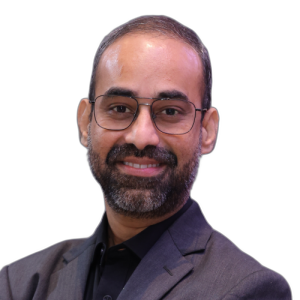

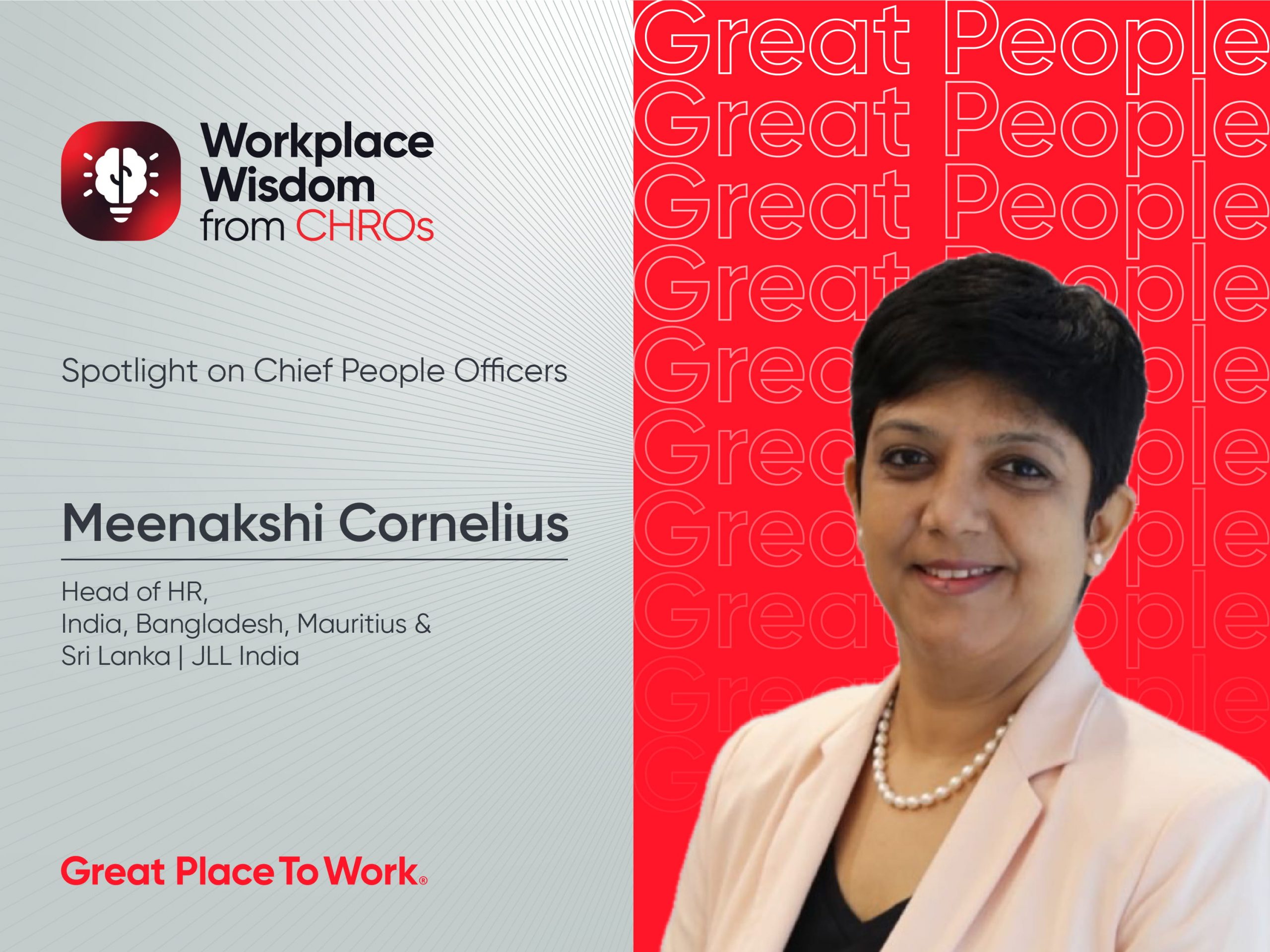
Meenakshi Cornelius is a distinguished Human Resources leader with over two decades of experience driving business transformation through people, culture, and leadership excellence. As Head of Human Resources for JLL across India, Bangladesh, Sri Lanka, and Mauritius, she leads the strategic people agenda for one of the world’s largest real estate services organizations, shaping high-performing, inclusive, and future-ready workplaces across the region.
Jones Lang Lasalle Property Consultants (India) Private Limited (JLL India) has featured seven times in Top 100 India’s Best Companies To Work For List and India’s Best Workplaces™ for Women respectively.
Leadership Journey & Personal Philosophy
Q: Your career has spanned industries, geographies and leadership roles. Looking back, what experiences have most shaped your philosophy as a people leader?
My path to real estate wasn’t linear, and I think that’s exactly what shaped me. I built my HR foundations in telecom and IT services, sectors defined by speed, disruption, and constant reinvention, before bringing that lens into real estate and professional services. Leading change management for technology and digital functions across India and globally taught me that people, not process, are what make transformation stay. And when I co-authored JLL’s white paper on the impact of COVID-19 on the workforce in 2020, I saw first-hand how quickly “nice-to-have” people practices become “non-negotiable” ones the moment a crisis hits.
Every industry shift I’ve navigated has reinforced the same belief: organisations transform because people transform, and a leader’s job is to build the trust, skills and safety net that let people transform with confidence, not fear.
One experience that really shaped this philosophy was my tenure in a global professional services and technology company. The industry was hiring almost exclusively younger talent. We decided to try something different: open up opportunities to professionals with much more experience. What we discovered was remarkable. When you build genuine connections with experienced talent, empathise with their journey, and create the right environment, they bring extraordinary value, stability, judgment, and perspective. That experiment didn’t just succeed; it opened up our entire hiring canvas and proved that potential isn’t defined by age or experience alone.
It’s a lesson I have carried forward: place your trust in people, empower them, and watch what becomes possible when you widen the lens on who belongs.
Q: What first drew you to HR, and after years of leading people and culture across diverse markets, what continues to energize you most about the profession?
What continues to energize me, over two decades in, is that HR is the one function that touches every single person’s daily experience of work—their growth, their sense of belonging, and their ability to bring their whole self to the table. Building and leading a team of HR professionals across India and the broader cluster, I get to see that impact multiply: every capability program we design, every leader we coach, and every policy we redraw doesn’t just move a metric; it changes how thousands of people experience their working lives. That compounding human impact is what makes me excited to go to work every day.
What’s been truly gratifying is how the people around me have helped me see myself more clearly. Over the years, colleagues, team members, and even leaders I’ve worked with have reflected something I hadn’t fully articulated: connecting with people and truly seeing them isn’t just what I do professionally; it’s who I am at my core. That feedback made me pause, introspect, and eventually own what had always come naturally: the instinct to listen deeply, empathize genuinely, and care about the person behind the title and the story behind the role. It is a skill I’ve honed, yes, but it is rooted in something deeper: an inherent people-centrism that shapes how I lead, how I build trust, and how I show up every day. When you lead from that place, the work becomes deeply personal, endlessly energizing, and profoundly human.
Q: How do you personally define a “great place to work,” and how has that definition evolved over the years?
For me, a great place to work is one where trust runs in both directions, where employees trust leadership’s intent even when a decision is hard, and leadership trusts employees enough to give them autonomy, flexibility and a real voice. Early in my career, I would have defined it mostly around policy: good compensation, safe workplaces, fair processes. Today, having led initiatives from Returning Mothers programmes to flexible-work frameworks, I define it more around psychological safety and belonging—whether every employee, regardless of role, gender or geography, believes this organisation is genuinely invested in their growth, not just their output.
Great workplaces understand that people come to work for purpose, for meaningful work that connects to something larger than themselves, and for the space to live full lives outside of work too. When organisations get serious about work-life balance, when they design around people’s real lives and not just business hours, something shifts. People stop performing and start contributing. They bring creativity, commitment, loyalty and not because they have to, but because they want to. And that’s when workplaces stop being places you go and become places you belong. That’s the standard we should all be building.
Q: What are the top three people/engagement metrics you track most closely, and how do they inform decisions on culture and talent strategy at JLL?
Three metrics anchor how we read the health of our culture. First, our Great Place to Work Trust Index score, along with our annual people survey and periodic pulse surveys, shows whether employees believe leadership’s actions match its words. These are broken down by function, gender, and tenure so we can identify trust gaps, not just average scores.
Second, retention, especially among mid-career and early-career talent, because that’s where our industry tends to lose people and where retention interventions have the highest leverage. Third, the succession pipeline: talent readiness is not just about headcount, but about how many people are actually advancing into people-manager and leadership roles.
Together, these three tell us not just how people feel today, but whether our talent strategy is structurally building the workforce we’ll need five years from now.
Culture, Trust & Great Place To Work
Q: JLL India has now been Great Place To Work-Certified™ for ten consecutive years and recognized among the Top 100 Best Companies To Work For seven times. What has been the most meaningful business or cultural outcome of your Great Place To Work journey?
The number I am proudest of isn’t the certification streak itself; it’s what that consistency has done for our ability to attract and retain talent in the industry. For us, being an employer of choice isn’t just an aspiration; it is something we track and take seriously. Our offer acceptance rate in India has consistently been over 90%, which speaks to how people perceive us even before they join. And our boomerang rate, representing people who leave and choose to come back, sits at more than 11%. That says everything about culture. People don’t return only to a company; they return to an experience, to leaders they trust, and to teams that value them. It’s powerful reinforcement that what we’re doing is working.
But here’s what ties it all together: when your people feel trusted, empowered and genuinely cared for, that energy doesn’t stay internal, it flows outward to clients. Our clients experience the difference when they work with teams that are engaged, agile and committed. Trust inside the organization becomes service excellence outside it. And in a relationship-driven business like ours, it’s a competitive advantage. Great workplaces deliver better outcomes for the people we serve.
Q: Can you share an example where employee feedback directly influenced a strategic business, workplace, or talent decision?
Employee feedback has been central to how we’ve shaped both our people strategy and our business outcomes, and I can point to several pivotal moments where listening translated into actions.
One of the earliest examples was the introduction of Flex My Day, our flexible work framework. That didn’t come from a boardroom—it came from honest conversations with employees about what they needed to sustain performance without burning out. We listened, we designed around real lives, and it fundamentally shifted how people experienced work here.
Similarly, our Returning Mothers program and extended paternity leave policies were direct responses to what our people told us mattered. When you create pathways for talent to return after caregiving, when you signal that fatherhood matters as much as motherhood, you’re expanding your talent pool and building loyalty that lasts.
Our continued focus has always been to develop policies and practices that are transparent and fair in nature. We continue to build a structured, transparent model that clearly links individual contribution to business outcomes, whether that’s revenue generation, client retention, or strategic impact. It is not only about fairness; it is also about unlocking motivation.
Q: If you had to describe JLL’s Great Place To Work journey in just one word, what would that word be and why does it best capture your experience?
Becoming.
Not “achieved.” Not “arrived.” Becoming.
Because the most honest and inspiring truth about building a great workplace is that it is never finished. It’s a living, breathing commitment that evolves with every person who walks through our doors, every challenge we navigate together, and every time we choose to listen rather than assume we already know.
“Becoming” captures the humility required to build something truly great. It acknowledges that we don’t have all the answers, that our employees’ voices reshape our direction constantly, and that what made us great yesterday won’t necessarily make us great tomorrow.
But it also captures the momentum, progress, and transformation happening in real time: every policy we reimagine, every barrier we dismantle, every leader we develop, and every moment an employee feels genuinely seen.
That’s the journey that keeps us moving forward.
Becoming!
The Evolving Real Estate & Workplace Landscape
Q: What structural or policy-level changes have you driven to advance gender diversity and inclusion in an industry that has historically had low female representation, particularly on the ground/operations side?
I think what gets missed in this conversation is that a large share of women in the informal workforce work without adequate social security, childcare support, insurance, or structured career progression. That tells us this is as much a protection gap as a promotion gap.
We have built dedicated platforms and programmes specifically designed to remove barriers and create visible pathways for women into roles where they have historically been underrepresented.
One of our flagship initiatives is eWIRE, which focuses on building leadership pipelines and creating sponsorship, not just mentorship, for women. This initiative is founded on four pillars: talent acquisition and retention, learning and development, engagement and networking, and a supportive ecosystem. Sponsorship is critical because it’s about advocacy, not advice: someone in the room using their voice and influence to open doors.
The broader principle is this: inclusion isn’t about special treatment for one group; it is about removing structural barriers that prevent talented people from contributing fully. When you design policies that support caregivers, enable flexibility, and create transparent career pathways, you create better workplaces for everyone while materially advancing representation where it has historically been lacking.
Q: Many young professionals may not immediately see real estate as a career destination. How can the industry better position itself to attract next-generation talent?
Real estate today is not the same as the industry most young professionals imagine. It’s a sector converging with technology, sustainability and data, tech platforms, ESG-linked green buildings, smart infrastructure, and workplace strategy powered by analytics. The industry’s biggest positioning gap is that this story isn’t reaching campuses and career-changers early enough. To attract young talent, we have built an employer brand that meets graduates where they are through strategic campus partnerships, sponsored innovation challenges, and visible digital presence while authentically showcasing what makes commercial real estate uniquely compelling.
Structured internships and graduate programmes become powerful brand touchpoints when paired with clear career pathways from entry level to leadership, demonstrated through real stories of professionals who have progressed within the organization. The employer brand should lead with purpose and impact: few sectors let a 24-year-old see their work take physical form as tangibly as shaping the buildings, neighborhoods, and sustainability initiatives that define how people live and work for decades.
By positioning JLL as both a thought leader invested in the next generation and a place where ambitious graduates build meaningful careers with genuine progression, the work itself becomes the most persuasive recruitment tool backed by an employer brand that highlights mentorship, professional development, cross-functional opportunities, and the rare chance to leave a lasting mark on the built environment.
Q: What are the emerging skills that professionals entering the real estate sector should start investing in today?
Four capabilities stand out: data and analytics fluency, because decisions on space, pricing, and portfolio strategy are increasingly evidence-led; sustainability and ESG literacy, as green building certification and climate-linked compliance move from optional to mandatory; digital and tech comfort, the ability to work fluidly with the platforms reshaping leasing, facilities management, and transactions; and, just as important, the human skills that don’t get automated: stakeholder negotiation, client advisory, and change leadership, because at its core this remains a relationship business built on trust.
Future of Work, AI & Workforce Transformation
Q: The real estate sector is experiencing significant growth and transformation. What are the biggest talent challenges leaders in the industry must solve over the next five years?
Three challenges will define the next five years, and recent research puts numbers to all three. First, the skills gap, specifically the AI skills gap: JLL’s own 2026 Future of Work survey of over 2,200 C-suite and CRE leaders across 21 countries found that, for the first time in the 15-year history of that research, skills gaps, not budget, are now the single biggest constraint on real estate transformation. While 78% of leaders expect AI to significantly reshape their portfolio strategy and CRE function over the next three to five years, only 15% have progressed beyond exploration and initial deployment to actively optimize AI in their CRE operations and prepare for AI-driven organizational change. This gap reflects the complexity of assessing the impact of a technology still in the early stages of enterprise adoption, where the effects on the workforce are unclear and most companies remain in evaluation mode.
Second, the retention gap: the industry is losing professionals mid-career, exactly when they’ve gained valuable experience but before they reach leadership positions. With some groups still representing only about 10% of the workforce, every departure means losing not just talent but future leaders who bring different perspectives the industry desperately needs.
Third, the generational gap: Gen Z now makes up 26% of India’s workforce, nearly double their 2023 share, and they explicitly define career growth as continuous learning rather than promotion, meaning organizations that can’t offer visible, fast-moving skill paths will lose the war for young talent before it starts.
Solving all three requires the same underlying shift: treating talent strategy as core business strategy, not a support function, and building deliberate pathways for leadership development and succession-ready capability that prepare the next generation to lead transformation rather than simply inherit organizations.
Q: How are you addressing the growing need for continuous learning and upskilling among employees whose roles are being reshaped by automation and AI?
We’ve built learning into the everyday fabric of work rather than treating it as an occasional event—through platforms like LinkedIn Learning, structured mentorship, and role-specific upskilling paths.
The gap that the same study flagged is mentorship: roughly half of India’s young workforce wants active guidance from managers, but fewer than half feel they’re getting it. That’s exactly why we’ve paired self-directed learning platforms with structured mentorship rather than relying on either alone.
At JLL, we’ve gone further by designing business-specific learning programs that address real challenges our people face, whether that’s tech integration, ESG compliance, or data analytics for portfolio management. We’ve created AI cohorts where employees actively experiment with GenAI tools in cross-functional groups, sharing use cases and building fluency that’s immediately applicable. And we’ve developed persona-based learning aligned with global markets and cultures. Continuous learning isn’t a program at JLL; it is the way we work.
Q: As Young Talent enters the real estate and CRE workforce, how is JLL adapting its culture, policies and employee value proposition to align with their expectations?
Younger talent is asking different questions of an employer than previous generations did, not just “What will I earn?” but “What will I learn?”, “How flexible is this?”, and “Does this organisation stand for something beyond profit?” We’ve responded by building flexibility into how and where people work, investing heavily and visibly in learning and internal mobility, so career growth doesn’t require leaving the organisation. We are being transparent about our commitments rather than treating them as separate from the business. The employers who win the next generation of talent will be the ones who treat purpose, flexibility, and visible learning as core to the employee value proposition, not as add-ons to it.
Q: What is one workplace trend that you believe will fundamentally reshape organizations over the next decade?
The shift from jobs to skills, and alongside it, a harder truth I think leaders are only now confronting: engagement and effort are no longer the same thing. Great Place to Work India’s 2026 research, covering 5.7 million employees, found that even as benefits and employee experience have genuinely improved at many Indian companies, discretionary effort—people going beyond their job description—has fallen 4% since 2023, a trend they’ve called the “effort recession.” Work is becoming a better place to be, but not always a stronger reason to strive. Paired with AI taking over routine, transactional work, I believe the decade ahead will be defined by organisations that figure out how to earn effort back through trust, purpose, and visible growth, rather than simply improving perks. The ones that build skills-based, fluid talent models on that foundation will be best positioned to compete a decade from now.
Leadership Reflections
Q: What advice would you offer to women aspiring to leadership careers in industries that have historically had lower female representation?
Don’t wait for the industry to feel ready for you; very few industries feel “ready” for change until the people driving that change are already inside the room. My advice would be to build your expertise visibly and confidently so it can’t be overlooked. Don’t apologize for negotiating the growth, compensation, and opportunities you’ve earned. Most importantly, follow your passion, and remember that every time you step forward, you’re creating pathways for others to follow. Seek out sponsors if you feel the need, not just mentors: people who will actively advocate for you in rooms you’re not yet in.
Q: What is one commonly held belief about HR, or about building a career in the real estate and workplace services industry, that you believe deserves to be challenged?
The belief that HR is still a “support function” rather than a strategic business driver. The reality is fundamentally different.
In a people-intensive industry like real estate and workplace services, where human capital represents one of the largest operating expenses, talent decisions aren’t HR decisions, they’re fundamental business decisions that directly impact profitability, client satisfaction, and competitive positioning. The organizations that understand this connection consistently outperform those that treat HR as purely transactional.
Yet too many companies still view HR as administrative: managing payroll, handling compliance, and organizing events, rather than recognizing that workforce planning, culture development, and employee experience are strategic imperatives that shape business outcomes. In a services business, your people strategy is your business strategy. When you’re delivering client experiences through human expertise and relationships, how you attract, develop, and retain talent becomes your primary competitive advantage.
Q: Is there a story or piece of feedback from an employee that has stayed with you and continues to guide your decisions as an HR leader?
Early in my career, a leader shared advice that fundamentally changed how I approach HR: “Understand people. Every employee is first a human being.” It sounds simple, but it was profound. He showed me that when you truly take time to understand what someone is experiencing—their aspirations, their challenges, and what keeps them up at night—you unlock something powerful. You build trust, make better decisions, and create environments where people genuinely want to contribute their best.
That lesson guides everything I do today. Before implementing any policy or making any decision, I ask myself: “Am I seeing the person or just the process?” It’s taught me to listen more deeply, to lead with curiosity rather than assumptions, and to build workplaces where people feel genuinely understood and valued. When employees know you see them as whole people navigating real lives, not just resources fulfilling roles, they bring their authentic selves to work and that’s when both individuals and organizations truly flourish.
Q: When you look back at your leadership journey many years from now, what impact would you most like to be remembered for?
When I look back at my leadership journey, I hope to be remembered for one simple truth: I built leaders from within my teams.
In the future of work, success won’t be measured by how many people reported to you, but by how many people grew because of you. I want to be remembered as someone who saw potential in others before they saw it in themselves, who created space for people to lead with authenticity, courage, and compassion. When your team feels genuinely valued and empowered, they transform client experiences. They go beyond transactions to build lasting relationships.
And if I can leave behind a generation of empowered, authentic leaders who put humanity at the centre of business, that’s a legacy worth building.