
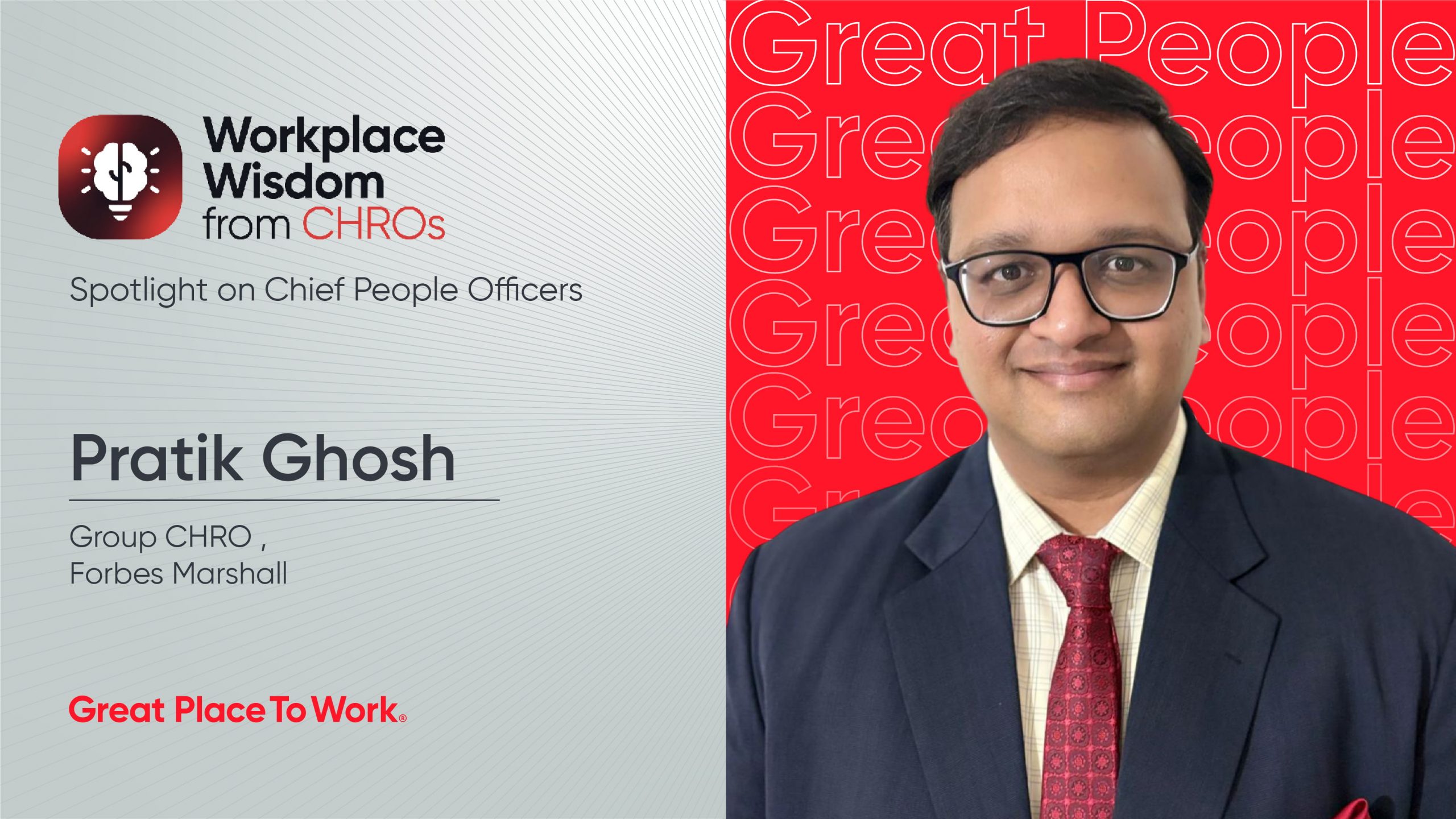
Pratik Ghosh, Group CHRO at Forbes Marshall, brings over two decades of experience across diverse functions and leadership roles. A member of the company’s Senior Management team, he combines deep organisational knowledge with a people-first perspective shaped by purpose, values and continuous learning.
In this insightful interview, Ghosh explores how Forbes Marshall is building a future ready, high-trust workplace amid rapid technological and workforce change. He discusses AI and automation as enablers of better work, personal accountability in safety, inclusive experiences for frontline and knowledge employees, and the importance of reskilling without leaving anyone behind. The conversation also covers career growth, sustainability, continuous employee listening, holistic well-being and values-based leadership under pressure. Drawing on Forbes Marshall’s eight decade journey, Ghosh offers a grounded view of how organisations can combine human connection, meaningful responsibility and collaboration to create lasting performance, engagement and growth for people and business alike over time.
Q1. Forbes Marshall operates at the intersection of engineering excellence, sustainability, and precision manufacturing. In today’s context of AI-driven operations and evolving workforce expectations, how are you redefining what a Great Place to Work means for both frontline and knowledge employees?
Our philosophy on having a great place to work is still fundamentally grounded in the fact of our Values to ensure everyone’s potential is fully utilised and that we provide every member an equal opportunity to perform, learn and grow. It’s proven to be meritorious to us in believing that the best way to nurture your talent is by ensuring you give them enough inputs to perform to the best of their ability. You can do this by providing inputs in a variety of ways and customise this to the environment that works best for the member. AI remains, rightly so, as a tool that enables better performance and adds value to the member’s work. It is not comparable to human beings and should not be, in my view. Having said that, we should not ignore the opportunities that exist in enabling us to do our work better and helps make our work easy and exciting. If we keep our focus on that, we will not only benefit from AI but be able to get better technology as a result too. After all, every technology has a human being behind in developing and evolving it.
Q2. With increasing use of automation, IoT, and predictive safety systems, how is Forbes Marshall evolving safety from a reactive compliance model to a predictive, behaviour-led culture?
I do not think this is a matter of choice but it is hygiene. In my experience, any safety measure or precaution should not be postponed for a later date. We should constantly set our guard rails in order to protect our systems, and our individual members. They all go hand in hand and is no different in creating a conducive environment for us to perform. Non compliance or lack of safety derails your operations and disrupts your productivity. That is the simple lesson of avoiding it and so the organisation should get in desired expertise across levels and have a deeper understanding of its systems and the repercussions of not securing it.
Q3. How do you ensure that digital interventions do not dilute personal accountability towards safety?
No accountability is on a system and always remains with individuals. This is a culture that brings in more responsibility as well. Digital products and tools are ways you use to get a job done but does not take away individual insights, skills and capability of interpretation and better problem solving. Therefore, no KRA’s are ever designed by making any system accountable. It is always a person. So you keep your system clean and do everything necessary for it to work but ultimately don’t replace your own thinking and time with the system for a better output.
Having said that process automation and improving the quality of one’s work is always on the Agenda and we have broken down milestones to see how one is making progress.
Q4. As manufacturing becomes more automated, how do you address the fear of job displacement and instead position automation as an enabler of employee growth and meaningful work?
As in the past, with every evolution of technology, we have only made the quality of work better. It has never negatively impacted our count on the workforce. The philosophy is simple, every member exists in the organisation for a purpose and they are fulfilled due to their own competence and capability. Therefore, technology and advancement in it only leverages better performance and productivity. If one keeps that in mind, you end us in having a very engaged workforce that does not get threatened by their job. We have been fortunately practising this for the last eight decades and can safely say that it is a better way to operate. Business planning should always reflect plans of automation in sync with that of enhanced member (employee) productivity. The latter should be at the heart of the automation and then you will always benefit overall from that as an organisation.
Q5. Across Indian manufacturing, there is a growing focus on frontline employee experience (FX). How is Forbes Marshall ensuring that shop-floor employees feel the same level of trust, inclusion, and engagement as corporate teams?
Forbes Marshall has never differentiated on focussing for a specific group of members. Even if a member from a third party vendor works in our facilities, we treat them as any other member. Therefore, including your workforce across levels for any initiative is critical. All HR processes are applicable for everyone and we take efforts to ensure that the experience is uniform across. All communication, initiative and practices always considers every member (employee) who can get influenced irrespective of their work area. This also helps us have a centralised approach to our processes and systems, and more importantly it also enables us to bring everyone together on various organisation wide strategic initiatives.
Q6. With rapid technological shifts, what are your key strategies to reskill and upskill employees, especially those in legacy roles, and build a future-ready workforce without leaving sections behind?
In my view, any organisation is able to embrace challenges well when it makes choices on what it wishes to do and be as an organisation. An efficient organisation tends to be a happy organisation is what was once told to us by a very dear Mentor. Technological shifts-be it AI or digitisation, is all in the direction of better quality work and productivity. The workforce needs to see how alternatively can talent be utilised for better qualitative outputs and not replacement. It is this approach that helps us bring in learning agility. We work towards capitalising the strength of our members and looking at building a growth mindset not just in individuals but as an organisation. Simply challenging how we can make our work and output better. The intention has to be clear in order to get a better buy in. We never have any change management as a process to hit down on our workforce but it is always with the intention of getting better and improving ourselves.
Q7. Many engineering-led organisations struggle with vertical growth limitations. How is Forbes Marshall reimagining career progression through skill depth, cross-functional mobility, and internal gig opportunities?
Forbes Marshall has placed great emphasis on learning and growing and have seen both those go hand in hand. Any demonstrated example of success has always reflected that by contributing to the customers value add chain, and by learning we enable growth opportunities. We are proud to have built several long term careers with us through meaningful added responsibilities and increasing the sphere of influence of members. Our growth always comes from members taking additional responsibilities and increasing their contribution, which has served well for eighty years now.
Forbes Marshall further believes in nurturing talent and having home grown members. This has, again, served us very well all the time. We invest in a great GT programme that brings members from diverse backgrounds, be it for our Indian or overseas operations. We value greatly in the long term careers we have of our members and have been extremely fortunate. Most management team members started with us as GTs and many going back three decades.
Q8. Forbes Marshall plays a significant role in energy efficiency, decarbonisation, and industrial sustainability. How do you translate this larger purpose into everyday meaning for employees—especially those not directly linked to sustainability projects?
Everyone in the organisation is energised by our purpose. The overarching purpose is what drives members to perform to their best potential. Sustainability for us is in what we provide to our customers, how we do business and how our functions and initiatives drive results. Therefore our ESG framework is comprehensive when it comes to this. This makes it easier for every member to relate to our purpose and all their deliverables collectively add up to this result.
Q9. With evolving employee expectations, listening mechanisms are shifting from annual surveys to continuous listening ecosystems. How is Forbes Marshall strengthening real-time employee voice and ensuring visible action on feedback?
We have a robust process of member connect. Each HR Business Partner meets a member one on one twice a year. In this we capture several aspects of the role and what enables the member to be fully engaged and performing. This provides a flexible platform for our members to share feedback. resolve concerns, which we feel ultimately drives better performance and productivity and gauges engagement. We also run a quarterly member NPS that we track and have been doing so for the past few years. The sense of purpose, which we define as aligning individual aspirations with that of the organisation is our strongest engagement pillar and if that is bridged and aligned regularly, you have an engaged happy workforce.
Q10. In a VUCA manufacturing environment, leaders often face trade-offs between cost, speed, and safety. How do you institutionalise values-based decision-making, even under operational pressure?
Ambiguity is here to stay and complexity is on an all time rise. The best way leadership can function is by embracing it with honesty and building a psychologically safe environment so that your energy is channelised in doing the right thing for the organisation. Forbes Marshall has inherently been resilient because of this characteristic. Be it in any phase, including the unprecedented pandemic, we have only emerged stronger as a company keeping our values intact and enabling ourselves to healthily contribute in the best way possible. All of this only helps the company and our members move forward.
Q11. Post-pandemic, well-being has expanded beyond physical safety to include mental, financial, and social well-being. How is Forbes Marshall approaching well-being holistically, particularly for plant and shift workers?
Anything we do here is less. I think we are always open to partnering and looking at wellness in a holistic way. We have a strong Social Compact programme that also greatly includes our vendors and their associates. Every member, very much including the shopfloor, is part of our wellness initiative that is largely customised to the needs from time to time. The access is made easier and based on our constant feedback, we try and cater to these needs.
Q12. Reflecting on Forbes Marshall’s journey, what has been your biggest learning in building a high-trust, high-performance culture in manufacturing, and what advice would you offer to other industrial organisations?
The biggest learning at Forbes Marshall is making the choice of action over anything else. Forbes Marshall always has a platform that allows you to take responsibility, take initiative and make things happen. The company enables this through its purpose and values and every design of our process and systems has an element of a human connection and the expertise it brings along. This is industry agnostic and more to do with Values and behaviour. Restricting oneself to a single job or discipline is very restrictive and we see it coming the way of learning and growth. Having a meaningful role and contributing with collaboration is seen as a great way to achieve great results. That’s my advice to all, as was said by our founder, take care of members in a way that they take care of your organisation. Spend time on the small fundamentals (how you sell, why you sell, and purpose of all you do) and the rest is addressed. 80 years and running is a good evidence to that!