
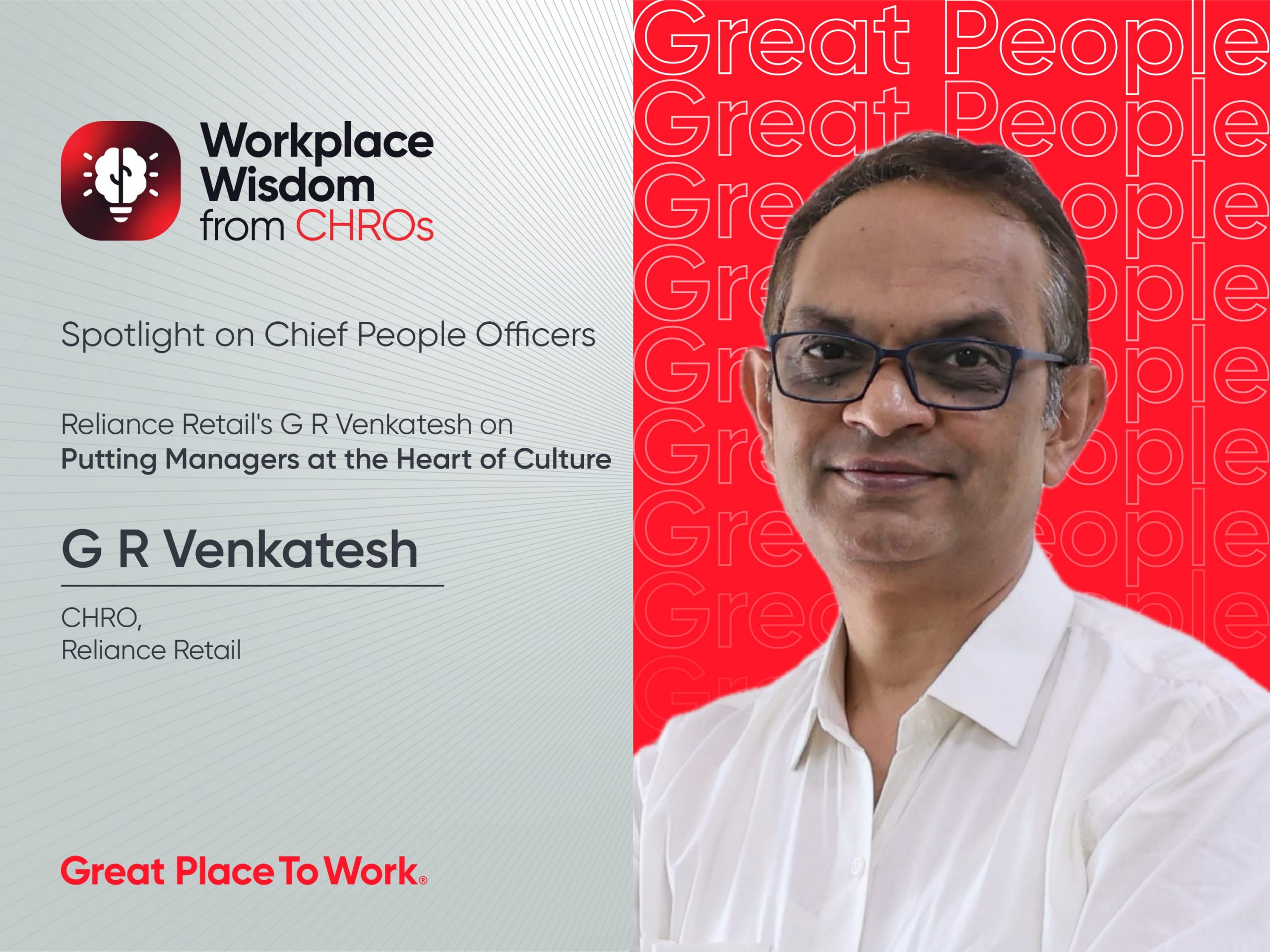
Mr. G R Venkatesh is the Chief Human Resources Officer at Reliance Retail. An alumnus of IIM Ahmedabad with over three decades of experience across HR, Finance, Marketing, and Strategy, he has played a pivotal role in shaping the people agenda at one of India’s largest retailers. Under his leadership, Reliance Retail has been Great Place To Work®-Certified for five consecutive years, ranked among India’s Best Companies To Work For and India’s Best Workplaces for Women, and recognised as a Best Employer Among Nation-Builders. A certified Executive Coach and advocate of people-centric leadership, he champions a workplace culture of mutual respect, shared purpose, and genuine belonging—believing deeply that sustainable leadership is rooted in listening to, learning from, and elevating every team member. Beyond the boardroom, he finds joy in singing and running marathons – hobbies that reflect both his creativity and discipline.
Q1. Across 30+ years of your rich career, around 20 of them have been spent in the retail industry. What has kept you anchored in this industry for the last 2 decades?
Retail is one of those rare industries where the complexity is hidden in plain sight. From the outside, it looks straightforward. You buy things, you sell things. From the inside, you are managing an ecosystem of extraordinary scale, diversity, and human intensity. That tension is what has kept me here.
When I moved into retail after stints in telecom, what struck me immediately was the sheer human density of the business. At Reliance Retail, we have lakhs of employees across thousands of stores, spanning virtually every format imaginable: grocery, fashion, electronics, connectivity. No two days, and honestly no two hours, are quite alike. The problems are real, they are immediate, and the feedback loop is brutally short. If something is not working on the shop floor, you know by evening.
For someone with an HR lens, retail is arguably the most demanding canvas there is. At one end of the workforce spectrum, you have frontline associates who are the face of the brand to millions of customers every day. At the other end, you have designers, technologists, and management graduates driving strategy and innovation. Managing the aspirations, career paths, and engagement of such a wide spectrum of talent, all within the same organisation, is an intellectual challenge that few industries can match. It keeps the HR function honest, creative, and permanently on its toes.
And then there is the pace of change itself. Retail does not let you get comfortable. Every year brings a new challenge. The integration of digital and physical commerce, the rise of quick commerce, and now the question of how AI will reshape store operations and workforce planning. The industry makes intellectual complacency very expensive.
Twenty years in, I am still asking new questions. That, more than anything, is why I have stayed.
Q2. 2026 marks the 20th anniversary of Reliance Retail. You have been associated with it for 12+ years, during which it grew from an INR 20,000 crore business with 40,000 employees to an INR 3,50,000+ crore business with 2,00,000+ employees. What has been your mantra for creating and sustaining culture consistency at this scale?
Scaling culture is harder than scaling revenue. Revenue follows strategy. Culture follows behaviour, and behaviour at 200,000 people across thousands of stores in every format and geography is not something you can manage from a policy document.
When I joined Reliance Retail, the organisation was already sizeable. What followed was growth of a different order entirely. Going from INR 20,000 crore to over INR 4,00,000 crore means you are rebuilding the ship while sailing it, at increasing speed. The cultural risk in that kind of growth is not creating something new. It is ensuring that what is real and true about the organisation does not get diluted as you add thousands of new people every year.
What I have learned over twelve years is that culture at this scale lives or dies on two things. First, whether values are consistently demonstrated at the leadership level. Not communicated. Demonstrated. People watch what leaders do far more carefully than what they say, and at our scale, that observation multiplies. Second, fairness. Abstract values are decoration; fairness in how people are treated, promoted, heard, and recognised is what makes those values real to a frontline associate in a store in Nagpur or Guwahati.
Our credibility, respect, and fairness scores in the Great Place To Work survey have moved up by five to six points over the last five years. That did not happen because we ran a culture programme. It happened because we treated manager behaviour as a strategic variable and invested seriously in it year after year.
Culture does not live in the head office. It lives in the way a store manager speaks to a new joinee on Day 1. Getting that right, consistently, at our scale remains both the most rewarding and the most unfinished work of my career.
Q3. Over the years of your association with Great Place To Work®, what is the value you have derived from the insights unlocked as part of your annual Trust Index™ survey?
I have worked with many diagnostic tools over a thirty-year career. The Trust Index survey is one of the few I would describe as genuinely consequential, not because the questions are uniquely clever, but because when taken seriously, the results have a way of puncturing comfortable assumptions very efficiently.
Our association with Great Place To Work has evolved over the years from a benchmarking exercise into something closer to an annual strategic conversation with our own workforce. The survey gives us a structured, statistically robust way of asking our people what they actually think, stripped of the filters that normal organisational hierarchies apply to upward feedback.
The value comes in layers. The first is the headline score, useful for tracking direction and external credibility. But the real intelligence is in the dimension-level analysis. When we dissect scores across credibility, respect, fairness, pride, and camaraderie, and then cut those further by business format, geography, tenure band, and level. Patterns emerge that no amount of anecdotal feedback would reliably surface. That granularity is where the actionable insight lives.
Over the years, this analysis has directly shaped our people strategy. Gaps in manager effectiveness scores led to structured investments in leadership capability. Lower scores on fairness in specific geographies triggered process audits and corrective interventions. Improvements in pride and camaraderie scores validated cultural initiatives we had invested in and gave us confidence to deepen them.
The other dimension of value, and perhaps less discussed, is accountability. When you publish your scores internally, share them honestly with your leadership team, and commit to acting on them, the survey stops being an annual ritual and becomes a living contract with your workforce. Our people know we take this seriously. That knowledge itself influences how they experience the organisation. What I am proud of is not the rank. It is the discipline of listening that produced it.
Q4. Reliance Retail’s journey among India’s Best Companies to Work For has been phenomenal — from Rank 92 in 2023 to Rank 13 in 2026. What strategic actions did you take based on the 2023 survey results that translated to this positive growth?
When we received our 2023 results, the honest reading was this: we had a solid foundation, and meaningful distance to close. Rank 92 with an 84% Trust Index told us we were doing several things right. It also told us our people were trying to tell us something important in the dimensions where scores were softer. We chose to listen carefully rather than celebrate prematurely.
The first decision we made was diagnostic rather than programmatic. We did not launch a broad employee experience initiative and call it done. We went question by question, dimension by dimension, and asked a simple question: where is the gap sharpest, and who owns fixing it? That accountability piece mattered enormously. Improvement at scale does not happen through central teams alone. It happens when line leaders own the problem.
Three areas received serious, sustained attention. Manager effectiveness — because a significant portion of the Trust Index is shaped by the immediate manager relationship, and we had evidence that this was inconsistent across geographies and formats. We invested in structured manager capability programmes, treating people management as a core skill, not an assumed one. Communication transparency — employees needed to feel genuinely connected to the direction of the business, not just informed of it. And fairness in processes — promotions, grievance handling, recognition — where we worked to close the gap between perception and reality through cleaner processes and greater visibility.
Trust Index moving from 84% to 90% over three years, and rank from 92 to 13, reflects genuine change on the ground. Our people told us what needed fixing. We listened, we fixed it, and we went back to them the following year and told them what changed. That closed loop, more than any single initiative, is what built the momentum.
Q5. As of 2026, Great Place To Work®’s research shows 42% of the Indian retail workforce indicates intent to leave. In comparison, Reliance Retail’s workforce shows increasing intent to stay — from 82% in 2024 to 91% in 2026. Which aspects of your culture are having the biggest influence on employee retention?
The 42% intent-to-leave statistic for the Indian retail industry does not surprise me. Retail is a high-intensity, high-mobility sector. Margins are thin, pace is relentless, and historically the industry has not always invested in its people the way it should. The fact that our intent-to-stay numbers have moved from 82% to 91% over two years, against that backdrop, is something I am genuinely proud of. It has not happened by chance.
The first is a sense of belonging and pride. Reliance Retail is not a small or anonymous employer. Being part of an organisation that is visibly growing, visibly winning, and visibly investing in its people creates a sense of pride that is a powerful retention force in itself. People want to be associated with something that is going somewhere.
The second is opportunity. In an organisation that has grown at the pace we have, internal mobility and career progression are real, not aspirational. A frontline associate who joins us today can see a credible path forward, and can see examples of people who have walked that path before them. When growth is visible and accessible, leaving becomes a harder decision.
The third is how we treat people in the moments that matter. Fairness in appraisals, responsiveness to grievances, manager behaviour during difficult conversations. These are the moments that build or break trust. We have invested significantly in getting these right, and our people have noticed.
Retention, at its core, is a consequence. If the culture is right, if the opportunity is real, and if people feel respected, they stay. We have tried to stay focused on those fundamentals rather than on retention as a standalone metric.
Q6. In the retail industry today, while 90% of the workforce perceives their management as competent, 5% report a growing disconnect between the executive level and frontline teams. How have you managed to nurture an authentic connection between your frontline workforce and management?
The disconnect between executive leadership and frontline teams is one of the most stubborn problems in large retail organisations. It does not come from bad intent. It comes from distance: physical, hierarchical, and sometimes cultural distance that grows quietly as organisations scale. I have seen it happen, and I have seen the Trust Index reflect it when it does.
What we chose to do differently was to make leadership presence at the store level a structural feature, not an occasional event. Our Bandhan initiative created a formal connect between senior leaders and store teams. These were regular, scheduled, and genuinely two-way. Not a leadership walkthrough where someone checks the displays. An actual conversation where frontline associates speak and leaders listen. Morning store huddles gave local teams a daily rhythm of communication and alignment that did not depend on cascading information from the top. Leadership store visits, structured specifically around listening rather than inspecting, became part of how we expected leaders to spend their time.
The results showed up in the data. Leadership accessibility scores improved by 17%. At our scale, that is not a rounding error. Credibility scores moved in parallel, because credibility is ultimately what happens when leaders say they will show up and then actually do.
What I would say to any leader watching a disconnect grow in their organisation: you cannot solve this with a communication campaign. You solve it by redesigning how leaders spend their time, and then holding them accountable for it. When a frontline associate feels seen by the people leading the organisation, something shifts. They stop being someone who works for Reliance Retail and start feeling like they are part of it. That shift is what we were really after.
Q7. Reliance Retail has outperformed the benchmark for India’s Best Workplaces in Retail in 2026 by 4 points on the Trust Index© Grand Mean. What does Reliance Retail do differently to secure the trust of all its people?
Trust is not built through programmes. It is built through patterns, the accumulated weight of how an organisation behaves in small moments and large ones, consistently over time. When I look at our 4-point outperformance over the retail benchmark on the Trust Index Grand Mean, what I see is an organisation whose patterns have become more predictable and more honest in the eyes of its people.
We treat scale as a design problem, not a management problem. With 200,000+ employees across grocery, fashion, electronics, and connectivity, you cannot rely on goodwill or informal culture to carry you. We have invested in building systems that deliver consistency in onboarding, performance assessment, grievance handling, and recognition. Consistency at scale is itself a trust signal, because people learn what to expect and the organisation delivers on that expectation, repeatedly.
We also communicate our survey results back to our people, honestly. Here is what you told us last year. Here is what we did about it. Here is what moved and what did not. Most organisations treat survey data as internal intelligence. We treat it as a conversation. That closed loop of listening, acting, and showing your people that you listened is more trust-building than most formal engagement programmes ever are.
And I think our people take genuine pride in the Reliance Retail story itself. Being part of an organisation that has grown from INR 20,000 crore to INR 4,00,000 crore in two decades, that is reshaping how India shops. That narrative creates a sense of shared ownership that no engagement initiative can manufacture. Pride and trust are more closely connected than most HR frameworks acknowledge.
Trust follows truth. We have tried to keep that equation simple.
Q8. Reliance Retail shows an impressive jump of 16 points over the last 3 years in work-life balance, with 89% employees today saying they are encouraged to practice healthy work-life balance. Which wellness initiatives have seen high adoption and success?
A 16-point jump in work-life balance scores in an industry structurally weighted against it is the result of many things working in concert — every wellness initiative, every World Health Day moment, and every small act of care that our people experience day to day — all of it adds up, and sits alongside the deeper shifts in how leaders think about their people and how the organisation designs work itself.
Retail’s challenge is real and structural. When your business operates seven days a week, across early morning and late evening hours, and your customers do not take holidays. The pressure on frontline employees is constant. Acknowledging that honestly was our starting point. We did not pretend the pressure does not exist. We asked instead: what can we do to make it manageable and sustainable?
Scheduling discipline has been one of the biggest levers. Predictable rosters, adequate notice for shift changes, and ensuring that weekly off days are actually protected. These sound basic, but their consistent implementation at scale has had a significant impact on how people experience their work week.
We have invested in mental health support in a structured way, through employee assistance programmes with access to counselling and a concerted effort to reduce the stigma around seeking help. In a workforce that skews young, mental wellness is not a peripheral concern. It is central.
Manager sensitisation has also been critical. A manager who respects personal time, who does not normalise after-hours messages as a badge of commitment, and who actively encourages their team to disconnect. That manager changes the culture of an entire store or department. We have built this into our manager effectiveness frameworks.
Eighty-nine percent of our people saying they are encouraged to maintain work-life balance is a number we do not take for granted. It is a commitment we renew every year.
Q9. While organisations are reassessing business metrics, home-grown talent is proving to be a big cost advantage. How is Reliance Retail empowering frontline talent to grow into senior leadership roles?
One of the least discussed advantages of a large retail organisation is the talent that already sits inside it, often in frontline roles, often unrecognised, and almost always more capable of growth than their current designation suggests. At Reliance Retail, we made a deliberate choice some years ago to invest in growing our own, rather than perpetually reaching outside for senior talent. That choice has been validated more comprehensively than I expected when we made it.
Reliance Samarth is our flagship programme in this space, a structured capability and career progression pathway designed specifically for frontline associates. The premise is straightforward: a motivated, capable person on the shop floor today, given the right investment and a credible path, can become a department manager, a store manager, and beyond. Samarth combines functional skill building, behavioural development, and structured on-the-job learning. Thousands of employees have progressed through it, moving from frontline roles into supervisory and managerial positions. The business impact is tangible in reduced hiring costs, faster time to effectiveness, and a powerful signal to every associate in our stores that upward movement here is real.
Our Step-Up programme identifies high-potential frontline employees and accelerates their readiness for the next level, with defined milestones, mentoring, and genuine accountability for outcomes. And our Retail Leadership Academy builds the pipeline further, preparing the next generation of senior retail leaders through immersive programmes that combine classroom learning, field exposure, and project-based development.
What home-grown leaders bring that no lateral hire can replicate for years is an instinctive understanding of our culture, our customers, and the ground realities of large-format retail. That institutional knowledge does not appear on a CV, and it cannot be bought. It has to be grown. We started growing it deliberately, and it is now one of our more durable competitive advantages.
Q10. You are known as a leader deeply invested in coaching and developing young talent. How do you personally build relationships with emerging talent, and what have these interactions taught you?
I am not sure I consciously set out to be known as someone invested in young talent. It has been more organic than that, a natural consequence of finding young people genuinely interesting to talk to. They ask uncomfortable questions, they carry fewer assumptions, and they have not yet learned to be cynical. That combination is refreshing, and if I am honest, it keeps me sharper than any leadership programme ever has.
My interactions with emerging talent happen in a few different ways. Some are structured: workshops, town halls, skip-level conversations. I conducted a prompt engineering workshop for my HR colleagues not long ago, teaching them how to work with AI tools, and watching young HR professionals engage with something that might fundamentally reshape their careers was one of the more energising afternoons I have spent recently. But some of the most meaningful interactions happen informally. A conversation after a meeting, a candid exchange during a store visit, a question someone asks that stops me in my tracks.
What have these interactions taught me? More than I expected. Young talent today is not looking for inspiration as much as it is looking for honesty. They can detect performance from a distance. What they respond to is a leader who speaks plainly about what is hard, what failed, and what they genuinely do not know.
The relationship also has to be reciprocal to be meaningful. I do not just invest in them. They invest in me, often without realising it. Some of my clearest thinking on where HR needs to go has come from conversations with people early in their careers, unencumbered by the weight of how things have always been done.
Staying connected to emerging talent is the best antidote to the kind of gradual irrelevance that can quietly catch up with senior leaders. The day I stop learning from people younger than me is the day I should seriously reconsider what I am contributing.
Q11. In Reliance Industries’ 2026 AGM, Mr. Mukesh Ambani heralded a new period of growth, calling it the ‘Deeptech Intelligence Era’. How do you envision transformation along these lines in Reliance Retail’s people and culture strategy?
When our Chairman described this as the Deeptech Intelligence Era at the AGM, I sat with that framing for a while. Because for HR, it is not simply an exciting label. It is a prompt to be honest about how much of what we have traditionally done in people management was built on imperfect information, processed slowly, acted on too late.
We have an asset that most HR functions would struggle to match: a longitudinal dataset covering 200,000+ employees across diverse formats, geographies, roles, and tenures. For years, that data existed largely in systems. What we are now doing is actually using it, to anticipate rather than react, to personalise rather than standardise, to give managers real-time insight into their teams rather than waiting for an annual survey to tell us what went wrong six months ago.
In practice, this means AI-assisted tools at the hiring stage that improve our ability to predict not just whether someone can do a job, but whether they will thrive in a specific role and format. It means early signals for flight risk that reach a manager weeks before an employee hands in their notice. It means learning pathways that adapt to where an individual actually is, not where we assume they should be.
But I want to be honest about where we are. We are in the middle of this journey, not at the end of it. Some of what we are building is working well. Some of it is still being figured out. The discipline of using data to inform people decisions, rather than gut and hierarchy alone, is something we are building as a cultural norm inside HR itself, not just as a technical capability.
What I am certain about is the direction. An HR function that spends less time on transactions and more time on people is a better HR function. The Deeptech Intelligence Era, for us, means using data and AI not to make HR more efficient alone, but to make the employee experience more personalised, more responsive, and paradoxically more human. That is the transformation we are building toward.
Q12. If you had to recommend one workforce priority that retail leaders should focus on over the next three to five years, what would it be and why?
If I had to name one priority, and I appreciate that the question forces that discipline, it would be this: preparing your workforce for a world where the nature of work itself is changing faster than our traditional people frameworks can keep up with.
AI and automation are not a future threat to retail jobs. They are a present reality. Quick commerce algorithms are optimising delivery routes. Computer vision is managing inventory. Conversational AI is handling customer queries. The question retail leaders need to be asking right now is not whether these technologies will affect their workforce. They already are. The real question is whether their people are being equipped to work alongside them.
This is fundamentally a learning and reskilling challenge. But it is also a leadership and culture challenge. Reskilling programmes only work if the culture treats learning as a continuous, valued activity rather than a one-time event. And they only work if leaders are honest with their people about what is changing and why, rather than offering reassurance that the disruption will somehow pass them by.
At Reliance Retail, we have made the AI-driven transformation of the HR function itself a priority, not just to improve efficiency, but to model the behaviour we want to see across the organisation. If HR is willing to reimagine itself in the age of AI, it sends a credible signal to the rest of the business that this transformation is real, necessary, and navigable.
My recommendation is simple: do not manage this transition from a distance. Get close to it. Understand what your frontline associates are experiencing as technology changes their day-to-day work. Invest in their adaptability, not just their current skill set. And be honest, because your people are perceptive and they will trust a leader who tells them the truth over one who tells them what they want to hear. The retailers who get this right will not just have a more efficient workforce. They will have a more resilient one.