

A Great Place To Work® For All™ should also have great managers for all. Managers bridge the gap between the operational team and the executive team. The outcome and efficiency of any project depend on the leader. Leadership influences far more than decisions, targets, or team structure. It shapes how people feel at work, how much trust they place in their managers, whether they stay, innovate, collaborate, or just work for the sake of it. All of this, ultimately, comes down to whether a workplace is truly great.
Based on research covering 75,000 employees and more than 10,000 managers across industries, Great Place To Work has identified five distinct leadership levels that directly influence employee experience, trust, retention, productivity, and innovation. The findings are clear: when leaders level up, workplace culture improves at every stage.
Why Is It Important for You to Understand the Levels of Leadership?
At Great Place To Work, our research consistently shows that leadership behaviour is later reflected in the company’s culture. Becoming a great workplace doesn’t happen only because of the right policies, but rather it is a result of how leaders communicate with their team, involve them in decision-making, recognize their efforts, and create fairness in everyday work. This is why understanding the levels of leadership matters for every organization. Because when you’re aware of the levels of leadership, only then will you be able to become a better version of yourself and reach the next level. The first thing that matters here for you is to understand where you stand today and take a step ahead to reach the highest level.
What Are the 5 Levels of Leadership?
The levels of leadership describe how leadership behaviors evolve from inconsistent people management to culture-building leadership that creates a great workplace for all.
The five levels are:
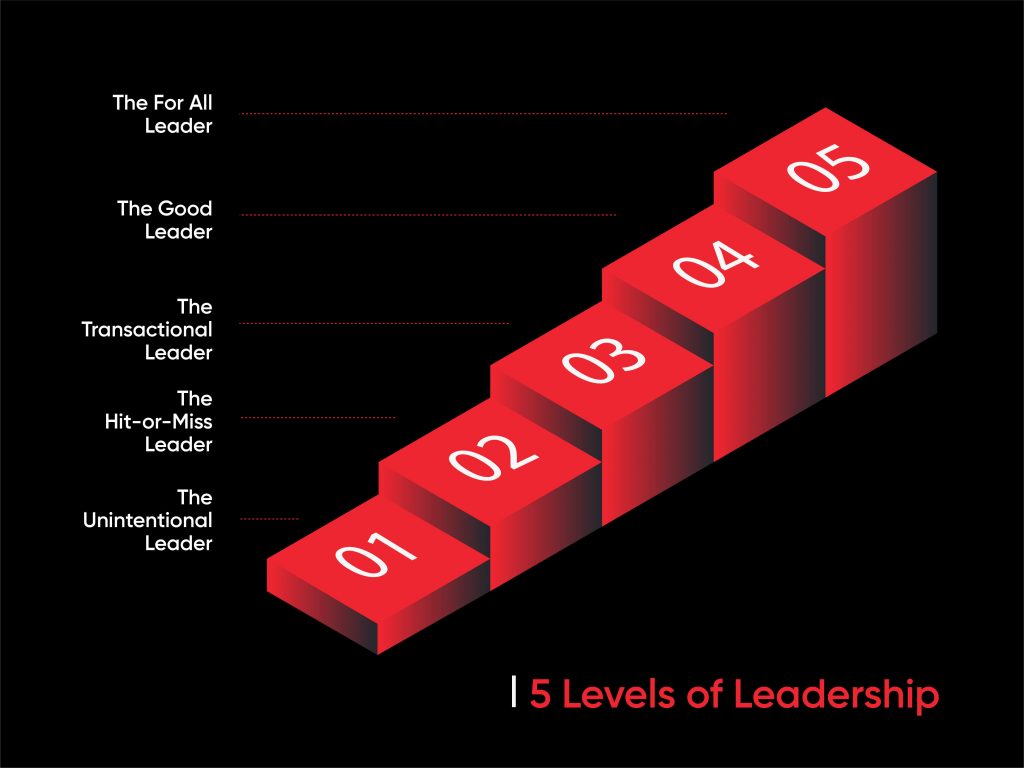
Each level reflects how leadership behavior affects employee trust, inclusion, and performance. What makes this framework powerful is that leadership does not stay static. Leaders can move from one level to the next through intentional behavior changes.
Why Levels of Leadership Matter in Workplace Culture?
Many organizations focus on leadership as a capability. Great workplaces treat leadership as a culture multiplier. Our research shows that moving across the levels of leadership creates measurable business impact. Compared with employees working under a Level 1 leader, employees with a Level 5 leader demonstrate:
- 353% higher productivity
- 300% greater agility
- 325% greater readiness to innovate
- 128% greater desire to stay
This means leadership quality is not only a human issue. It is directly linked to business performance. The strongest workplace cultures are built when leaders consistently create trust, clarity, fairness, and belonging.
What Are the Levels of Leadership?
Even leadership has levels based on a leader’s behavior or way of working. Let’s understand the five levels of leadership:
Level 1: The Unintentional Leader
When leadership lacks awareness, culture weakens quickly. The first of the five levels of leadership is the Unintentional Leader. This leader often does not realize how their behavior affects others. The issue is not always poor intent, but lack of awareness, poor people skills, or failure to adapt to leadership responsibilities. Employees under this type of leader often feel uncertain, unsupported, and emotionally disconnected.
Common signs include:
- Withholding information
- Taking credit for work done by others
- Criticizing people personally
- Raising voice under pressure
- Failing to act on feedback
In this environment, trust declines quickly. Even employees with an Unintentional Leader do not consistently experience a positive workplace. At this level, leadership creates friction instead of confidence. And, the cultural impact can be seen as:
- Lower motivation
- Higher voluntary turnover
- Reduced teamwork
- Minimal discretionary effort
Level 2: The Hit-or-Miss Leader
Inconsistency creates uncertainty. A leader should be a leader for all and not just an ideal for a few. The second stage in the levels of leadership is the Hit-or-Miss Leader. This leader is not consistently ineffective, but they are not reliably supportive either. Some employees may experience encouragement, while others feel ignored or excluded. This inconsistency often appears through:
- Favoritism
- Uneven communication
- Limited accountability
- Selective support
- Avoiding difficult leadership moments
Employees often describe this leadership style as unpredictable. Some days, the leader is available and helpful. On others, they are distant or disengaged. This creates uncertainty inside teams because employees are never fully sure what to expect.
The cultural consequence is reduced cooperation. Employees under this leadership level are less likely to experience strong trust across teams because fairness feels uneven.
Level 3: The Transactional Leader
Performance improves, but engagement stays limited. The third of the five levels of leadership is the Transactional Leader. This leader gets work done. They focus on delivery, targets, and execution. They usually perform well operationally, but leadership remains task-centered rather than people-centered. Typical behaviors include:
- Prioritizing output over conversation
- Giving instructions more than listening
- Limited emotional connection
- Low personal engagement with employees
Employees often describe these leaders as efficient but distant. They are more involved in deliveries and less involved in connections. The culture under transactional leadership is functional but rarely energizing. A majority of employees here feel positive about work, yet innovation remains limited because people do not always feel encouraged to think beyond immediate tasks. Compared with higher leadership levels, teams led this way are significantly less likely to innovate because ideas do not always flow upward. This is often where many organizations plateau: work happens, but culture does not fully thrive.
Level 4: The Good Leader
Trust becomes stronger, and retention improves. At Level 4, leadership begins to actively strengthen workplace culture. A Good Leader is consistent, fair, approachable, and supportive.
Employees often say, “I stay because of my manager.” This level of leadership usually includes:
- Clear expectations
- Career support
- Fair treatment
- Openness to discussion
- Mentoring employees
Employees trust these leaders because they feel heard and respected. This directly improves retention. Research shows that employees with a good leader report a positive workplace experience. Yet even strong leadership at this level still has room to grow. The difference between a good leader and a truly culture-shaping leader is breadth. A good leader often builds strong team trust but may still not fully connect people to the larger organizational purposes.
Level 5: The For All™ Leader
The highest level of leadership builds a great workplace for all. The highest of the five levels of leadership is the For All Leader. This is where leadership turns into culture-building. For All Leaders create environments where nearly every employee experiences fairness, dignity, trust, and belonging. What makes this leadership level distinct is that people do not simply work under the leader; they grow because of the leader. These leaders:
- Lead with humility
- Invite input across teams
- Share credit openly
- Create fairness in decisions
- Help people succeed without seeking personal visibility
They are trusted because employees see them as competent, honest, and reliable. They also create stronger collaboration beyond individual teams. This leadership level reflects the core Great Place To Work perspective: great leadership is not about authority alone, but about helping every employee do their best work.
The 5 Leadership Behaviours That Shape Great Workplace Culture
Across all levels of leadership, five leadership behaviours consistently determine whether culture improves or weakens.
1. Involving people in decisions
Employees trust leaders more when they are invited into decisions that affect their work. The strongest leaders actively seek input rather than assuming they already have the best answer.
2. Recognizing people meaningfully
Recognition is not only about praise. It includes acknowledging contributions, helping people progress, and making efforts visible.
3. Being someone people want to follow
Employees stay engaged when leaders are seen as competent, honest, and dependable. Credibility matters more than authority.
4. Creating fairness across tea
The strongest cultures reduce favoritism and create consistency in opportunity, communication, and respect.
5. Helping people connect their work to a bigger purpose
People engage more deeply when they understand why their work matters beyond immediate tasks.
How Leaders Move Up Across the Levels of Leadership?
Leadership growth does not happen through title changes. It happens through daily habits. Small improvements make a visible difference.
For example, a Level 2 leader who communicates more consistently and reduces favoritism can move toward Level 3. A Level 3 leader who listens more and builds stronger human connections can move toward Level 4. Similarly, a Level 4 leader who expands fairness, purpose, and inclusion across all teams can become a Level 5 leader.
This matters because even one leadership-level improvement creates measurable gains in trust, productivity, and retention.
Great Workplace Culture Begins With Leadership That Includes Everyone
Organizations often invest heavily in engagement programs, recognition platforms, and culture initiatives. But leadership remains the strongest culture signal employees experience every day. The real difference between average workplaces and great workplaces is not whether leaders manage well. It is whether leaders create conditions where every employee can contribute, trust, and grow. That is what the highest levels of leadership make possible.
Frequently Asked Questions
What are the five levels of leadership?
The five levels are Unintentional Leader, Hit-or-Miss Leader, Transactional Leader, Good Leader, and For All™ Leader. Each level reflects a leader’s behaviour towards their team and how that affects the business.
Why are leadership levels important?
Leadership levels matter because they influence some very important aspects of a business, such as workplace culture, employee trust, and business outcomes, which in turn lead to productivity and retention.
Which level of leadership is most effective?
The most effective level is Level 5: The For All™ Leader. These leaders create fairness, trust, and belonging for everyone. They go beyond managing tasks to building a culture where every employee can grow and feel connected.
How do leadership levels affect employee engagement?
Leadership levels shape how employees feel at work. At lower levels, employees often experience uncertainty and low trust, which reduces engagement. At higher levels, leaders create fairness, recognition, and purpose, which significantly boost engagement.
How do leaders reach the next level?
Leaders move up by adopting intentional behaviors. For example, improving communication, reducing favoritism, and building trust can move a leader from Level 2 to Level 3. Consistently involving employees, recognizing contributions, and creating fairness help leaders progress toward Level 5.