Ask a CHRO what stands between their organization and a genuinely innovative culture, and “we don’t have enough ideas” is rarely the answer. The real answer is, “The ideas exist; they simply die in transit, filtered out by hierarchy, starved of follow-through, or never asked for in the first place.” Few industries feel this tension as acutely as pharmaceuticals, where precision, protocol and long approval cycles are not bureaucracy, but the cost of getting medicine right and where the instinct to control can quietly override the instinct to create.

Yet some of pharma’s most admired workplaces have solved for exactly this. Their answer was never to loosen discipline in the name of creativity. It was to build people practices where discipline and creativity work for each other instead of against each other. Where the same rigour that governs a clinical trial also governs how an idea is heard, tested and scaled.

The link between opportunity and trust is visible in Great Place To Work’s ongoing research in the pharmaceutical sector. Employees who report receiving “a lot” of opportunities to innovate score, on average, 39 percentage points higher on both Trust Index and Overriding Sentiment than those who report receiving none. In other words, innovation opportunity is not only a creativity lever, it is also a trust-building system.

What follows are real practices drawn from Best Workplaces and Certified Workplaces in Pharma, and the principles any leader in pharma or well beyond it can put to work.

Innovation only becomes real when it stops being a special event and becomes part of how daily work gets done.

– echoing the central argument of Innovation as Usual by Paddy Miller & Thomas Wedell-Wedellsborg

1. Make Leadership Visible, Supportive & Accessible

Every innovation strategy eventually meets its first real test. Does a junior employee genuinely believe leadership wants to hear from them? At Alkem Laboratories Limited, that belief is built into the system rather than left to chance. Senior leaders are not distant approvers of innovation, they are visible participants in the process — mentoring, evaluating, sponsoring and thinking alongside the people bringing ideas to life. Through its flagship initiative, Alkem Scientifica, more than fifteen senior leaders personally mentored and judged employee teams, reviewing ideas and coaching them toward maturity.

The impact goes beyond visibility. When leaders engage consistently as mentors, sponsors and active participants, hierarchy begins to feel less like a barrier to innovation and more like an enabling structure that helps ideas move forward with confidence.

Alkem extends this commitment through its pan-India platform, “Who’s the Next Edison?”, which invites employees to contribute ideas across scientific, technological, regulatory and operational challenges. Each submission is reviewed by a committee of senior leaders and subject-matter experts against clearly defined criteria: originality, feasibility, scalability, business relevance and implementation potential. Importantly, the process does not position non-selected ideas as failed ideas. Employees receive structured feedback, reinforcing that participation, learning and thoughtful experimentation are valued outcomes in themselves.

Ideas are evaluated with rigour and respect. Learning is valued alongside outcomes.

– the operating beliefs behind Alkem’s innovation system

2. Build Channels Where Every Employee Can Contribute

At Lupin, innovation does not wait for a strategy offsite. The Idea Box mechanism is designed to capture what the organization calls “everyday genius”, the thousands of small, local improvements that, collectively, move the needle on cost, quality, safety and compliance as powerfully as any single breakthrough. What makes Idea Box distinctive is its reach: every permanent employee, from workmen on the shop floor to managers in the plant office, can submit an idea at any time.

Each submission is assigned a unique tracking ID, allowing the employee to follow its journey instead of wondering whether it has disappeared into the system. From there, ideas move through a defined pathway: the reporting manager, plant manager and head of department review them for categorisation and feasibility; an expert committee conducts cross-functional evaluation; site finance validates cost impact; and the site head provides final approval. The scope is deliberately broad, from energy and solvent savings, yield, EHS, productivity, automation, cGMP compliance, digital adoption and inventory control with each idea tied directly to a business KPI rather than left as a broad suggestion.

This is innovation democratised not as a slogan, but as a workflow. An idea from the plant floor and an idea from a corporate strategy session are given the same basic respect: a visible process, a named owner and a clear response either way.

3. Balance Everyday Improvements with Bold, Strategic Bets

It is tempting to think of innovation culture as a single dial: either more bottom-up ideas or more top-down strategic bets. Lupin’s approach suggests it is better understood as two engines running in parallel. Alongside Idea Box’s steady stream of micro-improvements sits INSPIRE, a phased, funnel-based programme built for larger strategic moves, platform choices, sourcing shifts and capacity configurations. The kinds of decisions that require senior sponsorship, cross-functional alignment and sustained governance rather than a quick fix.

INSPIRE’s operating rhythm is worth studying closely. Ideas move from brainstorming into formal documentation, then through sponsor sign-off and finance validation for feasibility and impact sizing, before entering a maturity pathway that applies increasing rigour at each stage. Weekly working-team reviews and sponsor reviews keep initiatives moving and make roadblocks visible, while transparent milestone tracking gives everyone not just the project owner but a single source of truth. The result is described internally as “One Team – One Goal”: departments that once worked in isolation now operate against a shared, cross-functional priority list.

Mature innovation cultures do not treat everyday improvements and strategic bets as competing priorities. They design distinct but connected systems for each, so the confidence built through small wins strengthens the ambition required for larger transformation.

4. Recognise Effort and Learning, Not Only Winners

Recognition systems often make a quiet but costly design error: they reserve visibility for the few ideas that reach the finish line, while the far larger group of employees who contributed, experimented or simply tried remain unseen. Cipla’s approach corrects for this deliberately. Its flagship initiative, Ideas@Work, is a half-yearly event under the company’s “One Cipla” philosophy, where teams showcase impactful initiatives across four categories: patient-centric activities, omnichannel and digital initiatives, best practices in market access, and initiatives that improve in-clinic effectiveness. Built on a three-pronged approach of encouraging, recognising and actively developing an innovation mindset, the programme treats recognition as a driver of business performance in its own right, not as a nice-to-have layered on top of it.

Jubilant Pharmova takes a different, but equally deliberate, route: recognising scientific contribution as a signal of talent and credibility. Its publication, Frontiers of Science, tracks the papers the company’s scientists publish in reputed journals on a six-monthly basis and compiles them into a single showcase. The publication is then distributed in hard copy at talent-acquisition events across cities including Kolkata, Jaipur, Bengaluru, Chennai, Hyderabad and Guwahati, turning internal recognition into an external proof point of scientific depth. Over the past three years, roughly two dozen employee publications have featured in it.

This is recognition not only for the scientists whose work is published, but also a signal to future candidates of the calibre of talent, rigour and ambition they are joining.

– on the intent behind Frontiers of Science

5. Wire Innovation into Culture, Performance and Career Growth

The real test of culture is not whether innovation appears in a values statement, but whether it shapes the decisions that matter most: how people are assessed, rewarded and advanced. Sentiss Pharma has taken that harder path by embedding “Innovative Thinking” as one of seven formal Cultural Anchors, alongside discipline and compliance, speed, continuous learning, collaborative working, caring for society, and empowerment with accountability and then wiring it directly into how performance and potential are evaluated. Cultural anchors carry a 25% weighting in the annual performance review, meaning innovative thinking sits alongside goal achievement as a formal component of a well-rounded performance rating, not as a soft addendum to it.

Promotion evaluations go a step further by assessing a candidate’s readiness against the same cultural anchors. In other words, stepping into a more senior role requires more than functional competence; it requires evidence of alignment with innovative thinking. In practice, employees are evaluated on their openness to being challenged, their willingness to question existing ways of working, and their ability to keep pushing for better outcomes with clear consequences attached to how consistently these behaviours are demonstrated.

6. Break Silos Through Structured, Recurring Collaboration

Some of the most valuable innovation infrastructure is not a portal or an award; it is a well-designed recurring meeting. Synergy Meetings at Sentiss Pharma brings together Manufacturing, Technology Transfer, R&D, Supply Chain and Finance once a month, governed by a standard operating procedure and owned by a project management team, with one clear purpose: to identify and bridge the gaps between functions that quietly slow projects down. The meetings exist so that R&D projects are executed smoothly, on time, at the right cost and to the right quality. When plant teams and technical teams meet in person, ideas and decisions move at the speed of conversation rather than the speed of email.

It is a reminder that not every innovation practice needs to be a large programme with a brand name. Sometimes the highest-leverage intervention is simply making sure the right people are regularly in the same room, with a mandate to solve problems rather than report on them.

The Closing Thought

Across the organizations profiled in this article, the practices may look different. From leadership mentoring and idea channels to governance forums, recognition platforms and cultural anchors but the direction of change is consistent. Innovation is being moved out of isolated campaigns and embedded into the everyday systems that shape behaviour: what leaders notice, what teams are encouraged to improve, what gets measured, what is recognised, and how people grow.

This is where innovation culture becomes durable. A shop-floor suggestion is given a clear pathway. Effort and learning are recognised alongside outcomes. Innovative thinking enters performance and promotion conversations, not only culture statements. For CHROs, MDs and business leaders, the priority is not simply to ask people for more ideas; it is to build the leadership attention, feedback loops and organizational systems that help those ideas travel. In the end, the strength of an innovation culture is not measured by how many ideas are generated, but by how deliberately the organization is designed to carry them forward.

Frequently Asked Questions

Why is building a culture of innovation important in today’s business environment?

In today’s fast-changing business environment, innovation can no longer be limited to a few teams, annual campaigns or leadership-led initiatives. Organizations need employees at every level to identify better ways of working, solve emerging challenges and respond quickly to changing customer, market and workforce expectations. A strong innovation culture creates the systems, trust and leadership support needed for ideas to move from suggestion to action, making innovation a consistent part of how the organization grows and adapts.

What role do leaders play in building an innovation culture?

Leaders play a critical role by being visible, accessible and actively involved in mentoring and sponsoring ideas. When senior leaders engage with employee-led innovation, it signals that ideas are valued and helps reduce the hesitation employees may feel because of hierarchy.

Why should companies recognise effort and learning, not just successful ideas?

Recognising effort and learning encourages employees to keep experimenting, even when every idea does not lead to immediate success. It builds psychological safety, reinforces continuous improvement and shows that thoughtful participation is valued alongside measurable outcomes.

This helps build a stronger and more sustainable innovation mindset.

How can innovation be embedded into everyday workplace culture?

Innovation becomes sustainable when it is linked to regular systems such as performance reviews, promotion criteria, cross-functional meetings, recognition platforms and leadership routines. This ensures that innovation is not dependent on occasional campaigns but becomes part of how the organization operates.
As compared to a few decades ago, women being part of the workforce has become the norm. However, while this has been viewed as a positive change, there is a noted lack of women in leadership. According to our DEIB report, ‘Despite women making up 26% of the workforce (a figure unchanged for three years), their representation sharply declines at each managerial level. The “broken rung” phenomenon persists, with only 8% of CEOs being women. Career interruptions post-maternity, lack of flexible work models, and unclear promotion pathways contribute to attrition and stagnation.”  

At Great Place to Work®, we help companies evaluate women’s representation in leadership, how existing employees feel about the current situation, and advise them on how to improve the workplace. This article will delve into the challenges, benefits, and strategies to help women in leadership thrive at work.   

What Does Women in Leadership Entail? 

Women have been part of the workforce since the 1900s and part of the corporate world for over the past five decades. However, the one factor that stands out is that even today, women are not a huge part of leadership. This statistic shows this clearly: ‘In 2025, 21% of women have not had the experience of leadership development opportunities.’  

Women in leadership are women holding higher positions on the corporate ladder, with immense decision-making power, influence over the company’s direction, and responsibility for leading significant aspects of the business.  

Women in leadership, in most companies, will include: 

  • Being part of the executive leadership team of the company 
  • Having a voice on the board of directors regarding the company’s strategy 
  • Leading teams and managing several aspects of their work and responsibilities 
  • C-suite executives who head a particular aspect of the company’s operations 
  • Heading the company as a managing director or chief executive officer 

Women in leadership make it easier for other women to join the ranks of leadership, enabling a diverse workforce to create a force that moves the organization in the right direction. 

Why Is It Critical for Women to Become Part of the Leadership? 

A study of a well-functioning and highly productive work environment will show that these outcomes result from balance, open communication, and a positive approach. Women and other under-represented groups in the workplace and in leadership are part of ensuring all the above-mentioned factors. Here are the benefits of women in leadership: 

  • Women bring an emotional intelligence angle to decision-making through balance 
  • Organizations gain a different and broader point of view 
  • The culture and outlook of the organization become more diverse 
  • It helps structure the benefits offered by the organization in a better way 
  • Businesses are better able to understand and serve customers 
  • Builds a better image of the business among all stakeholders 
  • Increased productivity and improved customer satisfaction positively impact the bottom line 

Challenges Women Face in Leadership Roles and Strategies to Overcome Them 

When women take on leadership roles, they face more challenges than their male counterparts. This can be due to societal, familial, and corporate pressures on them. Let’s look at some of the challenges. 

Challenge #1: Stereotyping and Gender Bias 

Often, women face a lot of gender bias from peers and leadership, which even they may not be aware of. There’s a lot of stereotyping around the kind of roles women can play and the skills they have. 

Some examples include: 

  • Assuming that women may not want to work on jobs that require manual skills or site visits where they have to be actively involved in physical tasks.  
  • Building a narrative where women use emotions for decision-making rather than logic and statistics. 
  • Viewing women as the weaker gender, not possessing the ‘killer instinct’ attributed to men who lead teams. 
  • Women lacking mechanical skills like repairing cars or working with software coding, making them incapable of leading in such roles 
  • Women leaders being uncomfortable leading a team of ambitious and aggressive men with a firm hand. 
  • Leadership assuming that women may not be ambitious because of the mother-wife roles they play along with their careers. 
  • Hormonal changes which are part of the woman’s life affecting their ability to work consistently and productively. 

Strategy # 1: Train Leadership to Overcome Bias 

Any change in the company’s outlook, culture, and overall attitude starts with the leadership team’s visible acceptance of these qualities. For the organization to overcome unconscious bias and the stereotyping of women, leadership teams must be trained. When leadership demonstrates a gender-neutral, merit-centric approach to work, this attitude permeates the rest of the organization.  

Here are some steps to make this strategy effective: 

  • Create and implement training programs that help people overcome their biases against women and other under-represented factions. 
  • Make it clear that any biases or gender-offensive attitudes will be dealt with strictly and will not be tolerated at any level. 
  • Provide mechanisms that enable women to record, report, and request support when they face such biases. 
  • Design recruitment processes to eliminate unconscious bias and standardize performance evaluations to avoid personal bias. 

Challenge # 2: Restricted Access to Leadership Roles 

Today, most companies welcome women into their ranks with open arms; however, not into leadership teams. It is often assumed that women will take career breaks to fulfill their personal commitments, which, in turn, makes them unsuitable for leadership roles. Another assumption is that women may not want to step into roles that require more responsibility. 

Some examples include: 

  • When companies consider potential leadership candidates, they focus mainly on service length, and women could show some gaps due to personal commitments 
  • Judging women by their leadership styles, as they may not always be the same as those of their male counterparts. 
  • Restricting women in leadership due to paucity of time they have for social and networking activities. 

Strategy# 2: Create Women-Specific Tracks and Leadership Programs 

It is a given that men and women think and act differently, which will also affect their leadership styles. However, to ensure that the company does not restrict women based on their working style, it is crucial to create women-specific tracks and programs.  

Here are some steps to make this strategy effective: 

  • Help women candidates identify their strengths and train them to improve in areas where they lack, ensuring they have a well-rounded skill set and can take on leadership roles. 
  • Aggressively promote mentorship programs to prepare women for their leadership roles by providing overall support on technical and emotional skills. 
  • Encourage existing women leaders within and outside the company to address women employees. 
  • Offer support in the form of training programs, certifications, courses, and sponsored workshops to prepare women for leadership roles. 

Challenge # 3: Interrupted Career Path Due to Personal Reasons 

Biology and nature have assigned women to caregiving and reproductive roles, which results in career gaps. Many women have successfully managed both these responsibilities, but this has also hindered their growth in the company.  

Some examples include: 

  • Women feel disoriented when they return from maternity leave due to changes in their roles and within the company. 
  • Some women have found themselves moved off the promotion track once they get married, on the assumption that their priorities have changed. 
  • Enable online meetings for important events, key client account handling, and crucial team events to keep the woman on leave updated on all changes and developments. 
  • Women with family responsibilities, such as caring for elderly parents or raising children, are often viewed as not suitable for leadership programs. 

Strategy #3: Enable Mentorship and Input During Such Situations 

Today, companies have become more understanding about supporting people, especially women as a whole, rather than only at a professional level. This strategy focuses on creating support systems and mentorship programs, and providing the right input to ensure that women on the leadership track move forward, no matter what. 

Here are some steps to make this strategy effective: 

  • Talk to women leaders to understand how they overcame these challenges to stay on track for leadership roles. 
  • Create programs that support women when their personal responsibilities create gaps in their schedules. For example, create a one-on-one support person for women who are on maternity leave. This person can keep the woman updated on developments in their work, clients, and any company changes. Furthermore, this person can also act as a liaison between the woman and the team to keep the link going. 
  • Partner with childcare services to ensure the woman leader can focus on work without worrying about missing any child-related issues. 
  • The Human Resources department can provide a forum for women with varied family commitments to seek guidance and support in difficult situations. 

Challenge # 4: Women Needing to Balance Work and Personal Life 

The world is evolving at a faster pace, and society’s outlook toward what women are responsible for has also changed. However, despite these changes, women still need to balance their personal and professional responsibilities. This could be due to societal pressures, specific skills that only women possess, and biological differences that confer traits men do not have. 

Some examples include: 

  • Women have more child-centric responsibilities, especially in their early years, due to the need to nourish their children during the first two years. 
  • Since women are often considered skilled at multitasking, they are expected to take on more household responsibilities than their male counterparts. 
  • Even when roles are divided equally, women often take on more of the personal load due to their nature. 

Strategy #4: Build a Flexible and Sustainable Hybrid Work Situation 

Companies seeking to encourage more women to take on leadership roles can adopt a strategy of offering flexible hybrid work arrangements that also measure productivity objectively. With hybrid working models, women can continue to perform at their best without sacrificing any aspect of their professional or personal responsibilities. 

Here are some steps to make this strategy effective: 

  • Identify all roles that can be performed without requiring employees to commute to the office and that support a viable hybrid work model. 
  • Empower these women with the right apps and tools to make communication with internal teams and external stakeholders easy and seamless. 
  • Enable them to create a professional, comfortable work setup at home to maintain a seamless experience when they interact with external parties. 
  • Set up mechanisms and establish metrics to measure performance without any bias and with complete transparency. 

Challenge # 5: Self-Doubts and Imposter Syndrome 

Historically, women have been placed in more subservient roles, and this has resulted in many women becoming victims of the ‘imposter syndrome’. When women doubt themselves, they often shy away from taking up leadership roles. 

Some examples include: 

  • Women in leadership roles often feel they have the skills but lack the confidence to lead a team with the necessary authority. 
  • Women are often unable to express their opinions or offer input in a male-dominated setting due to a lack of authority. 
  • Colleagues often put down women for being emotional, leading them to doubt the logic and merit of their input. 

Strategy #5: Offer Career Counseling and Support Services 

For women on the leadership track, it is often not a lack of skills or aptitude but doubt and a lack of confidence that lead them to shy away from such opportunities. Companies seeking to encourage more women to take on leadership roles must adopt a strategy that helps them discover their potential. 

Here are some steps to make this strategy effective: 

  • Build programs and support workshops to help women build their confidence and realize their complete potential. 
  • Highlight and share the achievements of women employees consistently, both within and outside the company. 
  • Offer courses on public speaking, mentoring, and discovering the power within to all those employees who show leadership potential. 
  • Identify leaders to mentor potential candidates in mentorship programs, helping them build confidence and learn new leadership skills. 

Challenge #6: Limited Networking Opportunities 

Traditionally, networking opportunities are restricted to clubs and night events where men meet and interact, resulting in an old-boys-club, which is a tight clique. Often, women either feel uncomfortable at such events or are unable to attend due to other commitments. In such cases, women miss out on crucial networking opportunities. 

Some examples include: 

  • Night events in clubs and places where entry is traditionally men-only in certain areas, restricting women from entering. 
  • Hunting, shooting, golfing, or other such events where men discuss business while participating, where many women may feel out of place or even unwelcome. 
  • Networking events that require investing time beyond work hours, which may not work for many women due to their personal responsibilities. 

Strategy #6: Build Professional Networking Events That Are Women-Friendly and Accessible 

While it is true that many business deals occur in social settings, it is important to have a strategy to ensure women do not miss out on opportunities to network, increase visibility, and close deals. The strategy is simple: schedule business events around times that work for the entire leadership team, including women.  

Here are some steps to make this strategy effective: 

  • Schedule events and meetings at times and places where women can also participate. For example, move the meeting to a hotel luncheon rather than a game night at a club. 
  • Form specific groups and forums where women can represent their skills. This can be at a board meeting or a client-based event where the celebrations occur only when business negotiations are concluded. 
  • Enable women to attend evening or night events by offering them the required support in terms of transportation, childcare, and accommodation as required. 

How to Ensure the Growth of Women in Leadership Roles Going Forward? 

The world is recognizing the need to recruit women actively, encourage their growth, and support their advancement into leadership roles. Having a well-balanced team with representation from all segments creates a positive and productive work environment. The starting point is to check the organization’s pulse through employee surveys

Another great way to kickstart this is to talk to an expert about DEIB to assess the current position and move forward. Change must start at the leadership level and permeate to lower levels to ensure the proper implementation of any women-in-leadership initiatives. At Great Place To Work, our team of experts can guide the process and ensure tangible results. Click here to connect with us

Frequently Asked Questions 

Why is it crucial to develop women in leadership roles? 

Women bring a different perspective and skills to any role they take on. With women in leadership roles, the company will benefit from increased productivity and creative solutions. Having women in leadership also builds a better image of the company internally and externally. 

What are the steps to take to encourage women to take leadership roles? 

Companies can start by identifying women leaders among existing employees and offer them training and support to encourage them to take on leadership roles. Moreover, women-specific initiatives can support women across various phases of their personal and professional lives, helping them continue their career trajectories. 

What programs can support women in leadership? 

Programs such as young executive boards, mentorship, networking events, and targeted soft-skills training can help women discover and develop their innate leadership skills. Support facilities such as hybrid working, maternity leave support, and opportunities to interact with other women leaders can also help. 

What issues do women in leadership face? 

Women in leadership can face issues at both personal and professional levels. At the personal level, a need to focus on their family, having babies, travel limitations, etc., can be some of the issues. At the professional level, challenges can include male colleagues not accepting them, a lack of confidence and networking opportunities, and a poor understanding of their specific needs.

Some organizations bend under pressure. Others build through it. The gap between the two rarely comes down to strategy or resources. It almost always comes down to leadership. Not leadership as a title or a position in an organizational chart. Leadership is a practiced set of skills that show up daily in how managers communicate, how they make decisions, how they respond to failure, and how they create the conditions for others to give their best. 

Great Place To Work® India’s research, conducted across 540 IT companies and 3.4 lakh employee voices, puts hard numbers to what many organizations sense but struggle to prove: the leadership skills managers carry determine business outcomes, not just culture scores.

What Are Leadership Skills? 

Leadership skills are the specific behaviors, capacities, and decision-making patterns that allow an individual to guide, influence, and build others toward shared outcomes. They are distinct from technical expertise or functional knowledge. A brilliant engineer or a sharp analyst does not automatically become an effective leader. Leadership skills are learned, practiced, and refined over time.

Also Read: 5 Leadership Levels That Shape Workplace Culture

In the workplace, leadership skills show up in concrete moments: how a manager responds when an employee shares a concern, whether a senior leader makes decisions that others can understand and trust, whether a team feels psychologically safe enough to flag a problem before it becomes a crisis. 

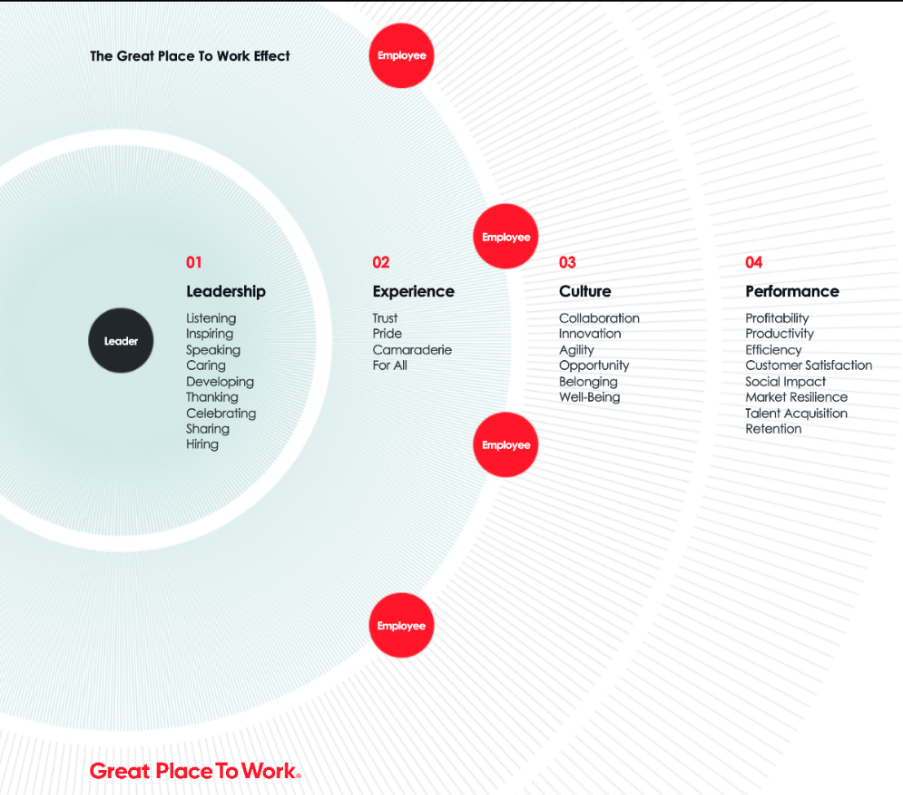
Great Place To Work’s research identifies 9 core leadership behaviors that matter most to employees across India’s workforce: 

  • Hiring & Welcoming: Attracting the right people and ensuring they feel genuinely included and valued from the very first day. 
  • Caring: Being genuinely present for the team, not just operationally available but personally invested in their wellbeing and growth. 
  • Celebrating: Recognizing contributions consistently and making people feel seen and appreciated for their effort and hard work. 
  • Inspiring: Helping colleagues understand how their role connects to larger business goals and a purpose that goes beyond day-to-day tasks. 
  • Speaking: Communicating with clarity and honesty while creating an environment where open dialogue is welcomed, and differing views are never penalized. 
  • Sharing: Using data insights to make fair and transparent decisions so that information flows equitably and people trust the process. 
  • Listening: Genuinely hearing alternative perspectives before acting, making people feel truly understood rather than simply heard. 
  • Developing: Investing in the long-term capability of individuals, building their confidence and readiness to think and execute at scale. 
  • Thanking: Expressing sincere and timely gratitude in ways that reinforce trust, belonging, and a culture where people know their efforts matter. 

Taken together, these are not only soft skills. They are business-critical competencies with a measurable impact on performance, retention, and growth. 

How Do Leadership Skills Directly Impact Business Performance? 

People are the drivers through which every business strategy gets executed. Strategy lives in documents, but execution lives in people. And how people execute depends almost entirely on the leadership environment they work within. 

When Great Place To Work analyzed data across Certified™ and non-certified companies, the gap was quite visible. Employees working at Certified workplaces rate their leadership experience significantly higher, scoring 25% higher than in typical workplaces. That gap does not stay confined to culture surveys. It translates directly into whether employees choose to stay, innovate, adapt, and go the extra mile. 

Employees who experience positive leadership are 61% more likely to intend to stay; compared to just 39% among those who do not. That difference is the business case for leadership development.

The research also reveals a compounding effect. When employees have strong confidence in their leadership’s judgment, 87% show significantly positive responses to AI-related experiences, meaning they are excited about new tools, open to learning, and hopeful about change. Leadership trust does not just retain people; it determines how readily an organization can absorb transformation. 

The impact of leadership is also not uniform across levels. Individual contributors score their leadership experience at 55%. C-level executives score it at 78%. That 23 percent gap is one of the most underappreciated risk factors in Indian organizations today.  

Top Leadership Skills That Drive Business Success 

Across industries and generations, employees share a remarkably consistent picture of what they need from their leaders. The skills below are not aspirational checklists; they are the behaviors that show up in the data as the true drivers of trust, performance, and retention. Understanding them is the first step to building leadership that actually works. 

1. Purpose Alignment 

People do not just want to do their jobs. They want to know why their job matters. The most effective managers are the ones who take time, whether in a quick team to huddle or a one-on-one conversation, to connect everyday work to a bigger picture. When employees understand how their contribution fits into something meaningful, they bring more energy, stay more focused, and push through challenges more willingly. Moreover, employees most frequently identify aligning their work with a clear purpose as the experience that best reflects their current manager.  

2. Empathy and Emotional Intelligence 

Great managers pay attention to people, not just performance. They notice when someone is struggling. They ask the right questions. They create space for honest conversations. This is what empathy looks like in a workplace setting, and it is quite questionable practice as well.  

When employees feel genuinely understood by their manager, they are more likely to speak up early, take initiative, and stay committed even when things get hard. Empathy and emotional intelligence ranked highest at 44% among the qualities that will define great leadership in 2030. 

3. Consistent Recognition and Trust-Building 

A simple thank you at the right moment can do more than a formal reward program. What employees want is to feel seen for their effort, consistently and fairly.  

The problem in many workplaces is not only the absence of recognition but also the inconsistency of it. When some individuals are celebrated while others doing equally good work are overlooked, it quietly damages the trust within a team. Managers who make recognition a regular habit, not an occasional gesture, build teams that genuinely want to give their best. 

4. Strategic Decision-Making 

Employees are not just frustrated by bad decisions. They are frustrated by decisions that feel unclear, unexplained, or disconnected from reality.  

What builds confidence in a leader is not perfection but transparency. When managers communicate clearly about what they decide, why they decide it, and what it means for the team, people feel informed and respected. That clarity is what allows teams to move quickly and execute well without second-guessing every step. 

5. Adaptability 

Things change, plans fall apart, and unexpected challenges come up. What employees remember is how their leader responded. Did they step in or step back? Did they adjust or hold rigidly to a plan that was no longer working?  

Adaptable leaders do not have all the answers but they stay calm, stay present, and help their teams navigate uncertainty without panic. That steadiness is what gives people the confidence to keep going when things get difficult. 

6. Tech Readiness and AI Literacy 

Employees are not just looking for leaders who understand technology. They are looking for leaders who help them feel confident about it. Change brings anxiety, and when a manager is visibly comfortable with new tools and willing to guide the team through them, that anxiety reduces significantly. Leaders who engage openly with technology, including AI, signal to their teams that learning and adapting is safe. That is more empowering than any training program. 

7. Psychological Safety 

When employees do not feel safe to speak up, the best ideas within an organization remain unheard. Psychological safety creates the conditions for honest, productive dialogue at every level. It enables individuals to raise concerns before they escalate, respectfully challenge decisions without fear of repercussion, and acknowledge gaps in knowledge without hesitation.  

Leaders who build this environment do not simply improve team morale. They build organizations that are sharper, more responsive, and better equipped to handle complexity. 

8. Active Listening and Openness 

There is a meaningful difference between a manager who hears what an employee says and one who actually listens to. Active listening means engaging with what is being shared, asking follow-up questions, and being genuinely open to changing course based on what you learn. When employees feel truly heard, they trust their leader more, communicate more honestly, and raise concerns earlier. When they feel ignored, they stop sharing, and organizations lose access to some of their most important signals. 

9. Integrity and Reliability 

At the end of the day, employees want to know they can count on their manager. They want consistency, fairness, and follow-through. They want a leader who says what they mean and means what they say. Integrity is not about being liked. It is about being trustworthy. And in high-pressure environments where change is constant, a reliable and fair manager becomes the anchor that holds a team together. 

How Do These Skills Improve Business Performance?

When employees experience all nine behaviors in combination, the business outcomes are not marginal. They are multiplicative:

Business Outcome Multiplier Effect
More likely to adapt quickly to organizational change 2.3x
More likely to look forward to coming to work 2.3x
More likely to intend to stay long-term 2.1x
More likely to receive innovation opportunities 1.9x
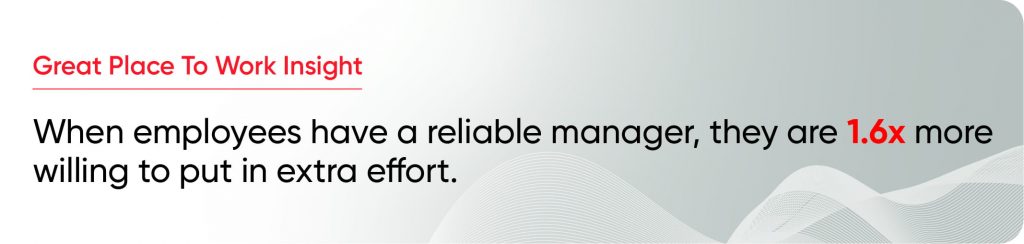
More likely to put in extra effort 1.7x


These outcomes are consistent across IT, BFSI, Retail, Manufacturing, and Pharma, suggesting the relationship between leadership quality and business performance is not industry specific. When employees trust their manager, they communicate openly and problems get caught early. When people feel valued, they keep giving their best without burning out. When leaders create psychological safety, teams take the small risks that lead to real innovation. All of these are the compounds of the above-mentioned business outcome. 

Conclusion 

Leadership skills are not a soft business investment. They are direct drivers of retention, adaptability, innovation, and extra effort. Great Place To Work India’s Voice of India 2025 study and the 9 Leadership Behaviors analysis across six sectors and thousands of companies make this connection explicit and quantifiable. 

The organizations that will outperform in 2026 and beyond are the ones that treat leadership development as seriously as product development or financial planning, with rigor, measurement, iteration, and investment.  

Frequently Asked Questions 

What is the link between strategic thinking and profitability? 

Strategic thinking drives focus on high-value opportunities and faster adaptation, which is a key to executing strategy and improving profitability. 

Can leadership skills improve employee engagement and retention? 

Yes, employees with positive leadership are significantly more likely to stay and remain engaged. 

How does emotional intelligence affect organizational success? 

It builds psychological safety, enabling open feedback, faster problem-solving, and stronger innovation. 

How long does it take to develop strong leadership skills? 

With consistent feedback and coaching, noticeable improvements typically occur within 6 to 12 months.

Every organization wants strong leaders. But the first step starts with getting intentional about building leaders who are future-ready. There are employees who are exceptional in their skills and talent but fail when it comes to leadership roles. Leadership gaps don’t usually come from a lack of talent, they come from a lack of structured development. High performers get promoted, critical talent gets stretched, and suddenly, individuals are expected to lead without ever being prepared for it. The result is inconsistent team experiences, declining trust, and missed business outcomes. 

At Great Place To Work®, one insight consistently stands out. Great workplaces are built by leaders who create high-trust, high-performance environments – not by policies alone. This is why Leadership Development Programs must evolve with changing requirements and trends. They cannot be limited to training sessions or one-time interventions. They must become intentional systems that build leadership capability through experience, exposure, and behaviour. 

What Are Leadership Development Programs? 

The goal of leadership development is to improve an individual’s ability to lead, motivate, and influence people within their team and inside a company. The objective is to develop critical leadership skills including communication, decision-making, emotional intelligence, and strategic thinking. These abilities enable both present and future leaders to effectively manage difficult situations and adjust to changes. 

Leadership development concentrates on the more ethereal traits that characterize exceptional leaders, whereas general management training concentrates on the practical and administrative abilities required to oversee daily operations. It places a strong emphasis on self-awareness, personal development, and the capacity to inspire and empower others.  

Basically, leadership Development Programs are structured approaches organizations use to build leadership capability across levels. But the most effective ones go beyond skill-building. 

They focus on developing: 

  • Decision-making under ambiguity  
  • Ability to influence without authority  
  • Trust-building within teams  
  • Inclusive and fair leadership behaviours  
  • Adaptability in fast-changing environments  

In simple terms, they prepare individuals not just to manage work, but to lead people and culture. 

Why Organizations Need Leadership Development Programs?

Great-place-to-work-india

Organizations that do not invest in leadership development often experience uneven manager effectiveness, lower employee trust, higher attrition among top talent, and reduced innovation and agility. Leadership is the multiplier of culture. Effective leaders steer their groups toward shared objectives, boosting output and effectiveness. They make strategic choices that have the power to influence an organization’s destiny and provide an atmosphere in which employees may flourish. In the end, this enhances an organization’s long-term viability, financial performance, and competitive edge. 

When leaders are strong, teams thrive. When leadership is inconsistent, even the best strategies fail. Therefore, investing in leadership learning and development also guarantees that employees have a greater stake in the success of their company. Even strong Leadership Development Programs help organizations in building a future-ready leadership pipeline, improve employee experience, strengthen culture consistency across teams, and drive sustained business performance. Additionally, leadership development coaching offers focused, individualized advice that helps leaders overcome certain obstacles and accelerate their progress.  

Leadership Development Starts Earlier Than You Think 

One of the biggest mistakes organizations make is starting leadership development too late. Leadership does not begin with a title. It begins when individuals start to: 

  • Take ownership beyond their role  
  • Influence decisions  
  • Collaborate across teams  
  • Step up during uncertainty  

Organizations that build strong leadership pipelines identify these signals early and invest in them. Because by the time someone becomes a manager, their behaviours are already shaped. The goal is to build leadership early. 

Who Should Be Included in Leadership Development Programs? 

Leadership development should be focused, not generic. Here are two group of people who are critical to be included in the leadership development programs: 

1. Next in-Line Leaders 

These are individuals expected to move into leadership roles in the near future based on their existing position in the company. They may already be leading projects, guiding peers, and taking ownership beyond their role. Investing in this group ensures smoother transitions and reduces the risk of ineffective first-time managers. This also ensures that if any of the existing leaders cannot perform their duties, then you’ll always have someone ready to take ownership. At this point, you’ll not have to figure out how to get started because you already have a ready pipeline.  

2. Critical Talent 

This includes high performers and individuals who are difficult to replace. 

You can identify such people if they typically: 

  • Go beyond their role and expectations 
  • Deliver strong business outcomes  
  • Hold key institutional knowledge 
  • Influence team performance  
  • Take ownership of a team project 

It is even more important to develop this group because if not done effectively, they might become disengaged or exit. But if developed well, they become the next generation of leaders.

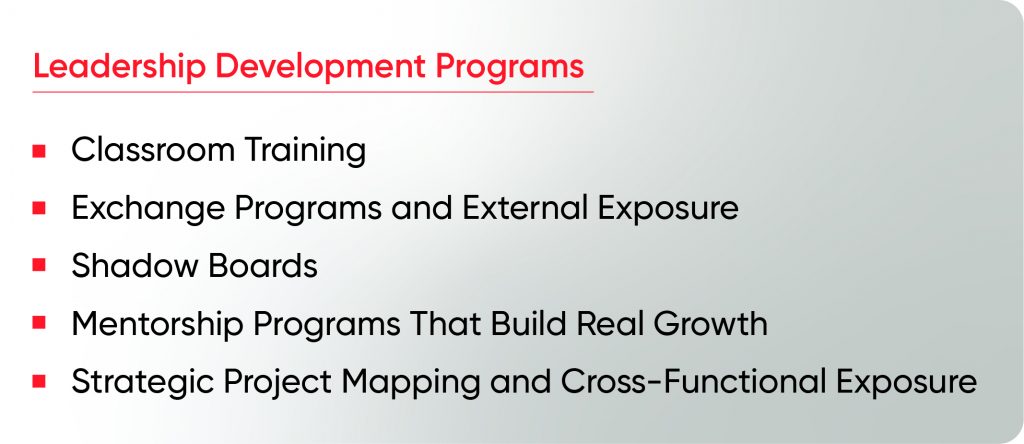
Top 5 Leadership Development Programs That Actually Work

Leadership development programs

The most effective Leadership Development Programs are not standalone initiatives. They are built through a combination of learning, exposure, and real-world responsibility. 

1. Classroom Training  

Classroom training still has a role, but only when it goes beyond theory. This is the most traditional kind of training program that not only provides knowledge but also changes behaviour. These are structured meetings focused on roles, responsibilities, strategic thinking, and emotional intelligence of an individual. Now, these sessions can be conducted in different forms and capacities.  

a. Tie-ups with External Programs (Sending People Out) 

Organizations can partner with institutions or curated learning experiences to expose employees to: 

  • New perspectives  
  • Structured leadership frameworks  
  • Cross-industry insights  

Employees are made aware of the industry’s best practices, structures framework, and a lot of other things that they can take back to their organization and implement in phases. Here, the real value does not lie in attending the sessions but in the post-learning application.  

b. Bringing in External Experts  

The other form of classroom can be inviting external experts into the organization, which allows learning to be: 

  • Contextual to business challenges  
  • Scalable across teams  
  • Interactive and discussion-led  

The major benefit of this form of training is that your employees will be able to gain outside perspective and knowledge. This will prepare them to deal with industry-related concerns.  

c. Focus on Behavioural Capabilities 

Modern leadership is behavioural, not just technical. Leadership today is about managing complexity, not just executing plans. The programs do not only focus on the skills required by an individual based on his or her job roles, but also on other basic skills that are required for leadership, such as: 

  • Agility – navigating constant change  
  • Resilience – sustaining performance under pressure  
  • AI-readiness – understanding how technology impacts decisions and teams  

2. Exchange Programs and External Exposure 

Leadership expands with exposure. Building a healthy pipeline requires exposure beyond your internal practices. Learning from experiencing how other people and organizations operate can lead to a different perception for your people, and this is how a company grows.  

a. Attending External Events 

Encouraging employees to attend industry events helps them understand emerging trends, learn from peers, and build external networks.  This exposure often translates into fresh ideas internally. 

Also Read: How Levels of Leadership Shape Workplace Culture

Great Place To Work is committed to bringing these experiences to you in the form of our biggest event, For All Summit, which takes place every year in February. Not only this, but we also conduct The Great Connects in different cities like Pune, Bangalore, Chennai, Delhi, and Ahmedabad to make networking more accessible for you.  

b. Sending Employees as Speakers 

This is a powerful leadership accelerator. When employees represent the organization externally, they build confidence, refine their thinking, and develop executive presence. It also signals trust, which in itself builds leadership behaviour. 

3. Shadow Boards  

A shadow board is a group of high-potential employees who work alongside senior leadership. This is one of the most impactful leadership development programs. The loop starts with identifying critical talent and bringing them into important conversations. 

By involving employees in key meetings, organizations enable them to understand strategic decision-making, see real business challenges, and contribute fresh perspectives. This is leadership development in its most authentic form, which is not simulated, not theoretical, but real. 

4. Mentorship Programs That Build Real Growth 

Mentorship programs are often practiced and seen as real growth builders. Companies often implement such programs but rarely optimize them to achieve the best outcome. 

a. Relatable Mentors and Coaches 

Before scheduling any mentorship program, the organization must decide on the group of people who will attend this program and what the intended outcome is. For example, if most of the people who’ll be attending this program are from the sales and marketing department, then the mentor should be a chief marketing officer or someone who has already served in a higher position in marketing. This is crucial because effective mentorship depends on alignment. Similarly, if the group attending the session is leaders from across the organization, then the mentor can be someone who can help them with critical thinking and decision making. The brownie point will be if he has worked in diverse industries at different positions, so that he is capable of guiding the people of different departments.

Also Read: What Great Managers Do Differently?

Moreover, a mentor should be approachable, experienced in relevant challenges, and capable of providing honest and actionable feedback. This could include internal leaders or external coaches. 

b. Combining Mentorship with Coaching 

Mentorship provides direction, and coaching builds self-awareness. Together, they help individuals reflect on behaviors, improve decision-making, and grow consistently over time. Leadership can’t be taught; it can be developed through reflection and feedback.   

5. Strategic Project Mapping and Cross-Functional Exposure 

Nothing builds leadership like responsibility. High-potential employees can be mapped to strategic initiatives, cross-functional projects, and business-critical challenges. This helps them understand the organization holistically, collaborate across teams, and make decisions with broader impact. This is where leadership capability becomes visible. Because leadership is not learned in isolation, it is learned through everyday action. 

What Makes Leadership Development Programs Truly Effective? 

Many organizations implement some of these initiatives. But effectiveness depends on how they are connected. Strong leadership development programs are: 

Continuous 

Leadership is built over time, not in isolated sessions. Therefore, one session will not do the needful; you’ll have to plan a series of sessions, which can be a mix of the above-mentioned programs as per your requirement.  

Experience-Led 

Real-world exposure matters more than theoretical knowledge. Therefore, you should consider external exposure and exchange programs as part of your L&D strategy for leaders.  

Behaviour-Focused 

Leadership is about how individuals show up, not just what they know. These training programs will not focus on an individual’s specific skill sets but on overall behaviour.     

Aligned with Culture 

Leadership development must reflect the organization’s values and expectations. Such programs should be designed to align with the organization’s culture because leaders are also culture makers.  

Reinforcing Leadership Through Recognition 

Leadership development does not end with programs. It is reinforced through everyday behaviours. Leaders repeat what organizations recognize. When behaviours such as: 

  • Inclusion  
  • Collaboration  
  • Ownership  
  • Innovation  

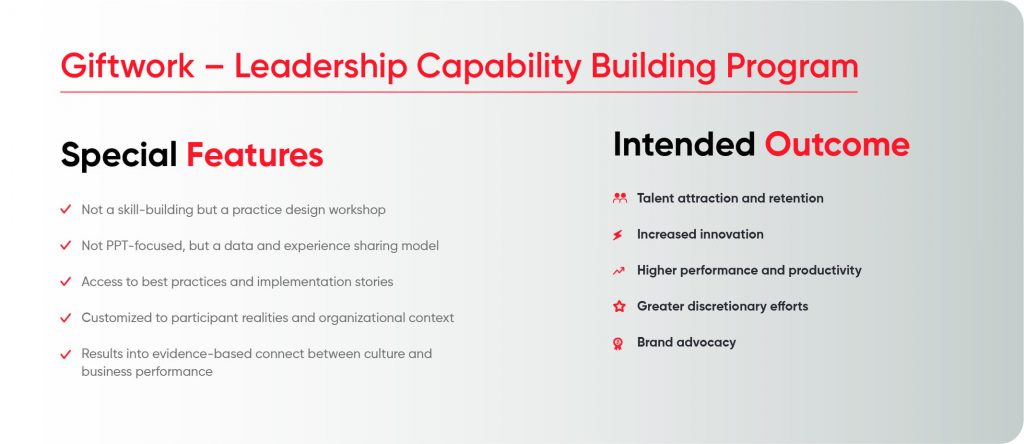
are consistently recognized, they become embedded in culture. This is where leadership capability-building programs like Giftwork® play a critical role. By enabling real-time, value-based recognition, organizations can reinforce leadership behaviours at scale, build a culture of appreciation, and make leadership visible across levels. Because leadership is not just developed in structured programs. It is strengthened in everyday moments.

leadership-building-capability-program

Conclusion 

Leadership development programs that actually work are not about sending employees to training. They are about building an ecosystem where leadership can grow. Organizations that succeed are the ones that identify potential early, provide meaningful exposure, create opportunities to lead, and reinforce the right behaviours consistently. Because leadership is not created overnight, it is built through experience, trust, and culture. 

Therefore, organizations that invest in building leaders don’t just strengthen their pipelines. They build great workplaces where people and performance thrive together. 

Frequently Asked Questions 

1. What are Leadership Development Programs? 

They are structured initiatives designed to build leadership capability, behaviour, and mindset within an organization. 

2. Who should be part of Leadership Development Programs? 

Next-in-line managers and high-potential critical talent should be prioritized for leadership development programs. 

3. What makes leadership development effective? 

In order to ensure the effectiveness of leadership development, there should be a combination of learning, real-world exposure, mentorship, and continuous feedback. 

4. How can organizations build future leaders internally? 

Future-ready leaders can be built by providing structured opportunities, strategic exposure, and reinforcing leadership behaviours through culture.

In today’s competitive world, businesses are looking for ways to gain a competitive advantage over others. One way to do that is with inclusive leadership. Until a few years back, inclusivity in the workplace was a good-to-have factor that most companies showed insincerity to.  

However, in today’s world, DEIB (Diversity, Equity, Inclusion, and Belonging) forms the foundation of growth and profitability for businesses. As per the report on the State of DEIB in 2025, ‘Organizations are moving beyond symbolic actions toward structural change, prioritizing fairness in access and opportunity. Data from our Great Place To Work® Voice of CHRO survey suggests that 64% of CHROs report a strong sense of belonging across their organizations, signaling a shift toward cultures of equity, inclusion, and shared growth.’  

The Great Place to Work® team works with its customers to understand where an organization stands on DEIB initiatives and helps them implement the right measures.

What Does Inclusive Leadership Mean? 

Inclusive leadership is a proactive approach that ensures diversity is part of the organization’s DNA. With a top-down approach, an inclusive leader helps all team members, regardless of gender, orientation, age, disability, or other factors, feel respected, valued, and included. They ensure that all voices are heard, an atmosphere of encouraging inputs is maintained, and that diverse perspectives are welcomed.  

To be effective and inculcate a culture of inclusivity at every level, an inclusive leader will display the following traits: 

  • Committed to inclusivity: As a leader, the inclusive leader will actively and consciously demonstrate their commitment to making inclusivity a priority. 
  • Courage to question: Inclusive leadership will need leaders who dare to question what is happening, examine the status quo, and hold themselves responsible, where required. 
  • Recognize bias: An inclusive leader will evaluate their personal biases, study organizational biases, and work to create processes to mitigate them. 
  • Be voraciously curious: Inclusive leadership is based on curiosity, open-minded listening, and seeking input from all levels of the organization. 
  • Culturally aware: Building on their curiosity to learn about others, an inclusive leader will learn about other cultures and show sensitivity in situations involving cross-cultural interactions. 
  • Collaborate continuously: As an inclusive leader, it is crucial to collaborate with others and encourage teams across the organization to do the same. 

Inclusive leadership brings a host of benefits that influence both short and long-term aspects of a business.  

Improved employee commitment 

Employees are more committed to the organization when they feel accepted, included, and valued. Inclusive leaders ensure they listen to employees’ input without bias, accept suggestions, and appreciate their work. This results in improved productivity, reduced absenteeism, and better retention rates. 

Inclusive and better decision-making 

When an inclusive leader leads a team, team members are likely to feel comfortable enough to share their unique perspectives. This, in turn, results in informed decisions, out-of-the-box solutions, and better business outcomes.  

Innovative approach to problem-solving 

People from different backgrounds, ages, and experiences approach the same issue from different angles, which can lead to unique solutions to business problems. Inclusive leadership encourages people to be innovative and to develop diverse solutions that benefit the organization. 

Positive impact on the company’s image 

A company that is truly committed to inclusive leadership is more likely to launch new products, move into new territories, and offer unique solutions to existing problems. By doing so, the company will gain a reputation for offering excellent products or services and for being an excellent employer, attracting customers and top talent.  

Enhanced financial performance 

Businesses with inclusive cultures often have a stronger presence in the market and can keep up with changing market needs. As a result, they often see an uptick in revenue, a consistent increase in market share, and improved customer satisfaction.  

How Does Inclusive Leadership Encourage Innovation? 

The foundation of innovation in any field is the ability to develop diverse approaches, and inclusive leadership lays the groundwork to enable this. Inclusive leadership encourages people at all levels and from all backgrounds to think differently and contribute their input.  

When this happens, innovation results as employees have the freedom to challenge the status quo, seek new opportunities, and offer creative solutions.  

With inclusive leadership at all levels, the company can ensure that: 

  • Ideas are not limited to a particular department or hierarchy 
  • Employees feel secure enough to share their ideas and take risks 
  • People have the wherewithal to collaborate across the organization 

Inclusive leadership weaves innovation and participation into the organization’s culture rather than treating them as forced initiatives. Different levels of leadership shape workplace culture in different ways. 

What Are the Best Practices to Build Inclusive Leadership? 

The culture of an organization permeates from the leadership level to the rest of the organization, and the best practices for building a culture of inclusive leadership start at the top. 

Emotional intelligence workshops 

Set up and offer emotional intelligence workshops to people at various levels. Work on aspects like active listening, recognizing unconscious bias, and inclusive communication. Running workshops like this regularly, or gamifying these concepts, will help people work toward becoming more inclusive. 

Create safe channels 

Employees are often not forthcoming about their ideas and feedback because they fear rejection, repercussions, or mockery. Ensure that your company has safe spaces, people, and channels where people can offer their input. Allow people to acknowledge and learn from their mistakes as required. 

Inclusive decision-making 

Inviting diverse perspectives, encouraging participation, and removing barriers, such as hierarchy in decision-making are great ways to ensure inclusive leadership. 

Feedback loops 

Check the pulse of employees through regular surveys and town hall sessions to encourage people to share their feedback. Collate the feedback, pinpoint the aspects to be implemented, and share it with the larger team. 

Rewards and recognition 

Establish a rewards program to recognize people who have offered unique perspectives that have resulted in success. Recognize contributions both at the individual and team levels.

Impact Measure Importance
Brand perception Employee and customer surveys Helps in talent retention and improving Lifetime Customer Value (LCV)
Innovation and product launches Product feedback and customer complaints Offers insights into where the company is lagging and areas for improvement.
People outcomes A mix of people from different backgrounds, and how well they feel supported Talent acquisition and ensuring that performance is on the uptick

How to Leverage the Benefits of Inclusive Leadership?

In conclusion, businesses need to realize that inclusive leadership is not an option but a critical aspect of their growth strategy. It is about ensuring that people from all walks of life feel valued, secure, and motivated to perform at their best. At Great Place To Work, the team helps companies transform their culture with culture consulting services.  

Want to know how to take this forward? Click here to connect with us 

Frequently Asked Questions

Why is inclusive leadership crucial for the growth of a business?

Inclusive leadership makes it easier for a company to attract and retain the top talent in the industry, meet customer expectations, offer innovative products, and maintain a good public image.

What is the first step to becoming an inclusive organization?

The first step to becoming inclusive is recognizing and acknowledging that talent is not limited to a particular age, gender, or type of person. Making it part of your company policy to accommodate people from all walks of life based on their talents or skills, and to offer them a good working environment, also helps.

How does inclusive leadership help us become profitable? 

  1.  

With inclusive leadership, the company becomes more innovative, solves problems, and ensures continuity. This, in turn, lowers costs, expands the customer base, and builds a positive market reputation, making the company profitable.

Whose responsibility is ensuring inclusive leadership? 

  1.  

While the process of ensuring inclusive leadership starts at the top, it is the responsibility of everyone in the organization to ensure an inclusive environment.  

Is inclusive leadership a one-time exercise or a continuous process? 

  1.  

Inclusive leadership is a continuous process in which every member of the organization commits to working hard to overcome biases and become more inclusive.


A Great Place To Work® For All™ should also have great managers for all. Managers bridge the gap between the operational team and the executive team. The outcome and efficiency of any project depend on the leader. Leadership influences far more than decisions, targets, or team structure. It shapes how people feel at work, how much trust they place in their managers, whether they stay, innovate, collaborate, or just work for the sake of it. All of this, ultimately, comes down to whether a workplace is truly great.

Based on research covering 75,000 employees and more than 10,000 managers across industries, Great Place To Work has identified five distinct leadership levels that directly influence employee experience, trust, retention, productivity, and innovation. The findings are clear: when leaders level up, workplace culture improves at every stage.

Why Is It Important for You to Understand the Levels of Leadership?

At Great Place To Work, our research consistently shows that leadership behaviour is later reflected in the company’s culture. Becoming a great workplace doesn’t happen only because of the right policies, but rather it is a result of how leaders communicate with their team, involve them in decision-making, recognize their efforts, and create fairness in everyday work. This is why understanding the levels of leadership matters for every organization. Because when you’re aware of the levels of leadership, only then will you be able to become a better version of yourself and reach the next level. The first thing that matters here for you is to understand where you stand today and take a step ahead to reach the highest level.

What Are the 5 Levels of Leadership?

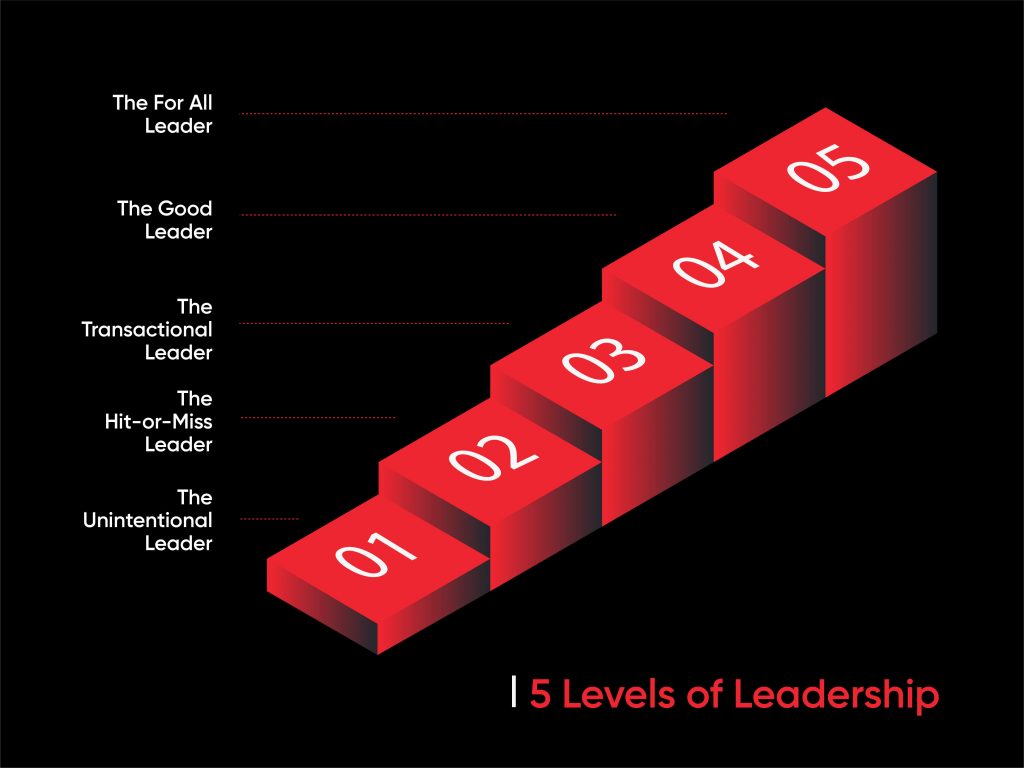
The levels of leadership describe how leadership behaviors evolve from inconsistent people management to culture-building leadership that creates a great workplace for all.

The five levels are:

5 Levels of leadership

Each level reflects how leadership behavior affects employee trust, inclusion, and performance. What makes this framework powerful is that leadership does not stay static. Leaders can move from one level to the next through intentional behavior changes.

Why Levels of Leadership Matter in Workplace Culture?

Many organizations focus on leadership as a capability. Great workplaces treat leadership as a culture multiplier. Our research shows that moving across the levels of leadership creates measurable business impact. Compared with employees working under a Level 1 leader, employees with a Level 5 leader demonstrate:

  • 353% higher productivity
  • 300% greater agility
  • 325% greater readiness to innovate
  • 128% greater desire to stay

This means leadership quality is not only a human issue. It is directly linked to business performance. The strongest workplace cultures are built when leaders consistently create trust, clarity, fairness, and belonging.

What Are the Levels of Leadership?

Even leadership has levels based on a leader’s behavior or way of working. Let’s understand the five levels of leadership:

Level 1: The Unintentional Leader

When leadership lacks awareness, culture weakens quickly. The first of the five levels of leadership is the Unintentional Leader. This leader often does not realize how their behavior affects others. The issue is not always poor intent, but lack of awareness, poor people skills, or failure to adapt to leadership responsibilities. Employees under this type of leader often feel uncertain, unsupported, and emotionally disconnected.

Common signs include:

  • Withholding information
  • Taking credit for work done by others
  • Criticizing people personally
  • Raising voice under pressure
  • Failing to act on feedback

In this environment, trust declines quickly. Even employees with an Unintentional Leader do not consistently experience a positive workplace. At this level, leadership creates friction instead of confidence. And, the cultural impact can be seen as:

  • Lower motivation
  • Higher voluntary turnover
  • Reduced teamwork
  • Minimal discretionary effort

Level 2: The Hit-or-Miss Leader 

Inconsistency creates uncertainty. A leader should be a leader for all and not just an ideal for a few. The second stage in the levels of leadership is the Hit-or-Miss Leader. This leader is not consistently ineffective, but they are not reliably supportive either. Some employees may experience encouragement, while others feel ignored or excluded. This inconsistency often appears through: 

  • Favoritism
  • Uneven communication
  • Limited accountability
  • Selective support
  • Avoiding difficult leadership moments 

Employees often describe this leadership style as unpredictable. Some days, the leader is available and helpful. On others, they are distant or disengaged. This creates uncertainty inside teams because employees are never fully sure what to expect.

The cultural consequence is reduced cooperation. Employees under this leadership level are less likely to experience strong trust across teams because fairness feels uneven. 

Level 3: The Transactional Leader 

Performance improves, but engagement stays limited. The third of the five levels of leadership is the Transactional Leader. This leader gets work done. They focus on delivery, targets, and execution. They usually perform well operationally, but leadership remains task-centered rather than people-centered. Typical behaviors include: 

  • Prioritizing output over conversation 
  • Giving instructions more than listening 
  • Limited emotional connection 
  • Low personal engagement with employees 

Employees often describe these leaders as efficient but distant. They are more involved in deliveries and less involved in connections. The culture under transactional leadership is functional but rarely energizing. A majority of employees here feel positive about work, yet innovation remains limited because people do not always feel encouraged to think beyond immediate tasks. Compared with higher leadership levels, teams led this way are significantly less likely to innovate because ideas do not always flow upward. This is often where many organizations plateau: work happens, but culture does not fully thrive. 

Level 4: The Good Leader 

Trust becomes stronger, and retention improves. At Level 4, leadership begins to actively strengthen workplace culture. A Good Leader is consistent, fair, approachable, and supportive. 

Employees often say, “I stay because of my manager.” This level of leadership usually includes: 

  • Clear expectations 
  • Career support 
  • Fair treatment 
  • Openness to discussion 
  • Mentoring employees 

Employees trust these leaders because they feel heard and respected. This directly improves retention. Research shows that employees with a good leader report a positive workplace experience. Yet even strong leadership at this level still has room to grow. The difference between a good leader and a truly culture-shaping leader is breadth. A good leader often builds strong team trust but may still not fully connect people to the larger organizational purposes. 

Level 5: The For All™ Leader 

The highest level of leadership builds a great workplace for all. The highest of the five levels of leadership is the For All Leader. This is where leadership turns into culture-building. For All Leaders create environments where nearly every employee experiences fairness, dignity, trust, and belonging. What makes this leadership level distinct is that people do not simply work under the leader; they grow because of the leader. These leaders: 

  • Lead with humility 
  • Invite input across teams 
  • Share credit openly 
  • Create fairness in decisions 
  • Help people succeed without seeking personal visibility 

 They are trusted because employees see them as competent, honest, and reliable. They also create stronger collaboration beyond individual teams. This leadership level reflects the core Great Place To Work perspective: great leadership is not about authority alone, but about helping every employee do their best work.

The 5 Leadership Behaviours That Shape Great Workplace Culture

Across all levels of leadership, five leadership behaviours consistently determine whether culture improves or weakens.

1. Involving people in decisions

Employees trust leaders more when they are invited into decisions that affect their work. The strongest leaders actively seek input rather than assuming they already have the best answer.

2. Recognizing people meaningfully

Recognition is not only about praise. It includes acknowledging contributions, helping people progress, and making efforts visible.

3. Being someone people want to follow

Employees stay engaged when leaders are seen as competent, honest, and dependable. Credibility matters more than authority.

4. Creating fairness across tea

The strongest cultures reduce favoritism and create consistency in opportunity, communication, and respect.

5. Helping people connect their work to a bigger purpose

People engage more deeply when they understand why their work matters beyond immediate tasks.

How Leaders Move Up Across the Levels of Leadership?

Leadership growth does not happen through title changes. It happens through daily habits. Small improvements make a visible difference.

For example, a Level 2 leader who communicates more consistently and reduces favoritism can move toward Level 3. A Level 3 leader who listens more and builds stronger human connections can move toward Level 4. Similarly, a Level 4 leader who expands fairness, purpose, and inclusion across all teams can become a Level 5 leader.

This matters because even one leadership-level improvement creates measurable gains in trust, productivity, and retention.

Great Workplace Culture Begins With Leadership That Includes Everyone

Organizations often invest heavily in engagement programs, recognition platforms, and culture initiatives. But leadership remains the strongest culture signal employees experience every day. The real difference between average workplaces and great workplaces is not whether leaders manage well. It is whether leaders create conditions where every employee can contribute, trust, and grow. That is what the highest levels of leadership make possible.

Frequently Asked Questions

What are the five levels of leadership?

The five levels are Unintentional Leader, Hit-or-Miss Leader, Transactional Leader, Good Leader, and For All™ Leader. Each level reflects a leader’s behaviour towards their team and how that affects the business.

Why are leadership levels important?

Leadership levels matter because they influence some very important aspects of a business, such as workplace culture, employee trust, and business outcomes, which in turn lead to productivity and retention.

Which level of leadership is most effective?

The most effective level is Level 5: The For All™ Leader. These leaders create fairness, trust, and belonging for everyone. They go beyond managing tasks to building a culture where every employee can grow and feel connected.

How do leadership levels affect employee engagement?

Leadership levels shape how employees feel at work. At lower levels, employees often experience uncertainty and low trust, which reduces engagement. At higher levels, leaders create fairness, recognition, and purpose, which significantly boost engagement.

How do leaders reach the next level?

Leaders move up by adopting intentional behaviors. For example, improving communication, reducing favoritism, and building trust can move a leader from Level 2 to Level 3. Consistently involving employees, recognizing contributions, and creating fairness help leaders progress toward Level 5.

India’s business dynamic is undergoing swift progression, where CEOs are not only defining the market trends but also structuring an impactful corporate landscape. As CEOs, our roles have a measurable impact on leadership, experience, culture, and performance. Leaders of Best Workplaces are consistently navigating a cultural direction from Influence to Impact, leveraging the globally acknowledged Great Place To Work Effect framework that is noteworthy:

The Great Place To Work Effect:

The Great Place To Work Effect

The Great Place To Work Effect is the positive transformation that occurs when leaders prioritize and create great workplace experiences for employees. Structuring a workplace culture fuelled by the Great Place to Work Effect yields pronounced outcomes, including enhanced employee productivity, business performance, customer satisfaction, and social impact. The roadmap begins with the 9 leadership behaviors, which pivot to creating a great employee experience, thereby shaping workplace culture and ultimately driving performance. Traits of great leadership cultivate trust, pride, and camaraderie For All, which boosts the employee experience throughout their journey. According to the latest Great Place To Work® Data, 62% of employees at Best Workplaces across industries demonstrate greater confidence in their leaders compared to 53% at other workplaces. This asserts the crucial role of trustworthy, transparent leadership in a high-trust culture.

Purpose-driven leadership for sustainable impact:

Leaders who consistently practice and embody organizational values play a key role in establishing trust within their organizations. The Great Place To Work Effect is a research-based framework that substantiates how trust-based leadership influences various aspects of business performance, specifically profitability, efficiency, social impact, market resilience, talent acquisition, and retention.

Trusting in Best Workplaces delivers 3X returns

The latest RSM study reveals that the Best Workplaces outperform the stock market by 3 times. The study measures the stock market returns calculated from FY 2007-2008 to 2024, highlighting that the shareholders’ investment in India’s Best Companies To Work For has yielded 14X returns on the initial investment, outperforming the bullion and major stock indices by a factor of more than 3. This is the power of culture that shapes profitability, all of which is strengthened by 9 leadership behaviors.

Great Place To Work Internal Graphs - Best Companies outperform major stock indices by providing more than 3x returns

Nine Leadership behaviors architecting the future:

Whether the outcome is to increase utilization, boost productivity, or enhance shareholder returns, our Best Workplaces leaders define what success looks like. Great Place To Work® research defines nine key leadership behaviors that create a high-trust culture. Leaders play a crucial role in shaping the employee experience, everyday interactions, and collaboration throughout the organization. Best Workplaces is where employees feel heard, belong, valued, inspired, and empowered. The nine leadership behaviors ensure:

  1. Listening: Great leaders are proactive listeners. They encourage feedback and are all ears to their team’s concerns and ideas. This conveys humility and empathy, radiating a sense of psychological safety where employees feel comfortable sharing their perspectives.
  2. Inspiring: Inspiration is a driving force that motivates everybody towards a common goal. Leaders can inspire others by becoming compelling storytellers, active listeners, and astute observers. Your vision can inspire your workforce. Set clarity in the objectives of the work and share the mission behind it. Align your employees’ work with the company’s higher purposes.
  3. Speaking: Speaking with clarity and having mindful communication builds trust. Regular connects, town halls, Q&A sessions, and one-on-one interactions are all forms of two-way communication that create a sense of accessibility and reliability.
  4. Caring: People care for their work when they receive the same care from the workplace. Showing genuine care for your team’s well-being builds trust and loyalty. Assisting during challenging times, promoting work-life balance, and being flexible when required highlight that the company values its employees as people.
  5. Developing: It is the responsibility of leaders to help employees grow as people and not just performers. Employees must feel that they matter. Relevant opportunities for upskilling, a comprehensive approach to development and training, constructive and regular feedback, and individualized learning plans – all while being empathetic – make way for a prolonged culture of development.
  6. Thanking: Small acts of gratitude nurture a culture of appreciation. Being thankful is the lasting gesture leaders of Great Workplaces create upon others. Sending personal notes, giving rewards, acknowledging the efforts of their team, and even appreciating mistakes as a part of learning – work wonders.
  7. Celebrating: Celebrating milestones and achievements sends a clear message to all the employees that their work and time are valued and appreciated. This further motivates them to cater to more milestones. Best Workplace leaders always make time to celebrate, reward, acknowledge, and recognize everyone’s efforts.
  8. Sharing: The equitable distribution of profits, compensation, bonuses, and resources fosters a sense of inclusion and belonging. However, it starts with a clear and shared understanding of the compensation and rewards philosophy and establishing a fair and equitable experience within the organization.
  9. Hiring: As leaders, it is important that we hire for attitude and value alignment, and not just skills. It is equally important to create a welcoming environment for people joining the organization. Most organizations are struggling with early attrition of new joiners. Creating the right environment and proving support will help enhance the overall experience of employees.

The future of corporate dynamics and business belongs to Best Workplace leaders who can assuredly and responsibly create a lasting impact, from a worthwhile influence. The purpose-driven Great Place To Work Effect, which spans leadership, experience, and cultural experience, ultimately leads to greater performance – where each aspect complements and shapes the others. And that’s how the architecture is framed with leadership behaviors, the right direction, and the Great Place To Work Effect.

The Pharmaceutical, Healthcare, and Biotech (PHB) industry is expanding swiftly, bringing its share of opportunities and challenges. That’s why it is necessary to pay attention to leadership, innovative practices, and employee engagement. By bridging the gap between organizational intent and employee sentiment, we can create a more people-centric culture that fosters positive people practices and encourages innovation across the board. In this blog, we’ll explore these topics in depth and share insights on creating a culture of innovation in the PHB industry.

How to Overcome Challenges in Pharmaceutical Industry?

Here are a few things that will help the organizations overcome the challenges in pharmaceutical industry:

Leadership Effectiveness

For any industry to thrive, leadership effectiveness is an essential component. To foster an environment of trust and engagement among employees, leaders must prioritize building genuine connections with their team, ensuring clear and effective communication. Leaders can achieve this by being approachable and showing genuine concern for the well-being of the team; while also, clearly communicating the organization’s vision and providing a clear roadmap to achieving the goals.

Organizations should explore leaders from varied backgrounds to truly maximize human potential, and improve employee engagement. From our recent study, leaders at the Best Workplaces in PHB ensure effective communication through all channels, including top-down, bottom-up, and candid communication. Not only do these leaders ensure they “walk the talk” by delivering on promises and actions matching their words, but also focus on hiring, the fitment of employees, and overall development. By focusing on proficiency and genuinely fulfilling unmet needs, leaders in the industry are taking a step toward building trust.

Employee Expectations

According to our recent study, there is a disconnect between employee expectations and the experience delivered by employers in the PHB industries. To bridge this gap and become more people-centric, organizations must listen to their employees more and implement changes accordingly.

Real-time employee listening and delivering feedback is key to creating a framework for a great workplace. A great workplace is built on the foundation of trust and embeds meaningful values and effective leadership. This allows the organization to maximize its human potential and foster innovation For All™. Trust is the fuel that powers performance, and the trust levels of employees are determined by the quality of their experience, which is generated through the right people practices.

Also Read: India’s Best Workplaces in Pharmaceuticals, Healthcare and Biotech 2025

Unfortunately, organizations in the PHB industry have sub-optimal levels of practices in all aspects. To improve employee engagement, overcome challenges in pharmaceutical industry and create a positive experience, organizations need to develop effective practices that show greater intent to employees. By focusing on trust, values, and effective leadership, organizations can create a great workplace culture that leads to financial growth.

Innovation Experience

Innovation is the key to success in the PHB industry, but it’s not always easy to achieve. Organizations need to focus on creating individual inspiration and organization-connect toward innovation. This can be achieved through effective practices and greater opportunities.

According to our recent study, employees in the PHB industry report the least positive experience in a culture of innovation due to a lack of innovation opportunities. The PHB industry shows maximum intent with practices focused on innovation, but employee experience is the lowest.

To improve this, organizations need to devise more and better practices as the first step and then disseminate them to employees for a better experience. By creating a culture of “Innovation by All” organizations can foster a sense of hyper-motivation and pride in the workplace. This culture is critical for sustenance and enduring success. An intentional 2-way conversation helps celebrate innovation at work and provides opportunities for developing new and better ways of doing things.

Also Read: 5 Platforms to Showcase Your Certification Badge

To build and sustain a culture of innovation, management needs to genuinely seek ideas and suggestions from employees and then act on them. This can be achieved through organizational connection, where management involves people in decision-making.

The way forward for the PHB industry is to bring the workplace culture to center stage. The industry needs to focus on fairness and managaement credibility to reduce the gap between the PHB industry and other industries in India. Compared to the previous year, organizations have managed to deliver positive growth in creating a safe place to work. However, amongst all aspects, the maximum decline is seen in fairness, followed by pay/benefits and credibility.

By addressing these areas, the industry can improve employee engagement and create a more positive and innovative work culture.

To conclude, the best workplaces in the PHB industry are leading the movement in all three aspects: quality of practices, employee experience, and culture of innovation. On average, the best workplaces score 25% higher on quality of practices and 5% more on employee experience. These organizations set the standard for the rest of the industry. This serves as a model for creating a positive and innovative work culture leading to sustainable success.

Frequently Asked Questions

1. What are the biggest challenges in the pharmaceutical industry today?

Regulatory compliance, talent shortages, and innovation gaps are the major challenges impacting growth and competitiveness in the pharmaceutical industry.

2. How can pharma companies improve employee engagement?

Pharmaceutical companies can enhance employee engagement by fostering trust, actively listening to employees, and establishing transparent communication channels.

3. Why is innovation important in the pharmaceutical sector?

Innovation drives drug development, operational efficiency, and long-term sustainability in a highly competitive market.

4. What role does leadership play in overcoming challenges in the pharmaceutical industry?

Effective leadership fosters trust, clear communication, and employee engagement, which are essential for navigating regulatory, operational, and innovation challenges in the industry.

Key trends include digital transformation, personalized medicine, increased focus on workplace culture, and the integration of AI in drug development and operations.

With over 3 million registered organisations serving more than 200 million people, the Indian NGO sector contributes approximately ₹3.56 lakh crore (around 2% of GDP) to the national economy. The industry is a powerhouse of social transformation, employing 2.7 million people and engaging 3.4 million full-time volunteers who work diligently to drive change in education, healthcare, environment, human rights, and social equity.  

However, to be successful in today’s world, NGOs must focus on several key areas. They need to attract purpose-driven talent and demonstrate credibility and strong governance. Additionally, they must show innovation and agility in complex, resource-constrained environments. Emphasizing positive volunteer experiences has become crucial, as has advocating for justice and inclusion. NGOs should also create succession pipelines and demonstrate resilience during times of crisis.

Thus, NGOs, being a people-powered business, for a sustained, massive-scale impact on the economy, it’s fundamental for them to consistently create great workplace experiences.

What Sets the Best Workplaces Apart?

Workplaces that cultivate great cultures outperform the market and competition on nearly every business metric, regardless of size, industry, or geography. According to Great Place To Work® India’s Best NGOs To Work For 2025, the difference between the Best Workplaces™ and the Other Workplaces is significant. Best Workplaces outperform others in multiple dimensions, including productivity, recruitment, retention, customer service, and agility. The key differentiator behind this performance edge is leadership. The most critical factors influencing employees’ experience in an organisation are the leadership behaviours that ultimately decide whether employees experience high trust levels and contribute their best.

Top Three Leadership Practices NGOs Must Prioritize

Based on the learnings from Best Workplaces, below are the top three leadership practices that NGOs must prioritise to create great workplaces and achieve long-term impact.

  1. Focus on Fair remuneration and financial recognition 

Fair compensation has long been a sensitive issue in the nonprofit sector. As NGO’s struggle with budget limitations while requiring high-quality talent, fair compensation remains an unresolved subject in the non-profit space. A study by CSIP at Ashoka University observed that NGO pay is 58% lower than general industry benchmarks. This gap not only reflects a financial challenge but also a cultural one. When employees consistently feel undervalued in monetary terms, morale drops, and turnover rises. However, a positive experience around it creates a powerful signal of value, trust, and fairness. 

Great Place To Work India data reveals that in NGOs: 

  • 25% of employees feel their contributions are not recognised through shared financial benefits.
  • 20% of employees report that their pay is unfair for the work they do.
  • Fair compensation and the presence of shared financial benefits boost long-term retention by 28%.
  • 80% of employees in Best Workplaces believe that they get a fair share of profits compared to 70% at other workplaces.
  • 83% employees at Best Workplaces say they are paid fairly for their work, while only 74% feel the same in the Other Workplaces.

A lack of positive experiences around fair compensation in NGOs may translate into a risk of losing their most talented staff to other industries or international organisations that offer more competitive pay. More importantly, inequities in pay strain credibility both internally among employees and externally with stakeholders. 

Sustainability in the nonprofit sector isn’t just about financial resources; it’s also about sustaining human capital. Failing to address compensation gaps undermines the long-term success of the mission of non-profit organisations. 

Leadership To Dos

Leaders in NGOs must rethink their approach to compensation by: 

  • Benchmarking salaries regularly against industry standards to stay competitive.
  • Ensure pay structures or financial benefits recognise contributions made by an individual above and beyond the requirements.
  • Implementing minimal yet symbolic gain-sharing mechanisms to ensure fairness. This can include recognition bonuses tied to the mission for staff welfare.
  • Cascading a strong message aligned with financial benefits about “Your work is valued, and your contribution is essential to our mission.”
  1. Care for recognition and unique benefits 

Recognition and benefits go hand in hand when it comes to motivation. Yet, many NGOs lag behind in building systems that reward contributions and offering benefits that align with the diverse needs of their employees. 

While NGOs often match industry benchmarks for essential benefits, they often fall short in non-traditional perks, such as insurance. More critically, recognition is also experienced unevenly across gender, role, and generation. 

Here’s what the Great Place To Work India data reveals: 

  • Best Workplaces report 84% employees feeling positive about special and unique benefits compared to 75% in other workplaces.
  • Similarly, 86% of employees at Best Workplaces in NGOs report opportunities for special recognition compared to 78% at other workplaces.
  • Women employees in NGOs report lower recognition (78%) compared to men (82%).
  • Junior staff feel less recognised (79%) than senior managers (81%).
  • Millennials and Gen Z employees experience fewer unique benefits (77%) than older generations (81%).

Recognition is not a one-size-fits-all exercise. For employees, especially those in mission-driven work, feeling seen and appreciated is as important as monetary compensation. When recognition is inconsistent, it amplifies disengagement. 

Similarly, unique benefits are critical in a generationally diverse workforce. Although older employees may prioritise retirement benefits, younger employees may frequently seek and value mental health support, flexible working options, or wellness perks. Overlooking these differences turns away emerging talent pools that NGOs need. 

Leadership To Dos

To cultivate inclusivity and motivation among employees, leaders must: 

  • Design inclusive recognition programs that go beyond tenure and seniority, ensuring visibility for contributions across all levels.
  • Audit parity around benefits to eliminate gaps across gender, role, or generational lines.
  • Offer flexible, and relevant perks that resonate with different employee groups such as parental support for young families, learning allowances for Gen Z, or health coverage for all.

Quantification of recognition and benefits, though short-lived, serves a great purpose. When this is combined with employees feeling celebrated and supported in a workplace culture, they repay the company with sheer commitment and engagement.

  1. Living up to the promises 

Workplaces in the NGO sector are an environment where missions are deeply tied to values, and trust in leadership is of paramount importance. Hence, failing to follow through on commitments may perhaps be the most adverse leadership misstep for the employees.  

For All Summit Mumbai 2026

Yet, many NGOs lack robust mechanisms to observe the leadership trust levels. In fact, fewer than 40% of NGOs track leadership effectiveness according to the Stanford Social Innovation Review. 

The results are clear: 

  • 18% of employees across the sector feel their management does not deliver on promises.
  • At Best Workplaces, 88% of employees believe management delivers on promises, compared to 81% at the Others.
  • Leadership confidence at Best Workplaces is 66%, but the Other Workplaces lag with a 9% lower rate.

In NGOs, where leaders often act as the face of the mission, the stakes are higher when it comes to credibility and governance. When employees lose trust in leadership, it cascades into lower morale, and weaker execution of programs. Consistent leadership, on the other hand, fosters a culture of credibility, alignment, and accountability, essential for organisations seeking to drive long-term social change. 

Leadership To Dos

NGO leaders must make delivering on promises a non-negotiable by: 

  • Setting clear expectations and aligning them with organisational goals.
  • Implementing leadership reviews that regularly assess effectiveness and accountability.
  • Communicating progress transparently, especially when challenges arise that may delay commitments.

In doing so, leaders strengthen the link between words and actions, a connection that employees seek when deciding whether to trust their organisation’s direction. 

Why Leadership Confidence Matters?

Fixing leadership gaps isn’t just about building a better workplace culture alone; it directly translates into higher employee satisfaction and better business outcomes. Best Workplaces consistently report higher productivity, recruitment, customer service, and agility. They also report 4% higher retention when compared to others. 

But perhaps the most significant statistic is employee confidence in leadership. At Best Workplaces, 66% of employees express a high deal of confidence in the leadership team’s judgment, compared to a 9% lower rate in other workplaces. This confidence fuels better execution, stronger teams, and greater impact. For NGOs, where missions depend on the collective strength of people, these outcomes are not optional; they are mission-critical.

Conclusion

NGOs exist to address some of society’s most pressing challenges, including poverty and inequality, climate change, and human rights. However, missions only guide directions; what truly builds great workplaces is the leadership actions. In 2025, NGOs must move beyond intentions to actions. By addressing the three critical leadership priorities of fair pay, recognition, and integrity, they can unlock trust, retain talent, and amplify their impact.  

Thus, the future of India’s nonprofit sector depends on leaders who create workplaces where employees feel valued, recognised, and guided with integrity. When leaders prioritise these objectives, NGOs won’t just transform society externally; they will also cultivate great workplaces internally, where missions thrive because people thrive.

In 2025, 63% of the Indian workforce is represented by Millennials (a generation born between 1980 and 1997). Moreover, 65% of the millennials are working in supervisory, managerial or senior managerial roles, enhancing the criticality of this group further. Thus, millennial managers act as a critical link between the leadership team and entry-level employees and play an important role in delivering business results. However, the latest study by Great Place To Work® India reveals that 23% of the millennial managers do not feel involved in decision-making at work. This calls for the attention of leaders across India Inc., as a positive experience or lack of the same for this group is likely to have an exponential impact on the overall employee experience across the organisation.

Although the business case for involving millennial managers is significant. Millennial managers across age groups (younger millennial managers and older millennial managers) report a higher intent to stay (+33%) and willingness to endorse the company (+35%) when they experience involvement in decision-making at their workplaces.

Hence, going forward, as we also observe the average tenure of employees is shrinking across sectors, involvement in workplaces is likely to be one of the strategic levers for retention of millennial managers.

Outcomes of Involvement in Decision-making

Great Place To Work India’s research highlights how the Best Workplaces are rewriting the rules of building a high-trust, high-performance culture, especially when it comes to involving millennial managers in decision-making at work and empowering them to deliver effectively. 

At organisations recognised as India’s Best Workplaces For Millennials 2025, 86% of millennial managers feel involved in decision-making, 10% more than in other workplaces. We found three emerging initiatives that are fuelling this experience at the Best Workplaces.

Three Ways The Best Workplaces Are Involving and Empowering Millennial Managers

1. Access to leadership and opportunity to participate in business-critical initiatives. 

Our research highlights that many of the Best Workplaces have embedded involvement as a fundamental part of their organisation’s DNA and how they run the business overall. 

H&R Block (India) Private Limited, one of the Best Workplaces for Millennials, has an Organisational Effectiveness Committee to involve employees in decision-making. It comprises a 10-member team along with the Managing Director that connects on a weekly basis to identify areas of improvement and suggest action plans, ideas and solutions to the corresponding departments. 

Best Workplaces create platforms for employees to contribute to strategic business initiatives beyond their routine roles. They do this by identifying high-performing and high-potential employees. These employees are provided enhanced exposure through opportunities to interact with the leadership team. Best Workplaces offer opportunities to participate and contribute to strategic business initiatives directly. This also becomes an opportunity to build and groom the leadership pipeline.

2. Co-creating policies and empowerment to become agents of change.

Best Workplaces tap into the energy and experience of millennial managers by facilitating programs that offer unique opportunities to drive positive change for the organisation. Through these platforms, employees can test or co-create policies, products or new processes. This ensures employees have a voice and opportunity to contribute to key changes and new initiatives in the organisation. All the inputs received are debated within internal teams, and those that cannot be incorporated are communicated with a rationale for not considering the ideas. 

Best Workplaces focus on creating a diverse team comprising representatives from all departments to make decisions on people policies, rather than relying on the human resources team. To meaningfully include millennials, one of the Best Workplaces also promotes Millennial Councils to leverage insights and diversify perspectives, which are then used to test and pivot initiatives critical to the younger generation workforce. This not only helps solve for the bias in policies but also creates opportunities for reverse mentoring, bringing fresh ideas and concepts to the table.

3. Create opportunities to be part of the solution.

The Best Workplaces know that some of the best innovations come directly from employees by offering them platforms to share their ideas and, more importantly, encouraging a culture of experimentation. Moreover, we have observed that there is a growing trend that also creates opportunities for employees to implement their ideas and become a part of the solution. 

Edelweiss Life Corporation Company Limited hosts ‘Culture Premier League’, to foster involvement in solving challenges. It has designed the initiative to take employees through a series of challenges revolving around the theme ‘My team, My pride’. The top teams compete in the final and pitch innovative ideas to Directors for a chance to emerge as a CPL champion for their respective zones.  

Best Workplaces create space for employees to drive the innovation charter alongside their core responsibilities. The range of these projects varies from technical to non-technical, of any shape or size, and is relevant to the organisational goals and objectives. This helps create a safe space and freedom to explore areas of interest for people from every department and fosters a sense of involvement in the organisation’s innovation projects.

Way Forward

For programs like these to be successful, it is essential that the loop is closed in time and feedback is shared transparently if an idea is not selected; otherwise, employees may lose faith in the program. As millennials belong to an era where everyone experienced the growing influence of the internet and social media, where feedback and communication became instant. Over time, this made millennials more used to sharing opinions than earlier generations and also receiving quick responses through online communications. Hence, it is only natural for them to bring those expectations of openness to workplace cultures too. 

Thus, involvement in decision-making will stay relevant for millennials to experience a great workplace, making it increasingly critical for organisations today to empower them to reach their full potential. 

To sum it up, these practices showcase an intentional strategy that highlights involvement as a core value and experiences that are positively valued in the workplace culture. This creates a shift for Best Workplaces that allows for increased trust and empowerment. 

Millennial managers are the current and future leaders of workplaces and involving them becomes a strategic imperative for organisations to sustain and grow. The approach of listening as a component of their day-to-day experience, empowering them to take ownership that triggers positive change, and integrating fresh ideas through diverse cross-functional teams signals to the workforce that every voice matters. Thus, involvement in decision-making not only shapes better decisions but also shapes a better future for the organisation.

Camera red icon

LIVE WEBINAR WITH Q & A

certification-badge-2026-rhc4efc9ny04x7lz17jff7guyhsup5b0yvrou4vd72

The Certification Advantage: Why Partner with Great Place To Work®

How partnering with Great Place To Work can strengthen your people strategy, and drive business outcomes through data-driven insights and Certification.

prasad-kachraj

Prasad Kachraj

Managing Director, Great Place To Work, India

23rd September 2026  |  4.00 PM - 4.30 PM IST

Register Now