Every employee engagement survey asks two questions. The first is obvious. “How do employees feel about their workplace?” The second is never written down, yet every employee silently asks about it. “Will anything actually change?” The answer to that second question determines whether a survey becomes another HR exercise or one of the most valuable leadership tools an organization has. For years, employee engagement surveys have been associated with measuring satisfaction. Organizations conducted annual surveys, reviewed engagement scores, presented dashboards to leadership, and moved on to the next cycle. Today’s workplace demands something different.

With AI reshaping work, employee expectations are changing faster than ever, and for organizations competing for skilled talent, listening has become a business requirement rather than an HR responsibility. Employee engagement surveys are no longer simply about measuring engagement, they are about understanding trust. Great Place To Work® India’s latest research reflects this changing reality.

The India’s Best Companies To Work For 2026 study draws insights from 5.7 million employee voices across more than 20 industries in India, supported by a global methodology informed by over 100 million employee voices across 170 countries. This study found that discretionary effort has declined by 4% since 2023, with 63% of organizations reporting a year-on-year decline, even as employee experience improved in several areas.

Best Companies to Work for 2026

This raises an important question. If workplaces are improving, why are employees less willing to go above and beyond? The answer often lies in something surveys are uniquely positioned to uncover – trust.

What Are Employee Engagement Surveys?

This is something every organization literally knows and understands, but these surveys are actually more than you think. These are not just feedback forms, the employee engagement surveys are structured listening tools that help organizations understand how employees experience work. A well-designed survey goes beyond asking whether employees are “happy”. It explores questions like:

  • Do employees trust leadership?
  • Do managers genuinely listen?
  • Do employees feel respected?
  • Do people understand how their work contributes to the organization’s purpose?
  • Do employees see opportunities to grow?

In a nutshell, these aren’t questions about engagement but about trust. People are more likely to collaborate when they trust each other. They’re more willing to share ideas when they trust their managers. They’re more likely to stay when they trust leadership to make fair decisions. Even in the times when AI is literally taking over parts of our routine jobs like chats, calls, ideation, content creation and what not, human essence and trust are the ultimate requirement to keep people engaged.

At Great Place To Work, these dimensions are captured through the Trust Index™, which measures trust in leadership, pride in work and camaraderie among colleagues. Combined with the Culture Audit™, the framework helps organizations understand not only what employees experience, but also the leadership practices shaping those experiences.

Start With Listening and Lead To Retention

Think about the best manager you’ve worked with. Chances are, they weren’t someone who had all the answers. They were someone who listened.

Employees don’t expect every concern to be solved overnight. But they do expect honesty. They expect transparency. Most importantly, they expect to know that their feedback has gone somewhere. That’s why the most successful organizations don’t stop at survey results. They share what they’ve heard. They explain what will change. They acknowledge what can’t change, and why. And then they keep the conversation going.

Great Place To Work India’s latest research captures this idea perfectly by describing listening as the first leadership act. When leaders listen actively and respond visibly, they create the conditions for trust to take root. This is often called closing the feedback loop, but it’s much more than a process. It’s a signal to employees that their voices influence decisions. Without that signal, surveys become routine. With it, they become culture.

Organizations often ask how they can improve retention. The answer rarely begins with compensation alone. People stay where they feel heard. When employees see leaders asking meaningful questions, responding to concerns, and making visible improvements, trust grows. That trust strengthens belonging, reinforces commitment, and creates an environment where people choose to build their careers.

Our research shows that organizations with the strongest experiences of caring and inspiring leadership outperform by 14% across workplace outcomes, including retention, recruitment, customer service, agility and discretionary effort. Employee engagement surveys don’t create those outcomes on their own, leadership does. Surveys simply give leaders the insight to make better decisions.

Why Employee Engagement Surveys Matter More Than Ever?

Today’s organizations are witnessing change on multiple fronts. New technologies are changing how work gets done. Teams are becoming more distributed. Employee expectations are shifting faster than policies can keep up. In this environment, assumptions become risky. Leaders may believe communication is clear while employees remain uncertain. Managers may think workloads are manageable while teams are quietly burning out. AI initiatives may appear successful on paper while employees struggle to adapt. This is where engagement surveys become invaluable. They help leaders see what dashboards can’t.

Great Place To Work India’s research highlights this growing challenge. 2 in 5 CHROs identify uneven AI adoption across teams, functions and geographies as the biggest challenge, while only 26% of organizations currently measure AI’s impact using business outcomes such as revenue growth and customer outcomes. These findings reinforce an important point: technological transformation cannot succeed without understanding the human experience behind it. Employee engagement surveys help organizations identify concerns early, understand changing employee expectations and respond before small issues become cultural challenges that lead to resignations.

What are the Benefits of Employee Engagement Surveys?

Employee engagement surveys hold a lot of importance, let’s talk about some of the benefits it has for leaders and the organizations:

1. Help Leaders Build Trust Instead of Assumptions

Every leader wants to believe they’re doing the right things for their people. They believe communication is clear because updates are shared regularly. They believe managers are supportive because they’ve invested in leadership training. They believe employees understand the company’s direction because everyone attended the town hall. But leadership isn’t measured by what leaders think they’re communicating. It’s measured by what employees actually experience. That’s why one of the biggest benefits of employee engagement surveys is that they replace assumptions with evidence.

A well-designed survey gives every employee a voice and a chance to share their honest experience about the company’s work culture. Sometimes the findings validate what leaders already know. But a lot of time everything seems smooth on the face of it but the survey results reveal something unexpected. A team that appears highly productive may be struggling with burnout. Employees may appreciate the company’s vision but feel disconnected from day-to-day decision-making. Managers may think they’re recognizing good work, while employees quietly feel overlooked. These are insights that don’t usually emerge in leadership meetings or one-on-one conversations.

At Great Place To Work, we believe that understanding these experiences begins with the Trust Index, which measures trust in leadership, pride in work, and camaraderie among colleagues. Rather than measuring satisfaction alone, it helps organizations understand whether employees genuinely trust the people they work for.

The real value of employee engagement surveys isn’t in the data they generate, it’s in the conversations they start. The data gives you direction, but it is you who will take the conversation ahead and respond to their questions. Because when leaders stop guessing and start listening, trust becomes easier to build.

2. Strengthen Workplace Culture

Ask ten leaders to describe their company culture, and you’ll probably hear ten versions of the same answer.

  • “We’re collaborative”
  • “We’re people-first”
  • “We value innovation”

But culture isn’t what an organization says about itself. Culture is what employees experience on an ordinary Tuesday afternoon. It’s whether someone feels comfortable sharing a different opinion in a meeting. It’s whether a manager checks in after a difficult project. It’s whether people feel recognized for their contribution or invisible despite their effort. These everyday moments shape culture far more than values written on office walls. Employee engagement surveys help leaders understand those moments. They reveal how consistently employees experience trust, respect, fairness and belonging across the organization, not just in one department or among one group of employees.

More importantly, a great workplace should try to offer constant experience to every employee irrespective of their job role or place of work. One thing is clear, surveys alone can’t fix your culture, it is the action of the leaders and management that will shape employee experience and Great Place To Work’s leadership capability building solution does exactly that.

3. Improve Employee Retention

When someone resigns, organizations often focus on the reason they gave:

  • A better opportunity
  • Higher compensation
  • Career growth
  • More flexibility

Those reasons are real. But they’re rarely where the story begins. Most employees don’t wake up one morning and decide to leave. Disengagement usually builds gradually. Small frustrations go unresolved. Good ideas stop being shared. Conversations with managers become less frequent. Eventually, employees stop believing that speaking up will make a difference.

By the time they resign, they’ve often been emotionally disconnected for months. This is where employee engagement surveys become incredibly valuable. They create opportunities to understand what employees are experiencing before disengagement turns into attrition. They help leaders identify recurring concerns, understand what matters most to their people, and respond while employees are still invested in the organization.

Great Place To Work India’s research supports this connection. Organizations that score high on caring and inspiring leadership outperform others by 14% across workplace outcomes, including retention, recruitment, customer service, agility and discretionary effort. That said, it is quite important for leaders to listen to their employees, support them in their journey, and motivate them to go beyond.

4. Help Organizations Navigate Change

Very few organizations are operating the way they were five years ago. AI is changing how work gets done. Teams are adapting to new ways of collaborating. Roles are evolving faster than job descriptions can keep up. For leaders, the focus is often on implementing change successfully.

For employees, the experience can look very different. A lot of questions emerge, such as:

  • Will my role change?
  • Do I have the skills I need?
  • How will this affect my career?

This is just not just an end of questions, there are many questions that employees are asking now. Because technology can be introduced in weeks, but trust takes much longer to build. Even our data reflects this reality. It found that two in five CHROs identify uneven AI adoption across teams, functions and geographies as their biggest challenge, while only 26% of organizations currently measure AI’s impact through business outcomes such as revenue growth and customer outcomes.

Employee engagement surveys help leaders understand the human side of transformation. Because successful change isn’t just about deploying new technology. It’s about ensuring people feel informed, supported, and confident enough to embrace it.

5. Create Accountability for Leaders

Here’s something organizations don’t talk about often enough. Employee engagement surveys don’t just measure employees, they measure leadership. Every response reflects how employees experience the decisions leaders make every day.

  • Do managers create psychological safety?
  • Do leaders communicate honestly?
  • Do employees feel recognized?
  • Do people believe leadership genuinely cares about them?

These aren’t questions about employee behavior. They’re questions about leadership behavior. That’s what makes engagement surveys so powerful. Business metrics can tell leaders whether targets were achieved. Employee feedback tells leaders how those results were achieved and whether the culture supporting them is sustainable. The best leaders don’t see survey results as a report card. They see them as an opportunity to become better leaders, because the goal isn’t to receive perfect scores. The goal is to create a workplace where employees trust leadership enough to tell the truth and that’s where meaningful improvement begins.

Why Employee Engagement Surveys Fail and How to Fix It?

A lot of times, the employee engagement surveys fail, and that’s not because of less employee participation. But because organizations consider these surveys as a finish line rather than a starting point. They feel that they’ve done their best to fix the culture and know they want feedback from their employees on the same. But this is not how this should work. In order to create a high-trust, high-performance workplace, companies should first start with a survey, listen to what their people say, gather data, and then turn those insights into actionable outcomes.

Because every company is different, you can’t copy what your competitors are doing. The best an organization can do is learn from their peers, gather action points, and implement the best practices in their organizations according to their people’s needs and organization’s requirements. Once the feedback cycle is complete from collecting data to creating new frameworks, the next survey will actually answer what you’re doing good and what’s something that still needs attention. So, this is a recurring thing and not a finish line, because work dynamics keep on changing and so are the demands of employees.

Why this is important is because employees notice when surveys are too long, when the same questions are repeated year after year, or when feedback disappears into a report that nobody ever talks about again. After one or two experiences like that, participation may still happen, but belief in the process begins to fade.

Another common mistake is expecting HR to own engagement alone. Workplace culture isn’t created by HR policies; it’s shaped by everyday leadership. If managers aren’t discussing survey results with their teams or taking ownership of improvements, even the best survey won’t create meaningful change. The organizations that see the greatest value from employee engagement surveys understand one simple truth: asking for feedback creates expectations. Employees expect transparency, communication, and visible action. When those expectations aren’t met, trust weakens instead of growing. A survey should never be remembered as the day employees fill out a questionnaire. It should be remembered as the moment the organization started listening.

Frequently Asked Questions

What are employee engagement surveys?

Employee engagement surveys are structured questionnaires that help organizations understand how employees experience their workplace, leadership, communication, growth opportunities, and overall culture.

What are the benefits of employee engagement surveys?

Employee engagement surveys help organizations build trust, improve workplace culture, strengthen employee retention, identify challenges early, support better leadership decisions, and create more meaningful employee experiences.

How often should organizations conduct employee engagement surveys?

Organizations should conduct employee engagement surveys at least once a year.

How do employee engagement surveys improve retention?

Surveys help organizations identify issues affecting employee experience before they lead to disengagement or attrition. When leaders act on employee feedback, trust grows, increasing employees’ willingness to stay and contribute.

What should organizations do after an employee engagement survey?

The most important step is to close the feedback loop. Organizations should communicate survey findings, prioritize improvement areas, implement visible actions, and regularly update employees on progress.
Employee retention has become one of the defining workforce challenges for the BFSI sector. Faced with changing employee expectations, increasing competition for talent and evolving career aspirations, organizations continue investing heavily in programmes designed to attract and retain their workforce. Yet in spite these efforts, many retention strategies are still built on a fundamental assumption: that employees stay for the same reasons throughout their careers.

The data suggests otherwise.

Our analysis of employee retention drivers across different employee levels shows that while certain employee experiences remain universally important, employees’ expectations evolve as they progress through the organization.

This employee retention trend in BFSI is particularly important in today’s multigenerational workforce where different generations of employees have different experiences and expectations. As responsibilities change, so does the psychological contract between employees and their employer. Rather than replacing one another, generational and career-stage perspectives together offer a richer understanding of why retention priorities shift over time.

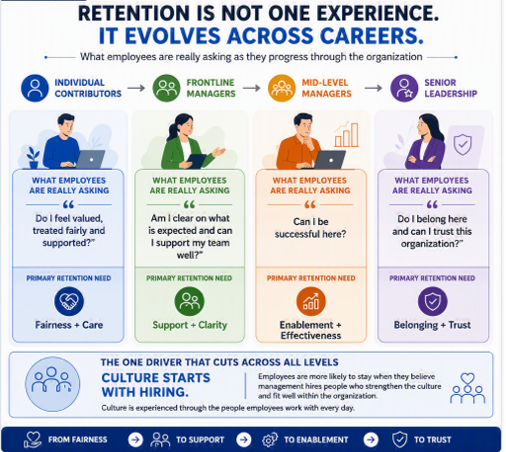
Retention is not an experience

This progression offers an important lesson for BFSI organizations. Employee retention in BFSI is not a single challenge that can be solved through a single intervention. It is an ongoing journey shaped by different needs at different stages of an employee’s career.

Culture Starts with Hiring: The Retention Driver That Transcends Levels

An interesting finding in across all job levels for retention: employees are likely to stay if they think that their employers are hiring employees with similar values.

This finding appears across individual contributors, frontline managers, mid-level managers and senior leaders, making it one of the few retention drivers that transcends organizational hierarchy.

This is especially true in BFSI. Branch teams, sales units, relationship managers, operations teams and contact centres work under constant customer, compliance and target pressure. Technical competence matters, but so does judgement, temperament and the ability to work in a high-trust environment. Hiring, therefore, cannot sit only with talent acquisition. It is one of the earliest culture decisions an organization makes.

For individual contributors, working alongside colleagues who share values and ways of working contributes to a more positive day-to-day experience. For managers, hiring quality directly influences team performance and collaboration. For senior leadership, however, the importance of this driver appears even more pronounced as it is a reflection of the culture of the organization. For other job levels, the relative weight of cultural fit as a key driver of retention is 9 whereas for senior leaders, it is at a 12.

Also Read: India’s Best Workplaces in BFSI

Culture is not simply experienced through policies or values statements. It is experienced through people. Every hiring decision reinforces or weakens the culture employees encounter every day.

For Employees in Individual Contributor and Frontline Managers, Retention Is Built on a Human and Economic Contract

For individual contributors and frontline employees, retention rests on two promises: a human contract and an economic contract.

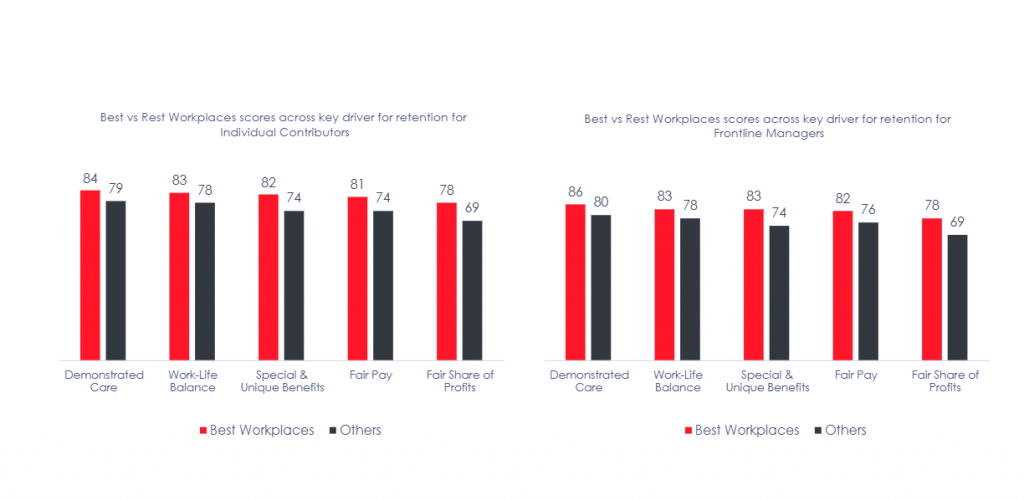
The human contract reflects employees’ desire to be treated as people rather than simply resources. Drivers such as management showing sincere interest in employees as individuals and encouraging work-life balance indicate that relationships and employee wellbeing remain important determinants of commitment.

Particularly in high-pressure BFSI roles, employees are more likely to stay when managers balance demanding targets with fair workload allocation, realistic expectations and efficient work processes.

The economic contract, meanwhile, reflects employees’ expectations around fairness. Fair pay, meaningful benefits and a sense of receiving an equitable share of organizational success emerge as important retention drivers, particularly among employees closest to day-to-day operations.

As BFSI hires GenZ and young millennials in the frontline roles, employees at this stage evaluate not only what the organization offers materially, but whether it creates an environment where they can learn, feel supported and envision a sustainable future.

Best-vs-rest-workplaces

As Employees Become Leaders, They Begin to Assess Whether the Organization Enables Success.

As employees go up the corporate ladder, there is a subtle shift in perspective. Managers are no longer asking only whether they enjoy working for the organization, they are evaluating whether the organization enables them to lead effectively and succeed.

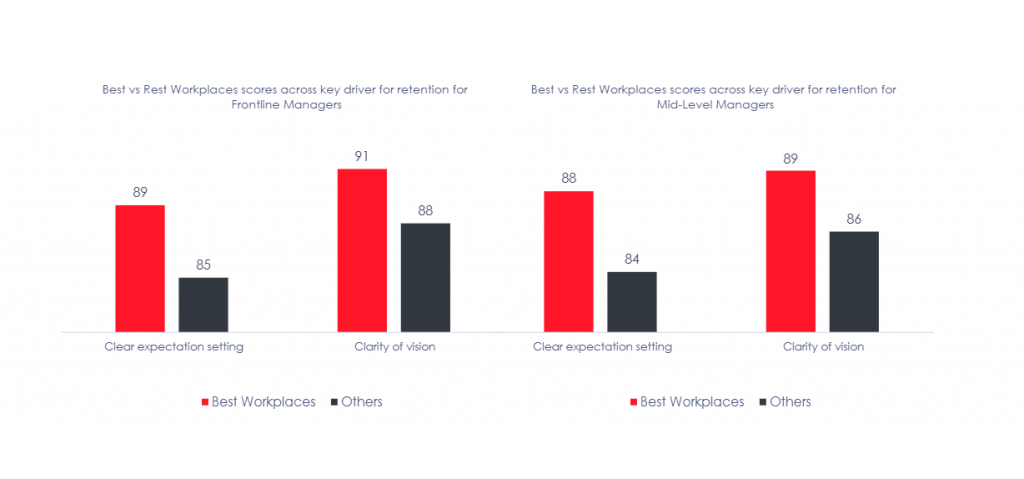
Frontline managers and Mid-level managers place greater emphasis on clarity of expectations and the organization working towards a clear vision. The generation they belong to, GenX, has accumulated significant organizational experience while balancing growing professional and personal responsibilities. At this stage, autonomy, trust and organizational enablement often become increasingly important.

When expectations are unclear, managers feel the consequences. When coordination breaks down, managers absorb the impact. When communication gaps emerge, managers are often required to bridge them. Their retention therefore becomes increasingly linked to managerial effectiveness and in turn organizational effectiveness.

The question shifts from “Do I enjoy working here?” to “Can I be successful here?”

This transition is particularly relevant in BFSI organizations, where managers play a critical role in driving performance, customer outcomes and team engagement. Supporting managers effectively is not only a retention strategy, it is also a business strategy.

Best-vs-rest-workplaces-2

At the Senior Leadership Level, Retention Is Ultimately About Belonging and Trust

At senior leadership levels, the strongest retention signals are less transactional. They point to belonging and trust.

The drivers for retention at this level revolves around being able to be oneself at work and participating in a workplace that celebrates important moments and milestones.

Collectively, these drivers paint a picture of leaders seeking something deeper than professional success. They point toward a desire for inclusion, connection and authenticity.

Senior leaders may differ in age and experience, but they are united by one expectation: they want to lead organisations that practise the values they promote. As accountability and scrutiny increase, authenticity and belongingness become increasingly important. Consistent with this, our findings identify belonging and management credibility as among the strongest drivers of retention for senior leaders.

Alongside belonging sits a second critical theme: trust.

Senior leadership places significant importance on ethical business practices, management credibility, transparency and organizational consistency. Drivers such as management delivering on promises, matching actions with words and keeping employees informed all point toward a broader need for confidence in leadership and the institution itself.

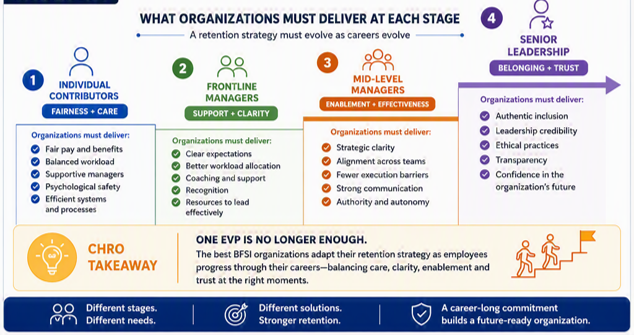
What Organizations Must Deliver at Each Stage

What organizations must deliver at each stage

Retention Is Not One Experience, it Is a Journey

The findings reveal that employees do not stop caring about culture as they move up the organization. Instead, they begin to define culture differently.

The findings also highlight an important distinction. Retention priorities are often discussed through the lens of generations, with organizations designing different strategies for Gen Z, Millennials or Gen X employees. While generational experiences undoubtedly shape workplace expectations, our analysis suggests that career progression deserves equal attention. Employees do not simply bring different expectations because of when they were born, they also develop new expectations because of the responsibilities they assume. Understanding both perspectives allows organizations to design retention strategies that are responsive without becoming overly segmented.

What remains constant throughout this journey is the importance of creating workplaces where employees feel valued, connected and aligned with the organization’s purpose.

The most effective retention strategies recognise that employee expectations evolve over time. Rather than relying on a single employee value proposition, the best workplaces continuously adapt the experiences they create to meet employees where they are in their careers.

In doing so, they transform retention from a reactive challenge into a long-term organizational advantage, by designing workplaces where people can see a future worth staying for.

Frequently Asked Questions

Why is employee retention becoming a strategic priority for BFSI organisations?

Employee retention is no longer just an HR concern, it is a business imperative. High attrition can disrupt customer relationships, weaken institutional knowledge, increase hiring and training costs, and place additional pressure on existing teams. In a sector built on trust, expertise and regulatory compliance, retaining experienced talent is essential to sustaining operational excellence and long-term growth.

Is employee retention a leading indicator of organisational health?

In BFSI, retention reflects much more than employees’ willingness to stay. It often signals the strength of organisational culture, leadership credibility and the organisation’s ability to sustain customer trust and operational excellence. While attrition alone does not define organisational health, consistently retaining talent can indicate that employees trust the organisation and believe in its long-term direction.

How does employee retention impact customer experience in the BFSI sector?

Customer trust is built through consistent relationships and high-quality service. Frequent employee turnover can disrupt these relationships, reduce service continuity and increase the time required for new employees to build customer confidence. Retaining experienced employees helps organisations deliver more consistent, personalised and trustworthy customer experiences.

Why is retaining experienced employees particularly important in BFSI?

Unlike many industries, BFSI relies heavily on institutional knowledge, regulatory expertise and long-term customer relationships. Experienced employees not only deliver stronger business outcomes but also mentor future leaders, preserve organisational knowledge and strengthen customer confidence during periods of change.

What does the future of retention look like for BFSI organisations?

As digital transformation, AI adoption and evolving workforce expectations reshape the sector, retention strategies will need to become increasingly personalised. Rather than relying on standardised programmes, organisations will need to create career-stage-specific experiences that combine meaningful work, continuous learning, leadership trust and organisational purpose to remain competitive in attracting and retaining talent.

What makes a business stand out? Is it in the way they meet customers’ needs, how they serve their stakeholders, or how they deal with vendors? The answer is all the above. The common factor that enables organizations to meet all the goals is their employees; more specifically, motivated and engaged employees.

Employee motivation lies at the center of a company’s success. Motivated employees are more likely to take ownership of their work, demonstrate creativity, collaborate, and consistently perform well. As motivated people are the best ambassadors of the organization, keeping them motivated becomes essential for business success.

As part of helping companies discover the best way forward to keep their employees motivated, Great Place to Work® offers various services.

What Does Employee Motivation Mean?

The technical definition of motivation is the process by which a person feels the need to act positively toward achieving a goal. Motivation can be both internal and external. Employee motivation is defined by the commitment, willingness, and energy employees demonstrate toward their work and achieving organizational goals. The process of motivating employees starts with external factors and, once employees are well motivated, becomes an intrinsic part of them.

Organizations understand the need to keep their employees motivated and will design programs, incentives, and other measures to maintain high motivation levels.

Some of the factors that will help with employee motivation include:

  • Competitive and comprehensive salary packages, including benefits and bonuses

  • Rewards, recognition, and appreciation programs that celebrate big and small wins

  • Enabling employees to do meaningful work and helping them understand how their work contributes to the company’s bottom line

  • Establishing clear and meaningful career paths that employees can aspire to within the company

  • Encouraging people to focus on their overall wellness within the workplace without sacrificing productivity

When an organization makes a visible effort to ensure it values its employees, it builds a sense of belonging and helps employees see themselves as an intrinsic part of the organization’s growth.

What Are the Different Types of Employee Motivation?

Employee motivation generally comes from two main sources: internal and external. In many cases, the internal and external motivation feed off each other. Organizations must work to ensure that employees are motivated at both levels.

Internal Motivation

This kind of motivation comes from the person themselves when they are made to feel that the work that they do is worthy and contributes to the overall growth of the company. As an employer, the company can do some of the following to ensure that the employee is motivated from within:

  • Provide opportunities to learn new skills or upskill so that their career advances

  • Offer a set up where the employee can see the bigger picture when they are solving a problem

  • Enable them to be part of a meaningful CSR activity

  • Help them grow personally as well by helping them plan finances and socialize better

When employees are motivated from within, they become proactive, show creativity is solving challenges, and demonstrate long-term commitment.

External Motivation

This type of motivation is more obvious and driven by external forces. By focusing on the external motivation, a company can ensure that employees are motivated internally. The starting point for external motivation starts with the remuneration package and can include some of the below factors:

  • Offering salary packages that is in sync with the market levels and inflation levels

  • Bonuses linked to work performance, enabling better teamwork, learning new skills, etc.

  • Creating a rewards and recognition program that helps employees feel appreciated

  • Running regular and meaningful employee surveys by a third party to understand their needs

With the correct external motivators, the business can ensure that employees are high on internal motivation and perform their work with complete commitment.

The Importance of Employee Motivation

One difference between a well-performing company and a mediocre one is the level of employee motivation. Motivated employees are productive, creative, and action-oriented. Here’s why employee motivation is important:

Motivation Helps Retain Talent

Voluntary attrition seldom happens suddenly.  Most employees who leave have been silently disengaging for months, often longer.  The last trigger can be a job offer or an unpleasant talk with a manager, but the underlying cause is nearly always a steady erosion of motivation: a growing sensation of being underappreciated, underutilized, or simply invisible.

Also Read: 5 Strategies to Boost Workplace Performance 

Organizations that engage in motivation are not only enhancing how people feel at work. To prevent turnover from becoming a financial issue, they are tackling its underlying causes. Replacing a skilled employee costs between half and twice their annual salary, depending on seniority and function.  One of the easiest ways to lower that expense is through motivation.

Motivation Boosts Productivity

There is a widespread and false assumption in many organizations that productivity scales with time. Put in more hours, get more production. When closely studied, this model immediately falls apart.

A motivated person working with attention and genuine investment in the objective will constantly outperform a disengaged one who is technically present but psychologically elsewhere. Motivation sharpens judgment, sustains concentration, and provides the kind of proactive problem-solving that no performance management framework can produce through pressure alone. The quality difference in production between motivated and demotivated personnel is rarely minor.

Motivation Fuels Innovation

Bringing a novel concept forward needs bravery. It entails risking judgment, possibly being told the concept is wrong or impracticable, and continuing to argue for it via skepticism and iteration. That kind of fearlessness does not emerge in low-motivation circumstances.

When employees feel valued and sincerely invested in where the organization is heading, they bring ideas. When they feel disregarded or underappreciated, they keep such ideas to themselves. The organization then mistakes a lack of innovation for a lack of creative potential, while the underlying issue is a culture that has stopped making it feel safe or valuable to attempt.

Motivation Strengthens Workplace Culture

Culture is not an outcome of policy documents or values statements. It’s the actual experience of working at a place, every day out, that’s built from how decisions are made, how feedback is given, how mistakes are addressed, and how contributions are celebrated. The people who really drive and extend that culture in practice are motivated employees. They are the ones who mentor new team members, who hold standards high without being asked, and who brings the enthusiasm that makes a team feel like a team.

Low motivation is also contagious. Someone who is disengaged can slowly drain the energy out of people around them, not by any one thing but by the slow accumulation of indifference. Organizations with low motivation are fundamentally weak, relying on a small group of very dedicated individuals to keep things together while everyone else coasts.

Key Factors Behind Employee Motivation

Before discussing how to enhance motivation, it is worth examining what truly leads to it. Several criteria emerge consistently across industries, locations, and levels of seniority as the most powerful impacts on whether employees feel really motivated or not.

  • Purpose and Meaning: People need to know why their work is important. Not in an airy, aspirational sense but in a real, practical way. When employees can see how their day-to-day work connects to an outcome they care about, it changes the relationship they have with that work. Purpose doesn’t need a big mission. It takes visibility and that visibility is something leaders can provide.

  • Autonomy and Trust: Perhaps the fastest way to drain motivation is micromanagement. When people are trusted to judge for themselves, to own their way and find their way to a goal, they bring a level of investment that cannot be overlooked. Autonomy is not a management style; it’s a signal. It tells an employee that his judgment is valued, and his talent is believed in.

  • Recognition & Appreciation: Feeling invisible is one of the most commonly cited reasons for workplace disengagement. Employees are not asking for lavish reward ceremonies. They want to know someone has seen their effort, and that the person they work for thinks their contribution is worthy of acknowledgment. Specific, timely, and real recognition is often one of the highest impact, lowest cost tools available to leaders.

  • Growth and Development: People are motivated by progress. When individuals believe they’re improving something they value, or when they have a sense of a way forward to the place they want to reach, their level of engagement with the work before them increases. Organizations investing in the growth of their people send a very clear message: the relationship is not just transactional; the person’s future is as important as their current output.

  • Fairness and Transparency: Motivation declines rapidly under conditions deemed unfair. When employees see that favoritism is used to make progress, information is selectively provided, or rules are applied to some but not others, they become disengaged. Fairness is fundamental. Without it, the best-designed recognition programs and growth opportunities don’t amount to much.

  • Belonging & Inclusion: No one brings their best self to a place where they don’t feel truly accepted. One of the most profound reasons to keep motivation high is a sense of belonging to something, of being recognized and heard and valued for who one really is rather than a version of oneself altered to fit in.

What Are the Factors That Affect Employee Motivation?

Employee motivation starts with a basic step, which is understanding where the organization stands right now and planning the steps needed to achieve the goal of motivating employees.

Here are the factors that can help motivate employees: 

  • Leadership: One of the factors that helps build a positive employee experience is by training leaders on the cultural aspects. An emotionally available and empathetic leader ensures that employees receive the guidance and help they require to perform at their best.  

  • Recognition: Employees respond positively when their employer recognizes their efforts and rewards them for their work. Transparent career paths and fair practices in the performance appraisal process helps employees feel positively motivated. 

  • Career: Any employee who joins a company wants their career to matter a lot and progress as per their skills. Companies that offer career paths with potential to grow and flourish tend to have motivated employees. 

  • Compensation: Money is an excellent motivator and companies that keep up with market trends and compensate their employees competitively have motivated employees. Companies that offer compensation commensurate with the employees’ work performance and skills are able to retain their well-performing employees. 

  • Balance: Companies that encourage employees to maintain a work-life balance, facilitate better working conditions, and focus on employee wellness, tend to have motivated employees. While a clean and safe work environment is the bare minimum, companies that go beyond to show their care for employees, have motivated employees. 

  • Purpose: Companies that are clear in their purpose and are able to communicate this to employees can keep them motivated. It is important for employees to understand the company’s direction to feel motivated from within. 

Strategies to Build Employee Motivation 

Here are some strategies that companies from every realm can adopt to keep their employees motivated.

Revise and update compensation and incentive packages 

Companies that track what the competition is offering as compensation and builds a salary and incentive packages will be able to keep their employees motivated.

Build an inclusive rewards and recognition platform 

Employees who are recognized and rewarded for good work, are more motivated. The strategy is to build a platform that enables peer-to-peer recognition alongside annual programs that is driven from the top.

Invest in learning and development programs 

Companies that help their employees upskill and learn new skills are more productive and able to keep their employees motivated. A robust program that enables learning on a constant basis can be a big part of employee motivation.

Create a transparent performance appraisal system 

When a company has a fair, equitable, and transparent performance appraisal system will engage with employees and keep them motivated. Clarity on goals and ratings is an important aspect of this. Connect this with the overall purpose of the organization to ensure people feel motivated from within.

Train leaders to promote the organization culture 

Leadership play a crucial role in motivating employees by living the company values and promoting the company’s culture. Training the leader to take on a positive and transparent approach can be a big factor in ensuring employee motivation.

Enable open and two-way communication 

Communication lies at the heart of an excellent organization and companies that enable two-way communication within requisite guidelines, can keep employees motivated. When employees realize that they can voice their concerns openly and be heard without bias, they tend to feel secure and more motivated.

The Leader’s Role in Employee Motivation 

Many companies respond to low motivation by launching an initiative, such as a new engagement survey, a revamped recognition platform, or a company-wide values refresh. These things are not valueless. But they tend to deal with motivation in a superficial way, without changing the underlying conditions.

What truly drives motivation is much more specific than any program can reach. It exists in the moment when a manager takes the time to explain the importance of a project. It lives in the leader who admits to a mistake in public rather than trying to deflect it. It exists in the senior executive who asks a junior employee for his or her honest opinion about a strategic question, and who takes that answer seriously.

And those moments, built up over weeks and months and years, are so much more potent in shaping how employees experience their work than any quarterly initiative. So, motivation improvement is not primarily an HR design problem. This is a leadership practice problem. It asks leaders at every level to look not only at what they are doing, but how that behavior is being experienced by those around them, and whether it is creating the kind of trust and investment that motivation requires.

The Way Forward for Employee Motivation 

Employee motivation can be the factor that ensures a company consistently performs well and meets customer needs. Employee motivation helps the company stay productive, meet customer needs, and retain talent. Employee motivation is more than a single action or strategy.

It is a series of planned actions that help the company thrive on various levels. Employee motivation helps employees develop a sense of commitment and belonging that sees the company through the ups and downs of business. At Great Place To Work, our team helps companies transform their culture with culture consulting services, surveys, and other means.

Want to know how to take this forward? Click here to connect with us

Frequently Asked Questions

Is employee motivation the responsibility of HR?

No, employee motivation is the responsibility of the entire leadership team working together with the human resource management team. In most companies, the responsibility of employee motivation will be driven by HR but completely supported by the leadership team.

What makes employee motivation so important?

Employee motivation is important because it will help a company improve on productivity, employee morale, public image, brand image, and customer satisfaction.

Which type of businesses need to work on employee motivation?

All types of businesses, no matter what they sell or provide, must work on employee motivation to survive in a competitive market where numerous businesses are competing for the same resources.

How does external motivation work?

External motivation is about all the factors that can be viewed from outside, and it works to make the employee feel valued in monetary and tangible ways. It helps the employee see visible benefits.

How does internal motivation work?

Internal motivation works to ensure the employee feels valued and empowered. It helps the employee feel motivated from within and implies factors that are not always visible but carry a lot of impact.

Companies today are including employee wellness as part of their growth strategy, since it is directly tied to improved productivity, business continuity, customer lifetime value (CLV), and brand reputation. Leaders today acknowledge that employee wellness is a set of carefully thought-out strategies that help future-proof the business.  

In 2026, the onus for ensuring employee wellness is no longer restricted to the HR department, and this is due to many factors. The way employees approach work has taken a new direction with the advent of technology, options like hybrid workplaces, and changing lifestyles. Adding to this is a mix of various generations and a diverse workforce with different outlooks.  

All these factors can lead to employee burnout, financial pressures, physical fatigue, and performance pressure, unless employee wellness takes center stage. As per a recent study. ‘Nearly two-thirds of Gen Z employees (65%) are at low wellness, higher than other generations.’  Another study reveals, ‘Best Workplaces maintain a consistent 2 – 4 % advantage across all core wellness drivers, with the largest gap in motivation for work (4%).’   

This article will focus on defining employee wellness, the factors to consider, and strategies for getting it right.

What are Employee Wellness Strategies?

Employee wellness strategies are structured, well-planned, long-term plans designed to improve the overall employee experience that leads to greater well-being. Along with engagement activities, wellness strategies consider deep-rooted changes in the leadership approach and organizational culture to align with the business purpose and goals.  

Wellness strategies will focus on supporting employees at various levels, including: 

  • Physical well-being, focusing on safety, health, fitness, sporting events, etc. 
  • Mental health support like counseling, wellness workshops, support groups, etc. 
  • Financial well-being to encourage better personal fund management, dealing with taxation, etc. 
  • Social engagement through group activities and outings to foster team spirit. 
  • Emotional help when employees face difficulties in their work or home environment. 
  • Career counseling and advisory services to help plan career paths and identify training requirements. 

The goal of wellness strategies is to provide employees with an atmosphere where they feel supported and encouraged to perform to their fullest potential. At Great Place to Work®, we help companies assess current wellness levels to better strategize for wellness.

Why Do Companies Need Robust Employee Wellness Strategies in Today’s Environment? 

Workplaces today are at a unique juncture, where you have generations working together, hybrid models becoming the norm, digital technologies evolving, and Artificial Intelligence driving many work processes. The erstwhile employee wellness strategies must be tweaked, updated, and changed to serve the needs of today’s workforce.

Also Read: 25 Best Health and Wellness Activities for Employees

According to a report, ‘Employees who experience wellness are 2 times more likely to stay longer, put in extra effort, adapt quickly, and innovate compared to those who don’t.’ Here are some of the main reasons that employee wellness strategies are critical for business growth and success:

#1 Changing workforce: 

The workforce today is a mix of genders, ages, orientations, and backgrounds, which means that what worked a few years back will not work today. One of the biggest evolutions we have seen in the past two decades is immense. Technology has made communication easier and more convenient, enabling people to work from home. While this is convenient for people with home-related responsibilities, it also isolates them from the camaraderie and interactions at work. All these changes require companies to formulate wellness strategies to suit the evolving needs.  

#2 Evolving awareness: 

Unlike in the past, employees today are more aware of their needs and expectations regarding support from the company. Women employees want to work for organizations that support them through various stages of life, such as marriage and motherhood, without limiting their growth. The younger generation expects support for their emotional and social well-being from their workplace. At the same time, people of different orientations are more open about their choices and want support from the workplace. 

#3 Retention and motivation: 

Companies have started to realize that while there are many skilled and qualified candidates out there, recruitment is a long-drawn process; one that they need to help by increasing retention and motivation. Having the right mix of employee wellness strategies will help motivate and retain the existing workforce. This, in turn, means a marked uptick in productivity and savings for recruitment costs. People look for factors like Employee Resource Groups that help them stay motivated.  

#4: Employer branding 

In today’s competitive world, where information is available at the tap of a button, potential candidates are more likely to research the company before joining. Moreover, the competition for the right talent is also intense out there. Keeping these factors in mind, it becomes critical for companies to build a genuine brand. Employer branding has become more than sharing a few press releases or posting on social media. It is about being authentic and showcasing how the company cares for its employees; having an employee wellness strategy is the way to go. 

#5 Empowering from within: 

The right employee wellness strategy is the best way to empower employees to be their best selves. Physical wellness ensures that employees are fit and ready to put in their best efforts. Mental, emotional, and social wellness enables individuals to self-motivate, be more productive, and maintain work-life balance. The right financial wellness strategy will encourage employees to plan their finances well and work without financial worries haunting them.

Why Do Companies Need Robust Employee Wellness Strategies in Today’s Environment? 

Workplaces today are at a unique juncture, where you have generations working together, hybrid models becoming the norm, digital technologies evolving, and Artificial Intelligence driving many work processes. The erstwhile employee wellness strategies must be tweaked, updated, and changed to serve the needs of today’s workforce.   

According to a report, ‘Employees who experience wellness are 2 times more likely to stay longer, put in extra effort, adapt quickly, and innovate compared to those who don’t.’ Here are some of the main reasons that employee wellness strategies are critical for business growth and success:

#1 Changing workforce: 

The workforce today is a mix of genders, ages, orientations, and backgrounds, which means that what worked a few years back will not work today. One of the biggest evolutions we have seen in the past two decades is immense. Technology has made communication easier and more convenient, enabling people to work from home. While this is convenient for people with home-related responsibilities, it also isolates them from the camaraderie and interactions at work. All these changes require companies to formulate wellness strategies to suit the evolving needs.  

#2 Evolving awareness: 

Unlike in the past, employees today are more aware of their needs and expectations regarding support from the company. Women employees want to work for organizations that support them through various stages of life, such as marriage and motherhood, without limiting their growth. The younger generation expects support for their emotional and social well-being from their workplace. At the same time, people of different orientations are more open about their choices and want support from the workplace. 

#3 Retention and motivation: 

Companies have started to realize that while there are many skilled and qualified candidates out there, recruitment is a long-drawn process; one that they need to help by increasing retention and motivation. Having the right mix of employee wellness strategies will help motivate and retain the existing workforce. This, in turn, means a marked uptick in productivity and savings for recruitment costs. People look for factors like Employee Resource Groups that help them stay motivated.  

#4: Employer branding 

In today’s competitive world, where information is available at the tap of a button, potential candidates are more likely to research the company before joining. Moreover, the competition for the right talent is also intense out there. Keeping these factors in mind, it becomes critical for companies to build a genuine brand. Employer branding has become more than sharing a few press releases or posting on social media. It is about being authentic and showcasing how the company cares for its employees; having an employee wellness strategy is the way to go. 

#5 Empowering from within: 

The right employee wellness strategy is the best way to empower employees to be their best selves. Physical wellness ensures that employees are fit and ready to put in their best efforts. Mental, emotional, and social wellness enables individuals to self-motivate, be more productive, and maintain work-life balance. The right financial wellness strategy will encourage employees to plan their finances well and work without financial worries haunting them.

How to Create the Right Employee Wellness Strategy? 

The right employment strategy needs to have a solid foundation built on the organization’s mission, vision, purpose, and values, with a certain flexibility to adapt to changing requirements. The right strategy should involve an analysis of the current situation, leadership involvement, and employees’ requirements.  

Step #1: Analyze the current situation 

When creating the right employee strategy, it is crucial to understand what the competition is doing. This step offers an insight into what similar companies are doing. The place to start this process is by joining industry-related associations, checking these companies’ on social media, and reviewing ratings and feedback on job sites. Accessing publicly available reports can also be another source. 

Step #2: Understanding employees’ needs 

This step could involve impromptu discussions, employee surveys conducted through a third party, and events like town halls. Another source could be the employee records on people hired and retained, years of service, and gaps. For instance, if the records show increased attrition among middle management, that could be an area to focus on.  

Alternatively, if women employees leave after a certain time, there could be either marital stress or lack of advancement. In physically demanding jobs, the focus could be on injuries or fatigue from repetitive tasks. Examining attrition rates among remote workers could provide insight into mental and social wellness needs. With older workers, it could be about financial wellness. Younger employees may need mental wellness initiatives.  

Step #3: Define wellness goals 

What the company hopes to achieve through its employee wellness programs may depend on the industry, the organization’s size, and employees’ profiles.  Generally speaking, wellness goals include reducing attrition, improving engagement, increasing productivity, supporting work-life balance, and fostering a viable, flourishing environment. It is important to quantify these goals and set KPIs to measure the efficacy of these strategies. 

Step #4: Getting leadership buy-in 

The next step would be to share the findings with the leadership group and present the way forward. Employee wellness strategies work well when leadership is involved and committed to their implementation. A visible adoption of wellness-related initiatives by leadership encourages employees to believe in and adopt them.  

As per a study it has been seen, ‘Among women, Gen Z, and early-tenured employees, the groups with the lowest overall wellness perception, ‘Management’s actions match its words’ is the lowest-scoring wellness driver across all three segments. This pattern is consistent across segments, making leadership follow-through the most commonly lower-rated driver among low-wellness groups.’ This finding highlights the importance of leadership buy-in.  

Some examples include the leadership teams: 

  • Maintaining work-life balance  
  • Encouraging use of wellness resources 
  • Committing to physical and mental wellness 
  • Normalizing discussions about mental health 
  • Accepting flexible working hours  

Step #5: Build resources, launch, and evaluate 

Once the employee wellness strategies are in place, it is crucial to have resources to enable usage. These could include the following: 

  • Creating a space for physical activities and offering company-sponsored gym memberships at a discounted rate.  
  • Setting up a panel of qualified counselors and mentors who can help employees work on their career paths and get the required support.  
  • Some mental health professionals affiliated with the company offer support to employees in times of need. 
  • Qualified finance and taxation experts to guide professionals on the best way to save money and build financial resources. 
  • Means for people from diverse backgrounds and different interests to form employee resource groups.  
  • A committee that will be in charge of organizing social activities for employees to participate in, mingle, and get to know each other. 

The launch process can involve internal communications, setting up intranet resources, and sharing at an event. The evaluation process needs to be data-based and supported by surveys, discussions, and wellness checks.

What Are the Pillars That Support a Complete Employee Wellness Strategy? 

Employee wellness strategies can be divided into six pillars. It considers all aspects that ensure that employees are happy, healthy, fit, secure, engaged, and motivated. 

The six pillars of employee wellness strategy

Wellness pillars What it entails
Physical and health

The focus is on the physical and health aspects of the employees’ wellness. Under this aspect, the company offers:

  • Health checkups
  • Wellness programs
  • Nutritional consultations
  • Gym and workout facilities
  • Safety aspects
Mental and emotional

Companies support employees in maintaining their emotional well-being through facilities like:

  • Counseling support as needed
  • Sessions on stress management
  • Prevention of burnout
  • Wellness practices for emotional health
Financial

Managing finances can be difficult, especially for young professionals or people with multiple responsibilities. Companies can help employees by:

  • Running programs on financial management
  • Helping plan for their retirement
  • Managing debt, the right way
  • Educating employees about investment options
Social

As humans, we have an inherent need to connect and interact with others. Companies support this by:

  • Promoting team outings and activities
  • Creating forums for group interactions
  • Encouraging cross-department collaboration
  • Mentorship and ERG programs
  • Peer recognition and rewards programs
Career

Employees are most motivated when they know they have a clear advancement path defined. Organizations offer:

  • Training programs for skill enhancement
  • Coaching and mentorship programs
  • Skill development opportunities
  • Career path planning
  • Company-sponsored education


Common Employee Wellness Strategy Mistakes to Avoid 

Here are some common mistakes to avoid while implementing employee wellness strategies. 

  1. Assuming that a boilerplate or templated employee wellness strategy will work for all companies. 
  1. Putting the complete ownership of wellness initiatives on the human resources department  
  1. Having no defined metrics to track the success of the employee wellness programs 
  1. Focusing on one easy-to-achieve and more visible aspect like offering gym or workout facilities 
  1. Leadership not fully committing to the wellness initiatives invalidating the entire initiative 

What Are the Best Employee Wellness Strategies for Remote and Hybrid Teams? 

The wellness strategies that a company adopts varies as per the type of organization and its needs, remote and hybrid teams being a case in point due to the way they work.  

Often, teams that work from different locations and away from each other may experience some of these: 

  • A feeling of being isolated  
  • Fatigue due to overuse of digital technology 
  • Work and life boundaries becoming unclear 
  • Too many meetings and over-communication 
  • Lack of social interaction with colleagues 

Some wellness tips for remote and hybrid teams: 

  • Setting strict work timings and cutting down communication outside of those hours 
  • Encourage the team to cut down on frequent meetings to reduce information overload 
  • Schedule and enforce regular breaks to ensure that employees have chance to relax 
  • Start online wellness challenges like meditation, exercises together to promote camaraderie 
  • Sponsor and provide proper ergonomic workstations for those who work remotely 
  • Offer counseling support and mental wellness talks to keep the morale of the team up 
  • Train team leaders to identify burnout symptoms and empower them with the tools to deal with it 

How to Make Employment Wellness Strategies a Part of the Company Vision? 

Employee wellness strategies are an essential part of the company’s growth and work towards ensuring that the company stays on course. The starting point for this is to understand where the company stands, what it needs to grow, and crafting strategies to ensure that it happens. 

It is time for organizations to acknowledge that what worked earlier may not work now because the entire business landscape has changed and people want to make informed choices. A good salary and benefits are just the starting point; employees want companies to commit to their overall wellness. To do this, companies must evaluate their culture and seek employee feedback to understand what must be included in the employee wellness strategy. 

Get started with the Great Place To Work team. Click here to connect with us 

Frequently Asked Questions

What are the key factors to consider for employee wellness? 

Apart from basics like a competitive remuneration package and safe environment, companies must consider emotional, social, mental, career, and physical well-being of its employees. People need to know that they are supported and valued to perform better.  

What metrics should be used to measure the success of a wellness strategy? 

Organizations can generally measure the success of their wellness strategy by looking factors like reduced attrition, lower recruitment costs, decreased absenteeism, an uptick in customer satisfaction, improved productivity, and positive feedback in employee surveys.  

What differentiates a wellness program from a wellness strategy? 

A wellness program is a single activity or a set of activities, such as a meditation session, that falls under the overall wellness strategy. A wellness strategy takes on a broader outlook and considers various factors to ensure that it aligns with the overall company strategy. 

What is the cost of an employee wellness strategy? 

The cost of planning, creating, and launching an employee wellness strategy will depend on the scope of the strategy, size of the organization, and type of activities and benefits provided under it. Some parts of the employee strategy will cost less like implementing flexible work hours while others like offering a discount on a gym membership may cost more. 

Will an employee wellness strategy work for scattered, diverse, and hybrid teams? 

Yes, it will work for all kinds of teams. In fact, a well-thought-out employee strategy becomes crucial for remote and hybrid teams. The right initiatives can ensure that the team works well together despite differences in work location, hours, and limited in-person interactions.

With the technology landscape evolving rapidly, it is equally crucial for businesses to ensure they have people with the right skill set. In many cases, businesses seek new candidates to fill gaps, which is a good option, but it also means added expenses and time to onboard new people and get them into the rhythm of the organization.  

However, a better option is to build an effective employee training and development program within the organization to help it scale faster. This can help businesses save time and the costs involved in recruiting new employees. It also keeps existing employees motivated, prevents burnout, and encourages an innovative approach.  

At Great Place to Work®, we help CHROs discover the gaps in Training and Development and take the next steps to implement effective programs. This blog will explore the definition, scope, and some best practices for employee training and development.

What Does Employee Training and Development Mean?  

Employee training and development is a defined, structured process that helps employees build their skills and knowledge, expand their capabilities, and learn about the latest developments in their work. In common parlance, training refers to enhancing employees’ skills to perform their current jobs better. At the same time, development focuses more on acquiring soft skills, preparing to take on leadership roles, and overall growth.  

Employee training  

Programs that offer employee training help employees understand new techniques and skills, deepen their knowledge of compliance requirements, enhance their customer service skills, and improve operational performance.  

Some examples of employee training include:  

  • How to use a software or tool after it has been deployed or upgraded  
  • Using a completely new tool or software after it has been implemented  
  • Training on sales techniques and negotiation skills  
  • Programs to improve safety at the workplace and ensure compliance  
  • Managing customer queries better and more quickly to save time and get better feedback  
  • Knowledge transfer sessions to understand a product better   

Employee development  

Employee development programs lay the groundwork for employees to take on better roles, move up the hierarchy, and develop the softer skills required for leadership. Some examples of employee development programs include:  

  • Coaching on leadership skills like emotional intelligence, active listening, etc 
  • Programs on how to become an effective mentor to others   
  • Programs to aid succession planning  
  • Young executive board, executive development, strategic planning, etc  
  • Cross-functional knowledge sharing to enable a broader perspective  

How Do Employee Training and Development Benefit the Organization?  

Any business that wants to lead the pack, stay relevant, remain profitable, and become future-ready must invest in employee training and development. The usual practice is for the HR department to work in tandem with leadership to create training programs that help employees and the business grow. An analysis to show what high-performing companies do differently will validate the need for effective employee training and development programs.  

Here are some of the direct and indirect benefits of employment training and development:  

#1. Better performance  

Trained and educated employees are likely to understand processes and perform better as a result of extensive training. The likelihood of errors also reduces dramatically. There is less guesswork and more informed decisions.   

#2. Increased engagement  

Employees are motivated and better committed when they see the continued investment the business makes in enhancing their skills. The chance to learn, share tips, and improve their knowledge is a great way to build a positive workplace culture.  

#3. Employee retention  

When a business invests time and resources in employee development, employees feel a sense of belonging, which increases retention. Often, employees see training programs as a way to advance their careers, which increases their commitment to the company.  

#4. Effective succession planning  

Companies want continuity in the skills and knowledge of their leaders about the business, its products, its vision, and purpose. With training and development programs, it becomes easier to identify potential leaders and develop them within, making succession planning easier.   

#5. Increased adaptability  

When the workforce is trained in new technologies and stronger skills, they are better prepared to face changes in the industry. It becomes easier for employees to take on an innovative approach when their foundational knowledge is robust.  

#6. Better inter-departmental cooperation  

With training and development programs, employees are likely to meet and interact with other departments (such as budgeting for marketing needs, which requires both the finance and marketing teams to attend). This ensures that each department has a deeper understanding of what the other does, thus increasing inter-departmental collaboration.  

#7. Improved brand image  

A company known for offering excellent training and development programs, being innovative, superb employee retention, and consistent performance will develop a positive brand image.  

#8. Reduced risk  

When employees are extensively trained on safety procedures, emergency protocols, and compliance requirements, risk management becomes easier. There are likely to be fewer instances of data loss, breach of contract, or other compliance issues.   

How to Create and Implement Effective Employee Training and Development Programs?  

The creation of an effective employee training and development program starts with the identification of clear objectives, leadership buy-in, extensive planning, and effective implementation.    

Step #1: Identify business objectives  

The first step would be for the HR department to work with department heads to review current employees, map their existing skills, and identify improvement areas. This will help identify the business objectives, including goals such as reducing time spent on customer calls, closing more deals, and updating technology. All these objectives must be mapped to business outcomes.  

Step #2: Analyze gaps  

This step could involve talking to people, launching a survey, or conducting tests to understand the current situation and identify skill gaps. For instance, today AI is involved in answering basic customer queries, and customer-facing teams must be trained to handle them in tandem with the software.  

The process of identifying gaps can include feedback loops, performance reviews, surveys, exit interview inputs, etc.  

Step #3: Segment training types  

Training requirements can vary by employee group. For instance, the training process for newcomers will require a general approach. Technical skill enhancements will require specific training from industry or in-house experts. For managers, the training will focus on conducting efficient meetings, communicating effectively, listening, and avoiding bias. The sales team needs both product and negotiation skills.  

Step #4: Decide on the training methods  

Training is about imparting knowledge in a way that makes it easier to consume, without infringing on their work time, while keeping it interesting. Some methods include classroom training, self-learning platforms, virtual sessions, one-on-one coaching, peer coaching, and gamification.  

Step #5: Collect and analyze effectiveness  

When deciding which training and development programs to launch, it is crucial to determine the metrics to track, establish mechanisms to collect data, and analyze the data. For instance, when there is a training program for handling customer queries, the data to look at would include time to resolve queries, improved customer feedback, etc.  

How to Identify Training and Development Needs?  

Here are some factors to consider while identifying training and development gaps and creating programs.  

  • Look for performance gaps in employees from a particular department. For instance, if the accounts department makes invoicing errors due to their inability to use the accounting software.  
  • The introduction of a new technology or system in a company warrants training for all those who will work on it.   
  • If the organization has plans to expand its business, acquire a new business, or move to a new territory, it is important to have a training program to support these efforts.  
  • The introduction of new safety, legal, or compliance standards requires training of the relevant personnel.  
  • When the company wants to develop leaders internally, it is critical to have leadership development programs to support succession plans.  

Build a Culture of Training and Development as Part of the Business Strategy  

Identifying training and development needs in an organization is a continuous process. The HR department, along with the leadership team, can make training part of the strategy to reward high-performing employees.   

Training and development are an investment in the business’s future growth, enabling it to withstand future challenges and changes. Wondering how to get started? Consult with the team at Great Place To Work. The team will help you assess training and development requirements, conduct impartial employee surveys, provide culture consulting services, and offer tailored solutions.   

Want to take the next step? Click here to connect with our team.  

Frequently Asked Questions  

How often should a company work on training and development?  

Training and development are continuous processes that must be updated in response to the company’s changing needs and shifts in the business climate. Often, it could include tweaking and updating current training materials as per changing requirements.  

What are some of the current trends that require training support?  

Some recent trends in training include Artificial Intelligence, Microlearning, Emotional Intelligence, Leadership Soft Skills, and Hybrid Learning.  

How does training and development support business growth?  

Training and development help current employees upskill, reduce recruitment costs, improve productivity and performance, and increase revenue and customer retention.  

How does offering training and development motivate employees?  

When a company offers smart, innovative training and development programs, employees feel supported, engagement rates go up, they see a clear path for growth, and this motivates them to do their best and strengthens their commitment to the company.

Competition and technological changes are constant factors in any given market. One aspect that helps a business thrive amid changing circumstances is the effective use of its resources, especially human resources. 

In today’s market, a business must have the right recruitment strategy to attract, develop, and retain the best talent. Recruitment today is more than putting up an advertisement, screening candidates, interviewing them, and making an offer. While the process remains the same, there is a lot of strategy involved in the backend. 

The reason for this shift is simple: today, candidates are more aware of their options and spend as much time evaluating the business as the business does evaluating them.  Add to that aspects like evolving technology, changing work styles, and intense competition, and the need for recruitment strategies becomes evident. 

This blog will explore what recruitment entails, best practices for recruitment, and how to make retention part of your strategy. This is where the Great Place to Work® team helps by providing services such as culture consulting.  

What Do Recruitment Strategies Mean? 

Recruitment strategies are the plans, tactics, and methods organizations use to attract the right talent, evaluate and hire them, and retain them to help the company grow and remain competitive. With well-thought-out recruitment strategies, companies can hire faster and better, reduce turnover, and build future-ready teams.

Apart from aligning with the core business values and growth plans, recruitment strategies will also include the following elements:

  • Building a realistic, appealing, and humane employer brand across various channels 
  • Fine-tuning sourcing methods, harnessing the latest technology to track the process better 
  • Engage with candidates for the entire lifecycle, from the offer letter stage to the exit interview 
  • Leveraging recruitment and employee feedback-related analytics to refine strategies 

What Are the Different Types of Recruitment Strategies?

In most companies, the HR department and the leadership team will develop recruitment strategies aligned with the company’s growth plans. The idea is to gather input from leadership to ensure that new talent is recruited on time and that existing talent is nurtured and retained.  

Retention is becoming an important element of overall people strategy, and according to a report, ‘Today only 51% of organizations have implemented any innovative or non-traditional retention strategy.’ Considering this, many organizations have made it a part of their people strategy. 

Here are some of the different recruitment strategies to consider while creating one:

#1: Internal recruitment from within the company 

As part of this strategy, a company will fill vacancies by seeking candidates within the organization. It can be from the same team, another department, or a different geography. The company can float an internal communication asking people to apply.  

Steps to make internal recruitment effective:

  1. Map career paths within the organization to understand who can transition into newer positions. 
  1. Ask managers to evaluate employees on their current and potential performance to fill in roles. 
  1. Keep an updated dashboard of performance appraisals and skills evaluations to assess people. 
  1. Create a process to evaluate skills for different roles that can be used for initial evaluation.  

Some of the benefits of recruiting from within the company are:

  • Less training and orientation required 
  • Improves the morale of employees 
  • Reduces fatigue from job roles 
  • Shortens the recruitment process 
  • Saves on hiring costs 
  • Encourages people to pursue growth 

#2: Recruitment through external sources 

Another part of the recruitment strategy can be to seek candidates from a broader talent pool. External options include advertisements, job portal postings, social media, network outreach, and other sources.  

Steps to make recruitment through external sources effective: 

  1. Talk to the team that works in the department to understand the context of the job role. 
  1. Draft the job placement content carefully to ensure it is attractive, realistic, and comprehensive. 
  1. Look at ads and job descriptions of companies in the same industry to understand what is working for them. 
  1. Keep track of which job placement content performed best in the past to attract relevant candidates so that it can be replicated in the future. 

The benefits of recruiting through external sources are: 

  • Broader talent pool to choose from 
  • Brings a fresh point of view to the company 
  • Helps add new skills and perspectives to the team  

#3: Referrals from existing and ex-employees 

Often, companies ask existing or former employees to refer candidates for certain roles. This kind of recruitment works best when the role requires a high level of specialized skill or is sensitive and requires strict confidentiality.  

Steps to make referrals from existing and ex-employees effective: 

  1. For ex-employees, start an alumni forum where they can interact and communicate with each other. This can also be the space to share job vacancies. 
  1. Formulate a lucrative and realistic referral bonus scheme and share it with current and ex-employees. 
  1. Keep updating the company intranet site with current vacancies so that employees know which positions are open. 
  1. Create and maintain a weekly cadence of a consolidated email about all open posts. 

Here are some benefits of recruitment through referrals: 

  • Speeds up the recruitment cycle and lowers the recruitment cost 
  • More chances of a cultural fit due to the connection with existing employees 
  • It motivates existing employees, as they may also get a referral bonus 

#4: Campus recruitment for freshers and interns 

Organizations regularly visit colleges and campuses across the country, depending on their requirements. This recruitment method allows the company to do some soft publicity and share its values with a larger audience.  

Steps to make campus recruitments effective: 

  1. Start by looking at top performers with the right attitude and aptitude within the company to determine which colleges and institutions they belong to. 
  1. Discuss with these top performers about what they like about the company.  
  1. Contact these colleges and institutions for the company’s recruitment drive. 
  1. If possible and willing, have alumni of these institutions participate in the pre-recruitment presentation during the campus recruitment process. 

Here are some benefits of campus recruitment: 

  • Getting access to a larger pool of candidates with the latest skills 
  • It is an economic way of hiring people with the right qualifications 
  • Onboarding freshers and orienting them with the company culture is easier 

#5: Recruitment outsourcing to consultants 

Organizations either go with smaller, individual recruitment consultants or a recruitment process outsourcing company to handle their recruitment requirements. Under this option, companies gain the advantage of third-party expertise, which also removes personal bias from the recruitment process.  

Steps to make recruitment outsourcing to consultants effective: 

  1. Create a database of specialist recruitment consultancy firms based on the company’s needs.  
  1. Onboard them on a per-candidate basis with a clear understanding of mutual terms. 
  1. Discuss the requirement with the consultant to understand if they have done similar placements in the past. 
  1. Share specific skills required and provide an understanding of the soft skills that work well with the company culture. 

Some of the benefits of outsourcing recruitment include: 

  • Increased access to a qualified talent pool 
  • Expert or streamlined interview processes  
  • Reduces the burden on company resources 

#6: Diversity recruitment 

Under this recruitment strategy, the company focuses on deliberately recruiting candidates from diverse backgrounds with the right skills and qualifications. Diversity in hiring ensures that the company benefits from different viewpoints and creative inputs. 

Steps to make diversity recruitment effective: 

  1. Analyze the current workforce to understand the gaps and plan the diversity hires accordingly. 
  1. Understand what kind of support they will need to work well in the organization. 
  1. Craft the job description to show the organization’s openness to diverse candidates.  
  1. Be prepared to create the right support when diversity hires join the company. 

Benefits of this strategy include: 

  • Promotes a more tolerant and accepting culture 
  • Encourages innovation and different thought processes 
  • Improves the company’s brand image  

#7. Find and leverage unconventional sources 

Often, companies restrict themselves to known sources and limit the types of employees they can hire. While effective, this strategy overlooks talent that is not strictly conventional but offers substantial experience and skills. This could include gig workers, freelancers, retirees, people with disabilities, ex-convicts, etc. 

Steps to make recruitment from unconventional sources effective: 

  1. Determine which of the unconventional categories will work for the current company structure.  
  1. Look at genuine sources to recruit people who bring in the right skills and experience, with the culture fit. 
  1. Prepare the existing team to work well with the unconventional hires to ensure cohesive working. 
  1. Provide continuing support to enable synchronized working of all the teams without any issues. 

Benefits of this strategy include: 

  • Access to hitherto unexplored talent that is willing and affordable 
  • Good public image for the company to be seen as supporting the community  
  • Brings in diverse points of view and fosters a culture of innovation 
  • Helps strengthen the employer brand across various platforms 

#8. Work on employer branding offline and online 

The company’s employer branding is one of the best vehicles for recruitment. As part of the recruitment strategy, it is critical to keep working on the employer brand. This means a consistent, sincere, genuine, and positive online presence. 

Steps to make the employer brand recruitment strategy effective: 

  1. Empower the brand image with a mix of customer testimonials and case studies online. 
  1. Seek and share input from existing and erstwhile employees on social media platforms. 
  1. Float a scheme where employees are rewarded for improving engagement online. 
  1. Host events regularly to interact with peers, consultants, and potential candidates. 

Benefits of this strategy include: 

  • A positive employer branding will help attract the best talent in the industry consistently 
  • Helps cut down the recruitment-associated costs and quickens the process 
  • Positive employee perception of the company’s brand encourages productivity and innovation 
  • It helps with employee and customer advocacy across the industry 

The Best Recruitment Strategies Going Forward 

In conclusion, effective recruitment strategies will make all the difference to a company’s growth and competitive position. Keep in mind factors like employer branding, building a talent pipeline, designing flexible work options, improving the candidate experience, streamlining recruitment, and training interviewers in the best techniques.  

Companies that consistently evaluate their culture, promote diversity, and seek employee feedback are more likely to have effective recruitment strategies, attract and retain the best talent, and stay ahead of the competition. 

At Great Place To Work, our team helps companies transform their organization with the right inputs. Want to know how to take this forward? Click here to connect with us.

Frequently Asked Questions

What is the best time to evaluate recruitment strategies? 

It is best to keep constant tabs on the efficacy of the company’s recruitment strategies to ensure corrective action can be taken. Investing in technology to track data can be a good way to identify patterns and take corrective action as needed. 

Is it possible to improve the employer brand with a smaller budget? 

Yes, it is possible to improve the employer brand with a limited budget. The company can do simple things like posting engagement activities on social media, creating genuine employee testimonials and sharing them online, encouraging thought leaders to share insights, and maintaining a real and regular presence on social media. 

Why is it important to have the right mix of recruitment strategies? 

Each company has different requirements depending on its industry, structure, and the type of product or service, and the same set of strategies may not work for it. It is crucial to consider company and industry-specific requirements when deciding on the right mix of recruitment strategies. 

How to use technology for recruitment to collect the right data? 

Technology can play a huge role throughout the process. It helps parse the information in the resumes and create a record of how many were selected from the lot. Another data point is tracking how many offer letters were issued versus how many candidates joined. Factors such as age, qualifications, skills, and demographics can be tracked and correlated with rejection, acceptance, tenure, and other outcomes. 

At which stage should a company focus on employer branding? 

Employer branding is a continuous, dynamic process that helps a company attract the best talent while reducing hiring costs and improving conversion rates. Companies should always focus on employer branding.

Key Takeaways:

1. Trust is not a perk. It is the foundation that determines whether employees speak up for their organization or quietly disengage from it.

2. Leaders who practice transparency, fairness, and consistent care are the primary drivers of employee advocacy in any workplace.

3. Great Place To Work® research shows that high-trust cultures produce employees who are more likely to recommend their organization, go the extra mile, and stay longer. 

Consider the last time someone really recommended a workplace to a friend. Not because there was a form to fill out or a referral bonus on offer, but because something about the experience compelled them to tell others. A policy is not the source of that kind of advocacy. It comes from how a place makes people feel. 

In its simplest form, employee advocacy is when employees talk favorably about a company without being asked to do so. They tell their friends about it. In discussions, they defend it. On social media, they discuss their experiences. They become unofficial ambassadors because they sincerely care about their workplace, not because HR asked them to.

At the core of all of this is an evident fact that trust comes before employee advocacy, and then leadership is followed by trust.

What Is Employee Advocacy and Why Does It Matter? 

Employee advocacy is the voluntary promotion of an organization, its culture, its offerings, or its principles by its employees. This can occur informally through discussions, social media posts, recommendations, or just the way an employee discusses work during a family reunion. It can also occur formally through established programs. 

Employee advocacy has a big business impact. Professionals are seen as significantly more reliable sources than the marketing channels used by a company. One of the most reliable indicators for job seekers assessing a new employer is word-of-mouth from current employees. Stronger talent pipelines, improved retention, and a more robust employer brand are all characteristics of companies with high employee advocacy.  

However, it is important to note that advocacy cannot be created. It can serve as the foundation for marketing. Posts can be shared by colleagues. Referral initiatives can be started. However, unless the underlying experience is one that employees genuinely want to discuss, none of it results in true advocacy. More than anything else, the quality of leadership shapes that experience.

The Connection Between Leadership and Trust 

According to Great Place To Work, a great workplace is one where employees like colleagues, take pride in their work, and trust the companies they work for. Trust in leadership is the most fundamental of these three dimensions. 

“Management is honest and ethical in its business practices” is one of the best signs of overall trust, according to Great Place To Work research. The whole work experience changes when individuals feel their leaders are performing fairly; people feel more secure, they take chances, and raise their voices. Eventually, they have an emotional stake in the results.  

How Leaders Shape the Conditions for Employee Advocacy? 

Leaders shape employee advocacy by building a foundation of trust, visibility, and empowerment. Here are a few ways through which leaders can create conditions for employee advocacy:

1. Transparent Communication Builds Psychological Safety 

One of the most recurring trends in Great Place To Work Certified™ companies is that their leaders communicate honestly and clearly, particularly when topics are unclear. They don’t wait for flawless responses. They invite others into the conversation, contribute what they know, and own up to their errors. 

This type of openness has a significant impact by letting individuals know that they are trusted to share the truth. Additionally, people return the favor when they feel trustworthy. Employees progressively become active players in the organization’s story rather than passive spectators when leaders choose transparency over silence. Advocacy starts with the transition from observer to participant.  

2. Structured Advocacy Programs Work When Trust Already Exists 

One of the clearest signs of a high-trust culture is when companies can create official advocacy initiatives and have people actually embrace them, rather than ignore them as simply another corporate endeavor. 

One of the IT companies operates an employee ambassador program with a clear goal to prepare employees to communicate their organization’s story authentically. Participants are urged to engage with the company’s social impact initiatives, stay involved with its products, share industry perspectives, and be active on social media. In addition to helping the company attract top talent, ambassadors develop their personal identity, get specialized training, and become recognized as thought leaders.  

This program does not operate on a mandate. It functions because the underlying culture is one in which employees are already confident enough to speak up. And that pride didn’t just happen. Leaders who made the employees feel educated, appreciated, and invested in the company’s direction grew it consciously and continuously. What was always there was merely given form by the program.  

3. Recognizing Advocacy as a Contribution Creates More of It 

Leaders who openly praise employees for their advocacy provide a strong message: this company recognizes and appreciates those who go above and beyond to represent it. 

Through an exclusive Social Influencer Award, a mid-sized IT company has formalized this acknowledgment. Employees who actively increase the brand’s visibility, build relationships with customers and clients, and use their personal and professional networks to tell the company’s narrative are recognized with this award. The fact that this award is linked to quantifiable contributions – such as the production of original material, the quantity of posts shared, the reach attained, and the overall impact of their advocacy distinguishes it from a general appreciation program.  

By quantifying advocacy and formally recognizing it, the organization shows that it values the effort employees make to enhance its position in the marketplace. As a result, more employees are motivated to engage, and trust has increased. When something is acknowledged as valuable, others want to contribute to it.  

4. Fairness in Decisions Creates Loyalty That Speaks 

Even if a decision has no immediate impact on them, employees pay attention to the way it was made. When promotions seem to be based on merit, when pay structures are clear, and when policies are applied fairly across all levels and teams, these are signs that the company treats people fairly. 

Fairness is more than just a moral value. It increases trust. When employees see that things are fair all the time, they feel like they belong and are loyal to the company beyond their own interests. When they talk about the organization, they say “we” more than “they.”  

According to Great Place To Work data, employees who say their workplace is fair are much more likely to recommend it as a great place to work. This is the direct connection between fair leadership and employee support.  

5. Genuine Care for People Makes Advocacy Authentic 

Some leaders care about their employees’ well-being as a measure of success, while others care about their employees as people. The employees themselves can tell the difference right away. 

Leaders who ask how someone is doing and then listen to the answer. Leaders who see when a team member is overworked and step in before they burn out. Leaders who remember and celebrate important events in their lives. These times of real care build emotional connections that no wellness program or engagement survey can match.  

One of the most interesting findings that Great Place To Work observed is that employees who feel cared for by their managers are 3.7 times more likely to stay. But these employees are also some of the most vocal supporters of their company, which is more important than keeping them.  

6. Advocacy Does Not End When an Employee Leaves 

Perhaps one of the most overlooked dimensions of employee advocacy is what happens after someone exits. Most organizations treat the last working day as the end of the relationship. High-trust organizations treat it as the beginning of a different kind of relationship. 

One organization has established a formal alumni network on the stated philosophy that those who leave to explore other possibilities continue to carry the organization’s culture and legacy. They become brand ambassadors, potential future hires, business partners, and client referrals when they are respected both during and after their departure. Maintaining these connections also produces a dependable pipeline of rehires who are already familiar with the organization’s methods of operation, as culture fit and subject expertise become more crucial to business success. 

The network keeps former employees engaged with welcome letters when they join the alumni group, birthday acknowledgments, work anniversary notes, festive communications, and updates on key company accomplishments. Although the touchpoints are straightforward, they provide a strong message: people mattered here. 

As a result, those who have moved on still speak positively of the organization, refer others in their networks, and frequently visit again when the time is appropriate. This is the strongest type of advocacy. It isn’t driven by a current incentive or salary. It is motivated by the experience of receiving honest, dependable, and kind treatment. Only when leaders create that memory while the individual is still employed by the company does it exist.  

What High-Trust Cultures Look Like in Practice? 

Organizations that consistently appear on Great Place To Work Best Workplaces™ lists share several observable characteristics. 

  • Employees feel informed – They know where the company is going, why decisions are made, and how their role fits into the larger picture. Leaders at these organizations communicate frequently and honestly
  • Employees feel valued beyond their output – They are recognized as people, not just resources. Leaders invest time in development, well-being conversations, and genuine connections. 
  • Employees feel psychologically safe – They can raise concerns without fear of retaliation. They can make mistakes and learn from them. They can disagree with their manager and still feel respected. 
  • Employees feel pride – In their work, in their organization, and in the values that are actually lived day to day rather than printed on a wall. 

These are the conditions in which employee advocacy flourishes naturally. When people feel all of the above, they do not need to be asked to advocate. They do it because it is genuine. 

Employee Advocacy Is an Outcome, Not a Campaign 

The most significant change in perspective on employee advocacy is that it cannot be implemented. A social media toolkit, a hashtag, or a referral bonus cannot be used to create it; however, they can help with existing campaigns.

Also Read: What High-Performing Companies Do Differently?

The result is authentic advocacy. It results from a long-term culture of fairness, trust, empathy, and purpose. And every day, executives at all levels of the business either build or break that culture. When leaders prioritize transparency over spin, fairness over favoritism, genuine care over performative wellness, and specific appreciation over meaningless praise, they create conditions for employees to be proud of their workplace. The leadership formula for employee advocacy is simple. Companies that comprehend this will not just have stronger employer brands. They will have cultures that attract the right people, retain the best talent, and create something that truly represents their culture. 

Explore how Great Place To Work may assist you in creating a culture of employee advocacy through certification, cultural consultancy, and the Giftwork management development program.

Frequently Asked Questions

What is employee advocacy in the workplace? 

Employee advocacy is when employees genuinely promote their organization’s culture, values, or brand through social media, referrals, or everyday conversations. 

How does leadership impact employee advocacy? 

Leadership builds or breaks advocacy by fostering trust through transparent, fair, and supportive behavior. 

What is the relationship between trust and employee advocacy? 

Employee advocacy is driven by trust, employees who trust their leaders are more likely to recommend and speak positively about the organization. 

How can organizations measure employee advocacy? 

It can be measured using metrics like eNPS and employee surveys that track recommendation intent and overall sentiment. 

What role do managers play in employee advocacy? 

Managers shape daily employee experiences, making them critical to building trust and driving advocacy. 

Can advocacy programs work without a high-trust culture? 

No, without a strong culture of trust, advocacy programs lack authenticity and fail to deliver real impact. 

Every organization has a few people who show up with care, who put thoughtfulness into their work, who invest in their colleagues, and who take quiet pride in what they do. Most of them never know about it from the organization around them. Not because nobody noticed it, but because recognition in most organizations is unstructured, ad hoc, and neglected to the extreme. Creating a culture of appreciation is a deliberate choice at all levels of the organization.

Employee recognition is one of those topics that every organization claims to prioritize but only a few actually get it right. Not because it’s complicated, but because it’s easy to treat as an afterthought, something that happens around appraisal cycles or annual award dinners, rather than something woven into the daily fabric of how people experience work.

That gap between intent and reality is where culture quietly erodes.

What is Employee Recognition and Why Does It Matter?

At its core, employee recognition is the act of validating a person’s contribution, character, and effort in a way that makes them feel seen. It can be formal or informal, public or private, monetary or verbal, but the one thing all successful recognitions have in common is authenticity.

Also Read: How Organizations Can Retain Their Best Talent?

It should feel real to the person being recognized. Recognition is important because belonging is important. A large portion of our lives is spent at work. We bring our talents, our judgment, our time, and a large portion of our identity to the places we work. When those things go unrecognized, a quiet and slow corrosive sense of invisibility begins to take hold.

Our research identifies insufficient recognition as one of the primary drivers behind declining employee engagement, not because people become less capable, but because they become less connected. To their work, to their colleagues, and to the organization’s sense of purpose.

Recognition, if done well, restores that connection.

Why Is It Critical to Build a Culture of Appreciation?

There’s a difference between an organization that recognizes and an organization where recognition is a culture.

In the first scenario, recognition is event-based, or tied to a person who thinks of appreciating/recognizing their fellow colleagues, or to HR. In the second, it’s ambient – especially in how meetings are run, how feedback is given, how managers talk about their teams, and the way peers recognize each other and their work.

The second scenario is not something that just comes into existence naturally. It’s the result of intentional decisions made on all levels of the organization.

Great Place To Work® data shows that Best Workplaces™ score 84% on recognition experience compared to 76% at other organizations. That 8-point gap reflects something deeper than program design; it reflects a fundamentally different relationship between people and the organizations they work for. One where employees feel that who they are and what they contribute actually registers.

When appreciation is cultural, it changes the texture of the workplace. People feel more comfortable being themselves. More comfortable sharing ideas. More invested in collective outcomes. Not because they’re chasing validation, but because they’re in an environment where the fact that they’re individualism is valued.

What are the Benefits of Employee Recognition?

The benefits of a strong recognition culture extend well beyond individual morale.

  1. Retention: People stay where they feel valued. 
  1. Psychological safety: Regular appreciation signals that it’s safe to contribute, to take initiative, and to be visible. It reduces the fear of failure because people trust that their effort will be acknowledged even when outcomes are imperfect. 
  1. Team cohesion: Recognition, particularly between peers, strengthens the relational fabric of teams.  
  1. Leadership credibility: Managers who recognize well are the ones people trust.  
  1. Organizational culture: Cumulatively, recognition shapes what an organization values and communicates

How Can you Build a Strong Culture of Appreciation? 

  1. Lead from the top, genuinely. Recognition cultures are built or broken at the leadership level. When senior leaders acknowledge contributions specifically and sincerely, it establishes the norm for the rest of the organization. People take their cues from those above them. 
  1. Be specific. The difference between “thanks for your help” and “the way you navigated that client conversation last week, your calm under pressure made a real difference” is enormous. Specificity communicates that you were actually paying attention, which is what makes recognition feel real rather than performative. 
  1. Diversify the channels. Effective recognition cultures don’t rely on one mechanism. They create multiple touchpoints, formal award programs, peer recognition tools, manager check-ins, team rituals, because different people feel seen in different ways. What moves one person leaves another unmoved. 
  1. Make it consistent, not occasional. Recognition that only appears at annual reviews or milestone moments creates long stretches where people receive no meaningful acknowledgment at all. The most effective cultures build small, frequent moments of appreciation into everyday workflows. 
  1. Involve everyone. Recognition shouldn’t be the exclusive domain of managers. Peer appreciation is particularly powerful because it captures the granular, daily contributions that leadership often doesn’t have visibility into. When teammates acknowledge each other, it reinforces that the whole organization, not just its hierarchy, is paying attention. 

Types of Employee Recognition 

  1. Peer-to-Peer is one of the most human ways to recognize. Colleagues recognize without any hierarchical obligation, but out of mutual respect. The culture that emerges from this is horizontal trust, where people feel appreciated from and by the people they work with every day, not just their managers. 
  1. Manager-to-Employee is especially powerful because of the relationship involved. Recognizing from someone who has direct responsibility for your growth and evaluation is inherently powerful. But this power also means it must be real. When managers recognize in a non-specific manner, they cause more harm than good, because it creates the impression that the action is more procedural than personal. 
  1. Public Recognition is visible to the whole organization, and in doing so, it signals what your organization valuesHarrisons Malayalam Limited’s Happiness Champion Awards Initiative is a well-designed example, recognizing employees quarterly and annually across individual, manager, leadership, and team categories, with criteria that includes community contribution and the elevation of colleagues’ happiness. What’s notable is that the criteria extend beyond performance outputs to include the human dimensions of workplace contribution. 

Conclusion 

Recognition is not a productivity hack. It is a statement of the kind of workplace you want to create, where people believe that who they are and what they do really does matter to the organization around them. 

Also Read: How to Reduce Employee Turnover Rate?

Creating a culture of appreciation is a long-term commitment. The flip side? A workplace where people feel unseen and invisible, which comes at a far greater cost in terms of retention, trust, and the quality of the relationships that sustain organizations over time. 

Frequently Asked Questions 

How does recognition impact employee engagement?  

Engagement is essentially a measure of how invested people feel in their work and work environment. Recognition is one of the most concrete ways to support that investment; it tells a person that their presence and contributions are being seen, which is a fundamental human desire in any relationship, including a professional relationship. 

What are the best ways to recognize employees?  

The best recognition is personal, timely and meaningful. There isn’t a one-size-fits-all, which is why it’s important to know what works for each individual. To some, public recognition is great. For others, a thoughtful note from their manager means much more. The best recognition cultures offer a variety of channels and trust people to let you know what works. 

How often should employees be recognized?  

Recognition is not for rationing. When you must recognize regularly. Add in small habits of appreciation into routine conversations, team meetings, one-on-ones and project close-outs, it’s more impactful than hoarding recognition for formal events. 

What is the difference between recognition and rewards?  

Recognition is relational. It’s the human act of seeing someone and acknowledging them. Rewards are tangible manifestations of that acknowledgment. Some form of acknowledgment is necessary for both, but the meaning of the reward can be diminished if they are not coupled with genuine recognition, and the reward is of secondary importance to the recognition. It is about the emotional experience of the feeling of being seen. 

What are low-cost recognition ideas?  

Some of the most meaningful forms of recognition require no budget at all, a specific, personal thank-you note, a public mention in a team meeting, a senior leader taking time to acknowledge someone’s contribution directly, or featuring an employee’s work in an internal communication. The currency of recognition is attention, and that is always within reach.

Creating the right HR policies has become the need of an hour. In the time when AI is taking over, employees are seeking more transparency and clarity from their leaders. Therefore, the HR function plays a very important role. They are now required to work beyond just execution to design policies strategically that fit their culture. Not only for employees, but these policies will also benefit the businesses in hiring and retaining the right talent. Organizations can create policies specific to their industry.

Time has changed and employees today seek more than just compensation; they need role clarity, job security and transparency. Leaders, on the other hand, are expected to build systems that ensure consistency, compliance, and performance alignment. In order to meet these expectations, the HR function is required to build future-ready policies.

The Best Workplaces™ recognized by Great Place to Work® India consistently demonstrate that trust is built through transparency, accountability, and fairness. Creating policies is not just a basic administrative requirement, but they also show an organization’s intent to treat its employees. A policy document communicates on behalf of the organization and showcases what an organization values, protects, and prioritizes. In this article, we will explore the 10 best HR policies that every business should incorporate into its rules and regulations structure.

Why Is It Important to Create the Right HR Policies?

HR policies are set rules and regulations that an organization creates in order to manage their employees and so that everyone in the organization remains on the same page. The only way to maintain consistency in an organization is to create policies and guidelines that include employee expectations, disciplinary actions, and behavioral norms that are accepted in an organization. All of this, in turn, creates a code of conduct for the company that protects an organization from legal claims while keeping the workplace safe and secure for everyone, not just for employees but for clients as well.

Also Read: Top HR Trends in 2026

Furthermore, it is the foundational step for an organization’s efficient operation. As a result, companies should establish suitable HR procedures for their staff. Companies should give an employee handbook that outlines all significant HR regulations in order to guarantee that employment laws are correctly obeyed.

What Are the 10 Must-Have HR Policies?

Creating an extensive set of HR rules & regulations is critical for every organization. Here are the top 10 must-have HR policies, discussed in depth:

1. Flexible Work Policy

Since the COVID-19 outbreak, flexible work arrangements have become popular. Even now, the management is asking employees to return to the office and continue working as usual. But as employers or managers, it is important for us to understand that a sudden shift might impact the employee. Therefore, having a structured policy is important to provide clarity. This is crucial because what started as a need has now become an edge in hiring and retaining the best talent.

A Flexible Work Policy should make things very clear:

  • Who can work from home or in a hybrid setting
  • Expectations for work hours and availability
  • Standards for evaluating performance
  • Rules on how to talk to each other
  • Requirements for protecting data
  • Rules for infrastructure and reimbursement.

It is also important to acknowledge the fact that flexibility gives people more freedom. And, this can not be mistaken with enjoyment but it widens the scope for employees to properly manage balance work and life. Such flexibility also reduces burnout. When we talk about flexibility, it is also important to have set rules and regulations so that there are no confusions. A good policy allows for flexibility without hurting accountability or productivity.

Companies that make flexible work arrangements official often see higher engagement and lower turnover, especially among younger and mid-career workers.

2. Role Clarity and AI Governance Policy

AI is changing the job roles and requirements faster than we could have imagined. Technology has evolved and new automation, analytics tools, generative AI platforms, and workflow intelligence systems are changing the way people work. When people are confused and unclear about their roles and expectations, they become anxious.

Employees should be made aware that AI is not a threat that will take their job, but a tool that can help them do their work efficiently. It becomes the job of leaders to explain to their teams how AI helps people make decisions without taking away their ability to think for themselves.

To conquer this, there is a need to have role clarity and AI governance policy that includes the following:

  • Clearly defined job duties
  • Steps to use AI tools
  • Rules for ethical AI usage
  • Guidelines for data privacy and confidentiality
  • Requirement for human intervention
  • Commitment to keep learning and improving skills

This policy should also protect against the misuse of AI, protect intellectual property, and make sure that employees comply with the HR rules and regulations.

3. Diversity, Equity, Inclusion, and Belonging (DEIB) Policy

Diversity, equity, inclusion, and Belonging (DEIB) are important topics on which many organizations have started working and have also gained potential benefits. Companies are now also looking at strategies to enhance their DEIB practices and the ways to include them in their daily routine. This might also include improving accessibility and supporting employee resource groups.

Also Read: Company Culture Evaluation Metrics

Diversity has become utmost important and modern workplaces are wanting to work with a diverse group of people. This includes employees across different gender, ethnicity, age, ability, and socio-economic background. However, diversity alone does not guarantee inclusion. Belonging is the ultimate goal, and employees should feel safe, valued, and empowered from within to contribute authentically. Organizations that include DEIB into their policy framework often experience stronger innovation, collaboration, and employer brand credibility.

An ideal DEIB policy should articulate:

  • Equal opportunity hiring practices
  • Bias-free recruitment processes
  • Inclusive leadership expectations
  • Fair performance evaluations
  • Accessibility commitments
  • Employee resource groups (ERGs)
  • Training programs and team building activities

4. Rewards and Recognition Policy

Organizations that regularly practice recognition see better business performance. A structured rewards and recognition policy includes ways to recognise employees’ achievements. Performance-linked incentives, quarterly or annual prizes, spot recognition programs, peer-to-peer appreciation campaigns, and even non-cash recognition, such as certificates or public recognition, are common components of such a strategy.

Now, to ensure transparency, it is important to set clear rules through which an employee will be eligible to earn a reward. This enhances transparency and the process remains easy and clear. Moreover, aligning the rewards and recognition policy with an organization’s core values helps organizations in achieving their long-term goals and objectives.

5. Anti-Discrimination and Harassment Policy

Everyone should be treated the same at work, no matter what color, gender, age, religion, or disability they have. The policy against discrimination makes sure that all employees are treated fairly and equally. It makes sure that anti-discrimination rules are followed and promotes diversity, fairness, and inclusion within the company. This policy helps to make the workplace more polite and welcoming by protecting employees from discrimination and giving everyone the same opportunities.

Also, an anti-harassment policy is needed to keep the workplace polite and safe. Harassment is any unwanted behavior that hurts someone’s dignity or makes them feel threatened, hostile, demeaning, humiliating, or insulted. The policy states that complaints will be looked into right away and in the right way, and it also gives people ways to report harassment. It covers both sexual and non-sexual harassment, which makes sure that all aspects of avoiding and dealing with workplace harassment are covered.

6. Health, Safety, and Wellness policy

Many organizations have rules and regulations about health and safety at work for risk and compliance reasons. Companies in specific industries, such as mining, utilities, and engineering, often have significant health and safety rules. Therefore, HR may not always be in charge of this policy. Risk evaluations for workstations are legally required, and health and safety might also apply to working from home. A wellness policy may occasionally be distinct from a health and safety policy. Wellness policies are implemented by HR departments to better support employees, especially regarding mental health concerns.

A health, safety, and wellness policy demonstrates that the organization values holistic employee safety and wellbeing. It may include:

  • Mental health counseling support
  • Employee assistance programs
  • Flexible leave options
  • Preventive health check-ups
  • Fitness reimbursements
  • Stress management initiatives

7. Learning and Development Policy

Learning and development policy reflects a company’s commitment to encouraging employees to grow, adapt, and succeed. It is important for every employee to upskill with new technologies & advancements. Moreover, this policy also opens opportunities that help them increase their knowledge, gain industry-specific insights, and prepare for future roles within the organization.

Learning and development policy should include:

  • Structured training programs
  • Leadership development initiatives
  • Skill-development workshops
  • Access to online learning platforms
  • Regular learning assessment

This policy is also important for organizations, as it demonstrates a commitment to investing in their people and long-term partnerships. It also helps in employer branding because today employees are not only looking for big pay cheques but they need a plan that helps them learn and grow. Having decent learning and development will retain your employees and also support in hiring the best talent. This will help organizations build a skilled, adaptable, and future-ready workforce that contributes to your long-term success.

8. Bereavement Leave Policy

Bereavement leave is a paid leave policy provided by the company when an employee loses a family member, relative, spouse, child, sibling, or any other close relative. This leave is provided so that the employee can cope with the immense grief caused by the loss of a loved one. To request bereavement leave, the employee must notify their manager immediately after the death.

This is not a mandatory leave policy; instead, organizations offer paid time off during difficult times to show their concern for their employees. Furthermore, bereavement leave is often offered for three to five days, however many businesses are flexible in terms of the number of days, and employees should address this with their reporting manager.

9. Pay Transparency and Compensation Policy

Fair pay and compensation transparency are critical topics, and organizations generally want to keep them confidential. Now, transparency in compensation does not mean sharing salaries, but there should be a pay range or grades based on the designations. So that two people working at similar positions are paid within the same range. This builds employees’ trust in their organization and makes them satisfied that they are treated fairly. Opaque compensation practices can breed dissatisfaction and speculation. Clear frameworks reduce inequity and enhance fairness. Employees who understand how compensation decisions are made are more likely to trust leadership.

A pay transparency and compensation policy should outline:

  • Salary bands and grading structures
  • Performance-based increments
  • Promotion-linked adjustments
  • Bonus eligibility criteria
  • Equal pay commitments

10. Code of Conduct Policy

A code of conduct lays down the rules that an organization must follow and its promise to act responsibly with both its own employees and those outside the organization. It sets the rules and regulations that employees must follow in the workplace.A code of conduct relates an organization’s overall mission and basic values to its employees’ behaviors and procedures. It is a statement of expectation from the company to its employees .

Why is it important to have a code of conduct?

  • A code of conduct clearly defines the leadership’s expectations within the organization in terms of honesty, objectivity, confidentiality, professional behavior, and professional competence.
  • It contributes to employee satisfaction in the workplace.
  • It establishes the standards for appropriate workplace behavior, which helps maintain positive relationships between coworkers as well as employees and employers.
  • When an organization and its employees agree on a code of conduct policy, it is best for the company culture. This, in turn, helps the organization retain and recruit individuals who want to work for a company that reflects their own beliefs and supports forward-thinking standards, leading to increased profitability through cost savings.

Conclusion

Managing an organization efficiently while meeting the employee expectations seems difficult because work dynamics keep on changing. Six years back when Covid 19 impacted us, the work policies have seen a drastic shift to strict on-site role requirements to complete work from home or flexible shifts. Now, when AI has entered and anxiety is increasing, a sudden shift is again a requirement and that should actually reflect in the company’s HR policies. To help your job a little easier, Great Place To Work has laid down 10 essential HR policies that your organization must implement to combat the changing times.

If you want to be the one who leads the change, then connect with us and explore the possibility of getting the right guidance straight from our experts.

Frequently Asked Questions

What are HR Policies?

HR policies are formal, written guidelines, regulations, and procedures developed by the organization to manage employee interactions, set behavioral standards, and ensure adherence to employment laws.

What are the most important HR policies every organization should have?

Every organization should have some essential HR rules and regulations that promote legal compliance, fairness, and safety.

How do HR policies benefit employees?

By creating an open framework that guarantees fair treatment, legal compliance, and a secure, friendly workplace, HR policies help employees.

How can HR policies improve workplace culture and compliance?

HR policies improve workplace culture and compliance by ensuring transparency and clarity. This gives a sense of assurance to both the employee and employer.

Employee engagement programs are structured initiatives that boost morale, improve productivity, and create a positive workplace culture. In 2026, these programs are more critical than ever due to evolving work styles and technology shifts. In the past few years, the definition of the workplace has changed, with concepts like telecommuting, hybrid work, gig workers, and offshore work becoming more prevalent. Add to that the stress of massive changes happening in the outside world, the hype about the threat of AI (artificial intelligence) to employment, and work pressure, and employees today need to be engaged and motivated.

In earlier days, when all employees essentially worked in the office, employee engagement programs consisted of a few games, shared festivities, and some light refreshments. At Great Place to Work®, we help our clients assess which employee engagement programs are working and how they can implement it.

One of our latest reports on India’s Best Workplaces in Retail 2026 quotes “Employee feedback shows that although leadership competence scores are high at 90%, employees do not consistently experience the human side of leadership. A 5-point gap in authentic connection highlights the need for greater empathy, listening, fairness, psychological safety, and genuine engagement”.

Engagement lies at the center of ensuring your employees take pride in working with the company and bring their best to work.

What Do Employee Engagement Programs Mean?

Employee engagement programs include various strategic initiatives aimed at fostering communication, improving team collaboration, and aligning with the company’s direction. The goal of employee engagement programs is to improve productivity, boost morale, identify potential candidates for internal growth, and increase employee satisfaction.

In most companies, the human resources development team will work with top management to formulate and implement the best engagement programs for the business. Often, the process will require:

Defining the short-term and long-term objectives of the programs

  • A brainstorming session to come up with the best ideas
  • Formalizing the best programs for the business and industry
  • Picking out the right candidates and teams for each program
  • Designing the content and gamification to make implementation easy

Why Is Implementing the Best Employee Engagement Programs Crucial in 2026?

As the introduction clearly mentions that  the workspace has evolved from the more traditional models to a completely new avatar. Moreover, the composition of the workforce has also changed drastically to include people from multiple generations with completely different attitudes and approaches. 

Here are some of the main reasons to implement the right employment engagement programs for your business:

#1 Changing work styles

People today seek employment for various reasons that go beyond remuneration. They want recognition, job satisfaction, and personal and professional growth, which has led to changes in work styles. With changing work styles, the need for innovative engagement programs becomes imperative.

# 2 Different expectations from Gen Z

With Gen Z entering the workforce, we have seen a new approach and attitude focused on a digital-first mindset, an entrepreneurial mindset, and greater flexibility. The right employee engagement programs can leverage their unique talents and help your company grow.

# 3 Advent of AI technology

Advancements in artificial intelligence have made it crucial that you arm your employees with a different set of skills, and the right employee engagement program will prepare them for this. It is not only about changing skills but also about developing a new way of approaching work, which the right engagement program can enable.

# 4 Internal growth and retention

Today, businesses need the right blend of experience and new talent to face challenges and thrive. Having the right engagement program will help you build a positive work culture where growth and retention become a natural outcome. It is a given that when employees are more productive and innovative, it will result in business growth.

10 Best Employee Engagement Programs to Implement in 2026

We have understood what employee engagement programs are and why they are necessary in today’s world. Let’s look at some of the best employee engagement programs that will work for you, what they entail, and how to get started on them.

1. Two-way feedback and surveys

The primary step towards engagement is to ensure that all employees have the means to provide feedback that works both ways. In most situations, the team leader or manager provides feedback to their team members. However, it is also crucial to allow the team members to provide feedback to their manager without fear of repercussions.

Surveys are another important way to feel the pulse of your employees and engage with them accordingly. The opportunity to express themselves freely makes surveys an effective tool for understanding what your employees need and acting accordingly.

2. Defined career development and upskilling programs

Employees at all levels want to grow according to their skills and learn new ones. A well-defined career development program that shows employees the available options can be a great way to engage them and encourage them to work towards self-development.

Another aspect of this is offering opportunities for them to upskill through training programs and mentorships. Since AI has become integral to work, it will help if your company enables employees to develop AI-related skills.

Planning and implementing career development programs also ensures that critical AI-related roles can be filled from your existing talent pool.

3. Train the manager and leadership programs

Most companies either promote existing employees to leadership roles or recruit from outside the company. However, this often leads to a gap in the leader’s performance. In most cases, it is a matter of orienting them and training them on EQ and soft skills.

These leadership coaching programs ensure that all employees are motivated and engaged to perform at their best through effective conflict resolution, better mentoring, and guidance. Hiring a culture consulting company will help you implement these programs effectively.

4. Establishing a rewards and recognition program

Most companies view rewards and recognition as a once-a-year top-down program that rewards people for their overall year-long performance. However, as the corporate landscape changes, rewards and recognition programs must evolve as well.

Adding factors such as peer-to-peer awards, recognition for upholding values, excellent teamwork, and spot awards can help better engage people. Companies should have a practice where team members vote for the best team leads and managers. This establishes a more democratic and accountable approach.

5. Offering a flexible work-life balance approach

The workforce of today is much more stressed than in yesteryear due to factors such as increased competition, peer pressure, changes in family structure, urban life, etc. Today’s generation, therefore, places a lot of importance on consciously balancing their work and personal lives.

A program that enables them to earn and implement an effective work-life balance will engage your employees and boost productivity. You could start by introducing a program that allows employees with a certain level of performance to choose their working hours and the number of days they need to work from the office.

6. Employee groups, forums, and resources

These are also known as employee communities or ERGs (employee resource groups), and they enable individuals with specific interests or shared identities to form support groups. Many companies have a forum to encourage women’s leadership or a network for the LGBTQ community to interact.

Programs like the Young Executive Board, where younger employees participate in strategic decision-making processes, are also good for grooming young leaders for future leadership.

7. Hackfests, innovation challenges, and technical workshops

You can have marathon sessions in which employees are encouraged to form groups and develop innovative ways to improve the company’s products, positioning, and strategies. Likewise, technical workshops help groups like sales, marketing, and production, who often have conflicts, understand each other’s points of view.

Offering innovation challenges, especially among younger employees, is a great way to generate new ideas across all areas of work.

8. Overall well-being initiatives

Employees thrive in an environment that focuses on their overall well-being. Which means companies must have programs that focus on their technical, financial, physical, and mental well-being. Activities under this umbrella can include the following:

  • Informal get-togethers
  • Gym and yoga sessions
  • On-site counselling
  • Impromptu get-togethers
  • Gaming and wellness rooms
  • Stress management sessions
  • Off-site parties and events

9. Social welfare activities

Today, most companies spend a certain amount of their resources on Corporate Social Responsibility (CSR) activities as a means of paying back to society. You can inform your employees about the various activities the company plans to undertake, ask for suggestions, and seek participation.

One of the ways to drive engagement with social welfare activities is by leadership visibly committing to them and participating actively.

10. Internal talent exchange programs

One of the biggest barriers to a company’s growth is apathy and resistance to change, and internal talent exchange programs are the best way to overcome them. It will encourage people to look at areas beyond their comfort zones, learn new skills, and work with new teams.

There are various ways to make this happen, and you can work with your department heads to design what will work for your organization.

How to select the correct engagement program for your company?

While there are many options when selecting an engagement program, it is vital to understand what works for your organization. Consider these three factors to pick the right one:

  • How mature is your organization? Along with this, consider the mix of people (skills, demographics, orientation, genders, and generations) to choose the right one.
  • How does the engagement program align with your business lifecycle? Also consider what your competition is doing and the results they have achieved so far.
  • What is your budget? How much will the engagement program cost, and what impact will it have on the organization as a whole?

What are the common mistakes to avoid?

When you look at engagement programs, you will realize that results vary from one organization to another. You will realize that for success, you must avoid these common mistakes:

  • Unthinkingly following an engagement program that is trending
  • Assuming that one program fits all organizations
  • Not getting the buy-in and active participation of leadership
  • Making superficial steps to show activities and not measuring results
  • Ignoring the need to evaluate and tweak these programs constantly

Here’s How To Get the Most Out of Employee Engagement Programs

Employee engagement programs can be the best investment you make to increase productivity, morale, and engagement. However, to do it right, you need to evaluate your organization internally, discuss it with leadership, plan the implementation properly, and engage an expert to get it right the first time. 

Want to know how we can help? Click here to connect with us.

Frequently Asked Questions

Do small companies require employee engagement programs?

Yes, in fact, companies of all sizes require employee engagement programs to ensure that they know how employees feel about the organization and employees recognize that the company cares about them. It benefits both the company and the employees.

What are the benefits of employee engagement programs?

Among the many benefits of employee engagement programs, the top ones include better growth, increased engagement, improved creativity, and enhanced customer focus. Employee engagement programs help bridge the gap between leadership and employees.

How much time do employee engagement programs require?

Once a company has established a set of employee engagement programs, it will require minimal effort. However, it is important to keep evaluating the efficacy of these programs, keeping with trends, and tweaking the program to accommodate the changing needs.

How to measure the efficacy of employee engagement programs?

While it is not easy to measure the effect of these programs, it is possible for companies to see an uptick in productivity, improved in the company image, better retention of their talent, and thereby profits in the long-run.

How often a company should run employee engagement programs?

Depending on the type of program a company launches, the process may differ. For instance, an employee experience survey should be conducted once a year, whereas a rewards and recognition program can run once in three months to keep the morale up. The frequency of these programs will depend on various factors including resource allocation and time required.

Camera red icon

LIVE WEBINAR WITH Q & A

certification-badge-2026-rhc4efc9ny04x7lz17jff7guyhsup5b0yvrou4vd72

The Certification Advantage: Why Partner with Great Place To Work®

How partnering with Great Place To Work can strengthen your people strategy, and drive business outcomes through data-driven insights and Certification.

prasad-kachraj

Prasad Kachraj

Managing Director, Great Place To Work, India

23rd September 2026  |  4.00 PM - 4.30 PM IST

Register Now