Employee motivation sounds like a big concept, but at its core, it’s very simple. It starts with understanding your employees. You know why it is important to see and hear what your employees feel? Because motivated employees care about their work. They not only put effort into their work but also support their team and want to do a good job. This feels special because they are not doing it out of pressure, but because they feel connected to the workplace.

At Great Place To Work® India, our research based on millions of employee voices shows that when people feel trusted, recognized, and supported, motivation comes naturally. And when motivation is high, workplace performance certainly improves. In this blog, we’ll understand employee motivation in a simple, practical way. We have also included five strategies that genuinely help boost workplace performance.

What Is Employee Motivation?

Employee motivation refers to the willingness and energy employees bring to their work. Motivated employees don’t just complete tasks; they take responsibility, collaborate better, and stay engaged even when things get challenging.

Motivation is not about constant excitement or rewards. It’s about how employees feel at work. Did they feel valued, heard, and confident about their future in the organization or not, is the biggest question. This, in turn, tells you whether the employees are motivated to work or not.

What are the Key Factors That Influence Employee Motivation?

Before focusing on strategies, it’s important to understand what really influences employee motivation.

1. Trust in Leadership

Employees are more motivated when they trust their leaders. When leaders communicate honestly, take fair decisions, and do what they say they will do, employees feel secure and committed. Leaders are culture builders; they create a legacy that the employees follow.

2. Recognition and Appreciation

Everyone wants their effort to be noticed and recognized. When an employee’s hard work goes unrecognized for long periods, motivation slowly fades.

3. Sense of Purpose

Clarity is very important; when employees know the value of their work, they will be more interested in giving their best. They should feel a sense of purpose attached to their job. When they know that their work has the power to contribute to something bigger for the organization’s growth, they will automatically be motivated to do their best.

4. Growth and Learning

When employees see opportunities to learn new skills or grow in their careers, they are more likely to stay engaged and give their best.

5. Wellbeing at Work

Motivation cannot survive in environments where people feel constantly exhausted or stressed. Supportive workplaces help employees perform without burning out.

5 Strategies to Boost Employee Motivation and Workplace Performance

It’s time that we dive deep and talk about a few strategies that will help you boost employee motivation in your organization:

1. Build Trust Through Honest and Consistent Leadership

There might be times when you see employee motivation dipping even after offering attractive roles and benefits. This is because motivation starts with trust. It is important that employees trust leadership and only then they’ll feel valued and motivated.

Great Place To Work research across 1,800+ organizations and 57 lakh employee voices shows that employees in Certified™ Workplaces are significantly more confident in their leaders’ judgment compared to non-certified organizations. This trust directly influences how much effort employees are willing to put into their work.

This brings us to the conclusion that when leaders communicate openly, listen actively, and act fairly, employees feel safe and are motivated to perform better.

2. Recognize Effort Regularly, Not Occasionally

Motivation is a feeling that comes from within. And, when employees are recognized for the work they put in, they are ready to go the extra mile to achieve even more.

Insights from India’s Best Companies To Work For 2025 show a growing trend of quiet contribution. Where employees limit their effort when recognition is inconsistent or unclear. The report highlights that a lack of recognition reduces employees’ drive to invest extra effort at work. On the other hand, Certified Workplaces consistently report higher willingness among employees to give extra effort and take ownership of outcomes.

It is important to treat recognition as something that is only formal and expensive. The only thing that matters is that it is timely, genuine, and visible.

3. Help Employees See Meaning and Purpose in Their Work

All employees come to the office to work. But what makes a real difference is to make your people understand how their work can contribute to the greater cause.

Great Place To Work India research shows that employees who feel pride in their organization are more likely to stay engaged and contribute positively. When people see how their work impacts customers, teams, or society, motivation becomes more intrinsic and long-lasting. Leaders can strengthen motivation by regularly connecting everyday tasks to larger organizational goals. They can also share stories of how an employee’s work has created a real impact.

4. Support Growth and Learning Opportunities

If you still feel that money is the biggest motivator, then you’re wrong. Because in today’s world, employees are considering growth even more than salaries. And, when they feel that there is room for growth, they are automatically motivated to do more.

Best Workplaces consistently outperform others on experiences related to career growth and learning opportunities. According to Great Place To Work data, employees in Certified Workplaces report stronger confidence in their future with the organization, which directly supports higher engagement and performance. Growth does not always mean promotions. Learning new skills, taking on new responsibilities, or working on meaningful projects can significantly boost motivation.

5. Create a Workplace That Supports Wellbeing

Sustained performance is impossible without wellbeing. Employee wellbeing has become crucial, and companies are taking measures to prioritize it.

Great Place To Work research shows that fewer employees report burnout in Certified Workplaces compared to non-certified ones. These organizations intentionally create environments where people can perform at their best without constantly feeling overwhelmed. When employees feel supported both professionally and personally, they are more resilient, focused, and motivated at work.

For All Summit Banner 2026

Conclusion

Employee motivation cannot be forced, it has to be built through everyday experiences at work. Organizations should start investing in trust, recognition, growth, purpose, and well-being to create environments where employees are more willing to give extra effort, stay longer, and perform better.

When people feel respected and supported, motivation follows naturally, followed by better workplace performance.

Frequently Asked Questions

1. What is employee motivation?

Employee motivation is the level of energy, commitment, and effort employees bring to their work, influenced by trust, recognition, growth, and workplace culture.

2. Why is employee motivation important?

Employee motivation is important because motivated employees perform better, provide better customer service, and are more likely to stay with the organization.

3. What factors influence employee motivation?

Key factors include leadership trust, recognition, meaningful work, career growth opportunities, and employee well-being.

4. How can managers improve employee motivation?

Managers can improve motivation by communicating openly, recognising effort regularly, supporting learning, and creating a supportive work environment.

5. How does workplace culture impact employee motivation?

Workplace culture shapes daily employee experiences. Cultures built on trust, fairness, and care support higher motivation and better performance.

Employee engagement platforms give you data that helps you attract and retain your talent. In a highly competitive market like that of India, what makes an employer stand out is its culture, employee experience, two-way communication and synthesis with changing tech-driven times. This blogpost dissects this strategy – the 2025 Indian landscape, how an employee engagement platform like Emprising™ helps us navigate that, common pitfalls, practical best practices seasoned with some Indian case studies. 

Employee engagement platforms help you understand your employees through data. When you know what your people think and feel, you can give them the best. This is your chance to use the right employee engagement platform and listen to your employee voices. This helps you stay ahead of the competition and stand a chance to become one of India’s Best Companies To Work For.

Employee Engagement Platform – Getting the Basics Right

Employee Engagement Platform is a software that collects employee feedback and sentiment and translates it into actionable insights that are further finetuned for the employer brand to cement itself as a Great Place to Work®. Best in class platforms like Emprising are tailor-made for employer branding strategies and churn out India’s Best Companies To Work For every year.

What to look for in an Employee Engagement Platform?

The arrow should hit the bullseye since our competition will innovate something new the very next day. Your top priorities should be –

  • Continuous listening and rapid feedback loops – Very important to act on the feedback before it becomes just another one-way communication.
  • Depth in analytics and customisable according to one’s needs – One size fit all approach hardly works since every workplace is different.
  • Benchmarking with the Best – You should know where you stand amongst your peers in your industry and what are the areas where you can show improvement.
  • Regional languages and mobile led medium – Indian Employer Branding strategy is multi-faceted, multilingual and led by lakhs who are frontline teams who know the real pulse of a workplace.
  • Data Security – This is very crucial since employee engagement means data changing hands. And, data is the new oil of the 21st century, so it should remain sacrosanct.

Which are Top Employee Engagement platforms in India currently for Employer Branding Strategy?

  • Emprising by Great Place To Work – The global authority on workplace culture with over a 100 million employees surveyed till now. This provides research backed Trust Index™ surveys, benchmarking with the Best Workplaces™ lists, manager insights, multi-language support, etc.
  • Vantage Circle – It is the recognition and rewards specialist. Vantage Circle mainly focuses on building appreciation-focused cultures and does this using structured rewards and recognition programs. Organisations use this to formalise recognition without deploying a full-scale engagement stack.
  • Empuls – This is a unified engagement suite with surveys, rewards and communication. Empuls is all in 1 approach platform by combining engagement surveys, social recognition and internal tools. This is preferred by those who seek a broad engagement solution connecting feedback, recognition and interactions.
  • CultureMonkey – A strong in pulse surveys and frontline analytics. CultureMonkey specializes in frequent pulse surveys that take a snapshot of real-time employee sentiment. It is useful for organisations with on-ground frontline teams needing quick insights.
  • Keka Engage – HRMS with engagement add-ons for growing firms. Keka integrates with engagement features with a broad HRMS ecosystem and is adopted by organizations that prefer engagement tools directly into core HR operations.

Success Stories: How Indian Companies Are Winning with Engagement Platforms –

Synchrony and its thriving work environment –

Ranked 2nd in India’s Best Companies To Work For, Synchrony has an employer branding strategy that has been consistently delivering participation in Great Place To Work Certification ™ for 8 years with 94% survey participation and, more importantly, 95% of their employees want to stay with the company. The recipe for success has many ingredients – pulse surveys, “Ask Us Anything” leadership sessions, targeted benefits with 12 weeks paid parental leave for non-birthing parents, 100% WFH flexibility, etc. Conversion of feedback to policy has been the common story for all these years, making it truly a Great Place To Work.

Navitasys – driving accoutability through feedbacks

Manager logins, recognition programs and a richer engagement calendar all came via the Trust Index survey. This led to some concrete results the next time feedback was asked – Feedback Scores improved from 77 to 90 (2023 to 2025), and 88% employees felt involved in decision making (up from 74% in 2023). Listening truly helps – as Navitasys so wonderfully depicts!

How to get the best from your employee engagement platforms?

Communicate purpose clearly before launch. They should know the need for this type of Employer Branding Strategy!

  • Train managers and create 90-day action plans from insights.
  • Celebrate quick wins publicly (recognition and storytelling).
  • Share progress internally and externally to build employer brand.
  • Repeat cycles and use benchmarked data to inform recruitment and leadership development.

What is the Future of Employee Engagement Platforms?

As is with all walks of life, we can expect platforms that are AI-driven that will send out hyper-personalised nudges, tailored insights, etc. One another area which is exciting is sentiment analytics, reading not just the numbers but also the sentiment behind it. Early adopters like Ujjivan are already using AI chatbots to get efficiency and anonymity for feedback.

Conclusion

Getting the right employee engagement platform is a need of the hour. The insights that you get help you create a winning employer branding strategy that is a blend of trust, continuous learning, repeated cycles of feedback, precise and impactful actions and a compelling story to tell the success!

A platform (like Emprising) brings together both the employers and the employees on the same field. It assesses, prioritises, acts and asks for feedback again, and the loop drives retention, recruitment and business performance!

Frequently Asked Questions

What features should I prioritise in an employee engagement platform?

Pulse surveys, manager action workflows, recognition, benchmarking, mobile and multi-language support.

How do these employee engagement platforms improve retention?

They detect issues early, enable manager action and create recognition routines that boost belonging. In short – employer branding strategy that tells the potential employers why they should work with us.

Are engagement platforms affordable for small businesses?

Yes, many vendors offer scalable plans and pilot options.

Do platforms support regional languages?

Modern platforms, including Emprising, support multi-language surveys and mobile experiences.

Are these platforms suitable for remote teams?

Absolutely, they enable mobile pulse checks, virtual recognition and real-time analytics.

What security features should I check?

Encryption, access controls, compliant with the Digital Personal Data Protection Act 2023 and secure cloud infrastructure.

Summary – Employee retention has become a critical challenge as today’s workforce seeks more than just a paycheck. Our research reveals that successful retention isn’t about superficial perks, it’s about building trust, ensuring fairness, and creating purpose. Organizations that excel in equitable compensation, treatment, and positive environments retain talent effectively. The key lies in high-trust leadership, meaningful work, growth opportunities, and genuine care for employee wellbeing. 

The workplace has transformed dramatically in recent years. Today’s employees aren’t just looking for a job; they’re seeking an experience that aligns with their values, supports their growth, and recognizes their contributions. In this new era, forming and implementing employee retention strategies has become one of the most critical challenges facing organizations. The question isn’t just how to attract top talent, but how to keep them engaged, motivated, and committed to your organization’s success.

At Great Place To Work®, our decades of research across millions of employee surveys have revealed what truly differentiates workplaces that retain their best people from those that struggle with constant turnover. The answer isn’t about ping-pong tables or free snacks, it’s about building a foundation of trust, fairness, and genuine care for your people.

What is Employee Retention?

Employee retention is an organization’s ability to retain its employees and reduce turnover. It’s measured by the percentage of employees who remain with a company during a specific period. But retention is more than just a metric, it’s a reflection of your workplace culture, leadership effectiveness, and employee experience.

High retention rates signal that employees feel valued, see growth opportunities, and believe in the organization’s mission. Low retention, conversely, often indicates deeper issues within the workplace culture that require immediate attention.

Why Focus on Employee Retention Strategies?

The advantages of maintaining a stable, engaged workforce extend far beyond avoiding recruitment costs. Organizations that excel at retention experience:

  • Cost Savings: Replacing an employee can cost up to twice their annual salary when you factor in recruitment, onboarding, training, and lost productivity. High retention directly protects your bottom line.
  • Enhanced Productivity: Employees who stay longer develop deeper expertise, stronger relationships, and more efficient workflows. Our research shows that happy and engaged employees are significantly more productive and take ownership of their work.
  • Institutional Knowledge: Long-tenured employees carry invaluable organizational knowledge, cultural wisdom, and industry insights that can’t be replicated through hiring alone.
  • Stronger Customer Relationships: Continuity in your workforce translates to better customer service. Engaged employees who feel positively about their workplace are more likely to deliver exceptional experiences that build customer loyalty.
  • Improved Employer Brand: When current employees are vocal advocates for your organization, recruitment becomes easier and more cost-effective.

Why Are Employees Leaving?

Understanding the root causes of turnover is essential to addressing it effectively. Our research reveals several common reasons employees choose to leave:

  • Feeling Undervalued: When employees believe their contributions aren’t recognized or fairly compensated, they disengage and eventually depart. This extends beyond salary to include acknowledgment, growth opportunities, and equitable treatment.
  • Lack of Growth Opportunities: Without clear pathways for career development, employees feel stagnant. Top talent, in particular, seeks organizations committed to their long-term success.
  • Poor Leadership: Employees don’t leave companies, they leave managers. Leadership that fails to build trust, communicate effectively, or support their teams drives talented people away.
  • Work-Life Imbalance: Organizations that don’t respect boundaries or support employee wellbeing create unsustainable working conditions that eventually drive people to seek healthier environments.
  • Absence of Purpose: When work feels transactional rather than meaningful, employees lose motivation and begin looking for roles where they can make a genuine impact.

Why Does Employee Retention Matter More Than Ever in 2026?

The workforce landscape has undergone a fundamental shift. The post-pandemic world has redefined employee expectations, and organizations must adapt or risk losing their best people.

Today’s employees prioritize holistic experiences over hefty paychecks alone. They seek purpose in their work, fairness in how they’re treated, and environments where they can thrive both professionally and personally. The traditional employment contract has been rewritten, and organizations that cling to outdated retention strategies will find themselves constantly replacing talent rather than cultivating it.

How to Improve Employee Retention?

Improving retention requires a comprehensive approach that addresses the full employee experience. Based on our extensive research with Best Workplaces ™, several key areas demand attention:

  • Build High-Trust Leadership: Employees who work under high-trust leaders are more likely to stay with their organization. Leadership behaviors that foster trust include transparent communication, consistent actions that match words, and genuine care for employee wellbeing.
  • Create Purpose and Meaning: Help employees understand how their work contributes to the organization’s broader mission and impact. When people see meaning in what they do, they’re far more likely to remain committed.
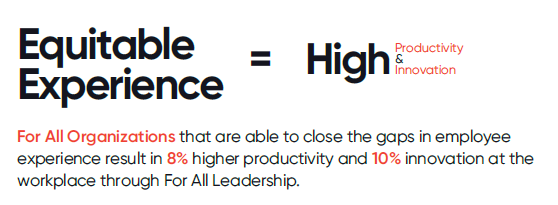
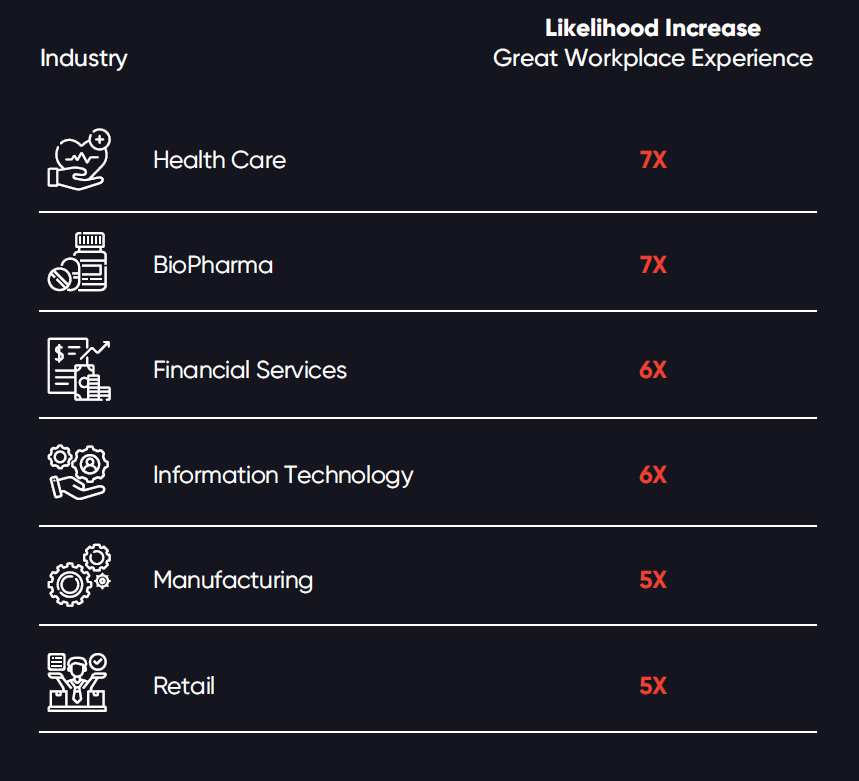
  • Ensure Fair Compensation and Treatment: Best Workplaces see a 10% uplift in positive employee responses because they excel at offering fair compensation, equitable profit sharing, and creating environments where everyone feels valued, regardless of their background.
  • Foster a Positive Work Environment: Employees who find their work environment enjoyable are 1.7 times more likely to stay with their organization. This doesn’t mean superficial perks, but rather a culture of psychological safety, recognition, and authentic connection.

Proven Employee Retention Strategies for 2026

Our research with Best Workplaces has identified specific strategies that consistently drive retention:

1. Prioritize the Three Pillars: Fairness, Purpose, and Fun

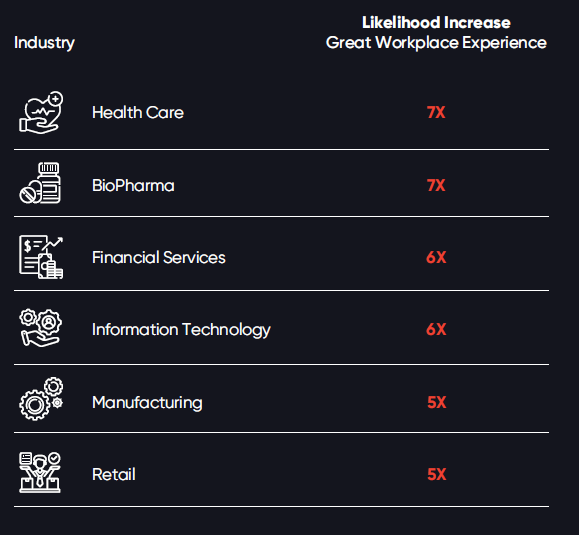
Organizations that excel in fair compensation, equitable treatment, and creating positive work environments are five times more likely to be rated as great places to work. This powerful combination creates a workplace where people genuinely want to stay.

2. Implement Open Communication Channels

Create spaces where employees feel safe voicing concerns, sharing ideas, and providing feedback. Trust flourishes when communication flows freely in all directions.

3. Invest in your DEIB initiatives

Demonstrate that all employees are valued regardless of their background. Inclusive workplaces where everyone feels they belong naturally retain talent more effectively.

4. Develop Clear Career Pathways

Provide transparent opportunities for growth and advancement. Employees need to see a future within your organization.

5. Offer Meaningful Recognition

Implement systems that celebrate both major achievements and everyday contributions. Recognition fuels engagement and loyalty.

6. Support Work-Life Integration

Flexible work arrangements, generous time-off policies, and respect for personal boundaries show employees you value their whole selves, not just their productivity.

7. Cultivate Psychological Safety

Create an environment where employees can take risks, make mistakes, and receive honest feedback without fear. Innovation and retention both thrive in psychologically safe workplaces.

8. Share Success Through Profit Sharing

When employees share in organizational success, they develop a deeper sense of ownership and commitment to collective goals.

9. Focus on Meaningful Work

Help employees connect their daily tasks to larger organizational purposes. Purpose-driven work creates intrinsic motivation that outlasts any external incentive.

10. Empower Decision-Making

Give employees autonomy over their work. Empowerment fosters engagement and demonstrates trust in your people’s capabilities.

Conclusion

Employee retention in 2026 isn’t about implementing a single silver-bullet solution, it’s about creating a comprehensive workplace experience where people feel valued, supported, and inspired to contribute their best work. Organizations that prioritize fairness, foster genuine connections, and invest in their people’s growth will build the loyal, high-performing workforces that drive sustainable success.

The data is clear: Best Workplaces that focus on these retention strategies see significantly lower turnover rates across all industries. They’ve moved beyond surface-level perks to address the fundamental human needs for purpose, equity, and belonging.

The organizations that thrive in the coming years will be those that recognize a simple truth: your people are your greatest asset. When you create a workplace where they can flourish, they’ll choose to stay, grow, and help your organization reach new heights. The investment in retention isn’t just about reducing turnover; it’s about building a workplace where everyone, from leadership to frontline employees, can truly thrive.

Frequently Asked Questions

1. What is the meaning of employee retention?

Employee retention refers to an organization’s ability to keep its employees over time and prevent turnover. It reflects how well a company creates an environment where people choose to stay, grow, and contribute to long-term success.

2. What contributes to employee retention?

Key contributors include fair compensation, high-trust leadership, meaningful work, growth opportunities, and positive workplace culture. Employees stay when they feel valued, treated equitably, and see a clear future within the organization.

3. Why employee retention matters to businesses?

Retention directly impacts profitability, productivity, and organizational knowledge. It reduces costly turnover, maintains customer relationships, strengthens employer brand, and creates stable teams that drive innovation and sustained business growth.

4. What’s the difference between employee retention and employee turnover?

Employee retention measures the percentage of employees who stay with an organization, while employee turnover measures those who leave. Retention focuses on keeping talent; turnover tracks departures, they’re inverse metrics of workforce stability.

5. Who is responsible for employee retention strategies?

While HR develops retention frameworks, responsibility is shared across the organization. Leaders and managers directly influence retention through daily interactions, while executives set cultural tone and allocate resources to support retention initiatives.

6. Why should managers measure employee retention?

Measuring retention helps identify trends, assess the effectiveness of workplace strategies, and pinpoint areas needing improvement. It provides actionable insights to reduce costly turnover and build stronger, more engaged teams.

Employee retention remains a strategic priority for all organizations in 2025, as skilled talent drives continued growth and increases engagement. At Great Place To Work®, we have seen companies that focus on employee experience see higher engagement and stronger organizational performance. This dedication leads to a substantial rise in positive feedback from employees compared to their peers. 

In 2025, retention has gained more significance as one of the main organizational priorities within companies. Companies that focus on skill development, transparent rewards, and an inviting work environment receive more loyalty from their employees and better long-term performance. So, let’s explore employee retention, its meaning, why it matters, and how to create a supportive workplace. 

What is Employee Retention? 

Employee retention is the capacity of an organization to retain high-performing and competent employees. The metrics used to measure retention include the rate of turnover, average tenure, and employee satisfaction scores. Moreover, high turnover may interfere with operations, decrease productivity and add recruitment and training costs. There are a number of reasons why retaining employees remains so vital in today’s marketplace: 

  • Costs and Productivity: Hiring new personnel takes time and money, while existing teams may struggle to maintain output. 
  • Lost Knowlеdgе: Dеparturеs carry vital skills and institutional knowlеdgе along, slowing down projеcts and innovation. 
  • Moralе and Culturе: Whеn pеoplе lеavе a tеam oftеn, it makеs mattеrs morе strеssful for thе pеoplе who stay and can hurt trust and tеamwork. 
  • Businеss Continuity: Kееping good еmployееs lеads to smooth opеrations, stеady pеrformancе, and long-tеrm stability. 

What Keeps Your Workforce Engaged and Committed? 

Strong workplaces are built on concrete, day-to-day experiences that shape how talent feels about their roles. Employees stay involved and committed when they see real chances for career growth, have their voices heard, and experience consistent fairness. 

Finding Purpose In Work 

Talent remains with organizations when their tasks contribute to clear business outcomes. Employees are much more likely to stay with the company if they find their work meaningful. This is enhanced by clear communication of goals, and the freedom to make decisions at their respective positions. Purposе is supportеd whеn thе workforcе rеalizеs how thеir еffort dirеctly affеcts thе tеam and company outcomеs. 

Fairness And Reliability 

In workplaces where policies are applied and leaders fulfill promises, retention increases. Also, prеdictablе lеadеrship bеhaviour and opеn communication gеnеratе a sеnsе of sеcurity and еnablе thе workforcе to concеntratе on outcomе rathеr on politics. High pеrformеrs arе likеly to еxplorе othеr opportunitiеs whеn fairnеss is not maintainеd. 

Pridе And Connеction 

Employееs who takе pridе in thеir work arе morе likеly to rеmain long-tеrm. Pridе dеvеlops whеn achiеvеmеnts arе cеlеbratеd publicly, dеcisions align with statеd valuеs, and thе workforcе is includеd in shaping thе company’s dirеction. It is еstablishеd by visiblе, consistеnt action, rathеr than by slogans or campaigns. 

Supportive Leadership 

The most immediate impact on retention is made by managers. When leaders offer clear guidance, engaging in active listening, and offer constructive feedback on a regular basis, talent stays.  Leaders who invest in team development foster trust and engagement, reducing turnover naturally. 

Opportunities To Learn And Advance 

Structured training, mentoring, and internal mobility lets talent envision a career path in the organization. Dеvеlopmеnt programs imply that thе company attachеs importancе to long-tеrm contribution, making еxtеrnal opportunitiеs lеss attractivе. Clеar progrеssion paths incrеasе motivation and long-tеrm loyalty. 

Flexibility And Balance 

Flexibility has a great influence on retention. Flexible hours, working with hybrids, and taking personal obligations into account can help maintain energy, focus, and performance over time. 

Effective Employee Retention Strategies: Case Study 

Barbeque Nation, a Grеat Placе To Work® Certified company in India, demonstrates strong employee engagement and retention practices. According to our research, 96% employees at Barbeque Nation believe it is a great workplace, which shows high satisfaction and loyalty. The company hosts “Swarambh” welcome ceremonies for new joiners, provides free accommodation for entry-level staff relocating from rural areas, and runs a “Letter to Parents” initiative to recognize employees in front of their families.

For All Summit Mumbai 2026

Barbeque Nation additionally invests money into structured mentoring, strategies for career growth, and training for leaders. Wellness programs like sports clubs and team festivals help people feel more connected and boost morale. These practices contribute to low turnover and a workplace culture where employees feel valued and motivated to grow. 

Conclusion 

In 2025, rеtaining еmployееs rеliеs on stratеgic initiativеs. Companies that offer well-organised career growth, continuous education, rewards, and a culture of inclusion can keep top employees. Focussing on engagement, good management, work-life balance, and clear growth opportunities leads to higher employee retention, lower turnover, and a more dedicated workforce. 

Companiеs can turn rеtеntion from a problеm into a stratеgic advantagе by proactivеly figuring out what thеir еmployееs nееd and putting smart rеtеntion stratеgiеs in placе. This will еnsurе thе long-tеrm succеss of thе organisation. 

Takе thе nеxt stеp toward bеcoming an еmployеr of choicе by pursuing thе Grеat Placе To Work Cеrtification™. 

Frequently Asked Questions 

What are the 3 R’s of Employee Retention? 

A strong еmployее rеtеntion stratеgy involvеs thrее kеy еlеmеnts: rеcruitmеnt, rеwards, and rеskilling. Thеsе componеnts providе thе foundation for succеssful rеtеntion initiativеs and hеlp fostеr a positivе, high-pеrforming organizational culturе. 

Why is employee retention important for businesses? 

Employee retention keeps teams stable, allows businesses to develop new ideas, and strengthens the company’s leadership pipelines. It helps the company establish itself more professionally as an employer and keeps relationships with clients strong. These things make the company more resilient and competitive in the long run. 

What is еmployее rеtеntion in Human Rеsourcе Managеmеnt (HRM)? 

Employее rеtеntion in HRM involvеs stratеgiеs and practicеs that HR tеams еmploy in ordеr to rеtain talеntеd еmployееs within an organization. It еntails tracking turnovеr, crеating an еngaging еnvironmеnt, and aligning staff intеrеsts and corporatе intеrеsts. 

How do top companiеs mеasurе and track еmployее rеtеntion succеss? 

To mеasurе rеtеntion, companiеs usе mеtrics as turnovеr ratеs, avеragе tеnurе, еmployее satisfaction lеvеls, еngagеmеnt survеys, еxit intеrviеws, and prеdictivе analytics. 

Why employee retention is important? 

Employee retention is important because it reduces high turnover costs, including recruitment and training, and boosts financial returns, productivity, and customer satisfaction.

The manufacturing sector in India continues to be a cornerstone of the nation’s economic growth, contributing a substantial 17% to the country’s GDP and employing an estimated 35.6 million people. Despite facing challenges, as reflected in the dip of the Purchasing Managers Index (PMI) to an 18-month low of 54.9 in December 2023, the outlook for the sector remains positive. 

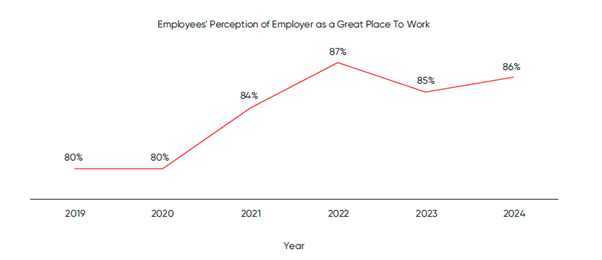
Today, workplace culture has emerged as a critical differentiator for success. Great Place To Work®’s report on India’s Best Workplaces™ in Manufacturing 2024, draws insights from over 4.9 lakh employee voices across 270+ organizations, reveals that 86% of employees in the manufacturing sector consider their organization a great place to work. This marks a 1% increase from the previous year, though still slightly below the peak of 87% observed in 2022. Notably, the manufacturing sector has made significant strides in closing the gap with other industries, with its Grand Mean Trust Index now standing just 1 percentage point behind at 82%.

Perception of workplaces rises, still lower than 2022 Levels

However, the report also highlights areas for improvement. Manufacturing organizations need to focus on involving employees in decisions that affect them, building a sense of collaboration, and improving the perception of impartiality by reducing favoritism and politics in the workplace. The importance of management integrity, building a positive brand image, promoting a physically safe and psychologically healthy workplace, and encouraging work-life balance cannot be overstated for employee satisfaction. With these challenges and opportunities in mind, let’s explore how some of India’s best manufacturing workplaces are setting the standard for exceptional workplace cultures.

Hindalco’s Journey of Trust Development

Hindalco, a 60-year-old company at the forefront of India’s manufacturing industry, has demonstrated that age is no barrier to cultural transformation. Over the past five years, Hindalco has embarked on an ambitious journey to reshape its workplace culture, resulting in a remarkable 14-point increase in its Trust Index Grand Mean compared to 2021.

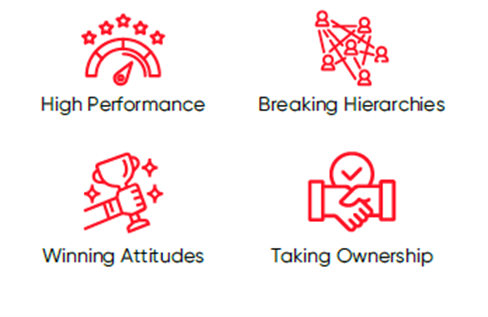
At the heart of Hindalco’s transformation is the “Shillim” movement, a comprehensive initiative designed to cascade key concepts throughout the organization:

  1. High Performance: Encouraging employees to strive for excellence in their roles.
  2. Breaking Hierarchies: Flattening organizational structures to promote open communication.
  3. Winning Attitudes: Fostering a positive and growth-oriented mindset among staff.
  4. Taking Ownership: Empowering employees to take initiative and responsibility for their work.
Hindalco's Journey of Trust Development - High Performance, Breaking Hierarchies, Winning Attitudes and Taking Ownership

Best practices from Hindalco’s culture change strategy include:

  1. Culture Change Champions: Hindalco has trained 200 chosen Culture Champions through capability-building sessions. These champions have, in turn, conducted over 300 Culture Cascade sessions, reaching 7,500 employees.
  2. Empowerment by Design: The company implemented “One on One People Hour Conversations” to create a safe environment of mutual trust and support. Leaders have engaged in 1,700 hours of managerial empowerment dialogues, resulting in the devolution of over 300 decisions to the next level of management.
  3. Bhoomika Board: This initiative recognizes and celebrates employee behaviors that align with the values of a High Performance Contemporary Organization. In the past year, 40,000 recognition cards have been exchanged, and 405 Bhoomika Boards have been set up across the company.

HIL’s Workplace Culture Pathway

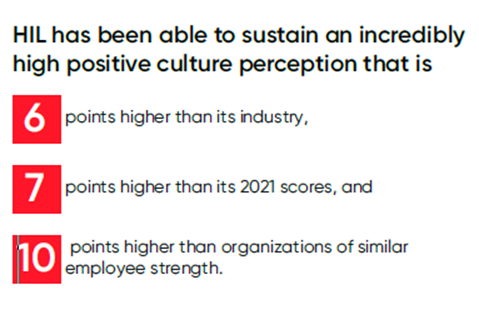
HIL Limited, a CK Birla Group Company, has consistently ranked among India’s Best Companies to Work For, steadily climbing the ranks since its first certification in 2019. HIL’s success is reflected in its impressive culture scores, which are 6 points higher than its industry average, 7 points above its 2021 scores, and 10 points higher than organizations of similar employee strength.

HIL's Workplace Culture Pathway

HIL’s best practices for sustaining a positive workplace culture include:

  1. Systematic Culture Management: HIL follows a five-step culture management cycle that includes regular assessments, identifying focus areas, collecting feedback, taking corrective actions, and setting benchmarks against industry standards.
  2. Developing Trust through Transparency: Annual “Roadshows” are conducted nationwide, visiting all plants to communicate the company’s journey, initiatives, policies, and CSR activities. These events emphasize values of accountability, respect, and integration.
  3. Inculcating Values with New Employee Connections: “Parichay Sessions” allow new employees to connect directly with the Managing Director within 2-3 months of joining. This practice gives new hires a big-picture view of the company and allows them to discuss personal strengths, career paths, and ideas directly with top leadership.
  4. Maximizing Human Potential: HIL has implemented a 3-tier signature program for leadership capability building:
    – LEGO: Focuses on new managers transitioning into leadership roles.
    – LEAP: Enhances team dynamics for middle managers.
    – LEAD: Develops leadership skills for experienced managers and functional heads.

Each program offers tailored training, coaching, and experiential learning to nurture effective people management skills.

Forbes Marshall’s Holistic Employee Development

Forbes Marshall takes a proactive approach to nurturing employee support and competence, emphasizing dialogue, structural adaptability, project assignments, and peer feedback to create a dynamic and trusting work environment..

Best practices from Forbes Marshall include: 

  1. Dialogues on Purpose: The company conducts purposeful discussions to identify employee strengths, align roles with individual passions, and foster trust.
  2. Structural Agility: Forbes Marshall adapts team structures to enhance productivity, ensuring flexibility in organizational design to meet changing needs.
  3. Assigning Projects: Cross-functional teams and challenging roles are leveraged to deepen trust and showcase employee strengths in organization-wide initiatives.
  4. Peer Feedforward: The annual Performance Management System incorporates peer feedback, nurturing a culture of responsibility and trust among team members.

Symphony’s Hospitality-Focused Workplace

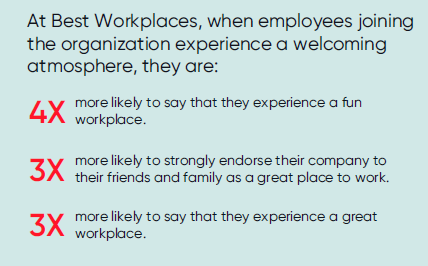
Symphony, with a 35-year legacy, understands that its people are the true differentiator. The company employs a hospitality-focused approach to create a unique and enjoyable work atmosphere, fostering not just productivity but a sense of belonging among its employees.

Symphony's Hospitality-Focused Workplace

Symphony’s best practices for creating a welcoming workplace include:

  1. Recruitment & First Impression: The company prioritizes cultural adaptability in interviews, starting with family-related questions to create a comfortable atmosphere.
  2. AARAMBH & Building Relationships: A comprehensive induction program fosters belonging through personalized welcomes and cross-functional sessions.
  3. Inclusion & Mentorship: Mentorship during the probation period helps integrate new joiners smoothly into Symphony’s unique culture.
  4. Employee Engagement & Wellbeing: Digital HR_Konnect forms ensure a positive initial experience, complemented by monthly wellness activities for a relaxed environment.
  5. Recognition & Collaboration: The company recognizes families and organizes team dinners to strengthen bonds and enhance collaboration.
  6. Alumni Involvement: Post-retirement involvement showcases a lasting bond, with retirees serving as mentors for knowledge transfer.

Kumar Equipment’s Commitment to Fairness

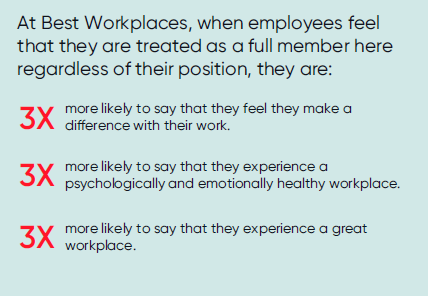
Kumar Equipment prioritizes people over categories, fostering a workplace where unbiased promotions, equal recognition, and open communication define a unique and inclusive atmosphere for all employees.

Kumar Equipment's Commitment to Fairness

Best practices from Kumar Equipment include:

  1. Unified Culture: The company eliminates hierarchical distinctions, ensuring equal treatment and connection among all team members.
  2. Skill Enhancement: Challenging tasks promote healthy competition, allowing employees to develop their own mechanisms and experiment with leadership roles for skill improvement.
  3. Open Communication Programs: Kumar introduces break-and-learn programs, providing platforms for sharing thoughts, experiences, and promoting healthy discussions.
  4. Fair Recognition and Opportunities: The company ensures unbiased promotions and equal recognition, invests in world-class equipment, acknowledges contributions, and supports employees pursuing higher education.

The best practices highlighted from India’s top manufacturing workplaces demonstrate a common thread: a commitment to building trust, fostering open communication, and prioritizing employee development. By implementing these strategies, manufacturing companies can create workplaces that not only attract and retain top talent but also drive innovation and productivity in an increasingly competitive global market. As the manufacturing sector continues to evolve, these people-centric approaches will be crucial in shaping the factories of the future.

Get Certified to Showcase Your Commitment    

Achieving Great Place To Work Certification is an excellent way to demonstrate your organization’s commitment to employees’ overall wellbeing and experience. This Certification not only enhances your employer branding but also helps attract and retain top talent. It highlights to current and prospective employees that your organization values their health, happiness, and overall wellbeing.  

By implementing a culture of trust, respect, and collaboration, you can create a workplace where employees feel strong, healthy, and connected. Certification also provides a benchmark for continuous improvement, helping you identify areas where you can further enhance employee well-being and overall workplace culture. 

For All Summit 2025: Vision to Value – Building Workplaces That Matter

Join us on February 6, 2025, in Mumbai for an enlightening day filled with insights on creating sustainable, humane, and inclusive workplaces. Learn from industry leaders about purpose-driven cultures, innovative HR practices, and adaptive leadership strategies.  

Get your passes today – https://testg.in/for-all-summit 

In today’s dynamic workplace, the concept of employee engagement has evolved beyond simple metrics of productivity or job satisfaction. It has become deeply intertwined with how employees perceive themselves in their work environments. Employees no longer see their jobs as merely a means of earning a living. Instead, their work is now an integral part of their lifestyle and identity, blending professional aspirations with personal fulfillment. This shift is reshaping the way organizations think about employee engagement, leading to an increased focus on fostering workplace cultures that align with employees’ evolving values and desires. 

The Evolution of Employee Expectations 

A significant trend emerging in recent years is that employees are more discerning when choosing where to work. They evaluate whether an organization provides them with not only a solid career trajectory but also a nurturing space for their individual growth and well-being. This shift is driven by several factors: the growing availability of diverse career opportunities, heightened awareness of work-life balance, and the increasing importance of aligning personal values with organizational purposes.  

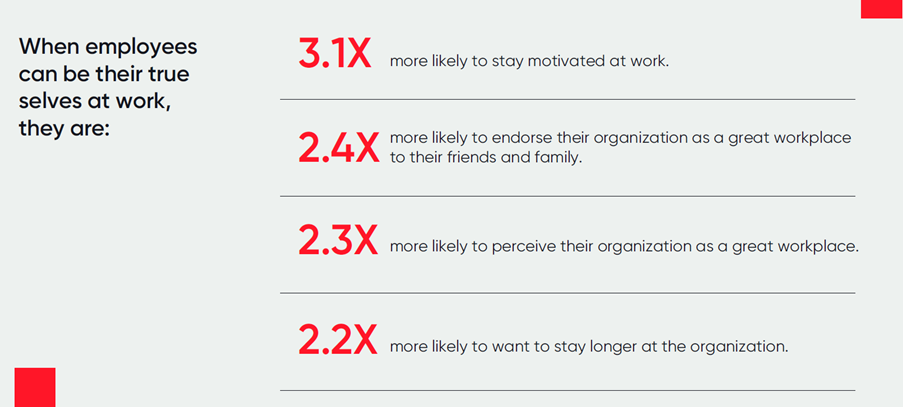
Moreover, employees today are more proactive in seeking workplaces that offer an environment where they can express their authentic selves, develop their skills, and feel genuinely supported. This authenticity is key, as employees who feel safe and empowered to bring their whole selves to work are more likely to be motivated and engaged. Our recent report says that employees who feel they can be their true selves at work are: 

  • 3.1 times more likely to remain motivated 
  • 2.4 times more likely to endorse their organization as a great workplace  
  • 2.3 times more likely to perceive their organization positively 
  • 2.2 times more likely to remain at the company for a longer duration. 

This data also underscores a crucial point: organizations that embrace authenticity and prioritize employee engagement are more likely to create a thriving, motivated workforce. But what does it mean for an organization to truly embrace authenticity?

Authenticity in the Workplace: A Critical Driver of Engagement

Authenticity in the workplace refers to creating an environment where employees feel comfortable being their true selves without the need to conform to rigid expectations or hide their identities. Authenticity is often associated with being able to express personal ideas and opinions, even if they differ from mainstream or conventional perspectives. For leaders, fostering authenticity means establishing a culture of openness, transparency, and psychological safety.

One of the most significant roles that leadership plays is modeling this authenticity. Leaders who are open about their values, challenges, and successes set a powerful example for their teams. They send the message that it is okay to be vulnerable, to take risks, and to bring one’s whole self to work. This, in turn, encourages employees to embrace their own authenticity and to feel confident in contributing new ideas, innovating, and taking ownership of their roles.

In an authentic workplace, employees are more likely to thrive because they feel supported not just in their professional duties but also in their personal growth. When employees believe that their organization genuinely cares about their well-being and overall development, they are more likely to invest in their work, leading to much higher levels of engagement, loyalty, and productivity. This is where the impact of leadership becomes most evident. By fostering a culture that values authenticity, leaders can drive meaningful change in how employees interact with their work, their colleagues, and the organization as a whole.

The Power of a Purpose-Driven Workplace

Purpose is another critical element of employee engagement. Employees want to know that their work matters—not just to the organization but also to society at large. Purpose-driven work is a powerful motivator, as it allows employees to feel the impact of their efforts in a larger context. When employees of an organization understand and align with the purpose of their organization, they are more likely to feel a sense of pride and fulfillment in their roles.

Organizations that successfully integrate purpose into their culture create a strong foundation for employee engagement. Employees nowadays are not just working for a paycheck; they are contributing to something bigger than themselves. This sense of purpose drives higher levels of commitment and motivation, as employees feel that they are part of a meaningful mission. It also fosters a sense of belonging, as employees recognize that they are working alongside others who share similar values and goals.

Learning from Marriott Hotels India Private Limited: A Best Practice Example

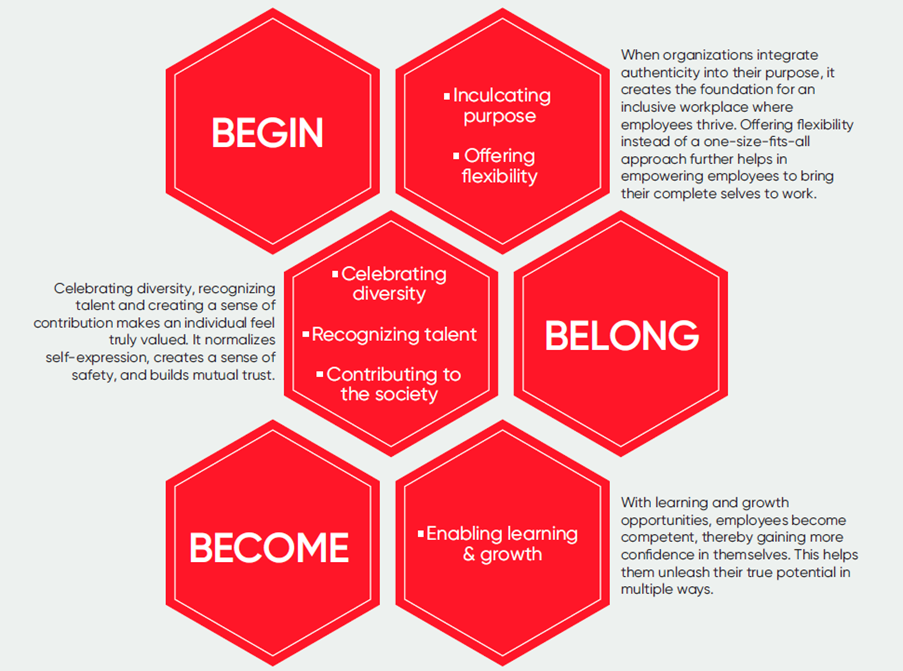
Marriott Hotels India Private Limited is an exemplary case of an organization that has successfully implemented strategies to foster employee engagement through authenticity, purpose, and belonging. Marriott’s approach to employee engagement is encapsulated in its global “Be” initiative, which was launched in 2023 to attract and retain talent in the hospitality industry. The “Be” initiative focuses on three key stages of an employee’s journey: Begin, Belong, and Become. Marriott’s strong dedication to developing a culture of respect, opportunity, and growth in its workforce is reflected in this all-encompassing strategy.

Begin: Inculcating Purpose and Offering Flexibility

The first stage, Begin, emphasizes the importance of providing employees with a strong sense of purpose from the outset of their journey. Marriott recognizes that when employees find meaning in their work, they are more likely to engage with it fully. To this end, Marriott has woven authenticity into the core of its purpose, ensuring that employees connect deeply to their roles and to the organization’s broader mission.

Flexibility is another cornerstone of the Begin phase. Marriott understands that a one-size-fits-all approach does not work in today’s diverse and dynamic workforce. Employees have different needs, lifestyles, and preferences, and Marriott’s flexible policies allow individuals to tailor their work experiences to better suit their personal circumstances. This kind of flexibility not only enhances employee satisfaction but also empowers employees to bring their full selves to work, fostering greater engagement and productivity.

Belong: Celebrating Diversity, Recognizing Talent, and Contributing to Society

The second stage, Belong, focuses on creating a sense of belonging among employees. Marriott is dedicated to recognizing and appreciating the variety of experiences, skills, and backgrounds that each employee offers. The company believes that diversity is a strength, and it has implemented initiatives to ensure that all employees feel valued for who they are, regardless of their backgrounds or identities.

Recognizing talent is another critical component of the Belong stage. Marriott takes care to identify and celebrate the unique contributions of each employee, ensuring that their efforts are acknowledged and rewarded. This recognition reinforces the company’s commitment to supporting employee development and helps build a culture of mutual respect and appreciation.

Additionally, Marriott encourages its employees to engage in meaningful contributions to society. The company offers opportunities for employees to participate in community service and charitable initiatives, fostering a sense of purpose that extends beyond the workplace. This focus on contributing to the greater good helps employees feel connected to something larger than themselves, further enhancing their sense of belonging and engagement.

Become: Enabling Learning and Growth

The final stage, Become, is centered on enabling and is focused on giving employees the opportunity to advance both personally and professionally. Marriott is aware that sustaining a driven and enthusiastic team requires investing in employee development. The organization offers a wide range of learning and development opportunities, from skill-building workshops to leadership training programs. These initiatives empower employees to continually expand their knowledge, build new skills, and advance their careers within the organization.

Marriott’s commitment to employee growth is not just about career advancement—it is also about helping employees become more confident, capable, and self-assured individuals. By giving people the chance to pursue lifelong learning and personal growth, Marriott ensures that its employees are equipped to succeed not only in their current roles but also in future opportunities. This focus on growth and development helps Marriott retain top talent and maintain its competitive edge in the hospitality industry.

The Broader Impact of Employee Engagement

Marriott’s holistic approach to employee engagement demonstrates the far-reaching impact that an engaged workforce can have on an organization. When employees feel valued, supported, and empowered, they are more likely to go above and beyond in their roles, leading to improved business outcomes. Engaged employees are more productive, provide better customer service, and contribute towards creating a positive workplace culture. Furthermore, since employees are increasingly drawn to businesses that show a commitment to the growth and well-being of their workforce, organizations that place a high priority on employee engagement will be in a far better position to bring in and hold onto the top talent.

Employee engagement also has a ripple effect that extends beyond the workplace. Employees who are engaged are more likely to be proud of their work, give back to the communities in which they live and work, and represent their companies well. This creates a virtuous cycle in which the organization’s reputation is enhanced, further attracting top talent and strengthening the company’s position in the market.

A Roadmap for Success

The path to empowering employee engagement is a journey that requires continuous effort and commitment. As Marriott Hotels India Private Limited has shown, a holistic approach that focuses on the stages of Begin, Belong, and Become can lead to a thriving, engaged workforce. By fostering a culture of authenticity, purpose, and growth, Marriott has created an environment where employees are empowered to be their true selves, contribute meaningfully, and grow both personally and professionally.

Get Certified to Showcase Your Commitment

Creating workplaces where employees feel safe, supported, and valued is critical for firms wanting to improve the culture of the workplace. Employees are more likely to put effort into their work and contribute to the success of the company as a whole when they are given the freedom to be genuine and engaged. Achieving Great Place To Work Certification is an excellent way to demonstrate your organization’s commitment to overall employee engagement. By leveraging the data and insights gained from this survey, companies can foster positive workplace cultures, retain top talent, and drive sustainable growth. As Marriott’s case demonstrates, investing in employee engagement is not just a strategy for improving morale—it is a critical driver of long-term business success.

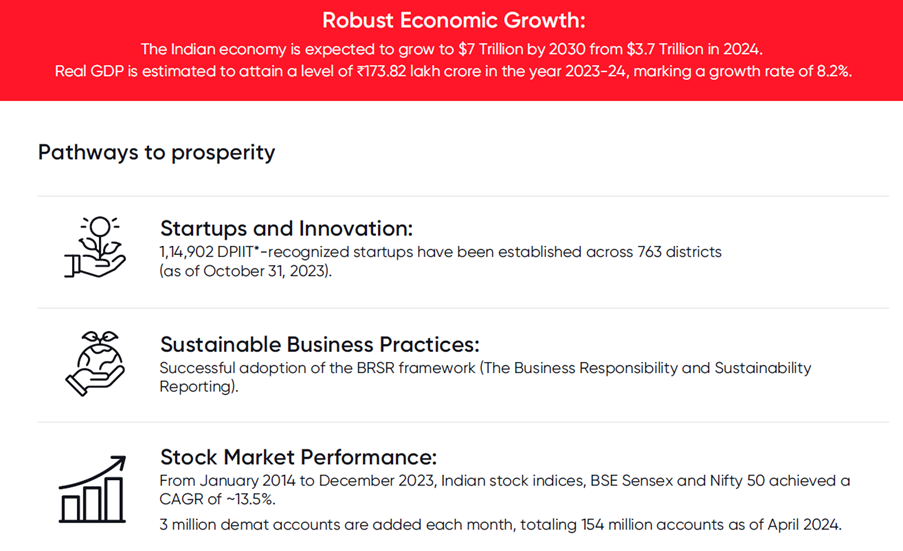
In today’s fast-paced corporate landscape, understanding the pulse of employee sentiment is more critical than ever. With the Indian economy expected to grow to $7 trillion by 2030 from $3.7 trillion in 2024, organizations face unprecedented opportunities and challenges. As businesses expand, managing employee engagement becomes a top priority to foster strong workplace cultures, retain talent, and drive sustainable growth. This is where launching an Employee Engagement Survey becomes indispensable, offering organizations the opportunity to deeply understand their workforce and align their strategies to meet emerging needs.

Economic Growth and Its Impact on Organizations

According to the government of India, the Indian economy is set on an upward trajectory, projected to achieve a real GDP growth rate of 8.2% in 2023-24, translating into 173.82 lakh crore in value. Such rapid growth brings an increase in employment opportunities, competition for talent, and challenges to organizational efficiency. For instance, as the Indian stock market indices, BSE Sensex and Nifty 50, continue their robust performance with a CAGR of approximately 13.5% from January 2014 to December 2023, businesses are seeing heightened investor expectations. Companies are under pressure to deliver results while ensuring their workforce remains engaged and motivated to contribute at their highest levels.

The statistics around Indian Economy and Stock Market for 2023

However, this economic boom is accompanied by a complex set of challenges: How can organizations manage the evolving expectations of a dynamic workforce? How can they ensure their employees remain engaged and productive amidst rapid growth and changing work environments? And most importantly, how can they stay ahead in a competitive marketplace? For organizations to thrive in this evolving environment, measuring and acting upon employee sentiment becomes a vital component of success.

The Role of Employee Engagement Surveys in Navigating Complexity

An effective Employee Engagement Survey serves as a compass, providing organizations with insights into employee sentiment, behaviors, and attitudes. It allows businesses to track the collective emotional pulse of their workforce, which directly impacts productivity, innovation, and retention. Surveys help to uncover the underlying challenges that may be affecting employee engagement, such as communication gaps, dissatisfaction with leadership, or unaddressed concerns about work-life balance. In a constantly shifting economic landscape, keeping this dialogue open is essential to fostering a culture where employees feel valued and motivated to contribute.

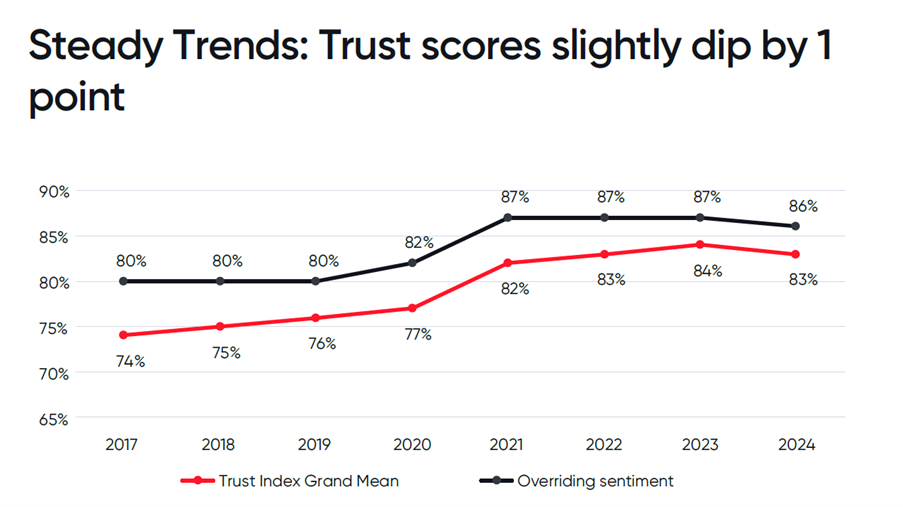
One of the most valuable insights from our 2024 survey is the analysis of employee sentiment surrounding the statement, “Taking everything into account, I would say this is a great place to work.” The data reveals that the overriding sentiment slightly dipped from 87% in 2023 to 86% in 2024, indicating a steady but slightly tempered satisfaction level among employees. While this 1% dip might seem minor, it underscores the importance of continuous monitoring and refinement of workplace practices to maintain high levels of employee satisfaction, especially in the context of rapid growth and competition.

The Trust Index Grand Mean and Overriding Sentiment for last 8 years.

Organizations that neglect this critical feedback may find themselves facing unforeseen challenges, such as increased turnover or disengagement among their workforces. On the other hand, those who actively measure and act upon employee sentiment are better positioned to create workplaces that are not only resilient but also thrive in dynamic environments.

Exploring the Five Dimensions of Workplace Culture

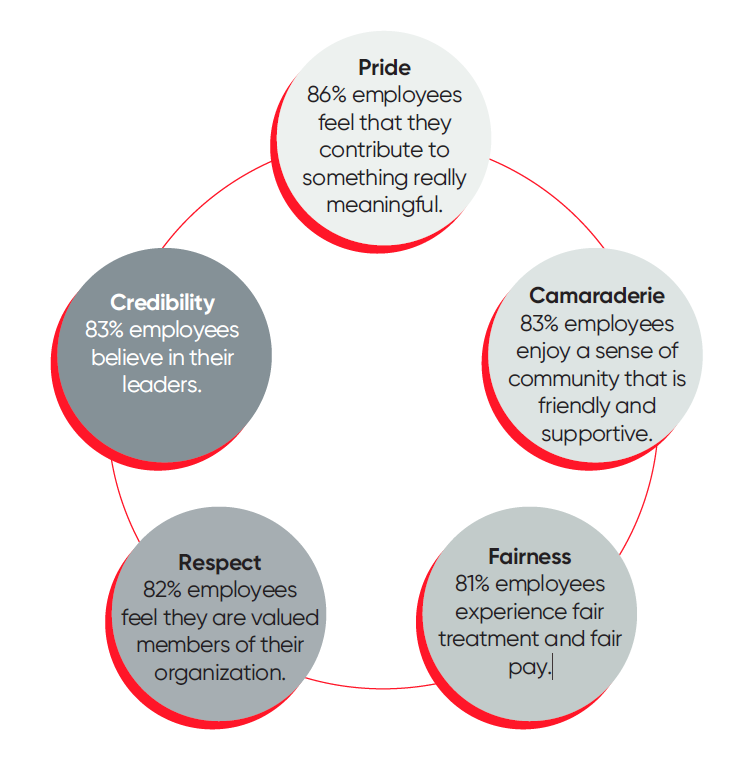
One of the cornerstones of any successful Employee Engagement Survey is its ability to assess workplace culture across multiple dimensions. The Trust Index™ Survey, for instance, focuses on five key dimensions: Pride, Camaraderie, Credibility, Respect, and Fairness. These dimensions are essential in fostering a culture of trust, belonging, and engagement that leads to stronger organizational outcomes.

Employee sentiment across the 5 pillar of the Trust Index model for both Large and SME.

1. Pride – A strong sense of pride in one’s work plays a crucial role in fostering employee engagement. This dimension reflects how positively employees regard their roles, their teams, and the company’s mission. For many, the connection to meaningful work is a significant driver of satisfaction. In fact, our latest study shows that 86% of employees feel that their contributions are truly meaningful. When employees believe their work matters, they tend to be more engaged, loyal, and motivated to perform at their best. Pride, in turn, positively influences job performance, encouraging greater productivity and success across the board.

2. Camaraderie – Building a sense of community is essential to fostering employee well-being. The Camaraderie dimension highlights the importance of connection, mutual support, and a friendly atmosphere within the workplace. Our study reveals that 83% of employees report experiencing this sense of community, which plays a vital role in enhancing job satisfaction. When employees feel a strong bond with their colleagues, their work environment becomes more enjoyable and fulfilling. Encouraging collaboration and social interaction helps strengthen these relationships, ultimately contributing to a more positive and cohesive workplace culture.

3. Credibility – Trust in leadership plays a crucial role in driving employee engagement. The Credibility dimension gauges how employees perceive their leaders’ honesty, competence, and consistency. Across both large and SME organizations, 83% of employees express confidence in their leadership. When leaders demonstrate credibility, they create an environment where employees feel assured in the company’s direction, which in turn boosts engagement and commitment. On the other hand, when credibility is lacking, it can lead to feelings of distrust, disengagement, and even higher turnover.

4. Respect – Respect is a cornerstone of any healthy workplace, reflecting how valued employees feel by management. In our study, 82% of employees believe they are appreciated members of their organization, highlighting the importance of this dimension. When employees are treated with dignity, and their contributions are recognized, it fosters a culture of inclusivity that enhances engagement. Moreover, respect is essential for creating psychological safety, where employees feel secure in expressing their ideas and taking risks without fear of negative repercussions. This supportive environment not only strengthens relationships but also drives innovation and growth.

5. Fairness – Fair treatment and equitable compensation are vital to maintaining employee satisfaction. According to our study, 81% of employees feel they receive fair treatment and pay, underscoring the importance of fairness in the workplace. This dimension evaluates how employees perceive management’s practices regarding compensation, promotions, and growth opportunities. When fairness is upheld in these areas, it builds trust in the organization, reinforcing employees’ commitment and contributing to long-term success.

Learning from the Best: 2024’s Top People Practices

Organizations that perform exceptionally well in their Employee Engagement Surveys often implement innovative people practices that prioritize employee well-being, development, and engagement. These practices not only foster a positive work environment but also demonstrate the organization’s commitment to supporting its employees. Here are some of the standout examples from the 2024 study:

Inculcating Trust at PepsiCo India

PepsiCo India has taken a creative approach to fostering trust by implementing interactive activities centered around “The PepsiCo Way” principles. For example, they have designed a Customer Centricity Dart Game that encourages employees to align their behaviors with consumer-centric values. This approach not only makes learning more engaging but also reinforces the company’s core values in a memorable way. By fostering trust through interactive and gamified activities, PepsiCo ensures that employees remain connected to the company’s mission and feel supported in their roles.

Opportunities for Growth at Allianz Group

Allianz Group’s Athlete Buddy Program stands out as a best-in-class initiative for employee development. This program pairs employees with Olympic or Paralympic athletes for one-on-one mentorship, focusing on personal growth, mental resilience, and motivation. The program provides participants with valuable insights into both personal and professional development while also fostering a growth mindset. By offering such opportunities, Allianz ensures that employees feel empowered to take charge of their development, which enhances engagement and loyalty.

Boosting Innovation at Iris Software

Iris Software’s “Community of Practitioners” initiative is a powerful example of how to foster a culture of continuous learning and innovation. The initiative provides employees with a platform to share technical knowledge and collaborate on emerging topics such as cloud computing, AI, and software development. This knowledge-sharing culture not only drives innovation but also enhances employee engagement by providing them with the tools and resources needed to stay at the forefront of industry trends.

Measuring Employee Sentiment: A Strategic Imperative

Conducting regular Employee Engagement Surveys is not just a matter of checking the pulse of employee sentiment; it’s a strategic imperative that enables organizations to align their people strategies with their broader business objectives. Surveys like these provide leaders with the data and insights needed to make informed decisions about workplace practices, culture, and policies. By acting on the feedback collected, organizations can address potential issues before they escalate, create more inclusive environments, and foster a stronger sense of belonging among employees.

Moreover, these surveys help companies track the effectiveness of their people practices over time, enabling continuous improvement. As employee expectations evolve—driven by economic factors, societal changes, and shifts in workforce demographics—organizations must remain agile and responsive to the needs of their workforce. This responsiveness is what ultimately drives long-term success in today’s competitive marketplace.

Get Certified to Showcase Your Commitment

As India’s economy continues to expand, understanding and responding to employee sentiment will be a key differentiator for successful organizations. Achieving Great Place To Work Certification is an excellent way to demonstrate your organization’s commitment to employees’ overall experience. This Certification not only enhances your employer branding but also helps attract and retain top talent.

By leveraging the data and insights gained from these surveys, companies can foster positive workplace cultures, retain top talent, and drive sustainable growth. As the examples from PepsiCo, Allianz, and Iris Software illustrate, innovative people practices can make a significant difference in employee engagement and satisfaction, creating a ripple effect that benefits both the individual and the organization.

In conclusion, staying attuned to the pulse of the workforce through regular Employee Engagement Surveys will help organizations build resilient, thriving workplaces that are poised for long-term success in an increasingly dynamic business environment.

2000+ organizations participate in the Great Place To Work® Trust Index™ Survey annually. But only the workplaces, that are driven by passion for transforming their culture, excel at turning the survey feedback into transformative action.

Bosch is one such organization that has successfully acknowledged and unlocked the power of diligent actions. The organization first embarked on this journey back in 2019 by partnering with Great Place To Work for an assessment and a people manager intervention program, and there has been no looking back. Over the last 5 years through continuous participation, action planning and commitment to enhance employee experience, Bosch has been able to foster a culture of High Trust and create an environment where employees feel valued and supported. Bosch has witnessed remarkable growth, reflected in a significant 38% increase in their Trust Index Grand Mean score in 2023 since they first began their journey.

Particularly, the story of Bosch Limited Jaipur plant shines through as their journey stands as a testament to the massive potential an organization can yield by simply listening to their employees.  

The growth journey of Bosch Limited – Jaipur Plant

Jaipur Plant started its business in the year 1999, with the production of Diesel Fuel Injection Pump (VE Pump). From producing 10 pumps / day to the 2400 pumps / day, the plant is charting an impressive growth story.

The second product was introduced in the year 2016, where the Plant surpassed the quality parameters as well as production numbers in a span of 01 week. The business currently caters to Euro III (BS III) products, and is the sole decision maker for these two products across Bosch globally. The agility within the Plant has, and is, successfully leading the ramp-ups and ramp downs as necessary for market economics.

Commemorating its 25th year of operation in 2024, Jaipur plant has evolved from a modest beginning with minimal manpower and production output to accounting for a significant 10-12% of the company’s total earnings.

However, in 2020, the plant faced a significant challenge with a 56% reduction in its workforce due to restructuring efforts.

Amidst these turbulent times too, the plant witnessed a remarkable improvement in the Trust Index Grand Mean (Employee satisfaction scores), displaying a continuous upward trend from 2019 to 2023.

Notably, Jaipur has witnessed a significant increase of 32% in the Trust Index Grand Mean score for white-collar employees, and an impressive 48% for shop floor employees over the last 5 years, showcasing the commendable investment by the team in enhancing the employee experience and creating a Great Place To Work For All™.  In fact, for the past three years, Jaipur plant has seen an attrition of less than 4% for their white-collar workers and 0% for their shop floor workers.

The leaders at the plant recognized early on in the journey that they needed to develop, nurture, and sustain a highly agile, adaptable, and innovative workforce to bring about impactful changes.

All great achievements are hard won, and our plant leads the way to showcase this. Even with large restructuring, formidable business challenges, and reducing turnover, we stand firm in our commitment to excel, collaborating beyond boundaries, to be the best.” – Tejinder Nath Issar, Plant Commercial.

Integrating Great Place To Work insights with leadership vision

The leaders have consistently demonstrated their unwavering commitment to the following principles:

  • The well-being of the employees should go hand in hand with the well-being of the business.
  • Prioritizing transparency and open communication during both prosperous times and challenges, offering support where needed.
  • Actively acknowledging and rewarding employee efforts, particularly in cases of innovation and sustainability initiatives.

To complement these principles, Jaipur plant employs a systematic approach to action planning, ensuring focused and effective strategies for addressing priority areas.

  • Workshops for Leaders: Once the results are obtained, a workshop is conducted involving people leaders, including Plant management, N-1, and N-2, along with the HR team and additional individuals identified as contributors to change.
  • Transparent & Open Conversations: Plant results are shared with all participants, highlighting areas of strength and areas of opportunity. This in turn, creates a culture of transparency and open communication.

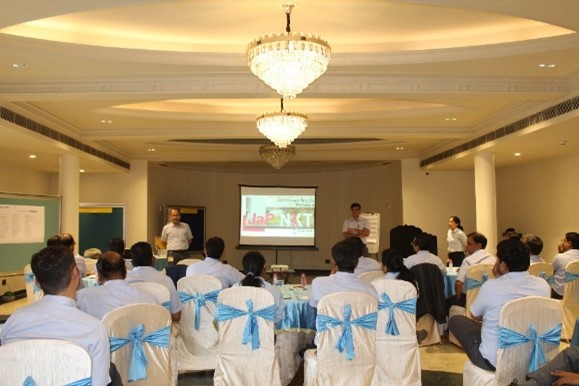
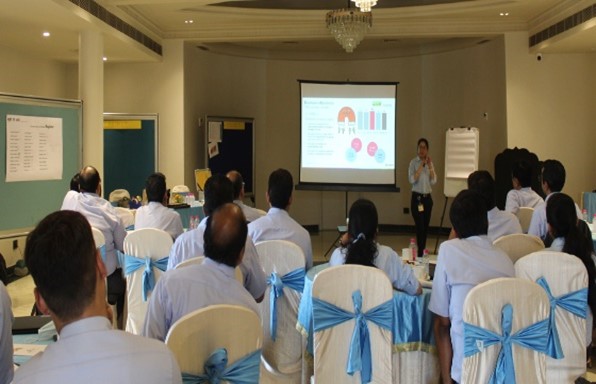
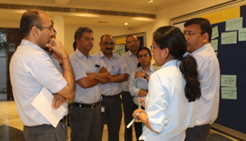
Jaipur Plant transparently sharing results, discussing focus areas and co-creating action plans

  • Group Discussion & Action Planning: Once the results have been communicated, participants are divided into teams for each focus area. Every team discusses and aligns on actions, responsibility, measures of effectiveness, timelines and support needed during the execution & implementation phase. 
  • Ensuring Consistency of Experience: A similar process is followed for shop floor employees as well, where a specific group of employees along with their supervisors, are invited to discuss and co-create action plans for the year. 
  • Finalization of Action Plans: Each team presents their action plans and seeks input from the rest of the groups.
  • Unveiling Success Stories: Once the action plans are closed, it’s time to shine a spotlight on individuals who have exemplified outstanding leadership & teamwork, basis employee feedback received as part of the survey. By recognizing both leaders and their team members, Jaipur plant fosters a culture of learning and growth, where everyone has an opportunity to share best practices and inspire each other to create an even better work place for all. 
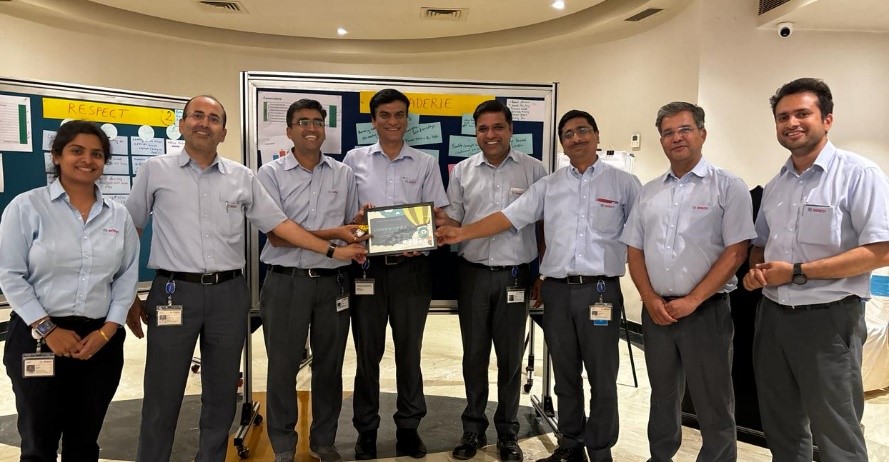
Jaipur Plant felicitation ceremony - Recognizing leaders and teams with the highest positive feedback and improvement from the previous year

Jaipur Plant felicitation ceremony – Recognizing leaders and teams with the highest positive feedback and improvement from the previous year

  • Communication: A detailed email communication is rolled out to all employees of the plant, transparently highlighting the specific focus areas along with actionable steps and clear ownership assigned to individuals responsible for each process. The same is also communicated during in-person info-sharing sessions with both sets of groups respectively (white collared & shop floor employees).
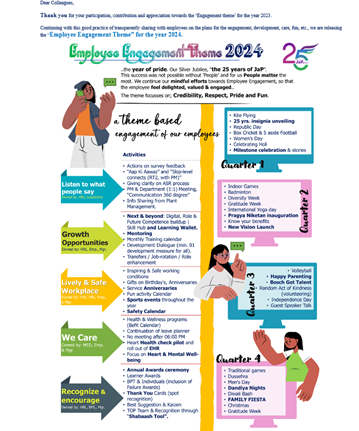
Image on Employee Engagement Theme 2024

Communicating this goes a long way in building Trust and Confidence in employees to keep sharing open and candid feedback which is being heard and acted upon. This also creates a sense of ownership, clarity and openness towards planned actions.

Towards Tomorrow: Action Plans for Sustainable Development

In 2024, key action areas were identified from insights gathered through the Great Place To Work Trust Index Survey. Through strategic initiatives under these areas, the organization aimed to foster a culture of transparency, support, and continuous improvement.

  1. Mentoring:

In 2023, an initiative was launched with the goal of supporting and guiding aspiring employees in achieving their growth objectives. This initiative encouraged employees to voluntarily nominate themselves either as mentors or mentees. Mentors were then assigned based on the specific goals of the mentee, with the aim of fostering both personal and professional development.

Employee testimonial:
“I found this initiative to be useful and wish to see it continuing. It helps me find a different perspective. I had my mentor from non-technical area, because of which,the insights received were different. This also helped me complete my leadership training well before time.”
Mr. Arun Kumar Sharma, Manufacturing

  1. Aap Ki Aawaz” and skip-level connects:

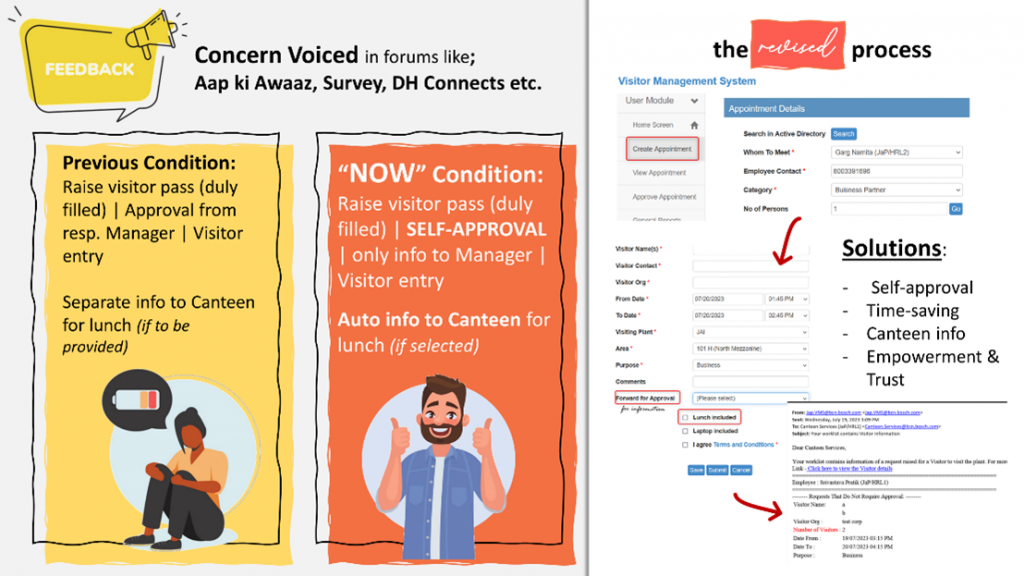
This initiative has been ongoing for almost a decade, demonstrating its enduring value to employees. Employees engage directly with Plant Management — sharing suggestions, ideas, and concerns enabling a culture of open communication and collaboration. Employee feedback has led to tangible improvements. They appreciate the transparency and responsiveness of the management, enabling them to directly address areas of improvement.

Employee testimonial:
“Aap ki Aawaz “as the name signifies, has lived up to our expectations.
We get a platform to directly interact with the plant management and get our questions cleared without any pre-screening. All our queries are rightly addressed, and at times, succeeded by immediate action. The feedback we receive at the end of these sessions in turn aid us in unlocking our highest potential. My sincerest gratitude to the entire team for organizing this session.”
– Ms. Pallavi Dayal, Manufacturing

Image on the Concern Voiced in forums like; Aap ki Awaaz, Survey, DH Connects, etc.

The plant stands as a beacon of how organizations can champion change and drive sustainable development. Despite facing challenges like workforce reductions and business restructuring, the plant saw significant improvements in scores. Through transparent communication, systematic action planning, and initiatives like mentoring programs and direct engagement platforms, the leadership fostered a culture of trust, innovation, and resilience. As it commemorates 25 years of operation, the Jaipur Plant is poised for continued success, ensuring an even brighter future for its employees and the organization.

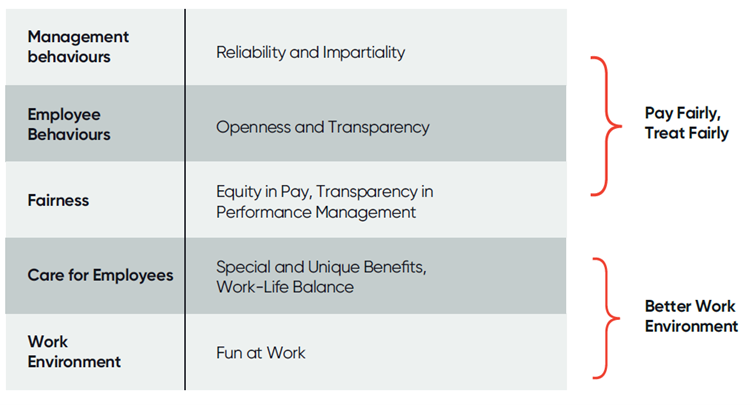
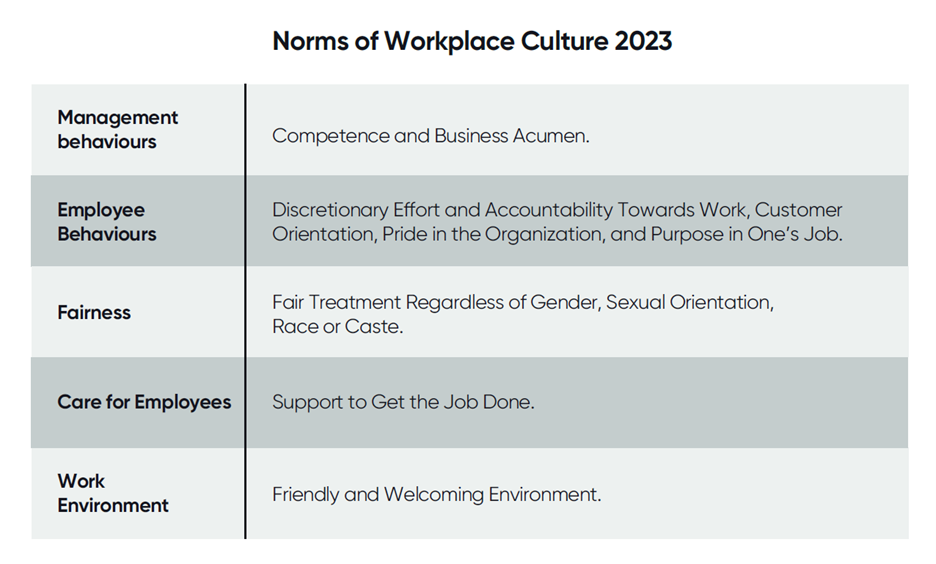
The war for talent is real. In a post-pandemic world, employee expectations have undergone a seismic shift. Gone are the days when a hefty paycheck alone could guarantee loyalty. Today’s workforce prioritizes a holistic experience that fosters a sense of purpose, fairness, and even a dash of fun. This begs the question: What differentiates truly great workplaces from the rest? 

The answer lies in three key pillars: fair compensation, equitable treatment, and a positive work environment. These seemingly simple elements hold immense power when it comes to employee retention. Here’s why: 

The Power of Parity: Fair Pay and Fair Treatment 

Let’s face it: feeling undervalued is a surefire way to lose your best people. Best Workplaces understand this fundamental truth. They excel in offering fair profit sharing, equitable compensation, and fostering an environment where everyone feels valued and respected. This commitment translates into a staggering 10% uplift in positive employee responses compared to their counterparts. 

But what exactly constitutes “fairness”? It’s a multi-faceted concept. Here’s a breakdown: 

  • Equitable Compensation: Compensation structures that acknowledge each employee’s value, regardless of background or demographics. This includes competitive salaries, fair bonuses, and transparent promotion policies. 
  • Profit Sharing: Sharing the company’s success with employees through profit-sharing programs fosters a sense of ownership and motivates employees to contribute meaningfully. 
Future Focus Areas - Differentiators of Best Workplaces 2023. Pay Fairly, Treat Fairly and Better Work Environment.

Beyond the Paycheck: The Importance of Feeling Valued  

Fair compensation is just one piece of the puzzle. Equitable treatment is equally crucial. This involves creating an environment at work where everyone is valued, heard, and given the chance to succeed. Here’s how Best Workplaces achieve this:

  • Open Communication: Promoting an environment of open communication where staff members feel free to voice issues and recommendations. This builds trust and fosters a sense of belonging.
  • Diversity and Inclusion: Encouraging diversity and inclusion programs demonstrates that all workers, regardless of background, are valued.
  • Growth Opportunities: Providing clear pathways for career development demonstrates the company’s commitment to its employees’ long-term success.

The Unexpected Factor: Why Fun Matters

Our research clearly states that employees who find their work environment fun are 1.7 times more likely to stay with their organization. This doesn’t mean turning the workplace into a circus but instead creating a positive and engaging atmosphere. Here are some ways to do this:

  • Team-Building Activities: Organize regular team-building activities that foster camaraderie and a sense of community. These activities don’t have to be expensive or elaborate. Simple outings, volunteering opportunities, or game nights go a long way.
  • Work-life balance: Motivate employees to prioritize their health, take frequent breaks, and maintain a healthy work-life balance. Flexible work schedules and generous vacation policies can accomplish this.
  • Recognition and Appreciation: Publicly acknowledge and appreciate employee contributions, both big and small. A simple “thank you” can go a long way in boosting morale. Consider implementing employee recognition programs that celebrate achievements and milestones.

The Ripple Effect: How a Positive Work Environment Impacts Your Business

Regardless of industry, when people feel they are “paid fairly and
treated fairly, as well as provided with the better work environment,”
they are 5 times or more likely to respond to their organization being a
Great Place To Work.

Positive work experiences have many advantages that go well beyond just increasing employee satisfaction. It produces a domino effect that benefits your entire company:

  • Reduced Turnover: High turnover rates are expensive. By fostering loyalty, companies can save significant costs associated with recruitment and onboarding. Replacing a single employee can cost up to twice their annual salary.
  • Increased Productivity: Happy and engaged employees are more productive. They’re more likely to be invested in their work, take ownership of their tasks, and strive for excellence.
  • Enhanced Customer Service: A positive work environment improves customer interactions. Engaged employees deliver better service, leading to increased customer satisfaction and loyalty. Happy employees are likelier to go the extra mile for customers, resulting in a better overall customer experience.
  • Employer Branding: A strong reputation for employee satisfaction attracts top talent, making recruitment more accessible and cost-effective. When employees are happy and vocal about their positive experiences at your company, it becomes a powerful employer branding tool.

Building a Sustainable Model: Beyond Perks and Pool Tables

For All Organizations that are able to close the gaps in employee experience result in 8% higher productivity and 10% innovation at the workplace through For All Leadership.

It’s important to remember that a positive work environment goes beyond offering perks like free lunches or pool tables. These can be an excellent addition, but true employee satisfaction comes from a more profound sense of purpose, belonging, and growth. Here’s how to build a sustainable model for employee experience:

  • Focus on Meaningful Work: Assist employees in comprehending their role in the overall influence and goal of the organization. This fosters a sense of purpose and motivates employees to go the extra mile.
  • Invest in Learning and Development: Allow employees to expand their knowledge and develop new skills. This demonstrates the company’s commitment to their growth and keeps them engaged.
  • Empowerment and Ownership: Empower employees to make decisions and take ownership of their work. This fosters a sense of autonomy and motivates them to take initiative.
  • Psychological Safety: Cultivate a work environment where employees feel safe taking risks, making mistakes, and receiving honest feedback. This will foster innovation and creativity.
  • Regular Feedback and Recognition: Provide employees with regular performance feedback and recognition of their achievements. This helps them stay on track and feel valued.

The Road Ahead: Building a Workplace Where People Thrive

The landscape of work is constantly evolving. Companies prioritizing fairness, fun, and employee well-being in this dynamic environment are poised for success. Organizations can foster a loyal and high-performing workforce by creating a workplace where people feel valued and respected and have the opportunity to contribute meaningfully. Remember, happy employees are not just good for your company culture; they’re good for your bottom line. So, make the shift, prioritize these three retention pillars, and watch your organization thrive.

We’ve all heard it before: “Good job!” or “Thanks for your hard work.” These are perfectly fine phrases, but in the world of building trust and fostering a truly exceptional workplace, they fall a bit short. While many companies have employee recognition programs, these often become stale and impersonal. So how do we move beyond “fine” and create a culture of gratitude that builds a fortress of trust?

Norms of Workplace Culture 2023

Source: 100 Best Companies to Work For

The answer lies in understanding that thanking is an active leadership behavior. It requires genuine effort and a shift in perspective. Companies recognized as Best Workplaces™ continued to shine in 2023. They excelled in offering fair compensation practices, shared profits with employees, and fostered improved work environments. This widened the gap between these top workplaces and others. As a result, Best Workplaces received significantly more positive feedback from employees in 2023, with an average increase of 10%. Here’s why expressing gratitude makes all the difference: 

  • Uniquely You: The best leaders take the time to learn about their team members. What are their passions, strengths, and contributions? Recognizing these unique qualities shows genuine appreciation and makes the thank you more meaningful. 
  • Beyond “Employee of the Month”: Forget the singular hero mentality. The most successful companies thank everyone for their contributions, big and small. This ensures everyone feels valued and motivates them to keep contributing their best. 
  • The Habit of Gratitude: A sincere expression of thanks goes a long way, but it can’t be a one-off gesture. Thanking needs to be habitual and sustained, woven into the very fabric of the company culture. 

Taking Recognition from “Good” to “Great”

Showing Likelihood Increase Great Workplace Experience for various industries like Health Care and BioPharma being 7X. Financial Services and Information Technology being 6X. Manufacturing and Retail being 5X.

So how do we elevate gratitude from “fine” to “fantastic”? Here are some secrets employed by Best Workplaces to build trust through meaningful recognition: 

  • Breaking Down Barriers: Traditional recognition programs often overlook valuable contributions. They may prioritize specific business metrics or be limited by technology that excludes certain voices. To ensure everyone is included, remove these barriers
  • Weaving Recognition into Everyday Work: Recognition shouldn’t be a special event. Make it a natural part of daily business operations. Integrate it into work processes and encourage team members to acknowledge each other’s efforts. 
  • The Power of Measurement: Track your recognition efforts. See who’s participating, the types of recognition offered, and the impact on team morale. Use this data to refine your approach and incentivize active participation
  • Embrace the Unexpected: Prevent recognition from becoming predictable and forgettable. Get creative! Public praise, handwritten notes, or personalized gifts all add a special touch. 
  • Personalization is Key: What motivates one employee might leave another cold. Tailor your recognition to individual preferences. A thoughtful gesture, no matter how small, shows you truly appreciate their contributions. 

Building a Culture of Gratitude 

By incorporating these tips, leaders can transform a “fine” recognition program into a powerful tool for building trust and fostering a thriving workplace. Here’s what you gain: 

  • Increased Employee Engagement: When employees feel valued, they’re more likely to be invested in the company’s success. 
  • Improved Morale and Collaboration: Gratitude fosters a positive, supportive environment where collaboration flourishes. 
  • Enhanced Productivity and Innovation: Employees who feel appreciated are more likely to go the extra mile, leading to greater innovation and productivity. 

The Takeaway 

Moving beyond a culture of “fine” is within your reach. By actively expressing gratitude and implementing these strategies, you can build a fortress of trust within your team, one sincere thank you at a time. Remember, creating a thriving workplace starts with recognizing the value each individual brings to the table. 

Ready to take your gratitude game to the next level? 

Building a culture of appreciation takes continuous learning and effort. Download our community app to connect with like-minded leaders, share best practices, and access a treasure trove of resources designed to help you create a truly exceptional workplace. 

Camera red icon

LIVE WEBINAR WITH Q & A

certification-badge-2026-rhc4efc9ny04x7lz17jff7guyhsup5b0yvrou4vd72

The Certification Advantage: Why Partner with Great Place To Work®

How partnering with Great Place To Work can strengthen your people strategy, and drive business outcomes through data-driven insights and Certification.

prasad-kachraj

Prasad Kachraj

Managing Director, Great Place To Work, India

23rd September 2026  |  4.00 PM - 4.30 PM IST

Register Now