Indian organizations are dealing with significant chaos, churn, and change in the business world. There is competition in every aspect of their business, and one constant they have to manage is their employees. Employee retention and loyalty affect the organization at several levels, and leadership plays a significant role in this.

This blog explores the leadership qualities that drive the growth of leading organizations across the country. With employees more aware of their options, their need to balance work and personal lives, and their need to be understood and nurtured, leadership will play a pivotal role in organizational growth. At Great Place to Work®, we work with companies to help them evaluate their culture, build leadership capability, and reduce employee attrition.

This blog will examine leadership qualities from employees’ perspectives, supported by data from employee surveys.

How Do Leadership Qualities Affect Employee Loyalty and Retention?

The impact of leadership can be summed up by this famous quote: “People leave managers, not companies.” While employees may be drawn to join a company because of the brand, remuneration package, career growth prospects, and learning opportunities, they stay because of the leadership.

What Does Leadership Mean?

Leadership can be defined by the culture, communication, career definition, support systems, listening skills, and managerial input they provide to their team. When an employee joins a company, their main touchpoints are with the HR department, team, and their team leader. While the HR department helps with settling-in matters and the team handles daily tasks, leaders play a crucial role.

Leaders or managers ensure that the employee:

  • Knows what is expected of them, both in the short and long term
  • Makes them feel valued in terms of their role and how they work with the team
  • Feels that they can share new ideas, which, when viable, they can work on
  • Ensures that good work is appreciated and recognized within and outside the team
  • Connects their work to the company’s purpose and mission
  • Supports them when they face difficulties in their professional and personal lives

In Indian organizations, managers and team leaders hold significant influence, power, and responsibility. Any employee, new or old, looks up to their leaders for guidance and support, and when this need is not met, they feel let down, disconnected, or disillusioned.

Which Leadership Qualities Are Crucial to Ensure Growth and Loyalty?

Here’s a look at some key leadership qualities that employees seek to grow with the organization and feel they should be loyal to.

Leadership Quality #1: Caring and Empathy

Studies on this aspect indicate that leaders who show a caring and empathetic side when required are five times more likely to retain employees. Caring in this context does not mean that leaders have to solve all problems. It means having a more present and connected attitude.

Employees appreciate leaders who interact with them regularly and listen to their input. They appreciate leaders who:

  • Lead discussions on the work they are doing, understand where they are, enquire about any roadblocks, and provide solutions where possible.
  • Understand work pressures, streamline processes, and help the team work cohesively to meet their goals.
  • Show empathy when employees face a crisis, whether personal or professional, and offer resources to help resolve it.
  • Help employees understand how their work contributions matter and how this will affect their career growth.

When leaders display empathy and care, they earn employees’ trust, which, in turn, supports employee growth and retention.

Leadership Quality #2: Inspiration and Guidance

Studies show that when a leader inspires and guides employees in times of need, employees are 5 times more likely to stay with the same company. This factor ranks equally with leaders being caring and empathetic. Indian employees aspire to be like their managers and team leaders when a leader inspires their team to do their best and guides them through difficult situations.

Employees are more likely to show loyalty when their manager inspires rather than controls. They will look up to leaders who:

  • Have understood the nuances of their work, appreciate it, and help them do it better, either through process changes or by adapting technology.
  • Showcase growth opportunities by mentoring employees through difficult periods and providing them with resources to grow more.
  • Lead the team by setting an example and adapting to systemic and technological advances without hesitation.

Leaders who inspire and guide will likely ensure employees feel valued and continue to stay and grow with the company.

Leadership Quality #3: Acknowledge, Recognize, and Reward

In most companies, the rewards and recognition event occurs annually and is based on a complicated process. However, the daily life of employees is full of challenges and small wins, and a leader who recognizes and acknowledges them is appreciated.

Studies show that employees whose work is acknowledged, recognized, and rewarded are twice as likely to stay with the company. They like leaders who give them credit for the work they do by:

  • Taking the time to recognize employees’ work, acknowledge the results in public, and reward them with small gifts, certificates, etc.
  • Giving employees credit for their ideas; if possible, involve them in the project in a leadership or consultant role.
  • Encouraging team members to appreciate each other, creating an atmosphere of peer-level appreciation and camaraderie.

Leadership Quality #4: Active Listening and Responding

Leadership is often associated with being good orators who communicate their thoughts and share their knowledge with their teams. However, an underrated and often-overlooked leadership trait is being a good, open listener. Leaders who take the time to listen to what employees say and understand what goes unsaid tend to be good at retaining their teams and inspiring them to do their best.

According to a study, employees are twice as likely to stay at companies where their managers and leaders listen to them. They like it when leadership:

  • Takes the time to ask them relevant questions, listens to their response with an open mind without bias, and follows up with actions where applicable.
  • Understands team dynamics and provides support as needed to foster a better work environment.
  • Steps up to solve customer issues when the team lacks the skills or resources to do so.
  • Takes a proactive approach to keeping the team updated on potential career opportunities and encourages them to take on new challenges.
  • Interacts informally with the team and occasionally engages them in fun activities to help everyone feel included.

These interactions can provide powerful insights into what employees think and feel, and the problems they are dealing with before they become bigger issues.

Leadership Quality #5: Sharing Values, Information, and Plans

When leaders take the time to share and live the company values, the team follows the example and ensures everyone is on the same page. Teams feel included when leaders take the time to keep them updated on the company’s plans and share information that helps them work better.

Here’s how sharing by leadership helps employees feel motivated:

  • They understand the tasks that must be prioritized as per the company’s long-term plans and work accordingly.
  • Being included in the company’s growth plans is a great way to increase employee growth and loyalty towards their job and the organization.
  • Sharing progress on previously shared plans shows employees that their work matters and that they are part of the company’s growth journey.

Leadership that encourages two-way communication and is transparent about the company’s plans (to the extent possible) builds teams of loyal and growth-oriented employees.

Leadership Quality #6: Making Good Hiring Decisions

Employees spend half their waking hours, five days a week, with their team, and their interactions with their colleagues shape their day, mood, and outlook. When leadership ensures the hiring process considers factors beyond skill and experience, it positively impacts growth and loyalty.

The onus is on the leadership team to evaluate candidates for team fit, organizational culture, and values to ensure the team is comfortable working together. This demonstrates that leadership cares about the below-given aspects:

  • Team morale and the ability to work together without any problems
  • Considers the team dynamics and reduces the need for micromanagement
  • Helps the team improve customer experience with ease at all times

Leadership Quality #7: Enabling Career Growth

Career ambitions and aspirations are common factors that motivate employees to remain loyal to the company. Leadership can play a big role in paving the path for employees to grow in their careers. When a leader takes time to explain the goals and signposts employees must meet to grow, provides support through learning and training opportunities, and mentors them to grow further.

People are more likely to stay loyal and want to grow with the organization when leadership offers:

  • Two-way communication about the company’s growth plan and how employees can align their career goals with this.
  • Encouragement for employees who want to expand beyond their area of expertise and move into other areas by offering resources to learn and grow.
  • Empower the human resources department to counsel employees on what to expect when they move up the career ladder and offer resources to help them adapt.

Leadership goes beyond management, control, or dominance. Leadership is about two-way communication, support, and an open approach to managing challenges.

How to Develop Leadership in Today’s Business Environment?

In most Indian organizations, leaders are appointed based on their experience, technical skills, and ability to communicate. This is a good starting point, as it ensures that the leadership team has a holistic view of the company’s inner workings, has earned the respect of employees, and has earned the trust of customers.

However, leadership is a skill that requires unlearning certain behaviors and learning new ones. Here are some aspects that leadership must be trained on.

Open Listening Skills

Excellent listening skills and great communication is the hallmark of a good manager or team leader. In cases when a manager rises from the ranks, there is a chance that they are good at technical skills but may need some training on the softer aspects of leadership.

People Management

In many cases, leadership is seen as authority and guidance rather than managing people alongside deliverables. However, people management is a big part of the leadership team, which includes understanding how people interact with each other, reading silences, anticipating issues before they occur, and motivating people to do their best.

Cultural Mindset

The onus of living the company’s values and culture visibly is on leadership as people under them emulate their actions. Part of leadership training is ensuring they understand which cultural aspects they must work and help them develop the areas in which they are lacking.

Remove Biases

As human beings, leaders are also prone to their prejudices due to their lives and experience. It is crucial for leaders to be aware of their biases and ensure that it does not affect their decision-making adversely. As leaders, it is important for them to be percieved as fair and just to ensure employees respect and obey them.

360-Degree Feedback

Another critical aspect that leaders must be trained on is to ask for feedback from their team members. This can be done anonymously. Leaders must be encouraged to view the feedback analytics and tweak certain aspects of their managerial style based on that. When team members feel heard, they are more likely to be motivated to do their best.

Leadership Qualities Are the Foundation for Growth and Loyalty

Any organization in today’s competitive market can future-proof their growth trajectory and the loyalty of their people by investing in leadership development. The discerning employee of today wants a competitive remuneration package, good working conditions, and leaders that inspire them.

In a world where growth aspirations and mentorship is critical, it is important for organizations to be equip their leadership with the soft skills that will make a difference. When this happens, it will permeate every level of the organization and directly impact all stakeholders. The key to building maximum customer lifetime value is by ensuring growth of the organization and employee loyalty.

At Great Place To Work India, our team works with your leadership team to build leadership capability. Our employee surveys help you understand their pulse. We also provide culture consulting services to help you act on the results. Want to take this forward? Click here to connect with us.

Frequently Asked Questions

Is it possible to train leaders on soft skills required for growth and loyalty?

Yes, it is possible to train leaders on soft skills as long as they have an open mind and are willing to adapt to the changing needs of the workforce. In many cases, the leaders are not aware of the areas in which they need to improve and making them aware of these areas and training them will help.

Why is effective leadership critical for organizational development?

In any organization, all the stakeholders like the employees, vendors, suppliers, contractors, shareholders, and all other parties look up to the leadership when assessing a company. When a company’s leadership consistently presents a charismatic, communicative, and controlled front, it leaves a positive impression on all the stakeholders and wins their confidence.

Do authority and control continue to be valuable leadership qualities?

Yes, authority and control are valuable leadership qualities and become even more effective when the leadership is open to input from others, good at communication, takes responsibility, offers guidance, and lives the company’s values.

How can leaders be trained on the required soft skills to help them succeed?

Leaders can be trained on the required soft skills through interactive workshops, case studies, gamification, self-learning modules, and practical classes. It is important to ensure that leaders are open to the training and understand the importance of these skills for the training to be effective.
Employees staying in an organization is generally viewed as a positive sign. But what if staying longer does not necessarily mean they are engaged, committed or excited about their future there? This is where the idea of job hugging comes in. Job hugging refers to employees holding on to their current jobs, even when they may not be fully satisfied with their role or workplace. This behaviour can be influenced by economic uncertainty, fewer opportunities in the market, or concerns about changing jobs.

But the concerning question for CHROs shouldn’t be Why aren’t employees leaving, but why are employees staying? There is an important distinction between employees who stay because they see a future with the organization and those who stay because leaving feels like a risk. This makes job hugging more than a retention issue. It is an employee experience and workplace culture issue.

What’s the Real Problem With Job Hugging?

A stable headcount and positive employee tenure graph can sometimes hide the real employee experience. If employees are staying but becoming less engaged, less motivated or less willing to invest in discretionary effort, organizations may eventually see the impact through productivity, innovation, collaboration and customer experience. All of this will in turn affect business outcomes. This is particularly relevant in times like today when organizations are navigating changing Genz expectations, recession and rapid changes due to evolution of AI.

Great Place To Work India’s research provides an important context here. In 2026, 63% of companies continue to see a decline in discretionary effort. The 2025 India workplace study also found that 63% of companies experienced a decline in employees’ willingness to go above and beyond, compared with 55% in 2024 and 43% in 2023. The report associates this decline with experiences such as inadequate recognition, unclear expectations, low-trust leadership, unfavourable team dynamics and limited growth opportunities.

This brings us to an observation that retention alone does not tell the whole story. CHROs need to understand the quality of that retention. There are a few questions that can help distinguish healthy retention from job hugging.

Are employees:

  • Growing in their careers?
  • Receiving meaningful recognition?
  • Trusting their leaders?
  • Able to speak openly?
  • Seeing opportunities within the organization?
  • Willing to recommend the workplace?
  • Giving their best at work?

What Does Great Place To Work India Data Tell Us About Job Hugging?

While job hugging is a relatively new term, the underlying employee behaviours can be explored through workplace data. Great Place To Work India’s research looks beyond whether employees stay or leave. Through employee feedback, organizations can understand how people experience leadership, trust, fairness, recognition, growth and their everyday workplace.

Our job-switching research reveals a divided employee landscape. Overall, 38% of employees are looking for a new job, while 70% of employees considering a change expect to leave their current organization within the next 12 months. At the same time, 6% of employees say they would like to leave but do not feel they can. This 6% represents the closest direct indicator of job hugging in the Indian workforce.

This makes the Indian picture more nuanced: job hugging exists alongside substantial mobility intent. Some employees are actively considering a move, while another group remains in their jobs despite wanting to leave. For CHROs, both signals matter.

1. Staying is not the same as being committed

One of the most important things CHROs need to examine is employee commitment. An employee may remain with an organization for several years, but tenure alone does not tell you whether they are genuinely committed to the organization. This is where employee sentiment becomes important.

38% of employees are looking for a new job, while 6% would like to leave but do not feel they can. Among employees considering a change, 70% expect to leave within the next 12 months. This highlights why simply looking at who has stayed with the organization may not provide a complete picture of employee commitment.

2. Career growth can influence whether employees see a future at work

One possible signal of job hugging is an employee feeling that there are limited opportunities outside their current role but also limited opportunities within it. When employees cannot see a clear path forward, staying can become a default rather than a deliberate career choice. For CHROs, this makes career development an important part of the retention conversation.

Our research identifies limited growth opportunities as one of the experiences associated with declining discretionary effort. In addition, 72% of CHROs identify a mismatch between role expectations and actual work as a driver of early exits, with retention risk particularly visible among early-tenure individual contributors in specific functions.

The implication is not that every employee needs a promotion. Employees also need opportunities to learn, take on meaningful work, build capabilities and see how their career can evolve.

3. Leadership behaviour can determine how employees experience staying

Managers and leaders have a significant influence on everyday employee experience. An employee may tolerate a role they have outgrown when the relationship with their manager is strong. Conversely, even an attractive role can become difficult to sustain when employees do not feel respected, supported or heard.

Great Place To Work India’s Trust Index™ looks at employee experience across dimensions including Credibility, Respect, Fairness, Pride and Camaraderie. This means that retention strategies cannot sit entirely within compensation and benefits. The way leaders behave is part of the retention strategy.

Job Hugging vs. Healthy Employee Retention

Job hugging and employee retention may look similar, but there’s a thin line of difference between both. Understanding the difference will enable CHROs and HR leaders to take the right step at the right time.

Healthy RetentionJob Hugging
Employees see a future in the organizationEmployees stay because leaving feels risky
Employees have opportunities to learn and growEmployees feel stuck in their current role
Employees trust their leadersEmployees may remain despite dissatisfaction
Employees feel recognized and valuedEmployees may disengage quietly
Employees contribute beyond minimum expectationsEmployees may reduce discretionary effort
Employees choose to stayEmployees feel they have to stay

The challenge for CHROs is that both can look identical in a basic attrition report. The headcount has not changed. The employee is still on payroll. But the underlying employee experience can be very different.

Great Place To Work India’s data reinforces this distinction. While 38% of employees are looking for a new job, 6% specifically say they would like to leave but do not feel they can. At the same time, 63% of companies continue to report a decline in discretionary effort. Together, these signals show why retention and employee commitment need to be viewed separately.

What Can CHROs Do About Job Hugging?

The answer is not to push employees to leave or to create artificial retention programmes. Instead, CHROs can focus on creating the conditions that make employees want to stay and grow.

1. Look Beyond Attrition Numbers

Attrition tells you who has left. It does not necessarily tell you who is disengaging, who is considering leaving, or who is staying despite being dissatisfied. CHROs can combine retention data with employee listening to identify patterns across:

  • Engagement
  • Trust
  • Leadership
  • Recognition
  • Career growth
  • Wellbeing
  • Inclusion
  • Intent to stay

This gives leaders a more complete picture of retention. Great Place To Work India’s 2026 research shows that the employee experience is a critical part of understanding retention. Its Trust Index™ Survey captures employee experience through a globally validated employee survey.

2. Ask Employees Why They Stay

Most organizations spend considerable effort understanding why employees leave. But there is another question worth asking – What makes you want to stay here?

Employee listening can uncover the factors that employees value most and the areas that could eventually push them towards the exit. This is where Great Place To Work India’s employee surveys can help organizations move from assumptions to employee-led insights. Our research found that belonging and fair treatment are the leading retention influence – 40% of CHROs rank a workplace where people feel they belong and are treated fairly as the #1 factor influencing employee retention. This is followed by opportunities to grow and be appreciated at 26%, and strong manager relationships at 15%. The goal is not simply to collect feedback. It is to turn employee feedback into action.

3. Create Internal Opportunities Before Employees Look Outside

If employees cannot see their next opportunity inside the organization, they may eventually start looking outside it. CHROs can strengthen internal mobility through:

  • Career conversations
  • Skill development
  • Mentoring
  • Stretch assignments
  • Cross-functional opportunities
  • Internal job opportunities
  • Leadership development

This changes the conversation from how do we retain employees? to how do we help employees continue to grow here? This becomes particularly important when 72% of CHROs identify a mismatch between role expectations and actual work as a driver of early exits. The finding points to the importance of understanding whether employees’ current roles match what they expected and whether they can see a meaningful path forward within the organization.

4. Equip Managers to Have Better Career Conversations

Employees don’t experience an organization through HR policies alone. They experience it through their managers, teams and everyday interactions. Managers can play a critical role in helping employees understand how their current work connects to their longer-term career aspirations. Regular conversations can cover:

  • What motivates the employee?
  • What skills do they want to build?
  • What kind of work interests them?
  • Where do they want to grow?
  • What is currently holding them back?

These conversations can help identify disengagement before it becomes an attrition problem. Great Place To Work India’s retention research also places strong manager relationships among the key influences on retention, with 15% of CHROs identifying them as an important retention factor.

5. Make Recognition Part of the Everyday Employee Experience

Recognition can reinforce an employee’s sense that their contribution matters. Rather than relying only on annual rewards, organizations can encourage managers and peers to recognize meaningful contributions throughout the year.

Great Place To Work India’s research identifies recognition and appreciation as an important part of the retention equation. In the 2025 CHRO retention data, 26% of CHROs rank opportunities to grow and be appreciated among the leading factors influencing employee retention. The India workplace research also associates declining discretionary effort with inadequate recognition. For CHROs, recognition should therefore be viewed not just as an engagement initiative, but as part of the broader culture employees experience every day.

6. Strengthen Trust Instead of Focusing Only on Retention

Ultimately, the job-hugging conversation comes back to trust. Employees need to believe that their organization is a place where they can build a meaningful career, not simply a place where they can hold on to a job.

Great Place To Work India’s Trust Index provides a way for organizations to understand how employees experience the workplace through dimensions such as credibility, respect, fairness, pride and camaraderie. When leaders understand where trust is strong and where it needs attention, they can move from retention tactics to culture-building actions.

The India 2026 study shows the business relevance of this approach: India’s Best Workplaces report nearly 2X higher revenue per employee than the average Nifty 500 company. The study also finds that organizations with the strongest Caring and Inspiring leadership experiences outperform by 14% across key outcomes including retention, recruitment, customer service, agility and discretionary effort.

The CHRO Question: Are Employees Staying or Choosing to Stay?

Job hugging presents an important shift in how organizations think about retention. A low attrition rate can look encouraging on a dashboard. But it does not automatically tell you whether employees are engaged, growing or committed to the organization. The more useful question is, are our employees staying because they see a future here or because they don’t see a better option outside? The answer lies in employee data. By combining employee listening with insights on trust, leadership, recognition, growth and workplace experience, CHROs can understand what is really happening beneath the retention numbers. Because the goal of a great workplace isn’t simply to keep employees from leaving. It is to create a workplace where people have compelling reasons to stay, contribute and grow.

Frequently Asked Questions

What is job hugging?

Job hugging refers to employees holding on to their current jobs despite potentially feeling dissatisfied, disengaged or uncertain about their future in the role. External economic conditions and a lack of alternative opportunities can contribute to this behaviour.

Is job hugging the same as employee retention?

No, employee retention measures whether employees remain with an organization. Job hugging focuses on the reason behind staying. Employees can stay because they are engaged and see a future in the organization, or because they are hesitant to make a move.

Why should CHROs care about job hugging?

Job hugging can make traditional attrition numbers less informative. Employees may remain in the organization while experiencing low engagement, limited growth, or declining motivation. Employee listening can help CHROs identify these underlying experiences.

How can companies identify job hugging?

Organizations can look beyond attrition data and examine employee feedback, engagement, intent to stay, leadership experience, career growth, recognition, and trust. Combining these signals can provide a more complete picture of employee retention.

How can organizations reduce job hugging?

Organizations can focus on the factors that make employees want to stay strong in leadership, career development, recognition, meaningful work, trust, wellbeing, and opportunities to grow. Regular employee listening can help identify where action is needed.

For healthcare, pharmaceutical and biotechnology organizations, employee productivity has emerged as an important people priority.

Key HR Priorities in Healthcare

When asked to identify their top three HR priorities in healthcare for the year ahead, 62% of HR leaders surveyed by us, cited improving productivity and output per employee, making it the most frequently selected strategic priority. AI-led transformation followed at 54%, while future-ready capability building and retention of critical talent were each selected by 46% of respondents. Leadership effectiveness and change resilience (38%) and people analytics (23%) featured further down the list.

At first glance, this may indicate a shift away from employee-centric priorities. However, the findings suggest something different.

What is emerging is not a choice between people and performance. Rather, healthcare organizations are increasingly viewing productivity, capability-building, retention and AI adoption as interconnected levers. The focus is lesser on employee experience as a standalone outcome and more on employee experience as an enabler or input-driver of business performance.

The prominence of AI in the findings reinforces this shift. More than half of organizations identify AI-led transformation as a strategic priority, while strengthening workforce capabilities for an AI-enabled future ranks alongside talent retention as a critical focus area. At the same time, healthcare organizations are directing AI investments toward stronger data foundations, customer and service innovation, and redesigned ways of working.

Yet the pursuit of productivity is not without challenges.

AI as a Differentiator for the Best Versus the Rest

The study reveals that AI is already creating cultural and workforce tensions. Nearly half (46%) of HR leaders report that high performers are leveraging AI to pull further ahead, creating a widening performance gap within teams. Others point to concerns around trust in AI-generated outputs and resistance from employees who see AI as a threat to established expertise.

The findings also suggest that managers may be among the least prepared stakeholders in this transition. While organizations are investing in technology and rethinking work, managerial expectations remain largely undefined. Only a minority report having adapted manager expectations, while 38% acknowledge that expectations need to evolve but have not yet clearly defined how. Another 15% say expectations have shifted informally, leaving managers to navigate the changes on their own. Notably, none of the organizations surveyed reported having formally updated and clearly communicated manager expectations in response to AI.

Role of Managers in Driving Employee Experience

This gap matters because managers remain one of the strongest drivers of organizational outcomes. Elsewhere in the study, relationship with the direct manager emerged as the most effective lever for reducing attrition and improving retention, cited by 85% of respondents.

Taken together, the findings point to a broader evolution of the healthcare sector. Faced with rising cost pressures, talent shortages, increasing service expectations and rapid advances in AI, organizations are elevating productivity from an operational metric to a strategic people agenda.

The question is no longer whether organizations should focus on productivity. The real challenge is how they do so.

Drivers of Success for Healthcare Organizations

The organizations that succeed will be those that view productivity not as a mandate to do more with less, but as an outcome of equipping people with the right skills, technology, data and managerial support. In that sense, the future belongs not to organizations that choose between performance and people, but to those that recognise that sustainable productivity is ultimately built through people.

Frequently Asked Questions

What is the top HR priority for pharmaceutical and healthcare organizations this year?

Improving productivity and output per employee are the leading priorities, cited by 62% of HR leaders in healthcare, pharma, and biotech organizations – ahead of AI-led transformation and talent retention.

How are healthcare organizations balancing productivity with employee experience?

Rather than treating productivity and people-centricity as contrasting goals, leading organizations are linking productivity to capability-building, retention, and AI adoption – treating employee experience as an enabler of business performance, not a separate initiative.

How prepared are managers for AI-driven changes in the workplace?

Managers appear to be among the least prepared stakeholders, where only a minority have adapted expectations, 38% say expectations need to change but haven’t been defined, and none have formally communicated updated expectations.

What drives retention amongst pharmaceutical & healthcare employees?

A strong relationship with their direct manager is the number one factor in driving retention, according to 85% of HR leaders surveyed.

Employee retention has become one of the defining workforce challenges for the BFSI sector. Faced with changing employee expectations, increasing competition for talent and evolving career aspirations, organizations continue investing heavily in programmes designed to attract and retain their workforce. Yet in spite these efforts, many retention strategies are still built on a fundamental assumption: that employees stay for the same reasons throughout their careers.

The data suggests otherwise.

Our analysis of employee retention drivers across different employee levels shows that while certain employee experiences remain universally important, employees’ expectations evolve as they progress through the organization.

This employee retention trend in BFSI is particularly important in today’s multigenerational workforce where different generations of employees have different experiences and expectations. As responsibilities change, so does the psychological contract between employees and their employer. Rather than replacing one another, generational and career-stage perspectives together offer a richer understanding of why retention priorities shift over time.

Retention is not an experience

This progression offers an important lesson for BFSI organizations. Employee retention in BFSI is not a single challenge that can be solved through a single intervention. It is an ongoing journey shaped by different needs at different stages of an employee’s career.

Culture Starts with Hiring: The Retention Driver That Transcends Levels

An interesting finding in across all job levels for retention: employees are likely to stay if they think that their employers are hiring employees with similar values.

This finding appears across individual contributors, frontline managers, mid-level managers and senior leaders, making it one of the few retention drivers that transcends organizational hierarchy.

This is especially true in BFSI. Branch teams, sales units, relationship managers, operations teams and contact centres work under constant customer, compliance and target pressure. Technical competence matters, but so does judgement, temperament and the ability to work in a high-trust environment. Hiring, therefore, cannot sit only with talent acquisition. It is one of the earliest culture decisions an organization makes.

For individual contributors, working alongside colleagues who share values and ways of working contributes to a more positive day-to-day experience. For managers, hiring quality directly influences team performance and collaboration. For senior leadership, however, the importance of this driver appears even more pronounced as it is a reflection of the culture of the organization. For other job levels, the relative weight of cultural fit as a key driver of retention is 9 whereas for senior leaders, it is at a 12.

Also Read: India’s Best Workplaces in BFSI

Culture is not simply experienced through policies or values statements. It is experienced through people. Every hiring decision reinforces or weakens the culture employees encounter every day.

For Employees in Individual Contributor and Frontline Managers, Retention Is Built on a Human and Economic Contract

For individual contributors and frontline employees, retention rests on two promises: a human contract and an economic contract.

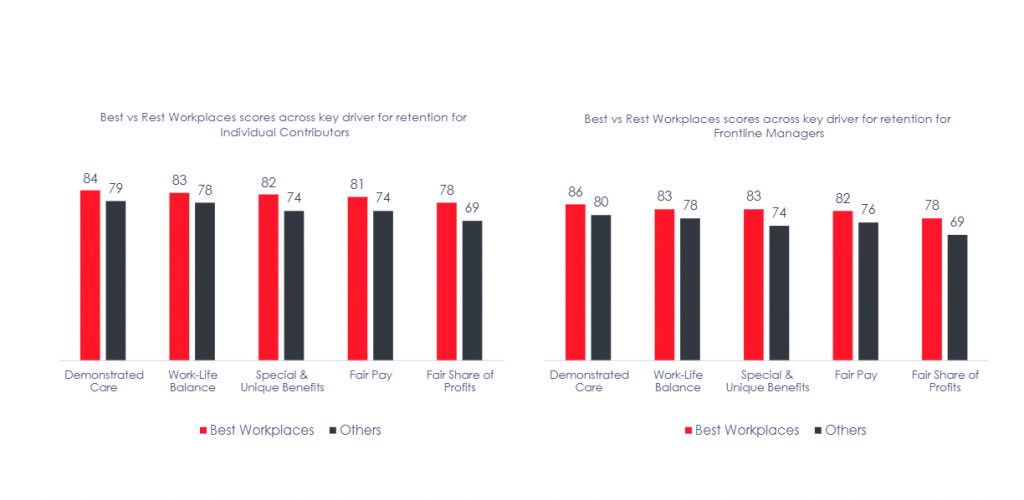
The human contract reflects employees’ desire to be treated as people rather than simply resources. Drivers such as management showing sincere interest in employees as individuals and encouraging work-life balance indicate that relationships and employee wellbeing remain important determinants of commitment.

Particularly in high-pressure BFSI roles, employees are more likely to stay when managers balance demanding targets with fair workload allocation, realistic expectations and efficient work processes.

The economic contract, meanwhile, reflects employees’ expectations around fairness. Fair pay, meaningful benefits and a sense of receiving an equitable share of organizational success emerge as important retention drivers, particularly among employees closest to day-to-day operations.

As BFSI hires GenZ and young millennials in the frontline roles, employees at this stage evaluate not only what the organization offers materially, but whether it creates an environment where they can learn, feel supported and envision a sustainable future.

Best-vs-rest-workplaces

As Employees Become Leaders, They Begin to Assess Whether the Organization Enables Success.

As employees go up the corporate ladder, there is a subtle shift in perspective. Managers are no longer asking only whether they enjoy working for the organization, they are evaluating whether the organization enables them to lead effectively and succeed.

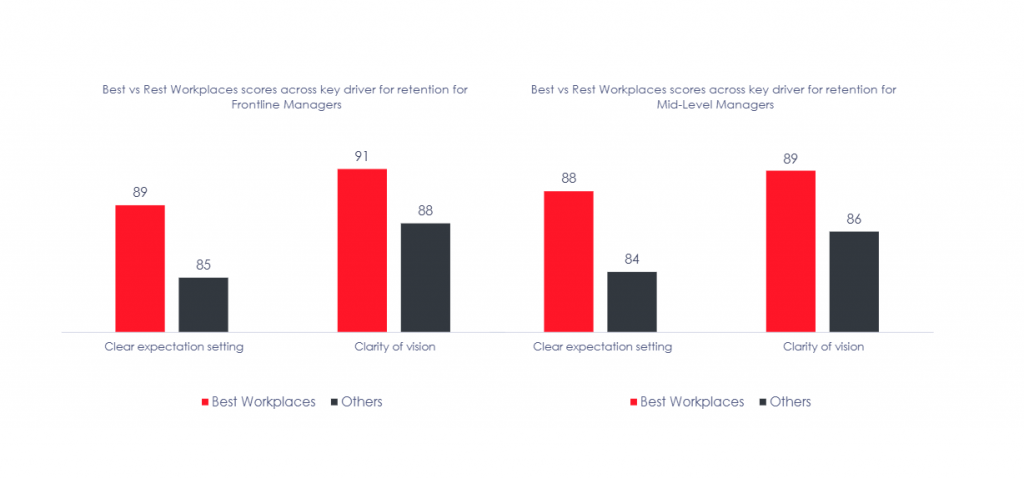
Frontline managers and Mid-level managers place greater emphasis on clarity of expectations and the organization working towards a clear vision. The generation they belong to, GenX, has accumulated significant organizational experience while balancing growing professional and personal responsibilities. At this stage, autonomy, trust and organizational enablement often become increasingly important.

When expectations are unclear, managers feel the consequences. When coordination breaks down, managers absorb the impact. When communication gaps emerge, managers are often required to bridge them. Their retention therefore becomes increasingly linked to managerial effectiveness and in turn organizational effectiveness.

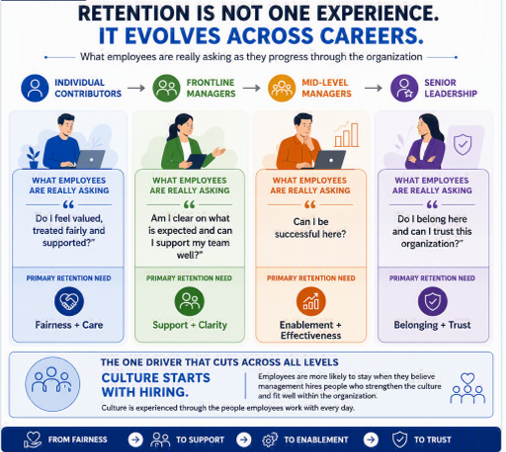
The question shifts from “Do I enjoy working here?” to “Can I be successful here?”

This transition is particularly relevant in BFSI organizations, where managers play a critical role in driving performance, customer outcomes and team engagement. Supporting managers effectively is not only a retention strategy, it is also a business strategy.

Best-vs-rest-workplaces-2

At the Senior Leadership Level, Retention Is Ultimately About Belonging and Trust

At senior leadership levels, the strongest retention signals are less transactional. They point to belonging and trust.

The drivers for retention at this level revolves around being able to be oneself at work and participating in a workplace that celebrates important moments and milestones.

Collectively, these drivers paint a picture of leaders seeking something deeper than professional success. They point toward a desire for inclusion, connection and authenticity.

Senior leaders may differ in age and experience, but they are united by one expectation: they want to lead organisations that practise the values they promote. As accountability and scrutiny increase, authenticity and belongingness become increasingly important. Consistent with this, our findings identify belonging and management credibility as among the strongest drivers of retention for senior leaders.

Alongside belonging sits a second critical theme: trust.

Senior leadership places significant importance on ethical business practices, management credibility, transparency and organizational consistency. Drivers such as management delivering on promises, matching actions with words and keeping employees informed all point toward a broader need for confidence in leadership and the institution itself.

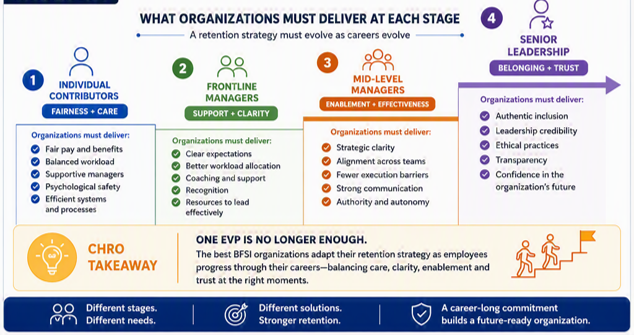
What Organizations Must Deliver at Each Stage

What organizations must deliver at each stage

Retention Is Not One Experience, it Is a Journey

The findings reveal that employees do not stop caring about culture as they move up the organization. Instead, they begin to define culture differently.

The findings also highlight an important distinction. Retention priorities are often discussed through the lens of generations, with organizations designing different strategies for Gen Z, Millennials or Gen X employees. While generational experiences undoubtedly shape workplace expectations, our analysis suggests that career progression deserves equal attention. Employees do not simply bring different expectations because of when they were born, they also develop new expectations because of the responsibilities they assume. Understanding both perspectives allows organizations to design retention strategies that are responsive without becoming overly segmented.

What remains constant throughout this journey is the importance of creating workplaces where employees feel valued, connected and aligned with the organization’s purpose.

The most effective retention strategies recognise that employee expectations evolve over time. Rather than relying on a single employee value proposition, the best workplaces continuously adapt the experiences they create to meet employees where they are in their careers.

In doing so, they transform retention from a reactive challenge into a long-term organizational advantage, by designing workplaces where people can see a future worth staying for.

Frequently Asked Questions

Why is employee retention becoming a strategic priority for BFSI organisations?

Employee retention is no longer just an HR concern, it is a business imperative. High attrition can disrupt customer relationships, weaken institutional knowledge, increase hiring and training costs, and place additional pressure on existing teams. In a sector built on trust, expertise and regulatory compliance, retaining experienced talent is essential to sustaining operational excellence and long-term growth.

Is employee retention a leading indicator of organisational health?

In BFSI, retention reflects much more than employees’ willingness to stay. It often signals the strength of organisational culture, leadership credibility and the organisation’s ability to sustain customer trust and operational excellence. While attrition alone does not define organisational health, consistently retaining talent can indicate that employees trust the organisation and believe in its long-term direction.

How does employee retention impact customer experience in the BFSI sector?

Customer trust is built through consistent relationships and high-quality service. Frequent employee turnover can disrupt these relationships, reduce service continuity and increase the time required for new employees to build customer confidence. Retaining experienced employees helps organisations deliver more consistent, personalised and trustworthy customer experiences.

Why is retaining experienced employees particularly important in BFSI?

Unlike many industries, BFSI relies heavily on institutional knowledge, regulatory expertise and long-term customer relationships. Experienced employees not only deliver stronger business outcomes but also mentor future leaders, preserve organisational knowledge and strengthen customer confidence during periods of change.

What does the future of retention look like for BFSI organisations?

As digital transformation, AI adoption and evolving workforce expectations reshape the sector, retention strategies will need to become increasingly personalised. Rather than relying on standardised programmes, organisations will need to create career-stage-specific experiences that combine meaningful work, continuous learning, leadership trust and organisational purpose to remain competitive in attracting and retaining talent.

Camera red icon

Earn Certification

certification-badge-2026-rhc4efc9ny04x7lz17jff7guyhsup5b0yvrou4vd72

The Certification Advantage: Why Partner with Great Place To Work®

How partnering with Great Place To Work® can strengthen your people strategy, and drive business outcomes through data-driven insights and Certification.

prasad-kachraj

Prasad Kachraj

Managing Director, Great Place To Work, India

akshat-shah

Akshat Shah

Managing Director, Great Place To Work® India

3rd November 2026  |  4.00 PM - 4.30 PM IST

Register Now