AI isn’t just creeping into the world of work; it’s shaping how people feel at work. Employee engagement is no longer shaped only by annual surveys, manager conversations, or recognition programs. In 2026, engagement is increasingly being influenced by how intelligently organizations listen, respond, and act in real time, and that is where AI enters the conversation.

Also Read: Employee Engagement Programs to Implement in 2026

Artificial intelligence is helping organizations move from reactive engagement practices to proactive culture decisions. It is enabling leaders to detect early signs of disengagement, personalize employee experiences, reduce repetitive work, and improve how people experience work every day. But AI in employee engagement is not simply about introducing new tools. It is about using technology in ways that strengthen trust, improve fairness, and help employees feel supported rather than monitored.

At Great Place To Work®, our recent research shows that organizations are already moving quickly in this direction. 84% of CHROs say their organizations are beyond the initial exploration phase of AI implementation, while 67% of employees report that their company is already at an intermediate or advanced stage of AI adoption. The real shift now is this – AI is no longer just a technology conversation; it is a workplace culture conversation.

What Does AI in Employee Engagement Mean?

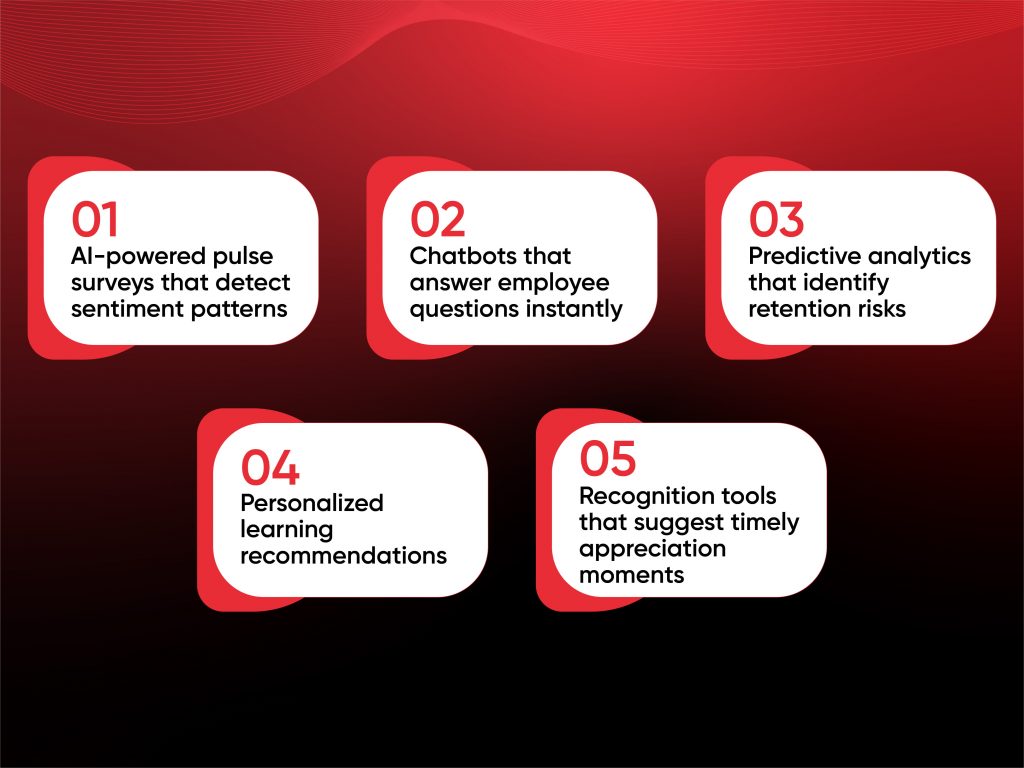
AI in employee engagement refers to the use of artificial intelligence to understand employee sentiment, improve communication, personalize support, and help organizations make faster and better people decisions. In practical terms, this can include:

What Does AI in Employee Engagement Mean

The difference between traditional engagement and AI-enabled engagement is speed and precision. Instead of waiting months to understand how employees feel, leaders can identify shifts in trust, workload pressure, manager effectiveness, or motivation much earlier. This matters because engagement today is highly dynamic. Employees expect organizations to respond faster, communicate better, and create work experiences that feel relevant to them.

Why AI is a Game-Changer for Engagement? 

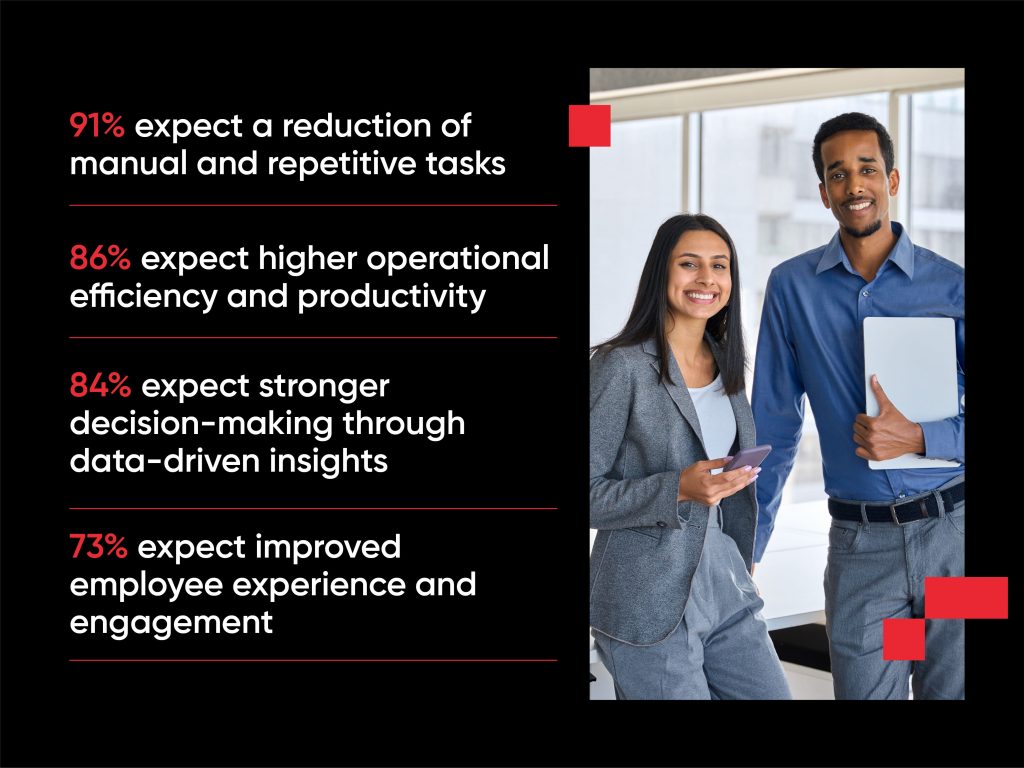
The biggest strength of AI is not automation alone; it is the ability to improve how organizations respond to human needs. Our research with CHROs shows that the top expected benefits of AI are:

Why AI is a Game-Changer for Engagement

When repetitive work is reduced, employees get more time for meaningful contributions. That directly influences motivation, ownership, and satisfaction. AI also changes engagement because it helps leaders move from assumptions to evidence. 

For example, a manager may believe a team is doing well because productivity remains high. AI-based engagement signals may reveal that response time has dropped, recognition has reduced, or attrition risk has increased. This allows earlier intervention, before disengagement becomes a resignation.

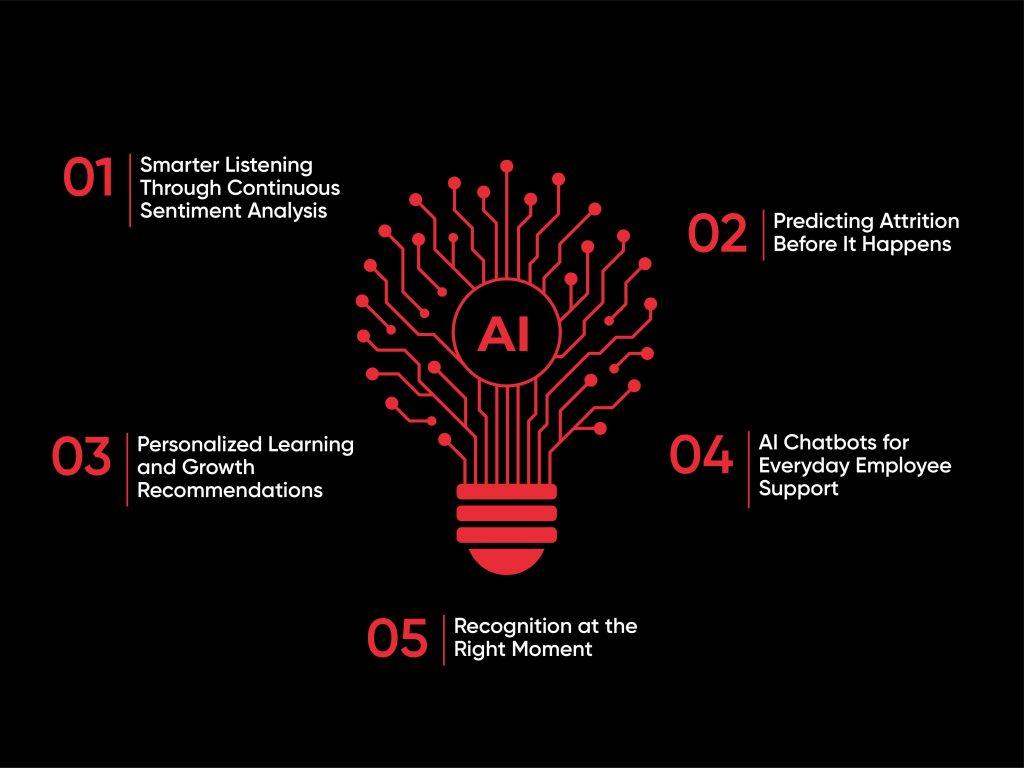
Key Applications of AI in Employee Engagement 

Key Applications of AI in Employee Engagement

With changing dynamics and workplace culture, AI adoption has become more common, and its key applications depend on the company’s usage and requirements. Let’s take a look at a few key applications of AI in employee engagement that every company should use: 

#1. Smarter Listening Through Continuous Sentiment Analysis 

Traditional engagement surveys capture a moment. AI helps capture patterns over time. AI tools can analyze survey responses, internal communication trends, and employee feedback to identify recurring themes such as workload pressure, lack of recognition, or trust concerns. This helps HR leaders move beyond scores and understand where action is most needed. Companies are consistently working hard to create the best culture, but something that works for one company may not work for another. Because every company is different, their industry is different, the scope of work and culture is different. Therefore, learning from Best Workplaces™ gives you an idea of the practices you can implement, but listening to your employees will show you the exact data and give you the right direction for creating the best workplace culture.  

#2. Predicting Attrition Before It Happens 

Employee retention is one of the strongest use cases of AI in employee engagement. Our research shows that at least 40% of employees who worry that AI may replace their jobs are already planning to leave, regardless of role level. This is critical because disengagement often begins long before resignation. 

AI can help detect patterns such as: 

  • Drop in participation 
  • Reduced internal mobility interest 
  • Lower manager interaction 
  • Increased absence patterns 

The value is not prediction alone, it is enabling timely conversations. Exit interviews are not the right time to gain feedback and act on it. An organization should use AI to understand an employee’s pattern of work and flag patterns of disengagement so that the conversation can begin quite before.  

#3. Personalized Learning and Growth Recommendations 

Career growth remains one of the strongest engagement drivers. As AI changes roles, organizations must also help employees adapt. According to Great Place To Work research, 57% of CHROs prefer reskilling and internal job rotations as their primary AI transition strategy. Conventional training programs frequently make the assumption that every employee learns at the same rate and in the same manner. Because of this, some workers could get bored while others find it difficult to keep up. Low involvement and underutilization of educational resources may result from this mismatch. AI-powered learning platforms personalize the entire development process. They assess an employee’s present skill set, pinpoint knowledge gaps, and design specialized learning programs. The system suggests new resources that meet employees’ changing demands as they advance.  

AI supports this by recommending: 

  • Relevant skill pathways 
  • Learning modules 
  • Internal opportunities 
  • Career movement options 

#4. AI Chatbots for Everyday Employee Support 

Employees increasingly expect quick answers. Regardless of an employee’s position or level of expertise, traditional onboarding procedures frequently adhere to a uniform checklist. As a result, even after the first few weeks, a lot of new recruits could still feel confused about their duties or alienated from their colleagues. By developing customized onboarding experiences that take into account each employee’s history, job function, and preferred method of learning, AI has the potential to completely change the onboarding process.

Also Read: Essential HR Policies Every Organization Must Implement

To guarantee a seamless incorporation into the company, these technologies provide knowledge progressively, pair workers with mentors, and track advancement. AI chatbots help simplify common workplace questions around: 

  • Leave policies 
  • Benefits 
  • Internal processes 
  • Learning access 
  • IT support 

The benefit is not replacing HR interaction; it is reducing delay in routine support. This allows HR teams to focus more on high-value people conversations. 

#5. Recognition at the Right Moment 

Recognition loses impact when it becomes delayed or is overlooked. AI tools can identify milestones, collaboration moments, or performance patterns and prompt leaders to recognize employees in real time. That helps create a stronger emotional connection because appreciation feels timely and visible. AI-driven recognition systems are able to identify trends in worker performance that managers might miss. These tools assist in identifying workers who regularly surpass expectations and provide suitable recognition opportunities by analyzing contributions across projects and activities. The advantages of utilizing AI for incentives and recognition are: 

  • Accurately tracking worker performance 
  • Notifying recipients of rewards or appreciation on time 
  • Examining performance information and recommending areas for development 

Benefits of AI in Employee Engagement 

Here are a few benefits of using AI in employee engagement: 

#1 Better Productivity Without Adding Pressure 

Today, the best use case of AI is that it reduces the time you take to do repetitive tasks. If you train an AI chatbot and set up a workflow, then your repetitive tasks can be taken care of, and you don’t have to invest the same time every day. For example, if your daily task includes segregating the data from an Excel sheet based on daily user experience, then AI can actually do that in seconds. When employees spend less time on repetitive tasks, focus improves. This explains why CHROs rank productivity as one of AI’s strongest benefits. 

#2 Higher Retention Through Early Intervention 

Engagement improves when organizations respond before frustration builds. AI helps leaders act earlier. This is where AI-powered employee engagement technologies truly shine. AI can identify the warning indicators weeks or even months before someone submits their resignation letter. The sentiment analysis monitors communication patterns and engagement levels to increase staff productivity with AI. Through this, the HR teams may take action before it’s too late when the system recognizes early indicators of disengagement or burnout. 

#3 More Personalized Employee Experience 

Not every employee needs the same support. AI helps organizations personalize communication, learning, recognition, and resources. Traditional performance review systems are now outdated. AI in employee engagement can now give you data time data based on deal data and insights, and you don’t have to wait a quarter to look at an employee’s experience or performance.  

#4 Stronger Leadership Decisions 

Data-backed decisions reduce guesswork. And employees trust leaders more when action feels informed and fair. Interestingly, Great Place To Work’s employee insights show that employees with high confidence in leadership report significantly more positive AI experiences at work. This means leadership trust still shapes whether AI strengthens culture or creates anxiety. 

How to Implement AI in Your Engagement Strategy? 

Introducing AI into engagement requires culture readiness, not just technology readiness. So, to make it a little easier for you, here is how you can actually implement AI in employee engagement: 

#1. Start with a Clear Business and People Problem 

The biggest mistake that organizations make is that they follow others, which is not completely wrong, but don’t forget that unique problems require unique solutions. Do not adopt AI because it is trending, rather look at your requirements. The best way is to start with a question: what engagement challenge are we solving? Is it retention, survey fatigue, manager effectiveness, or learning participation? Once you know the problem, you’ll be able to find the right answer.  

#2. Build Trust Before Expanding Tools 

Our research on CHROs shows that 21% of CHROs identify governance, ethics, and privacy safeguards as a top priority when implementing AI. During the times of increasing anxiety among employees due to the evolution and implementation of AI, leaders need to be transparent.  

Employees must know what data is being used, why it is being used, and how decisions are being made. Providing information or reasoning will help them gain clarity and increase trust in leadership, because trust determines adoption. 

#3. Invest in Capability Building 

The biggest barrier today is not employee resistance; it is capability. 28% of CHROs say limited internal AI skills are the biggest challenge in implementation. Organizations need to train both managers and employees. Not just on tool usage, but on responsible use. Employees should be made aware of the do’s and don’ts. Moreover, there should be a set of guidelines on the usage of AI tools, and employees should be given proper training before using them. 

#4. Keep Human Oversight Strong 

AI should guide decisions, not replace judgment. Especially in engagement, human interpretation remains essential. Human connection is the essence of any interaction and will remain the same. Signals will always require conversation, and data will require real context. 

#5. Future of AI in Employee Engagement 

The future of engagement will not be fully automated, it will be intelligently assisted. In the next few years, organizations will likely see: 

  • Predictive engagement dashboards 
  • AI-supported manager coaching 
  • Real-time culture diagnostics 
  • Personalized career pathways  

At the same time, role evolution will also increase. Great Place To Work research shows 61% of CHROs expect 5% to 25% of roles to change because of AI within three years. This means employee engagement strategies must increasingly focus on adaptability, confidence, and reskilling. The organizations that succeed will not be those with the most AI tools. They will be the ones that help employees feel prepared, included, and supported through change. 

Conclusion 

AI can improve employee engagement, but only when it is used to make work more human, not less. The strongest cultures do not use AI simply to monitor productivity. They use it to listen better, reduce friction, support growth, and help leaders act with greater clarity. At Great Place To Work, we continue to see that when trust is strong, employees are more open to change, more willing to learn, and more optimistic about the future of work. And in 2026, that may become the biggest competitive advantage of all. 

Frequently Asked Questions 

Is AI replacing HR roles in employee engagement? 

No, AI is helping HR teams automate repetitive tasks and improve decision-making, but human conversations, trust-building, and culture leadership will remain crucial. 

What are the examples of AI tools for engagement? 

Examples include pulse survey platforms, sentiment analysis tools, AI chatbots, recognition platforms, and predictive retention analytics. 

How does AI improve employee engagement? 

AI improves engagement by helping organizations detect concerns earlier, personalize employee support, reduce repetitive work, and strengthen manager action. 

How can companies ensure ethical AI use? 

Organizations should establish governance, explain data usage clearly, maintain privacy safeguards, and ensure human oversight in people’s decisions.

At Great Place To Work®, our research consistently shows that the most engaged, most productive, and most loyal employees are those who feel genuinely supported as human beings, not just as contributors to a business outcome. And at the heart of that experience is one critical factor: work-life balance.

Yet for many organizations across India, work-life balance remains an aspiration rather than a reality. Employees are logging in long after hours, carrying the weight of personal responsibilities without institutional support, and experiencing burnout that quietly chips away at their commitment and performance. Our data tells us that in cultures where wellbeing is neglected, fewer than 20% of employees are motivated and intend to stay. In cultures where wellbeing is genuinely prioritized, that number rises to 97%.

That is not a small gap. That is the difference between a workplace where people merely survive and one where they truly thrive.

In this blog, we explore meaningful, human-centric work life balance examples drawing from practices championed by some of India’s leading organizations that HR leaders, people managers, and business leaders can implement to build cultures of genuine engagement.

When Work-Life Balance Becomes a Business Priority?

The conversation around work-life balance has fundamentally shifted. What was once considered a ‘good to have’ has emerged as a core driver of organizational performance. Our research at Great Place To Work India reveals that employees who feel psychologically safe and valued are 5x more likely to feel engaged and committed to their organization.

Companies see quantifiable advantages in retention, productivity, team collaboration, and innovation when employees have a consistent work-life balance. On the other hand, when work deadlines are unreasonable and personal time is not respected, the effect appears as increased absenteeism, disengagement, and attrition, all of which have a direct impact on the bottom line.

Additionally, work-life balance is not a consistent experience. Every individual brings a unique set of personal circumstances, responsibilities, and wellness requirements to work. Organizations that identify this variability and customize their processes accordingly usually earn their employees’ trust and dedication.

Work Life Balance Examples That High-Trust Workplaces Are Getting Right

High-trust workplaces bring this philosophy to life through practical, people-centric initiatives such as:

Flexible Working Environment:

A flexible working environment is one of the best examples of work-life balance, but how it is implemented is important. The best companies incorporate a flexible working environment plan as a cultural value rather than just offering remote work as a policy.

A well-known global real estate firm with operations in India has switched from transactional methods to entirely human-focused approaches. The company gives employees the freedom to select where and when they work because it understands that every employee is different and has different needs. There are times when working remotely or from home helps employees achieve a meaningful balance between their personal and professional goals, even though offices promote a connected, high-performance environment.

Also Read: 10 Essential HR Policies Every Organization Must Implement

To conquer this, the organization has evolved its working model entirely from a transactional model to a human well-being focused plan. The primary focus of the plan was to create a meaningful balance between employees’ personal and professional goals and promote a connected, high-performance environment.

The intent is the primary objective behind this approach to reward employees’ commitment to the company. Here are some of the key takeaways:-

  • Define flexibility around outcomes, not office hours
  • Anchor remote flexibility in trust, not surveillance
  • Ensure flexibility is accessible equitably across levels and roles
  1.  

Gradual Return-to-Work Plan

Absence due to illness, childbirth, mental health challenges, or bereavement is a reality in every workforce. But how an organization handles the return from absence reveals a great deal about its culture. This is one of the most underutilized yet deeply impactful work life balance examples we see championed by high-trust workplaces.

Also Read: Virtual Team-Building Activities to Improve Teamwork

The same property consultancy referenced above has formalized a Gradual Return-to-Work program that allows employees to re-enter the workforce with a reduced workload for a fixed period after an absence. The philosophy behind this practice is both simple and profound: employees should feel comfortable and be able to bring their whole selves back to work. Rather than expecting full performance from day one, the program creates a supported transition one that acknowledges human experience.

In general, practices like these are among the strongest predictors of long-term employee loyalty. When an employee feels cared for during a difficult time, their emotional connection to the organization deepens in ways that no incentive program can replicate.

Purposeful In-Office Collaboration

As hybrid work becomes embedded in India’s corporate landscape, many organizations are struggling to find the right cadence between in-person collaboration and remote flexibility. The most effective work life balance examples in this space involve treating in-office days as purposeful collaboration opportunities not attendance mandates.

A professional tax services firm has built an exceptionally thoughtful model around this challenge. Rather than setting a blanket policy, the organization worked with individual teams to co-create schedules that serve their specific collaboration needs. Some teams remain fully remote; others come in two to three days a week, but these days are identified together and used intentionally. Meetings that benefit from in-person dynamics are deliberately scheduled these days, making every office visit meaningful.

What is particularly noteworthy is the organization’s recognition that team dynamics have evolved. Certain ‘trigger events, such as welcoming a new team member, prompt a re-evaluation of collaboration requirements. Development needs can temporarily take priority over flexibility, ensuring the model remains adaptive rather than rigid.

This approach reflects a principle we champion at Great Place To Work: effectiveness must always be the north star. Flexibility is not an end in itself; it is a means to help people do their best work, together and individually.

Dedicated Wellbeing Days

Among the most inspiring work-life balance examples emerging from India’s best workplaces is the concept of a dedicated quarterly wellbeing day, a structured opportunity for employees to invest in their personal growth and self-care without using leave or sacrificing deliverables.

A leading telecommunications shared services organization has implemented this practice through a quarterly initiative that designates one day every quarter for employee well-being and self-improvement. The initiative is not passive; it is powered by internal ‘spirit champions’ who operate as role models for the company’s values, work alongside dedicated spirit leads, and actively engage colleagues in cultural transformation activities.

The importance of this goes well beyond a single day. By making personal growth a formal priority on the organizational calendar, leadership sends a strong message: we care about your growth as a person, not just your work performance. Our research shows that employees who feel this level of genuine care are three times more likely to see a long-term future with their companies.

Inclusive Leave Policies

A truly supportive approach to work-life balance requires leave policies that reflect the full diversity of employees’ life experiences. One of the clearest work life balance examples of this in action comes from a globally respected professional services firm whose wellbeing philosophy is anchored in the belief that caring for people is caring for the business.

The organization’s approach to take time off is both comprehensive and inclusive: employees can enjoy public holidays based on geographic location and personal preference and have access to a broad range of leave options: vacation days, sick leave, parental leave, adoption and surrogacy leave, and bereavement leave. 

At Great Place To Work, we have consistently found that when organizations align their benefits to the actual needs employees share, it fosters a culture of openness and genuine wellbeing, one where employees feel seen, not just employed.

No-Meeting Days

Back-to-back meetings are one of the most gradual contributors to workplace fatigue and disengagement. Yet they are so normalized that most employees do not register them as a balance issue until burnout sets in.

India’s best workplaces are finding creative ways to address this. For example, announcing a no-meeting day once every month for all employees. Critically, this is not just a policy; it is a leadership commitment. Senior leaders not only practice it themselves but also embed it into their OKRs, making the protection of focused time a measurable organizational value.

For HR leaders seeking actionable work life balance examples to reduce burnout, the no-meeting day is a low-cost, high-impact intervention that demonstrates respect for employees’ time and cognitive energy.

Build a Great Place To Work

The examples of work-life balance above are not distinct initiatives. They indicate a stronger cultural commitment. Here are a few practices that you should practice to create a better work life balance for your employees: 

  • Leadership modelling: The leadership sets the stage for workplace culture in companies. Leaders who take time off, do not work after office hours, and create an open communication culture influence their teams to do the same. 
  • Policy to practice: Creating flexible working policies on paper is not enough for work life balance. The results will showcase only if every employee, no matter what level, job, or location they are in, can use and benefit from them.
  • Listen, learn, and lead forward: Work-life balance demands change throughout time. Surveys conducted annually are not only an effective way but also a necessary one. Implementing real-time feedback methods can respond to emerging needs before employees become dissatisfied.
  • Metrics That Matter Most: HR leaders should also focus on tracking wellbeing indicators, eNPS, tenure-based attrition and engagement scores across all departments to understand the organization’s work-life balance 

Conclusion

Organizations that recognize a fundamental truth that sustainable high performance is fundamentally linked to sustainable human wellbeing will be the ones that define India’s great workplaces in the years ahead. Every employee should be treated as a human before an employee, which unites the work-life balance examples discussed in this blog, from individualized flexibility and phased return-to-work programs to dedicated wellbeing days and inclusive leave policies.

At Great Place To Work, we think that when companies genuinely and consistently invest in their employees’ well-being, their employees will repay them with discretionary effort, loyalty, and advocacy that no hiring budget can spend.

Work-life balance is a program that should not be started and then abandoned. Every level of the organization must uphold this cultural commitment on a daily basis. For HR and business leaders, the question is not whether they can afford to prioritize it, but rather whether they can afford not to.

Frequently Asked Questions

What are some real work life balance examples?

  1.  

Examples include flexible work environments focused on outcomes, gradual return-to-work programs after leave, purposeful in-office collaboration, dedicated wellbeing days, inclusive leave policies, and no-meeting days to reduce burnout.

What are the best work-life balance practices for remote teams?

  1.  

Best practices include defining flexibility around outcomes (not hours), building trust instead of surveillance, setting clear expectations, and creating structured yet flexible collaboration based on team’s needs.

Can work-life balance increase productivity?

  1.  

Yes, organizations that prioritize employee wellbeing see higher engagement, stronger retention, better collaboration, and improved productivity, as employees feel valued and supported.

What are the 4 pillars of work-life balance?

The key pillars include flexibility, wellbeing support, inclusive policies, and a strong culture driven by leadership, trust, and continuous feedback.

Today, most medium and large-sized companies have offices in several locations with diverse teams working across the globe. Moreover, a hybrid work style has become the norm rather than the exception. Given all these factors, interactions between teams from different locations, or even teams based at the same location, are virtual rather than in person.

Great Place to Work® offers culture consulting services to help businesses operate cohesively. One way to sustain engagement and collaboration is to streamline virtual team interactions and encourage team-building activities.

This article will define virtual team-building activities, explain why they are important, highlight trending virtual activities, and present some excellent virtual team-building activities for 2026.

What Do Virtual Team-Building Activities Mean?

Virtual team-building activities include planned, structured, non-work-related online activities that engage different teams and departments through engagement, education, or entertainment-related content. In most cases, the HR department will seek input from team members, management, and team leads to decide which virtual team-building activity will work best.

These virtual team-building activities can be integrated into the overall employee experience strategy. They will then select a suitable digital platform, choose a time slot, and share an invitation with an outline of the activity and guidance on how participants can prepare.

Some popular examples of virtual team-building activities can include:

  • Participants are divided into teams and tasked with a puzzle they have to solve together
  • Pop quizzes and trivia games is another example of an online team-building exercise
  • Webinars conducted by a particular team to educate others, like tax-planning workshops
  • Collaborative online games that require participants to step out of their comfort zones

Why Are Virtual Team-Building Activities Crucial in 2026?

The workplace and working style have evolved over the years, and, in recent years, have transformed significantly due to technological advances. However, that’s not all; the world has shrunk, newer generations have entered the workforce, and technology has both expanded and shrunk distances. Given all these factors, virtual team-building activities have become key in ensuring a cohesive work experience.

Here are some reasons why virtual team-building activities are crucial:

#1. Overcome the isolation of remote working

While working remotely from home has its own pros and cons, many people may miss the camaraderie and interactions of working in the office. Virtual activities will help bridge the gap by allowing the team to get together for a short time to share thoughts and ideas and fulfill their need for human interaction. Virtual interactions help people share laughter, show creativity, and exchange information. 

#2. Bring together diverse teams 

Today, we have teams working from different locations, both within the same country and across the globe. Even teams that work from the same location may be diverse due to the nature of their work or the role they play. And today, we have Generation X, millennials, and Generation Z working together. Virtual bonding helps each generation draw on each other’s strengths and work in complementary ways.

#3. Ease communication at all levels

When people interact and engage informally, it lowers barriers. And this, in turn, helps ease communication, removes barriers, and helps people understand the tone behind it. When people who have not met physically but interact online, chances are that they do not understand the nuances of what is said. Virtual activities help break these barriers.

#4. Improve employee engagement

People like to celebrate wins together, commemorate special occasions, commiserate over losses, and share knowledge. Online activities help people overcome barriers such as time zones, generational gaps, and cultural differences. There’s nothing like a marathon problem-solving session to bring people together.

#5. Promote overall company culture

Work culture across regions and countries can be vastly different, which can lead to dissonance when people from one region or country interact with those from another. A good way to ensure that all employees adopt the overall company culture is to organize a virtual greet-and-meet to help them learn how to promote the brand and culture with their stakeholders.

#6. Increase collaboration and productivity

With virtual team-building activities, you can improve transparency in the workplace, leading to collaboration and productivity. For instance, if the marketing team understands how costing works from the finance team, they will be able to price products competitively. Virtual team-building activities help showcase each team’s contributions and needs.

Trending Virtual Team-Building Activities for 2026

 Virtual team-building activities have also evolved along with the changing work scenarios, technological developments, and team requirements. There are a lot of ideas to choose from apart from the quarterly outings, company picnics, award functions, and team sporting events. Here are a few to keep your team interested.

1. Engagement using AI-powered tools

  1.  

With AI taking on a bigger role in our lives, companies can organize team-building activities using AI. Moreover, AI will help track team engagement levels and course-correct as required.

2. Sharing a cultural event virtually

  1.  

A team working in one location may be eager to learn about festivals and cultural events in another area. A virtual meeting with all employees dressed in festive attire, talking about the celebration, and enjoying some refreshments is a great way to bring diverse teams together.

3. Mini team-building activities

  1.  

Instead of organizing large-scale activities, HR departments can break them into small teams so teams can mingle and participate together quickly. These activities help alleviate tensions and improve creativity.

4. Cross-team skill-sharing sessions

  1.  

Companies often wish that each department understood how the other departments work and how each team’s work contributes to the final output. Cross-team skill-sharing is a good way to enable this.

5. Mental and physical well-being activities 

  1.  

Stress levels are high, and people often spend hours seated in the same place. Mental and physical wellness activities will help teams enjoy a break and promote overall well-being.

Which Are the Best Virtual Team-Building Activities for 2026?

Businesses today are willing to experiment with various activities and invest in technology to promote collaboration and employee well-being. Here are some top ideas:

  • Online escape rooms where teams get together to find clues, collaborate, solve puzzles, and escape the confines of the room within a time limit. This activity encourages people to cooperate, develop problem-solving skills, and results in friendly competition.
  • Virtual pop quizzes where the organizer can put together a mix of trivia-, company-, sports-, and pop-culture-based questions. This activity reveals participants’ non-work-related interests.
  • Online hackathons where participants are given a problem statement or a technology type (e.g., drones) and encouraged to come up with solutions that tie in with the company’s core business. 
  • Skill-training webinars will encourage people to mentor others, cross-pollinate across teams, and encourage team members to realize the value of their contributions. Skill-sharing can also be for other skills, interests, and talents.
  • Wellness sessions encourage team members to learn about ways to improve their physical and mental well-being. They can share goals and make it a competitive activity in which each participant works to improve their health.

How to Select the Right Virtual Team-Building Activities for Maximum Impact?

While there are plenty of virtual team-building activity ideas, it is crucial to select the one that will have the best impact. 

Here are some steps to help pick the right option by asking the following questions:

What is the objective?

The first step is to be clear about the desired outcome for this virtual activity. Is it closing the generation gap? Improve communication? Engage with diverse teams? Enhance employee wellness? Or something else. This helps narrow down the type of activity.

How big is the team?

The team size will play an essential role in determining the type of team activity. A large team will require several sessions, while smaller teams can be easier to organize. It becomes easier to organize such events once the participant list is finalized.

Which time zones to include?

Different time zones often mean that some teams find it difficult to participate. Decide on which time zones will work together and group them accordingly to make it easier for people to participate.

What do employees prefer?

Depending on the demographics and employee mix, preferences may vary. Take a quick survey to determine which activities employees prefer, and organize events accordingly.

What technology is required? 

Technology will play a pivotal role in ensuring a good experience. However, one has to consider the budgets while investing in technology for virtual team-building activities. Participants must also have access to the technology to ensure their participation.

How to Ensure Virtual Team-Building Activities Are Successful?

Here are some tips to ensure the success of virtual team-building activities:

  • Be clear about the goal, keep it crisp, and encourage the team to stay focused
  • Ask the leaders to participate in promoting inclusivity and engagement
  • Do not make the sessions too long so that participants do not tire out
  • Create activities that will encourage everyone to participate and enjoy the session
  • Keep refreshing the type of activity to garner interest from employees
  • Ask for feedback so that activities can be improved and tweaked

Here’s How to Keep the Employees Engaged With Virtual Team-Building Activities

As a company that wants to recruit, develop, and retain the best talent, it is crucial to engage with your team. One aspect of that is organizing team-building activities. However, the starting point for team-building and collaboration is understanding what they think. Employee surveys by a third-party expert can help.

Here’s where a company like Great Place To Work can help with surveys, consulting, and more. Want to know how we can help? Click here to connect with us.

Frequently Asked Questions

Which type of company can benefit from virtual team-building activities?

  1.  

Any type of company, no matter its size, can benefit from virtual team-building activities. Such activities help different teams meet and get to know each other virtually, removing barriers caused by regions, ages, beliefs, etc. 

What type of technology does a company need for virtual team-building?

  1.  

The technology required for virtual team activities depends on the activity. However, at a minimum, a good internet connection, a video conferencing platform, and forms to collect input are required. Participants need a good laptop with a solid connection to start with.

How effective are virtual team-building activities for team collaboration?

  1.  

In a world where teams work from different locations and belong to different cultures, generations, and beliefs, virtual team activities can bring them closer together. Virtual activities help teams better understand and complement each other.

What are some simple and economical virtual team-building activities?

  1.  

Some simple virtual team-building activities can be birthday and anniversary celebrations, competitions, quizzes, and sharing updates. 

How often should virtual team-building activities be held? 

  1.  

The timing and frequency of virtual team-building activities have to ensure that you engage enough, while not interfering with work. Special thought and planning are needed for this aspect to ensure maximum participation with minimal disruption.

Employee engagement programs are structured initiatives that boost morale, improve productivity, and create a positive workplace culture. In 2026, these programs are more critical than ever due to evolving work styles and technology shifts. In the past few years, the definition of the workplace has changed, with concepts like telecommuting, hybrid work, gig workers, and offshore work becoming more prevalent. Add to that the stress of massive changes happening in the outside world, the hype about the threat of AI (artificial intelligence) to employment, and work pressure, and employees today need to be engaged and motivated.

In earlier days, when all employees essentially worked in the office, employee engagement programs consisted of a few games, shared festivities, and some light refreshments. At Great Place to Work®, we help our clients assess which employee engagement programs are working and how they can implement it.

One of our latest reports on India’s Best Workplaces in Retail 2026 quotes “Employee feedback shows that although leadership competence scores are high at 90%, employees do not consistently experience the human side of leadership. A 5-point gap in authentic connection highlights the need for greater empathy, listening, fairness, psychological safety, and genuine engagement”.

Engagement lies at the center of ensuring your employees take pride in working with the company and bring their best to work.

What Do Employee Engagement Programs Mean?

Employee engagement programs include various strategic initiatives aimed at fostering communication, improving team collaboration, and aligning with the company’s direction. The goal of employee engagement programs is to improve productivity, boost morale, identify potential candidates for internal growth, and increase employee satisfaction.

In most companies, the human resources development team will work with top management to formulate and implement the best engagement programs for the business. Often, the process will require:

Defining the short-term and long-term objectives of the programs

  • A brainstorming session to come up with the best ideas
  • Formalizing the best programs for the business and industry
  • Picking out the right candidates and teams for each program
  • Designing the content and gamification to make implementation easy

Why Is Implementing the Best Employee Engagement Programs Crucial in 2026?

As the introduction clearly mentions that  the workspace has evolved from the more traditional models to a completely new avatar. Moreover, the composition of the workforce has also changed drastically to include people from multiple generations with completely different attitudes and approaches. 

Here are some of the main reasons to implement the right employment engagement programs for your business:

#1 Changing work styles

People today seek employment for various reasons that go beyond remuneration. They want recognition, job satisfaction, and personal and professional growth, which has led to changes in work styles. With changing work styles, the need for innovative engagement programs becomes imperative.

# 2 Different expectations from Gen Z

With Gen Z entering the workforce, we have seen a new approach and attitude focused on a digital-first mindset, an entrepreneurial mindset, and greater flexibility. The right employee engagement programs can leverage their unique talents and help your company grow.

# 3 Advent of AI technology

Advancements in artificial intelligence have made it crucial that you arm your employees with a different set of skills, and the right employee engagement program will prepare them for this. It is not only about changing skills but also about developing a new way of approaching work, which the right engagement program can enable.

# 4 Internal growth and retention

Today, businesses need the right blend of experience and new talent to face challenges and thrive. Having the right engagement program will help you build a positive work culture where growth and retention become a natural outcome. It is a given that when employees are more productive and innovative, it will result in business growth.

10 Best Employee Engagement Programs to Implement in 2026

We have understood what employee engagement programs are and why they are necessary in today’s world. Let’s look at some of the best employee engagement programs that will work for you, what they entail, and how to get started on them.

1. Two-way feedback and surveys

The primary step towards engagement is to ensure that all employees have the means to provide feedback that works both ways. In most situations, the team leader or manager provides feedback to their team members. However, it is also crucial to allow the team members to provide feedback to their manager without fear of repercussions.

Surveys are another important way to feel the pulse of your employees and engage with them accordingly. The opportunity to express themselves freely makes surveys an effective tool for understanding what your employees need and acting accordingly.

2. Defined career development and upskilling programs

Employees at all levels want to grow according to their skills and learn new ones. A well-defined career development program that shows employees the available options can be a great way to engage them and encourage them to work towards self-development.

Another aspect of this is offering opportunities for them to upskill through training programs and mentorships. Since AI has become integral to work, it will help if your company enables employees to develop AI-related skills.

Planning and implementing career development programs also ensures that critical AI-related roles can be filled from your existing talent pool.

3. Train the manager and leadership programs

Most companies either promote existing employees to leadership roles or recruit from outside the company. However, this often leads to a gap in the leader’s performance. In most cases, it is a matter of orienting them and training them on EQ and soft skills.

These leadership coaching programs ensure that all employees are motivated and engaged to perform at their best through effective conflict resolution, better mentoring, and guidance. Hiring a culture consulting company will help you implement these programs effectively.

4. Establishing a rewards and recognition program

Most companies view rewards and recognition as a once-a-year top-down program that rewards people for their overall year-long performance. However, as the corporate landscape changes, rewards and recognition programs must evolve as well.

Adding factors such as peer-to-peer awards, recognition for upholding values, excellent teamwork, and spot awards can help better engage people. Companies should have a practice where team members vote for the best team leads and managers. This establishes a more democratic and accountable approach.

5. Offering a flexible work-life balance approach

The workforce of today is much more stressed than in yesteryear due to factors such as increased competition, peer pressure, changes in family structure, urban life, etc. Today’s generation, therefore, places a lot of importance on consciously balancing their work and personal lives.

A program that enables them to earn and implement an effective work-life balance will engage your employees and boost productivity. You could start by introducing a program that allows employees with a certain level of performance to choose their working hours and the number of days they need to work from the office.

6. Employee groups, forums, and resources

These are also known as employee communities or ERGs (employee resource groups), and they enable individuals with specific interests or shared identities to form support groups. Many companies have a forum to encourage women’s leadership or a network for the LGBTQ community to interact.

Programs like the Young Executive Board, where younger employees participate in strategic decision-making processes, are also good for grooming young leaders for future leadership.

7. Hackfests, innovation challenges, and technical workshops

You can have marathon sessions in which employees are encouraged to form groups and develop innovative ways to improve the company’s products, positioning, and strategies. Likewise, technical workshops help groups like sales, marketing, and production, who often have conflicts, understand each other’s points of view.

Offering innovation challenges, especially among younger employees, is a great way to generate new ideas across all areas of work.

8. Overall well-being initiatives

Employees thrive in an environment that focuses on their overall well-being. Which means companies must have programs that focus on their technical, financial, physical, and mental well-being. Activities under this umbrella can include the following:

  • Informal get-togethers
  • Gym and yoga sessions
  • On-site counselling
  • Impromptu get-togethers
  • Gaming and wellness rooms
  • Stress management sessions
  • Off-site parties and events

9. Social welfare activities

Today, most companies spend a certain amount of their resources on Corporate Social Responsibility (CSR) activities as a means of paying back to society. You can inform your employees about the various activities the company plans to undertake, ask for suggestions, and seek participation.

One of the ways to drive engagement with social welfare activities is by leadership visibly committing to them and participating actively.

10. Internal talent exchange programs

One of the biggest barriers to a company’s growth is apathy and resistance to change, and internal talent exchange programs are the best way to overcome them. It will encourage people to look at areas beyond their comfort zones, learn new skills, and work with new teams.

There are various ways to make this happen, and you can work with your department heads to design what will work for your organization.

How to select the correct engagement program for your company?

While there are many options when selecting an engagement program, it is vital to understand what works for your organization. Consider these three factors to pick the right one:

  • How mature is your organization? Along with this, consider the mix of people (skills, demographics, orientation, genders, and generations) to choose the right one.
  • How does the engagement program align with your business lifecycle? Also consider what your competition is doing and the results they have achieved so far.
  • What is your budget? How much will the engagement program cost, and what impact will it have on the organization as a whole?

What are the common mistakes to avoid?

When you look at engagement programs, you will realize that results vary from one organization to another. You will realize that for success, you must avoid these common mistakes:

  • Unthinkingly following an engagement program that is trending
  • Assuming that one program fits all organizations
  • Not getting the buy-in and active participation of leadership
  • Making superficial steps to show activities and not measuring results
  • Ignoring the need to evaluate and tweak these programs constantly

Here’s How To Get the Most Out of Employee Engagement Programs

Employee engagement programs can be the best investment you make to increase productivity, morale, and engagement. However, to do it right, you need to evaluate your organization internally, discuss it with leadership, plan the implementation properly, and engage an expert to get it right the first time. 

Want to know how we can help? Click here to connect with us.

Frequently Asked Questions

Do small companies require employee engagement programs?

Yes, in fact, companies of all sizes require employee engagement programs to ensure that they know how employees feel about the organization and employees recognize that the company cares about them. It benefits both the company and the employees.

What are the benefits of employee engagement programs?

Among the many benefits of employee engagement programs, the top ones include better growth, increased engagement, improved creativity, and enhanced customer focus. Employee engagement programs help bridge the gap between leadership and employees.

How much time do employee engagement programs require?

Once a company has established a set of employee engagement programs, it will require minimal effort. However, it is important to keep evaluating the efficacy of these programs, keeping with trends, and tweaking the program to accommodate the changing needs.

How to measure the efficacy of employee engagement programs?

While it is not easy to measure the effect of these programs, it is possible for companies to see an uptick in productivity, improved in the company image, better retention of their talent, and thereby profits in the long-run.

How often a company should run employee engagement programs?

Depending on the type of program a company launches, the process may differ. For instance, an employee experience survey should be conducted once a year, whereas a rewards and recognition program can run once in three months to keep the morale up. The frequency of these programs will depend on various factors including resource allocation and time required.

Camera red icon

LIVE WEBINAR WITH Q & A

certification-badge-2026-rhc4efc9ny04x7lz17jff7guyhsup5b0yvrou4vd72

The Certification Advantage: Why Partner with Great Place To Work®

How partnering with Great Place To Work can strengthen your people strategy, and drive business outcomes through data-driven insights and Certification.

prasad-kachraj

Prasad Kachraj

Managing Director, Great Place To Work, India

23rd September 2026  |  4.00 PM - 4.30 PM IST

Register Now