
Key Takeaways:
1. AI in employee engagement will play a crucial role in understanding employee sentiments before it’s too late.
2. AI will reduce the time taken to do certain tasks, but culture will still be the real differentiator.
3. AI supports the HR function, but human oversight remains essential for trust.
AI isn’t just creeping into the world of work; it’s shaping how people feel at work. Employee engagement is no longer shaped only by annual surveys, manager conversations, or recognition programs. In 2026, engagement is increasingly being influenced by how intelligently organizations listen, respond, and act in real time, and that is where AI enters the conversation.
Also Read: Employee Engagement Programs to Implement in 2026
Artificial intelligence is helping organizations move from reactive engagement practices to proactive culture decisions. It is enabling leaders to detect early signs of disengagement, personalize employee experiences, reduce repetitive work, and improve how people experience work every day. But AI in employee engagement is not simply about introducing new tools. It is about using technology in ways that strengthen trust, improve fairness, and help employees feel supported rather than monitored.
At Great Place To Work®, our recent research shows that organizations are already moving quickly in this direction. 84% of CHROs say their organizations are beyond the initial exploration phase of AI implementation, while 67% of employees report that their company is already at an intermediate or advanced stage of AI adoption. The real shift now is this – AI is no longer just a technology conversation; it is a workplace culture conversation.
What Does AI in Employee Engagement Mean?
AI in employee engagement refers to the use of artificial intelligence to understand employee sentiment, improve communication, personalize support, and help organizations make faster and better people decisions. In practical terms, this can include:
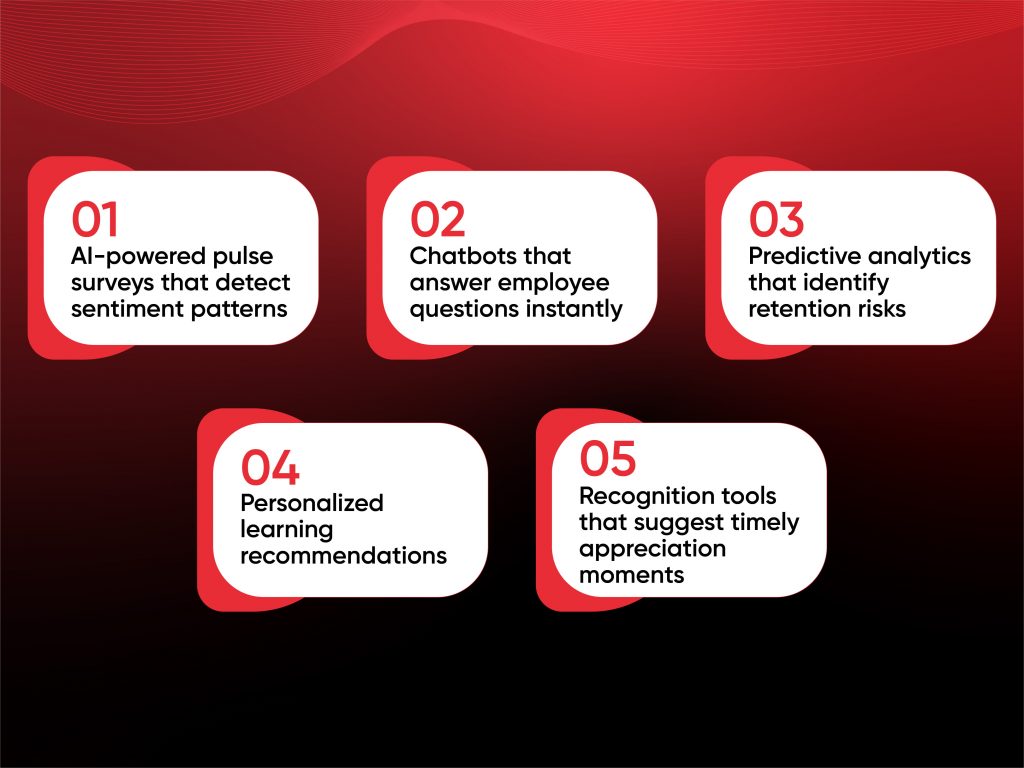
The difference between traditional engagement and AI-enabled engagement is speed and precision. Instead of waiting months to understand how employees feel, leaders can identify shifts in trust, workload pressure, manager effectiveness, or motivation much earlier. This matters because engagement today is highly dynamic. Employees expect organizations to respond faster, communicate better, and create work experiences that feel relevant to them.
Why AI is a Game-Changer for Engagement?
The biggest strength of AI is not automation alone; it is the ability to improve how organizations respond to human needs. Our research with CHROs shows that the top expected benefits of AI are:
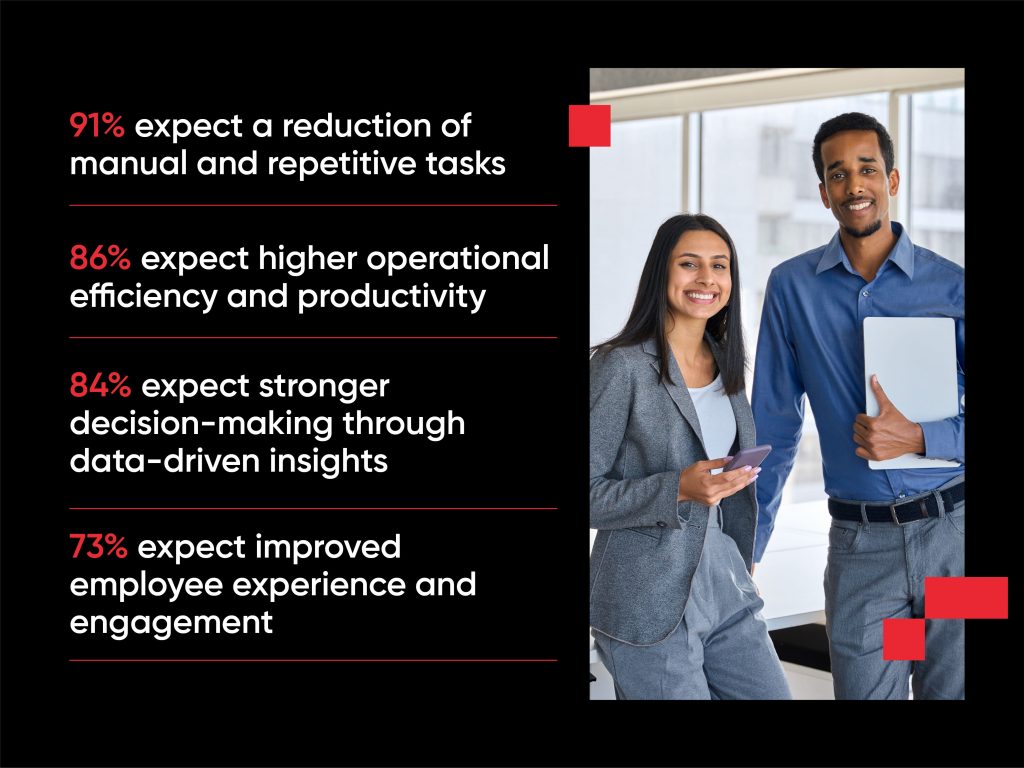
When repetitive work is reduced, employees get more time for meaningful contributions. That directly influences motivation, ownership, and satisfaction. AI also changes engagement because it helps leaders move from assumptions to evidence.
For example, a manager may believe a team is doing well because productivity remains high. AI-based engagement signals may reveal that response time has dropped, recognition has reduced, or attrition risk has increased. This allows earlier intervention, before disengagement becomes a resignation.
Key Applications of AI in Employee Engagement
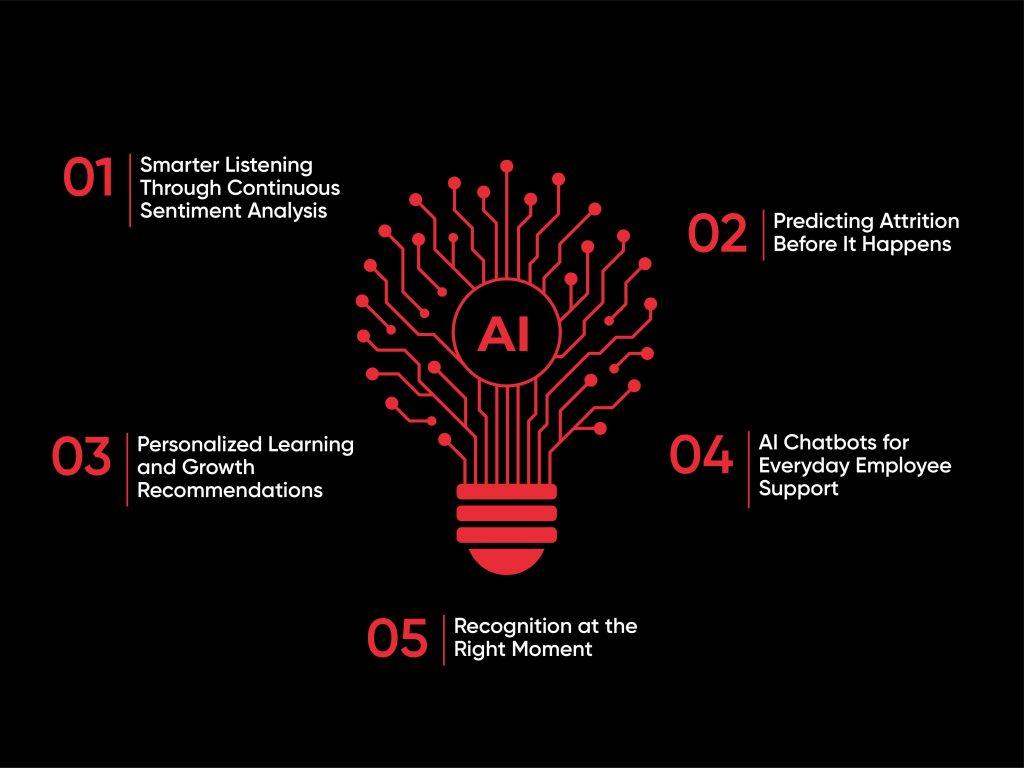
With changing dynamics and workplace culture, AI adoption has become more common, and its key applications depend on the company’s usage and requirements. Let’s take a look at a few key applications of AI in employee engagement that every company should use:
#1. Smarter Listening Through Continuous Sentiment Analysis
Traditional engagement surveys capture a moment. AI helps capture patterns over time. AI tools can analyze survey responses, internal communication trends, and employee feedback to identify recurring themes such as workload pressure, lack of recognition, or trust concerns. This helps HR leaders move beyond scores and understand where action is most needed. Companies are consistently working hard to create the best culture, but something that works for one company may not work for another. Because every company is different, their industry is different, the scope of work and culture is different. Therefore, learning from Best Workplaces™ gives you an idea of the practices you can implement, but listening to your employees will show you the exact data and give you the right direction for creating the best workplace culture.
#2. Predicting Attrition Before It Happens
Employee retention is one of the strongest use cases of AI in employee engagement. Our research shows that at least 40% of employees who worry that AI may replace their jobs are already planning to leave, regardless of role level. This is critical because disengagement often begins long before resignation.
AI can help detect patterns such as:
- Drop in participation
- Reduced internal mobility interest
- Lower manager interaction
- Increased absence patterns
The value is not prediction alone, it is enabling timely conversations. Exit interviews are not the right time to gain feedback and act on it. An organization should use AI to understand an employee’s pattern of work and flag patterns of disengagement so that the conversation can begin quite before.
#3. Personalized Learning and Growth Recommendations
Career growth remains one of the strongest engagement drivers. As AI changes roles, organizations must also help employees adapt. According to Great Place To Work research, 57% of CHROs prefer reskilling and internal job rotations as their primary AI transition strategy. Conventional training programs frequently make the assumption that every employee learns at the same rate and in the same manner. Because of this, some workers could get bored while others find it difficult to keep up. Low involvement and underutilization of educational resources may result from this mismatch. AI-powered learning platforms personalize the entire development process. They assess an employee’s present skill set, pinpoint knowledge gaps, and design specialized learning programs. The system suggests new resources that meet employees’ changing demands as they advance.
AI supports this by recommending:
- Relevant skill pathways
- Learning modules
- Internal opportunities
- Career movement options
#4. AI Chatbots for Everyday Employee Support
Employees increasingly expect quick answers. Regardless of an employee’s position or level of expertise, traditional onboarding procedures frequently adhere to a uniform checklist. As a result, even after the first few weeks, a lot of new recruits could still feel confused about their duties or alienated from their colleagues. By developing customized onboarding experiences that take into account each employee’s history, job function, and preferred method of learning, AI has the potential to completely change the onboarding process.
Also Read: Essential HR Policies Every Organization Must Implement
To guarantee a seamless incorporation into the company, these technologies provide knowledge progressively, pair workers with mentors, and track advancement. AI chatbots help simplify common workplace questions around:
- Leave policies
- Benefits
- Internal processes
- Learning access
- IT support
The benefit is not replacing HR interaction; it is reducing delay in routine support. This allows HR teams to focus more on high-value people conversations.
#5. Recognition at the Right Moment
Recognition loses impact when it becomes delayed or is overlooked. AI tools can identify milestones, collaboration moments, or performance patterns and prompt leaders to recognize employees in real time. That helps create a stronger emotional connection because appreciation feels timely and visible. AI-driven recognition systems are able to identify trends in worker performance that managers might miss. These tools assist in identifying workers who regularly surpass expectations and provide suitable recognition opportunities by analyzing contributions across projects and activities. The advantages of utilizing AI for incentives and recognition are:
- Accurately tracking worker performance
- Notifying recipients of rewards or appreciation on time
- Examining performance information and recommending areas for development
Benefits of AI in Employee Engagement
Here are a few benefits of using AI in employee engagement:
#1 Better Productivity Without Adding Pressure
Today, the best use case of AI is that it reduces the time you take to do repetitive tasks. If you train an AI chatbot and set up a workflow, then your repetitive tasks can be taken care of, and you don’t have to invest the same time every day. For example, if your daily task includes segregating the data from an Excel sheet based on daily user experience, then AI can actually do that in seconds. When employees spend less time on repetitive tasks, focus improves. This explains why CHROs rank productivity as one of AI’s strongest benefits.
#2 Higher Retention Through Early Intervention
Engagement improves when organizations respond before frustration builds. AI helps leaders act earlier. This is where AI-powered employee engagement technologies truly shine. AI can identify the warning indicators weeks or even months before someone submits their resignation letter. The sentiment analysis monitors communication patterns and engagement levels to increase staff productivity with AI. Through this, the HR teams may take action before it’s too late when the system recognizes early indicators of disengagement or burnout.
#3 More Personalized Employee Experience
Not every employee needs the same support. AI helps organizations personalize communication, learning, recognition, and resources. Traditional performance review systems are now outdated. AI in employee engagement can now give you data time data based on deal data and insights, and you don’t have to wait a quarter to look at an employee’s experience or performance.
#4 Stronger Leadership Decisions
Data-backed decisions reduce guesswork. And employees trust leaders more when action feels informed and fair. Interestingly, Great Place To Work’s employee insights show that employees with high confidence in leadership report significantly more positive AI experiences at work. This means leadership trust still shapes whether AI strengthens culture or creates anxiety.
How to Implement AI in Your Engagement Strategy?
Introducing AI into engagement requires culture readiness, not just technology readiness. So, to make it a little easier for you, here is how you can actually implement AI in employee engagement:
#1. Start with a Clear Business and People Problem
The biggest mistake that organizations make is that they follow others, which is not completely wrong, but don’t forget that unique problems require unique solutions. Do not adopt AI because it is trending, rather look at your requirements. The best way is to start with a question: what engagement challenge are we solving? Is it retention, survey fatigue, manager effectiveness, or learning participation? Once you know the problem, you’ll be able to find the right answer.
#2. Build Trust Before Expanding Tools
Our research on CHROs shows that 21% of CHROs identify governance, ethics, and privacy safeguards as a top priority when implementing AI. During the times of increasing anxiety among employees due to the evolution and implementation of AI, leaders need to be transparent.
Employees must know what data is being used, why it is being used, and how decisions are being made. Providing information or reasoning will help them gain clarity and increase trust in leadership, because trust determines adoption.
#3. Invest in Capability Building
The biggest barrier today is not employee resistance; it is capability. 28% of CHROs say limited internal AI skills are the biggest challenge in implementation. Organizations need to train both managers and employees. Not just on tool usage, but on responsible use. Employees should be made aware of the do’s and don’ts. Moreover, there should be a set of guidelines on the usage of AI tools, and employees should be given proper training before using them.
#4. Keep Human Oversight Strong
AI should guide decisions, not replace judgment. Especially in engagement, human interpretation remains essential. Human connection is the essence of any interaction and will remain the same. Signals will always require conversation, and data will require real context.
#5. Future of AI in Employee Engagement
The future of engagement will not be fully automated, it will be intelligently assisted. In the next few years, organizations will likely see:
- Predictive engagement dashboards
- AI-supported manager coaching
- Real-time culture diagnostics
- Personalized career pathways
At the same time, role evolution will also increase. Great Place To Work research shows 61% of CHROs expect 5% to 25% of roles to change because of AI within three years. This means employee engagement strategies must increasingly focus on adaptability, confidence, and reskilling. The organizations that succeed will not be those with the most AI tools. They will be the ones that help employees feel prepared, included, and supported through change.
Conclusion
AI can improve employee engagement, but only when it is used to make work more human, not less. The strongest cultures do not use AI simply to monitor productivity. They use it to listen better, reduce friction, support growth, and help leaders act with greater clarity. At Great Place To Work, we continue to see that when trust is strong, employees are more open to change, more willing to learn, and more optimistic about the future of work. And in 2026, that may become the biggest competitive advantage of all.
Frequently Asked Questions
Is AI replacing HR roles in employee engagement?
No, AI is helping HR teams automate repetitive tasks and improve decision-making, but human conversations, trust-building, and culture leadership will remain crucial.
What are the examples of AI tools for engagement?
Examples include pulse survey platforms, sentiment analysis tools, AI chatbots, recognition platforms, and predictive retention analytics.
How does AI improve employee engagement?
AI improves engagement by helping organizations detect concerns earlier, personalize employee support, reduce repetitive work, and strengthen manager action.
How can companies ensure ethical AI use?
Organizations should establish governance, explain data usage clearly, maintain privacy safeguards, and ensure human oversight in people’s decisions.