
Living in the age of AI is a new experience for everyone, but by no means is it an equal experience for all in terms of adaptability and usage. In the past few years, the workplace environment has changed rapidly, resulting in a rise in hybrid workplace culture, newer expectations regarding innovation, extinction and creation of jobs, and lots more. The younger generations, comprising Gen Z and younger millennials, have had the opportunity to embrace AI and grow alongside it as they have just entered the workplace. The foundation, training, and evolution of AI come naturally for them. The generations prior need to demonstrate stronger agility and adaptability as AI goes on to evolve their workplace culture experience.
But whenever something new is presented, it brings its own set of challenges. We have seen changes in the workplace regarding employee wellness, and AI is at the forefront of it. As organizations go on accelerating innovation and integrating AI into operations, employees are left navigating a blend of opportunity, pressure, and ambiguity in their work lives. The question today therefore is: Is AI behind a potential new wave of burnout at the workplace amid growing uncertainty?
Understanding this tension that employees feel with regards to AI, therefore becomes the first step in examining the state of wellness today.
Current state of workplace wellness (Best vs Rest)
Despite these changes, the overall wellness trend is moving upward. The Great Place To Work® Wellness Index improved from 82% to 85% this year. With notable gains in fulfillment and autonomy (81%-84%), Best Workplaces consistently outperformed the others, scoring higher across all wellness dimensions, thereby enabling stronger work environment, leadership, community, and manager support. With wellness rising, the question remains: why should you care?
Burnout trend over time: While the wellness rate has improved, burnout has not disappeared and remains uneven across groups, particularly among younger generations.
The Burnout & Innovation Link: According to Great Place To Work data, opportunities to innovate rise by 79% when burnout is low, showing that low‑burnout employees are 12 times more likely to feel able to innovate.
Industry lens: Wellness in industries has varied in ways that reinforce this pattern. Construction showed the highest wellness (87%) and the lowest burnout (23%), whereas industries such as IT and Manufacturing, despite being innovation‑centric, records higher burnout (33%) with wellness at 83%.
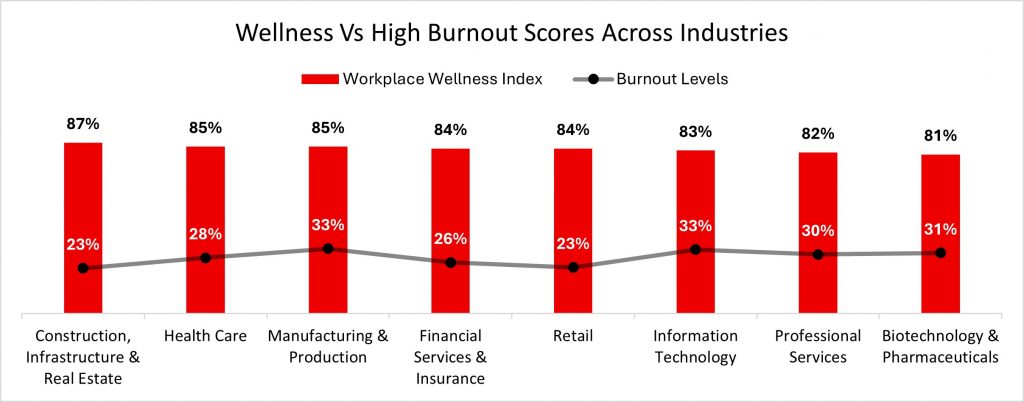
These stats clearly reinforce the strong relationship among innovation, wellness, and burnout, and establish organizational structure and culture as foundational pillars of business performance.
With younger generations reporting higher burnout, a deeper dive into this relationship with AI reveals a bigger picture.
Generational Differences in AI‑Related Stress
Gen Z and millennials are often grouped together, but their workplace experiences differ sharply. Millennials entered the workforce during a time of digital transformation and economic turbulence, which aided in building resilience. Gen Z, however, began entering during a period of global disruption, rapid AI acceleration, and heightened mental health awareness.
Also Read: How AI is changing employee engagement?
Because Gen Z is more comfortable with AI, also enabled by its expansive use in later stages of their education. It is not surprising that millennials showed higher concerns related to the probability of AI replacing their job, with 1 in 2 expressing significant fear. This concern also likely stems from millennials being mid‑career at a stage where disruption carries heavier financial and personal consequences for them. In contrast, Gen Z showed less fear than Millennials.
Gen Z’s deep integration with technology, constant digital stimulation, and reliance on AI tools can increase emotional fragility. They also carry higher expectations of purpose, flexibility, and wellness, making the gap between expectations and reality more emotionally taxing. Millennials, in contrast, display stronger resilience but face a much higher anxiety around long‑term job stability.
Yet anxiety does not overshadow optimism. Across generations, 8 in 10 employees feel hopeful about the opportunities AI will create. This two‑way sentiment of hope mixed with fear demonstrates that employees view AI as both a potential enabler and a destabilizer.
These generational contrasts suggest that AI’s impact on burnout is not uniform and that its emotional weight depends heavily on career stage and lived experience.
When AI Is Used Well, It Can Reduce Burnout
Employees enthusiastic or cautiously optimistic about AI report significantly better wellness outcomes. Among those excited to use AI at work, 72%-83% reported “Good” or “Excellent” wellness across emotional, social, mental, physical, and financial dimensions. Similarly, employees who are hopeful about AI opportunities show 75%-84% of wellness scores across the board.
AI shows its positive effect in many ways,
- Reduces cognitive load by taking over repetitive tasks and summarizing information.
- Gives employees a greater sense of control, which supports mental and emotional wellbeing.
- Improves productivity without adding additional fatigue.
- Benefits hybrid workers the most, helping them maintain better balance and experience lower burnout.
- Builds confidence through training, supported by hands on learning, access to tools, use‑case examples, and clear responsible AI policies.
Employees who have a strong wellness perception and are supported by effective AI integration, are going to be twice as likely to stay long‑term in their organization. This makes AI driven wellbeing not just beneficial, but a strategic tool for organizations going forward.
AI can therefore both increase burnout by making people feel threatened, overwhelmed, or underprepared to use it, and simultaneously decrease burnout depending on how thoughtfully it is implemented by empowering employees in their work.
A Call for Leadership
Leaders now carry a crucial responsibility in shaping how their organizations adapt to an AI‑integrated future. This means moving beyond mere technology adoption and actively preparing their workforce through continuous training, transparent communication about changing roles, and a culture where experimentation is encouraged without fear of consequences. It also requires strengthening mental health and wellness support, ensuring that employees feel psychologically safe amidst rapid transformation. Most importantly, leaders must be intentional about using AI as an enabler rather than a replacement, by designing systems, processes, and expectations that allow AI to elevate human contribution instead of overwhelming it.