
Key Takeaways:
1. AI literacy and career redesign will be critical for HR in 2026, and there will be a need to redesign roles that fit in the AI era.
2. Flexibility and outcome-based performance will replace traditional models.
3. DEIB will shift from intent to measurable accountability, and HR will evolve into cross-functional, data-driven strategy teams.
HR trends in India are changing faster than ever. This is why the Human Resource function will see it as a significant turning point. AI has already started to change how businesses plan projects, make choices, and provide value. Simultaneously, there is an increase in unpredictability, a widening skills gap, and a growing demand for speed and flexibility. By re-evaluating its operations, developing new skills, and assisting the company in remaining resilient, people-centered, and aligned through change, HR has a rare chance to spearhead organizational transformation.
The HR professionals who work as architects of innovation, trust, and agility will be the most successful in 2026. Great Place To Work data received from CHROs has helped us identify top priorities that will take a shift in the coming times. Not only this, but we have also included how HR’s can understand these trends and make their strategies accordingly.
What are the top HR Trends in India?
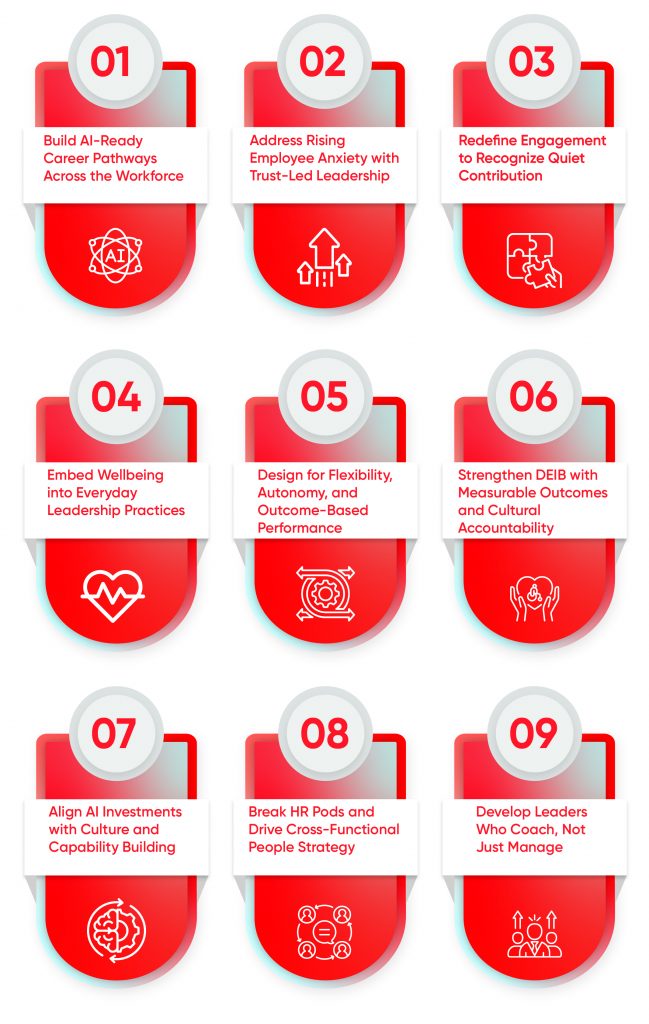
1. Build AI-Ready Career Pathways Across the Workforce
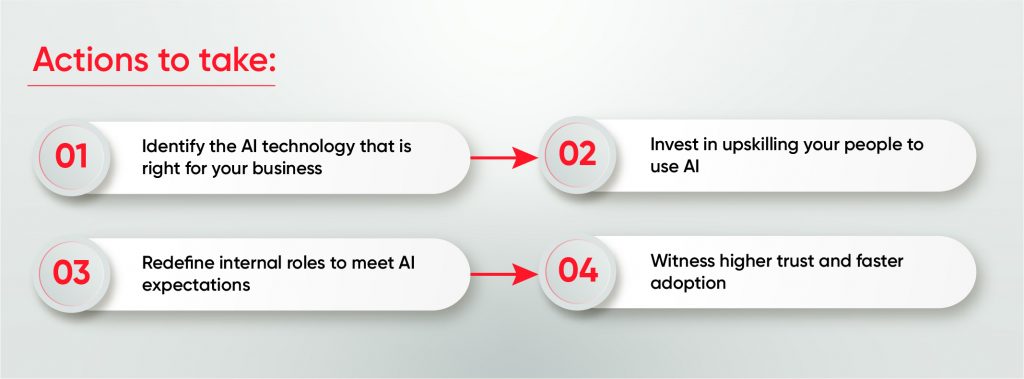
AI is no longer in its experimental stage; it is now being implemented in organizations. It is becoming foundational to how work gets done faster. But adopting new tools is not actually a shift that we are talking about; it’s about redesigning careers. In 2026, AI literacy will be as fundamental as digital literacy was a decade ago. Organizations will expect employees to collaborate with AI systems, not compete with them. This means that with the evolution of new HR trends in India, HRs will not have to move from just organizing to embedding continuous upskilling in the workflow. Now that AI is slowly taking over, we’ll have to find an opportunity, not a challenge. Replacing your people isn’t the right solution; rather take this as an opportunity to create new AI-driven roles. This way, even the employee will feel more empowered and ready for what’s next. Because companies that frame AI as empowerment, not replacement, will see higher trust and faster adoption.
2. Address Rising Employee Anxiety with Trust-Led Leadership
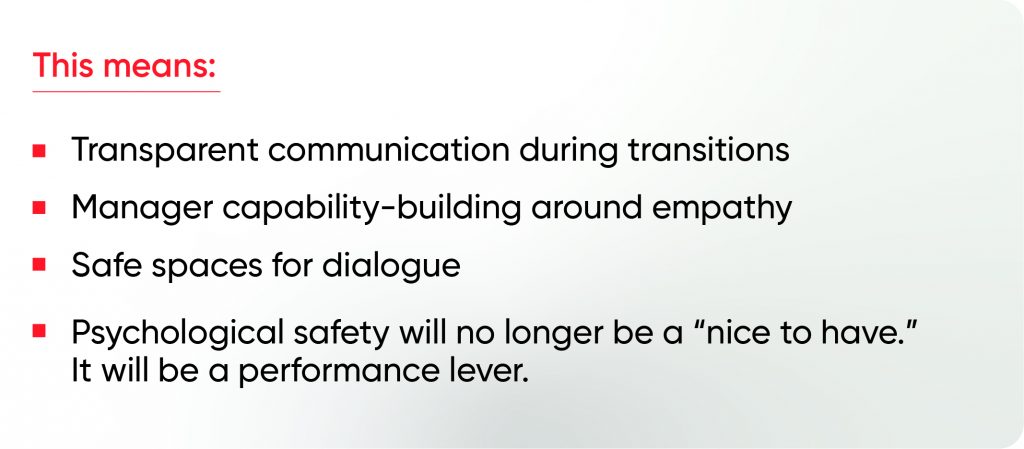
In this change where AI is taking over, increased anxiety among employees will naturally rise. But to deal with this, managers will have to play a major role; human touch will be the baseline requirement. Above that, uncertainty is becoming a new normal. From automation to restructuring, employees are going through constant change. This doesn’t just affect productivity but also affects trust.
Our insights show that when employees feel uninformed during change, anxiety increases and discretionary effort drops. 6 out of 10 companies report a drop in employees willing to go the extra mile to get the job done – a trend that has been on the rise over the past three years. In 2026, the biggest risk is not AI adoption; it’s unmanaged human anxiety around AI. So, the role will be to humanize that change with more discussions.
3. Redefine Engagement to Recognize Quiet Contribution
Employees have been doing what is required, but this is slowly changing. We call it quiet contribution. Employees may not always display high-energy engagement, but they are still delivering meaningful work. HR leaders will need to redefine what commitment looks like in a post-burnout world. Instead of asking, “Are employees excited?” The better question will be: “Do employees feel respected, trusted, and fairly treated?” Because Organizations where everyone experiences a positive work environment report 9% greater discretionary effort compared to others, across all industries.
The solution is hidden in your culture. According to the new HR trends in India, human resource leaders must evolve their culture metrics to capture contribution, not just sentiment. Because discretionary effort cannot be demanded, it comes from within.
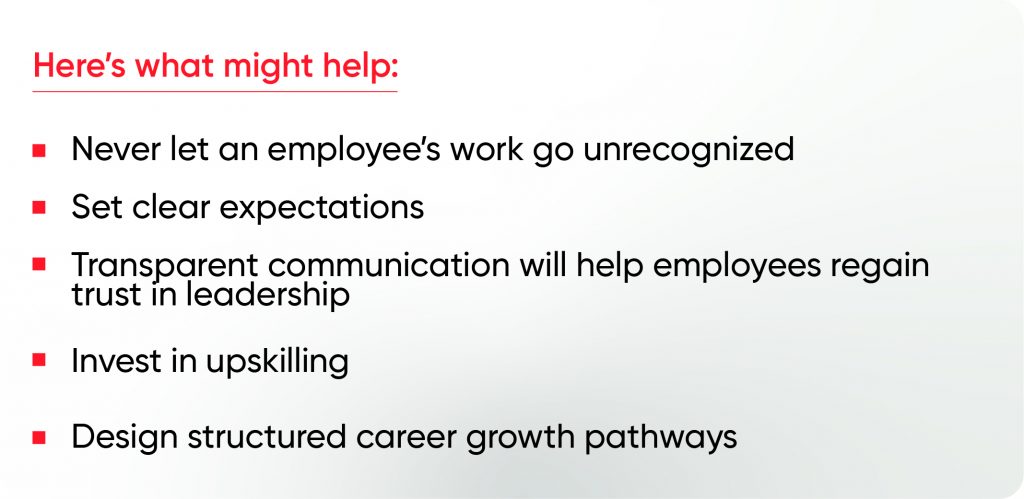
4. Embed Wellbeing into Everyday Leadership Practices
Wellness policies look good on paper, but now is the time to execute. In 2026, employees will trust more on lived experience, not policy documents.
True wellbeing will show up in:
- Reasonable workloads
- Manager behaviour
- Clear boundaries around work hours
- Real conversations about burnout
The best way forward is for the organizations to integrate wellbeing into performance conversations and not just keep it as an added benefit. This will in turn help you retain your best talent because leaders who listen attentively, ask meaningful questions, and connect work to purpose create 3.7X higher intent to stay. This will be a major shift for leaders as wellness is now not only HR responsibility but also leader’s accountability.
Also Read: Top HR Events in India
As career anxiety rises, employees look to their immediate leaders for stability, clarity, and care. Now, Micro-rituals, regular check-ins, recognition moments, meaningful conversations, and flexibility in execution will matter more than broad wellness frameworks. Leadership behavior will become the strongest multiplier of experience.
5. Design for Flexibility, Autonomy, and Outcome-Based Performance
With Gen Z employees and gig workers reshaping the baseline expectations of work, gone are the days when flexibility was seen as a differentiator; it has now become an expectation. Also, with evolving times and changing dynamics, flexibility in 2026 will go beyond hybrid models. Brand name or presence is no longer the only requirement; employees will also seek clarity on how they will achieve their job outcomes. Now is the time when HR leaders will have to move from attendance-based management to outcome-based management. Because employees today are less focused on where they work from and more focused on how much control they have over their work, growth, and time.
Organizations are now facing the paradox as they have to manage the expectations of both Gen Z and millennials. Our research shows that millennials report high access to learning and resources.
To combat the expectations, organizations require:
- Clear role clarity
- Strong goal-setting frameworks
- Manager trust
- Autonomy, when designed intentionally, increases ownership and innovation.
6. Strengthen DEIB with Measurable Outcomes and Cultural Accountability
While trends evolve, trust remains timeless. Diversity, equity, inclusion, and belonging will continue having influence on employee retention and employer reputation. DEIB has always been an important part of building or breaking an organization’s culture. The same is still expected and will remain constant even in the years to come. Now that employees have noticed symbolic initiatives, they will look forward to measurable outcomes. Organizations are now coming forward to create special charters for women and persons with disabilities, but progress is stagnant and isn’t checked upon regularly. Therefore, the only shift is that now DEIB will move from intent to accountability. Even 6 out of 10 CHROs believe that developing inclusive leadership capabilities is the most effective way to advance DEIB practices.
Here’s what will work:
- Data transparency
- Fair promotions and pay equity
- Representation in leadership
- Inclusive decision-making processes
- Cultural credibility will define employer brand strength.
Trust is built when fairness is experienced consistently across roles, genders, and generations. While everything evolves from policy to execution, one thing that remains constant is the human connection. This is something that will be demanded more than ever, especially between team members and the manager. Leaders who build trust, create belonging, and translate values into daily experience will build cultures that win, both in the workplace and the marketplace.
7. Align AI Investments with Culture and Capability Building
Businesses are now investing more in AI, and this is rapidly increasing. But when technology slowly starts taking over culture, people resist. When AI started delivering real value, companies are now integrating it at a much higher speed than ever. But the culture has slightly been overlooked. Employees feel alienated or uncertain about what AI implies for their work; projects frequently stagnate after the pilot stage, and ethical issues are not adequately addressed. Organizations find it difficult to transition from aspiration to effect in the absence of a defined framework.
To keep up with the new HR trends in India, human Resource leaders to serve as intermediaries between human experience and technological aspirations. Active HR participation increases an organization’s capacity to scale innovation, strengthen its culture, and provide quantifiable commercial results. Because they avoid the threat of fragmented, tech-led transformation and align strategy and workforce effect from the outset, so that things move more quickly. Without culture, an AI strategy will stagnate. Therefore, only a trustworthy AI approach will grow. Companies that lead with trust will now take over those that rely solely on technology.
Successful AI transformation will require:
- Reskilling at scale
- Ethical guidelines
- Clear change narratives
- Reinforcement from managers
8. Break HR Pods and Drive Cross-Functional People Strategy
The independent HR Pits will break in the future. In an AI-powered workplace, traditional HR systems based on pods such as hiring, training, incentives, and performance are progressively becoming obsolete. Leading companies are moving away from conventional HR Centers of Excellence, which include specialized teams for performance management, learning and development, talent acquisition, and total rewards. Rather, they are creating flexible, multidisciplinary groups in which human resources specialists from many fields collaborate on common business problems.
Priority issues including leadership pipeline development, retention enhancement, and onboarding redesign are the emphasis of these interdisciplinary pods. They use common platforms, data, and feedback loops to combine their efforts instead of distributing work across segregated functions. Stronger alignment with corporate objectives, quicker decision-making, and more coherent employee experiences are the results.
The change is both structural and cultural. HR employees must abandon function-first mentalities and embrace outcome-focused strategies backed by systems thinking and data literacy. HR becomes a catalyst for speed, creativity, and relevance when it reorganizes into adaptable, cross-functional capabilities networks. By co-piloting new technologies or using insights to define the overall HR strategy and employee experience, these changing structures also put HR in a stronger position to deploy AI in meaningful ways.
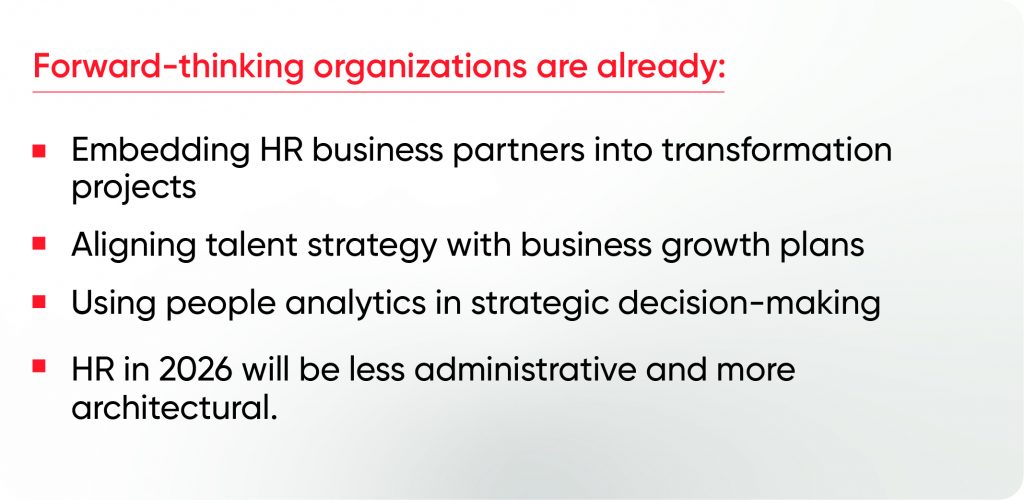
9. Develop Leaders Who Coach, Not Just Manage
The levels of traditional management are becoming flatter. Expectations for leadership are also increasing at the same time. Employees are no longer looking for supervisors; they are looking for coaches.
As part of a larger trend known as “The Great Flattening,” organizations have been gradually simplifying their structures to increase productivity and cut down on layers. The consequences of this change are becoming more apparent. Supervisory layers are being reassessed or eliminated completely as AI technologies replace humans in functions like scheduling, tracking, and coordinating.
Organizational definitions of management and leadership roles are evolving as a result of cost pressure and AI maturity. The human aspect of leadership is becoming more important than ever, even as the administrative aspect of management is declining. In order to share accountability for leading teams across levels and settings, organizations are shifting toward situational, dispersed, and informal leadership. Although AI and the drive for efficiency are changing the manager’s position, they are also increasing the need for human-centered leadership in fostering culture, performance, and trust
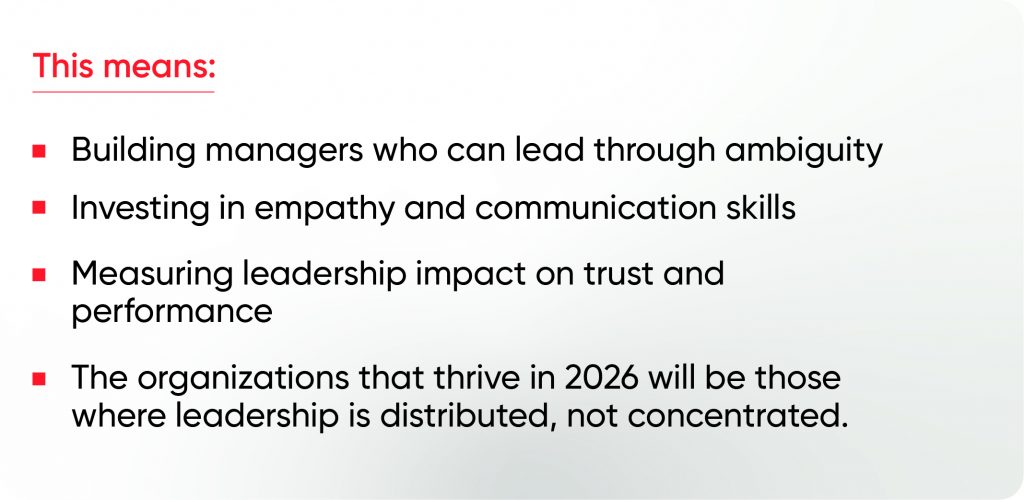
HR Trends in India: The Road Ahead for HR Leaders
The future of work will not be defined by technology alone. It will be defined by how organizations treat their people during transformation. Culture will become the biggest differentiator. In order for companies to take a shift and increase AI usage, they must rethink individual roles with AI and give employees the transparency they are looking for. Because in the AI era, human connection will be of utmost importance, and nothing else can replace it.
The most successful HR leaders in 2026 will use data to guide decisions, build trust deliberately, redesign careers proactively, and put culture at the center of business strategy. Because in an era of disruption, culture is the only sustainable competitive advantage.
To win with culture in 2026, explore how Great Place To Work® can help you on this journey, and to make your managers ready for what’s coming next, join our Giftwork program and see the impact it leaves.
Frequently Asked Questions
1. What are the top HR trends in India for 2026?
The top HR trends in India for 2026 include AI-driven career pathways, trust-led leadership, flexible and outcome-based work models, integrated wellbeing practices, and measurable DEIB initiatives.
2. How will AI impact HR roles in India?
With the evolution of new HR trends in India and AI, HR roles will shift from administrative functions to strategic roles. HR leaders will need to include AI literacy, redesign career paths, and integrate ethical AI practices.
3. Why is employee wellbeing a priority for HR leaders?
Employee wellbeing directly impacts retention, engagement, and performance. In 2026, wellbeing will move beyond policies to lived experiences, with leaders including wellbeing into daily practice.
4. What does outcome-based performance mean for organizations?
Outcome-based performance shifts focus from hours worked to results delivered. It sets clear goals, and accountability, enabling employees to work flexibly while driving innovation and ownership.
5. How can companies strengthen DEIB in 2026?
Companies can strengthen DEIB by moving from intent to practice. This includes transparent data reporting, fair promotions, inclusive leadership training, and cultural credibility.