
 Listen on Spotify
 Listen on Apple
 Watch on YouTube
The CEO-to-CEO Playbook for Inclusive Growth
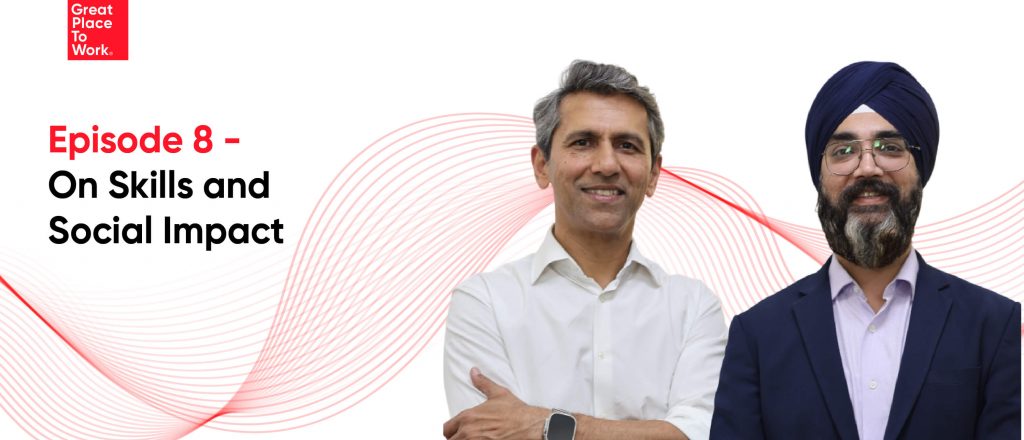
This episode of the For All Podcast features a candid discussion between Jayant Rastogi, Global CEO, Magic Bus, and Balbir Singh, CEO, Great Place To Work® India, about developing an inclusive economy by leveraging mission, measurement, and technology. Together they create opportunities that allow millions of people to transform their lives from being vulnerable to successful. Their conversations unfold the transformative power of leadership, technology, and culture while delivering social impact at scale. Tune in to explore how Jayant’s three-decade career experience in corporate leadership helps him in building one of the world’s largest ‘Childhood to Livelihood’ programs for youth.
From Corporate Boardrooms to Community Impact
Jayant Rastogi was not actively involved in the development sector in his initial career stages. Venturing into the exposure of vulnerable communities through day-to-day experiences led him to develop an interest in systemic inequalities, the path that ultimately led him to Magic Bus. He became convinced to join the Magic Bus team because of its mission to help the youth of some of the most vulnerable communities through experiential learning programs, enabling them to gain the confidence and life skills necessary to grow. After being with Magic Bus for more than 9 years, he states that he continues to learn about the social sector every day and how it is one of the best teachers of his life. He learned how to address complex, generational problems with limited resources and an abundance of creativity.
Building a Continuum of Opportunity: “Childhood to Livelihood”
Magic Bus believes in the power of guiding young people through childhood and adulthood, which is at the center of their mission. The organization has focused on working with young people aged 12 to 18, supporting them to develop life skills, helping them continue their education, and helping them attain employment skills. Many of these young people would drop out of school for reasons such as being unable to afford school, unsafe travel to school, or having family responsibilities. Magic Bus intervenes with young people at this crucial time to keep them in education and facilitate their transition to either higher education or employment. Magic Bus assists approximately 350,000 young people each year in preparing for the workforce, with around 80–85% securing jobs. Of this group of trained young people, 60% are girls, representing an important step forward in addressing the issue of low workforce participation among women in India.
Technology as the Great Leveller
Jayant shares that he leverages technology as a support system to multiply the effects of social change. Magic Bus tracks program results for millions of beneficiaries through data dashboards and software applications, enabling its leadership to measure progress in real time and make rapid scaling decisions. With respect to technology’s larger role, he states: “Technology is a great enabler, and it is also a great leveller.” Rastogi sees AI as a democratizing function of knowledge. He adds, technology provides access to the best educational resources, whether one lives in poverty or an affluent community.
The AI Revolution: Preparing Young People for a Changed Work Environment
To Jayant Rastogi, AI is one of the major disruptive forces shaping the future of work. The question is not how you resist this change, but rather how you equip young people to succeed in this new environment. Magic Bus has taken this philosophy and turned it into action by training thousands of young people in AI skills to prepare them for future jobs. Although he knows that new technologies will disrupt existing job markets, he remains confident that technology will create new jobs in the future. “The world always finds its balance,” he said, adding that when technology is used responsibly, it can increase equal access to information and create access to a high-quality learning experience even in very remote areas.
Building a Great Place to Work in the Social Sector
The development of a culture of success has been a key element in Magic Bus’s transformation of its workplace culture. In 2016, Rastogi had an employee Net Promoter Score of -35, signalling high employee disengagement, and since then, the company has made a dedicated effort to restore trust by focusing on four key components: People, Programs, Processes, and Partners. Jayant believes that the first step to creating a strong culture is defining a clear purpose and fostering transparency in communication. “If people feel connected to their work, and feel like they are valued, there’s a cascade of good things that result from that.” Through the development of internal processes and the establishment of a zero-politics workplace culture, the company has created an environment where its employees feel empowered and aligned with the company’s mission.
A Partnership to Strengthen Culture
Great Place To Work’s partnership with Magic Bus has also had a positive impact on the organization’s culture. With the help of independent Trust Index™ surveys and external verification methods, the organization gained reliable, employee-influenced insights into leadership, trust, and workplace experiences. It has created a culture where purpose, people, and performance mutually support one another, and is based on trust verified against a worldwide gold standard. Jayant shares that the Great Place To Work assessment process offers an external validation that strengthens transparency and accountability throughout the organization.
Magic Bus is a demonstration of how to operate at scale, build systems, and develop strong leaders to achieve a significant social outcome. The organization has developed new pathways from childhood through to livelihood by effectively combining technology, purpose-driven cultures, and leading strategic partnerships. It provides a continued reminder to leaders across all sectors that transforming millions of lives requires both access to opportunity and access to the right support.
Listen in to the full episode now!
Show Transcript
Balbir Singh: 00:01
Hello and welcome to episode 8 of the For All podcast with Great Place to Work India. Today I have the privilege of Jayant Rastogi, Global CEO and Board Director of Magic Bus India Foundation. Jayant has been with Magic Bus for more than nine years and has been leading the organization right from its strategy and operations to daily delivery. Jayant, before we get started, I want you to tell us what got you excited about Magic Bus when you decided to join Magic Bus nine years back. And what does Magic Bus do for our viewers?
Jayant Rastogi: 00:41
Thank you, Balbir, for having me on this podcast. Real honor and pleasure and privilege to be here. I’m very excited about it. And in fact, I’ve decided I’ll learn more from Great Places to Work than I’ll speak over here. So it’s also a learning session for me. What got me interested? Actually, lots of things. I was on the corporate side, you know, for almost close to three decades, and uh did two technology startups. One of the technology startups that I did was actually a social entrepreneurship, not for profit. And it all started because of uh one of the drivers that I used to have. So he was in his 20s, and I think you know, every month he used to fall ill, and then when he used to come back, he used to say glucose, or you can doctor. So I used to wonder, yeah, I was in my 40s, or I was in the house.
So that curiosity led me to understanding that you know there’s a lot of uh these people who are Dhari workers, daily wages. They actually, whenever they’re down, they can’t miss a day’s salary. So, what the doctors, the local in the slumps, they do they put steroids. So which makes them cochla from inside, and it’s very, very harmful. Yeah. So once I understood that, then I wanted to do something in healthcare, which was a honor. So that was something which I did. I also had a for-profit which did uh well, and uh, but this completely flopped, did not do well. It was the technology platform that I was trying to create for you know primary, secondary, and tertiary healthcare. And but so somewhere you know there was that, and then when I got a call from one of the consultants to actually join Magic Plus, I had not heard of them. I don’t know. Uh my initial uh uh reaction was no, can’t have NGO full-time. But then I met Matthew Spaceil. Fantastic, you know, lovely, lovely. You’ve met him, right? Yeah, yeah. More importantly than that, I went to see one of our programs. Uh so when I saw the program, I really liked it.
I realized how things, how some programs, experiential learning, can change people, you know, and that also marginalized committees at a ground level. So that got me interested, and then here I am now nine plus years. Wow. And it’s been a it’s been a fantastic journey. Uh, even for myself, also, because I have learned tremendously, much more than I learned in the three decades of my corporate career.
Balbir Singh: 03:02
So, you know, one of the taglines that I read about Magic Bus, it says childhood to livelihood. So tell us more about it. What exactly do you mean by childhood to livelihood? And Magic Bus has been working with Great Plays to work for uh you know for many years and has been one of the best NGOs to work for for the last five years consecutively. So definitely you’re doing a lot of things uh that are right, that are appreciated by your employees to tell you that you’re a great employer. So, how do you get that balance of being an NGO but also be an employer of choice for your employees? But the first part I
Balbir Singh: 03:36
want to know from you what exactly do you mean by childhood to livelihood?
Jayant Rastogi: 03:41
So, see, we do two programs. So we do an adolescent program and we do a livelihood program. Okay, it was not conceived as that. What we want to do was we wanted to hold the hand of every child from a marginalized community, get them through their school life, and be successful in their uh professional life, you know, once they get into their work career, etc. Now, so what has happened is because of you know a variety of reasons, what we do is we work with adolescent children, uh, age group of you know 12 years onwards, up to 18. And why we do this is because we used to work at the primary ages, uh, which are the primary classes, uh, five, six, seven when the children get into school. But we’ve realized there’s a good amount of enrollment, 99 to 100%. So the problem has shifted to the adolescent.
Okay. So we work with these adolescent children, provide them with life skills so that they can they understand how to manage their personal lives, their school life, and subsequently their work life. So we work, hold their hands, we see that people they complete school, they don’t get married early, and then there are two exit paths they can get into higher education or they can get into livelihoods. Okay, and then we run the livelihood program, which is uh probably one of the largest in the country and probably also in the world. Wow. Where we actually this year uh we’ll be uh training or skilling 3.5 lakh young people, okay, and almost 80-85% will get into jobs. More importantly, 60% are girls. Placing girls is far more difficult. Okay, it’s inclusive growth.
Balbir Singh: 05:06
Yeah. So 3.5 lakhs is a huge number, and this is span India. This is span India.
Jayant Rastogi: 05:12
But on the adolescent side, we’ll have 40 lakh young adolescents who will be part of our program this year. Okay. So adolescent is basically the class 5 to class, class. 62 class. This is where you know, uh, see, we work with both boys and girls, but this is the age where there are very high chances of children dropping off because they can go and earn a salary. Yeah, they have to look after siblings. For girls, the school gets further away in rural areas, there’s no safe transport and a variety of reasons.
Balbir Singh: 05:35
I think uh, you know, Magic Bus has been operating in India for I think more than 25 plus years now. And you said, you know, you were slightly reluctant when you first uh met Matthew if you wanted to join full-time. So, what was that moment that you said, you know, after joining, of course, after you joined, you thought, no, yeah, this is where I want to be. And uh what I am doing, it’s really, really making that difference into the lives of people.
Jayant Rastogi: 06:02
Okay, what I’m gonna tell you is something absolutely the opposite, okay? So 10 days into magic bus. I realized, see, it was a good organization, it was large. Uh, but what was happening is we we did not have too much of technology. And we realized that you know, a lot of stuff that we were saying and doing might not be happening on the ground. So I said, maybe I got into the wrong place. I think I need to leave. So first 10 days, that was so I was just trying to make a mind. But one thing led to the other. See, the intent was very honest. Yeah, the people were really, really good. So then I just got into one thing after the other, and then I started realizing that you know, this kind of an organization needs more people like us, you know, people who come on the other side. Not that you know, we know everything because I’ve learned tremendously over here. Yeah, uh, but because the systems, the processes, the understanding of technology that we bring in will really make a big difference. So I just really started enjoying what I was doing, and I can be very honest that see, 30 years what I learned over there, the way I’ve evolved, I think I’ve evolved much more in the last 10 years. The learning has been tremendous for me in terms of you know doing new things, trying out new stuff. Because, see, there is no history, there’s no precedent in the work that we do. These are generational decades old problems which we are solving, and we’re solving at scale with very frugal
Jayant Rastogi: 07:21
resources using technology. So that’s what is really interesting that you know the scale, the use of technology, how we can lean on it to kind of really make a huge impact, and doing the work very honestly and credibly.
Balbir Singh: 07:34
So you just said, you know, uh your uh job placement rate is about 80 to 85 percentage. If I might ask, what happens with the remaining 15 or 20 percentage that is not able to secure a job?
Jayant Rastogi: 07:47
See, the thing is that you know, some of them might just drop off. We try and see that you know, we counsel them, we get get them back into something. Maybe post we kind of, you know, we we take job placement as in the first 60 days, how many people get job after our training? Yeah, those people could get subsequently also they could get jobs somewhere, but we don’t track them actually. Got it.
Balbir Singh: 08:06
No, I think now I’ll switch tracks now that you have also created a great place to work for your employees. Uh, how easy or difficult it is for an NGO to attract and retain talent?
Jayant Rastogi: 08:18
Again, I’ll start with a real life example, which was a challenge for us. So when I started uh in the year 2016, our employee net promoter score was minus 35. Wow. Which meant nobody was recommending our employees are not recommending. Recommending to us. So it was a big challenge getting the right talent at that point in time. And also the question of affordability of finances were not so strong. Uh, but I believe that you know, if you’re doing some really good work, people are involved and they feel connected and valued. There’s no, I can’t say zero politics, but I try and do that zero politics. I think people start understanding what they are doing. And that kind of once they’re connected, hooked onto it, then I think one thing leads to the other. It has a positive casket. It’s not easy. But we really started focusing on the four pieces, like I say. The first is people.
The second is, you know, our programs, the third is the process and the capacity that we’re building, and the fourth are our partners. And we externally validate each one of them. And that is where great places comes. It’s the really, really big, strong validation of our people. What are they feeling about the senior leadership team, the trust, the capacity that we are building, and everything, the whole environment around culture. So for us, you know, we used to do this uh internal, our own anonymous uh uh survey, but still, you know, people did not believe in it too much because it was end of the day managed by the management for them.
So when Great Places came, yeah, we thought it was a fantastic because you know you anonymously reach out to all our employees. Yes, and then you know, when people connect, for our in our case, I think 70%, which is which is a really strong connect, is what I understand, right? So when people are connecting on their own, of their own choice and they’re validating you know whatever’s happening, I think that’s that’s the biggest uh testament or validation of what you’re doing. So you know you I’m getting an external validation of how we do or how our people kind of you know look at the organization. So that’s that’s the biggest validation.
Balbir Singh: 10:12
That’s where I find a lot of. And I think the biggest one of the biggest strengths uh that we enjoy at Create Place to Work is the trust of the employees. Because when they see a red box by Great Place to Work, they really feel uh you know that they can share their feedback openly and honestly. And uh they know that their feedback will not be directly shared with anyone from the management. Of course, we share the aggregate scores. So uh that’s the trust requires many years of work. So, you know, you just made a mention that you were at minus 35 NPS and now you are one of the best employers when it comes to uh NGOs in India. So it must have been a long journey and uh a fruitful journey, I must say, because of the kind of impact that you are creating. Uh, you know, as a leader, when you’re hiring talent, let’s say for your own team, you know, someone who has to work with you, report to you, what are some of the things that you look for in that individual when you’re hiring someone to work with you?
Jayant Rastogi: 11:08
See, first is uh so see, we we work with uh two sections, two sets of actually we work with many sets of people. But first, if you really look at it, you know, there are people from the sector and the people from outside. So when people from outside are there, we look for people who don’t come with a chip on the shoulder. Typically, when corporate people come, they feel they know everything. Yeah, and they’re going to teach something to honestly speaking, you know, we know very little on the other side. When we come here, we learn much more. Yeah. So we are looking for people on the corporate side is without a chip on the shoulder, grounded, humble, and willing to learn. So that’s and from the sector, obviously, we have some good people and not so great people like everywhere else. Yeah, yeah. When we’re looking at, at least for my immediate team, uh, one thing which is very important for me is that you know they should try and at least bring in some skill sets which are different from mine. I also want an environment where people are also comfortable questioning me. I’m answerable to them.
Balbir Singh: 12:02
Yeah.
Jayant Rastogi: 12:02
I want to have the very honest discussion with people, and when I talk about myself, I try I have actually worked
Jayant Rastogi: 12:08
on creating an image for myself, which is a very approachable image. So when I look at, you know, we play those games where we say that you know what kind of an animal you are. People say tiger, elephant, eagle. I call myself a deer. Nobody is scared of the deer. Very approachable, but tenacious.
Balbir Singh: 12:25
Yeah.
Jayant Rastogi: 12:25
Right? And swift and agile. So that’s that’s the image that once try to create around yourself. So even if I’m working on something, if there’s something important, people still walk into my room and I will. I’m I’m okay with it, right? It’s uh it’s it’s a very informal environment. And uh as a boss, you know, you get all the good news everybody comes and shares. Bad news nobody shares with you. It’s important to know the bad news because you need to act on that before you need to act on the good news. So I think you know that’s that’s that’s what we also uh I believe in a zero politics environment. I I would uh I try and see people, at least I don’t do that, and I see that you know the teams below me directly reporting to me also are in that environment.
Balbir Singh: 13:06
So if I were to ask you what are the two or three major differences when you hired for rules in corporate and when you hire uh for people here, anything that you are very, very conscious about? Once you said no chip on the shoulder, anything else that you would want to add on to that?
Jayant Rastogi: 13:23
See, uh it’s far more difficult hiring for an NGO because obviously the remuneration, yeah, salary. So you also get sometimes, see, you get some, you might be very lucky, you’ll get some good talent once in a while. But a lot of times it’s very difficult. Also in the sector, there’s a dearth of talent. So, and especially for organizations like ours, which are you know which are run like professional organizations, you know, technology processes, etc. There are very few NGOs who actually understand technology, systems, processes, and the scale that we are growing, when we have to hire, we find a really big challenge because you know we have to train our own people and develop them, and we have our own internal learning development programs, etc.
So a lot of talent we have to grow within the organization. It’s very difficult to get uh when the crossovers are there, people from the other side, then it’s relatively easy. But then you know, we have those simple ground rules of hiring. So it’s a challenge. Also, when you work in an NGO, you have different sex, I would say uh different levels of people or different people coming from different backgrounds. Yeah, see the corporate side, you know, you have people like you and me. Typically, you know, parents are educated, they’ve worked before. Yeah, you’ve gone to a good professional college, you come join. So people understand what the environment is. Yeah, when we worked over here, we work with, you know, we work with uh Generation Alpha, Gen Z, millennials, uh people like me, uh, and a whole lot of and even you know, baby boomers. So we have a whole sect of them. The so we need to be able to kind of understand each group of persons.
The other is that you know, a lot of people on the ground are first-time earners in their family, nobody’s earned before. Yeah, they don’t understand the work ethos, they don’t understand the culture. So you have to also inculcate that into them, induct them into it. So that that’s why it becomes far more challenging, you know, as compared to a corporate over here. So I think but that’s tremendous learning and you really enjoy.
Balbir Singh: 15:20
So, Jayant, what are some of the cultural programs that you run at Magic Bus? Something that you yourself champion or the HR team champions, and that you think that is that makes you unique, and not many others are doing something with that.
Jayant Rastogi: 15:36
See, we I I personally believe believe in risk and innovation. So we are probably one of the few, or I don’t know of any other company. Uh so we run an award which is risk and innovation. Risk and innovation. I’m very happy for my people to fail, not fail at the same thing again and again, yeah. But very happy for them to fail. I want them to learn because see, when you push yourself, there are very high chances that you fail. And you want people to push themselves, otherwise, everybody does sandbagging and you know there’s there’s no improvement. Yeah, so we keep we push ourselves and we want to take those risks and do. And for me, innovation starts at the lowest level. Even the guy who’s sweeping the floor, if he can do the sweeping, better sweeping with less number of strokes in a shorter time, that is also, you know, for me is innovation.
So we try and encourage that kind of innovation right grounds up. I won’t say that we’ve been very successful, but uh we have a CEO circle, which is actually now next week, uh, where we get all the top people uh who are top performers, get them. They’re the senior leadership is are the hosts and they are the guests, and we treat them like royalty and uh they have a good time, recognize them, give them certain awards, etc. etc. So we we we we have these kind of things where you know we are trying to create meritocracy, uh also create a culture where you know there’s honesty. We’ve
Jayant Rastogi: 16:55
created uh see people like to do honest work, and but you still need a uh a checking mechanism, you know, maker checker give us calm honestly. So we’ve created uh uh tech tech solutions like you know, fraud prevention detection, which keeps looking, auditing our data, doing data triangulation to see what we are reporting, what we’re doing is accurate or not. So that’s first office kind uh problem for any NGO. So we do a lot of these things, which also kind of, you know, I think the amount of learning which people get, yeah, uh, what they’re seeing, the agility of the organization working at a huge scale. I think that motivates people, you know, when they’re doing some good work, I think it really, really uh connects the people.
Balbir Singh: 17:34
So most of the CEOs have a way of measuring things, like you know, there are so many initiatives and you can’t track everything. Like you spoke about risk and innovation. So, is there some KPI that you track uh on a more regular basis and something that it keeps you on top of? It can be your people sentiment, it can be your NPS score. But what are some of the things that you track yourself?
Jayant Rastogi: 17:56
See, uh, firstly, I I spoke about the four P. Yeah, these are very close to me. And I wherever I go, I kind of you know carry them with me. So on the people front, I said it’s great places to work with the validation. Yeah. On the programmatic front, we face close to 70 or different audits because you know the KPMGs, the Deloit’s, uh, the uh ENY Sattvas, they actually audit us because this is the government mandate for CSR programs. So we get a finance, a financial audit, a social audit. So come out with flying colors, which tells me that my programs are running well. And besides, you know what the funders talk about us. The third is in terms of process, we have KPMGs, the auditors. We do an internal IFC, we do have uh internal audit through PWC. So we do all that to kind of keep us honest, healthy, check, and then the FPD and those things for prevention detection. The last one is partners. On the partners fund, we do our own internal survey.
Balbir Singh: 18:48
Okay.
Jayant Rastogi: 18:48
Uh again anonymous, yeah, with the partners rate what they feel about, which are funder partners predominantly. Yeah. So our last funder partners survey actually gave us an NPS of uh north of 90%, which is a good score. That means 90-95% of my funders are happy to recommend and promote us to other funders. So I think that’s that’s the greatest validation. So that is one thing. Other than that, see, we have multiple, so we had a huge operation, right? 40 lakh people every week classes being held, some classes getting cancelled. So, how do you reschedule those classes? You know, each batch is 25,000 or 25 uh the group of children. So imagine the number of batches we would be having every day. Wow. And then you know you have to. So we run a very massive operation, you know, where we have developed our own tools.
There’s a tool called OSS, okay, which actually looks at every single matrix, and we built it, you know, ground stuff now. So I have the dashboard at a very high level where I’m looking at you know the child-level tracking as to how many children have attended our sessions. So we have that level of tracking for the children on the programmatic front. In we have FutureX technology platform, which is uh talking about skilling and livelihood. So you look at how many people placed, how many girls have come in, how’s the mobilization? So you have to create those batches before that then looking at employers tying up and picking up those. So that’s a massive scale of operation that we do, and we look at all the key index parameters. What I have done is I call it my Bible. The very high level, I have the headlines, and I can drill down into any level that I need to. So those are things then you have to look at your funder health, your pipeline of funders, uh financials. So I think I think these are the two, three metrics which are there.
Balbir Singh: 20:35
Uh which uh which we really the scale is mesmerizing 40 lakh adolescent students. Wow. So, you know, if I were to ask you, uh Jayant, like you work with 40 lakh here on this side, three and a half lakh on the other side. What do you see as some of the biggest capability gaps in in the youth in India? Uh, you know, from the work that you have been doing.
Jayant Rastogi: 21:00
See, when you look at India as a whole, yeah, you know the biggest problem that the country has, and there’s a lot of things which are going forward in our speaker about that. But the biggest problem that the country has is uh if you if you really ask me,
Jayant Rastogi: 21:14
is education livelihoods. Then we talk about you know our agricultural productivity and healthcare. So if I think you know these four four things that we can solve for, I think you know, we will uh I’m sure you know it’ll really help us really. Two of these problems, which are education and livelihoods, is what we work on. And that is what we work at at really, really huge scale. Uh I’m sorry, was what was the question? I forgot.
Balbir Singh: 21:41
Basically, what is the biggest capability gap? Yeah.
Jayant Rastogi: 21:44
Uh correct. So now see when we talk about uh when we talk about livelihoods, so if you look at it, it’s in the public domain that more than 50% of our graduates are unemployable. So they don’t have employability skills. The second problem that we have is the number of people who are coming into jobs and the number of Jobs that are being created are far lower. With AI, it’s supposed to slow down even further. The third is that our labor force participation for females is very low, much, much lower than the international averages. We need a 70% female workforce participation for inclusive growth and to become a $30 trillion economy by 2047. Now, when we look at all these things put together, what does it mean? It means that you know there are people who are dropping off at the adolescent ages. Yeah. And they’re not, they’re just getting off the pipeline. Then we call it neat, not in education, employment, or training. So the 120 million are people who kind of dropped off that. So we need to see that they get back into on the radar, they get into that pipeline. So that’s one of the big gaps that you know, children dropping off from senior primary to higher secondary. In some of the states, districts is as high as 40%. So we try and bridge that. The second is that you know, when you talk about on the skilling side, see there are jobs, but people don’t find there are a few jobs, but when the jobs are also there, don’t find people who are employable because I told you the 50% of our graduates. So we make them employable. So that’s the other thing that we do at a very, very huge scale, making them employable, seeing that get into jobs. Our idea is that we build sustainability into them with life skills so that they are successful in whatever environment they are.
Balbir Singh: 23:24
Yeah. No, today I know another full form of need, not in education, employment, or training. Uh, but what is the role that corporates or government partnerships can play in addressing some of the gaps? And what is some of the work that you are doing with them?
Jayant Rastogi: 23:40
Uh the NGOs bring the domain scale, at least for the sector in the sector. And the government brings the scale. So when NGOs work with government, they can really work at a very, very large scale. So it’s required. Yeah. Now when you work with the government, is the body which decides in terms of the policy, advocacy, etc. So when we will build enough evidences as the development sector, we take it to the government and government change the policies. They can bring in those changes. And that is something that we are trying to do at a huge scale. We’re trying to bring the systemic change. Where if you ask me, you know, we should not be doing any projects. Once we brought it transferred to the government, the government is taking everything on their own. That’s the ideal situation. So systemic change is where I think the government comes in in terms of you know bringing in the right policies, obviously supported by evidence and impact. And the private sector can bring in the technology, the money, uh, the funding to help you know take these things ahead. Besides that, the private sector is also great, you know, test bed for employment, giving people chances to kind of intern, work, learn what a work, uh work uh environment is like.
Balbir Singh: 24:46
I want to ask you a question, which is not in the you know, list that I have. And uh how do you see AI impacting your work or the job employment that you are trying to create? And what are some of the risks and how do you plan to cater to that risk?
Jayant Rastogi: 25:04
Really good question. This is very close to my heart. And in fact, just before this, we had an AI workshop. We got uh some diggers to come and kind of you know discuss that with us and you’re putting a strategy together. We’ve taken a leadership position on AI. Okay, so just when it started, we started doing it. So there are a lot of so I look at it as two sections: one is internally within the organization, efficiencies, uh making things life simpler, a sector. So we’ve done a whole lot of stuff which is around that. The second is taking to our beneficiaries or our participants. So we were the first NGO, and I say this with a lot of sense of pride because you’ve not asked me that question, but I still want to answer it. Last year we did 35,000 people we trained on AI. Wow. This year we’ll do 1.5 lakhs out of the 3.5 lakh youth we’ll train on AI. Putting them into jobs, seeing that you know they have far more robustness, stability, longevity in the jobs. See, there is no doubt that AI is very disruptive. See, technology is a great enabler and it’s also a great leveler.
Now, I would say that you know we have to embrace technology as long as it’s working for us. If it doesn’t work for us, we need to then move to the next thing which is working. Now, there are a lot of questions around AI. Is it disruptive? Absolutely, yes, no doubt. But I think the questions which you must be also, you know, hearing in the West that you know the whole US economy is around this AI bubble. People have invested. I think 60% of the US uh people’s investments are in uh stocks. And if this bubble bursts, then you know what is going to happen to them and all those kind of things which we which which we keep kind of reading and kind of hearing about. So now, see, we are our objective is to look at what is it that the technology can do for us? How does it help us reach every nook and corner? How does it help us reach the marginalized, give them better learning, better training? That is our thing. Whichever technology helps us, we will lean on it, leverage it, and
Jayant Rastogi: 27:03
do that. So I see AI as one such technology which is helping us do it as of now. If it stays, obviously we will. But what it is doing is see, there is no doubt that it is reducing the number of jobs which are coming up. Now, I’m sure a lot of tech leaders say there are new jobs coming up, etc. I hope they come and they change. But I think it is going to be far more different from what it is. But I also feel that see, the world is also, you know, finds its own balance. So if you look at, you know, when the calculator came out in the 60s, people said that this was the end of accountants. But look at it how it has evolved. Yeah. When the digital camera came out, they said this was the end of photographers.
But look how the whole market has evolved, right? So I’m sure the world will find its balance. Yeah, we will find something. But as of now, obviously we need to be ready for it, we need to be prepared, and we need to get more and more people. And I think it’s a great opportunity for a country like India, where you know it’s a huge country and there is not equal access to people. Uh, that this technology actually provides the best of learning to the person in the remotest of corners. And uh so I’ll and I’ll, you know, if you look at the IITs, IAMs or any of these top premier colleges worldwide, the less than 2% people who make it to these colleges. Are they not smart? Are they not intelligent? They don’t get the same opportunities as people from you know privileged families. So AI will help bridge that gap. AI can get the best of learnings through anyone, and I feel that is a big game changer. And we are betting on that, and we’ve developed some tools and uh which which help us kind of you know really take it across JavaScript.
Balbir Singh: 28:40
So, you know, when we we’ve been speaking about AI, we have been speaking of technology, but how can India become a global leader when it comes to social innovation, which is not just tech, not just AI, but a lot more. So, any any thoughts you have on that?
Jayant Rastogi: 28:57
See, I think one is that you know, if you have to become a global leader, you need to invest in it. Our RD spends, unfortunately, are still one of the lowest. In fact, I was I was seeing a news article or reading somewhere that you know our RD spends have actually become lower now. So I think you know, and see what is happening, a lot of technology hardcore real work is happening in these AI. So I think the lead has been taken by US and China. We still need to catch up, but I feel that there’s a lot of uh I would say, see, if you look at we are a confluence of a lot of positive things: good governance and stability in policy, fastest growing economy, and a very young demographic, you know, rebukable-age people. So I think these three things are really, really big. And combined with that, that you know, we are the IT hub of the world.
We do understand technology, and we also produce a maximum number of you know engineering graduates. So I think if you put all this together and I think you know, do some really intelligent thinking and working and strategizing, I think you know, we are weird and strong. And this is what the government has started doing. You know, government is really working hard in terms of you know putting things right. Uh, they have a they’re thinking of a global scaling hub because we can be net suppliers of you know trained manpower to the world. Now, with whatever’s happening now around the world, obviously there’s a little bit of a slowdown. But but I think it should pick up again, you know, once things stabilize. And the government’s really uh kudos to the government, they’ve done some really fantastic work with a lot of intent to you know uh build some of some of these assets.
Balbir Singh: 30:30
So uh couple of last questions, uh Jayant. Uh, what would be your advice to leaders who are generally interested in making a social impact? You know, you started your journey a few years back. So if someone were to start their journey today, what would you advise at first? When you say journey, uh people from the sector or outside the sector?
Jayant Rastogi: 30:49
Anyone, I think more from outside the sector, I would say. See, I would for people from outside the sector, I would say that you know, when you come over here, please come with you know without a chip on the shoulder because you learn much more. The second thing which I personally, and obviously I can’t I can’t hold others to it. I feel that you know the minute you say that you’re giving back, yeah, means your hand is on top of the other person. So then you know you’re you’re trying to control things. So you know, when you’re coming here, you can’t come with that attitude that I’m giving back. You have to come with that attitude that I’m learning, I’m doing something, I’m learning, I’m developing myself, while at the same time, you know, there’s some good, whatever I know I’m bringing that to the so that’s that’s very important. I would say that you know, don’t come with that feeling that I’m giving back. Uh to people from the sector, I would say that you know, accountability, ownership of your outcomes is very important. You have to deliver on what you
Jayant Rastogi: 31:44
promise. I call it, you know, I tell my teams this is taxpayers money. If we cannot do a good job, let some other NGO who can do it take it. Yeah. So for us, that is very important. That’s the reason we build those assets, you know, around fraud prevention, detection, metal scorecards, a whole lot of them to see that when we say something, we actually do it.
Balbir Singh: 32:01
Absolutely.
Jayant Rastogi: 32:02
So I would say that, you know, let’s be honest about you know, delivering what we have to.
Balbir Singh: 32:07
Okay, great. What are some of the initiatives that NGOs as a body can drive? Uh, you know, everybody has their own charter, but what are some of the initiatives that can be driven at a much larger scale if NGOs body were to decide something?
Jayant Rastogi: 32:23
See, uh, I would say a lot of NGOs are doing some phenomenal work on the ground. But what is happening is there’s very little collaboration between the different NGOs. So, you know, one plus one plus one is equal to two and a half or three only.
Balbir Singh: 32:37
Yeah.
Jayant Rastogi: 32:37
But if they can come together as a collective, this thing where they’re sharing ideas, they’re working together. I think that one plus one, one could be 11 or 30 or whatever it could be. So I think that collaboration is very important. The other thing which sometimes really troubles me is that you know, uh corporate funding is typically you know, uh close to a city or some some of the, you know, my factories here, so do it over here. So as a result, what happens is there are 500, 600 large funders in the country. So most of the NGOs are working in the main cities only. So school karma, school maybe charge, and we can’t do it. So everything is in and around that. So there is overlap, yeah, and there’s too much of you know, within. We would really love to go to a needy area. We in fact put our own monies, we go to the tribal districts. Okay, we go to the aspirational blocks, which are the most needy. We put our own money because we don’t get funding for those. So, in fact, 30% of India’s aspirational blocks, we put our own money and we actually go and work over there because we want to do that. So, I would love to see that you know, more and more people are actually doing where the real need is. I’m not saying that the need is not here, but I’m saying between the two, where the real need is. We would love to see that happening more and more. And uh, I feel there is a lot of scope if I think you know we can come together as NGOs, share. There’s a lot more that we can achieve.
Balbir Singh: 33:60
Okay, great. Absolutely. Uh thank you, Jayant. And uh, before I let you go, I wanted to do a quick rapid fire with you. Okay. And one word or a short one-sentence answer only. I’ll try. Even if you feel the need to for giving a longish answer. Uh, so one book that changed your perspective.
Jayant Rastogi: 34:21
Okay, short answer. There’s one book, Elephants Can Dance. Louis Gestner, this is the IBM, he used to be the head IBM. Yeah, yeah. Uh, I’ve always believed in this because it tells us, you know, it is not just expectations, it’s also inspection which gets you there. And I believed in this philosophy right from my you know uh corporate days. Because if you don’t check what you are doing, you will never get there. You have to, and that is only that’s the only time when you can add value. Okay. One myth about leading NGOs. Uh life is easy. Uh, it’s the second second phase of your life. If you want to lead a retired life, get there.
Balbir Singh: 34:56
One thing that keeps you grounded.
Jayant Rastogi: 34:58
My wife, she can get me to the ground just flat a few seconds.
Balbir Singh: 35:03
Uh uh, I think the answer I know the answer to this one, but one tech trend that NGOs must embrace. See, right now it is AI. Yeah.
Jayant Rastogi: 35:11
But I would say whatever is that leading at that point in time, one should embrace that. Absolutely. Brings in high governance, transparency, accountability. One quality that makes a great team. Uh I see the biggest thing, if you ask me, is zero politics. But this not one thing which is there, as you know. Yeah. There are multiple of them. But I think you know the other is that you know, commitment, uh, alignment to the cause.
Balbir Singh: 35:35
Your prediction for the social sector in the next 10 to 15 years in India?
Jayant Rastogi: 35:41
See, very difficult question, okay. My sense is that you know, we should meet our SDG, uh, SDG goals. Yeah. And a lot more collaboration, technology being there to help. I think, you know, uh, see, one one one dream that I’ve had for a very long time is uh you spoke about you know NGOs coming together. See, there has to be proper tracking and measurement of
Jayant Rastogi: 36:06
what everybody does. Without measurement, there’s no accountability. I would love to see if we can take what Akshay Patra is doing, what Magic Bus is doing, what somebody else is doing. If we look at the whole outcome of all these things, and it could be very transparently kind of uh you know, picked up, captured. And the government has to put this in place because an NGO does it, other NGOs will not trust. So if they can put something like that, then you know I think it’ll the collective what works, what doesn’t work, the evidence for policy change, I think it will be a fantastic tool.
Balbir Singh: 36:38
So I think the last one, if you had unlimited resources, what’s that first initiative that you would really, really go hard after?
Jayant Rastogi: 36:48
As of now, I would love to put a mobile and internet connection in the hand of every marginalized. I think it’s a great opportunity for people to learn and make the best for themselves.
Balbir Singh: 37:01
Thank you. Absolutely uh amazing conversation with you, Jayant. Thank you, thank you for your time and thank you for all the honest answers that you gave. And uh pleasure. Thank you. Delight.