
Every organization wants strong leaders. But the first step starts with getting intentional about building leaders who are future-ready. There are employees who are exceptional in their skills and talent but fail when it comes to leadership roles. Leadership gaps don’t usually come from a lack of talent, they come from a lack of structured development. High performers get promoted, critical talent gets stretched, and suddenly, individuals are expected to lead without ever being prepared for it. The result is inconsistent team experiences, declining trust, and missed business outcomes.
At Great Place To Work®, one insight consistently stands out. Great workplaces are built by leaders who create high-trust, high-performance environments – not by policies alone. This is why Leadership Development Programs must evolve with changing requirements and trends. They cannot be limited to training sessions or one-time interventions. They must become intentional systems that build leadership capability through experience, exposure, and behaviour.
What Are Leadership Development Programs?
The goal of leadership development is to improve an individual’s ability to lead, motivate, and influence people within their team and inside a company. The objective is to develop critical leadership skills including communication, decision-making, emotional intelligence, and strategic thinking. These abilities enable both present and future leaders to effectively manage difficult situations and adjust to changes.
Leadership development concentrates on the more ethereal traits that characterize exceptional leaders, whereas general management training concentrates on the practical and administrative abilities required to oversee daily operations. It places a strong emphasis on self-awareness, personal development, and the capacity to inspire and empower others.
Basically, leadership Development Programs are structured approaches organizations use to build leadership capability across levels. But the most effective ones go beyond skill-building.
They focus on developing:
- Decision-making under ambiguity
- Ability to influence without authority
- Trust-building within teams
- Inclusive and fair leadership behaviours
- Adaptability in fast-changing environments
In simple terms, they prepare individuals not just to manage work, but to lead people and culture.
Why Organizations Need Leadership Development Programs?

Organizations that do not invest in leadership development often experience uneven manager effectiveness, lower employee trust, higher attrition among top talent, and reduced innovation and agility. Leadership is the multiplier of culture. Effective leaders steer their groups toward shared objectives, boosting output and effectiveness. They make strategic choices that have the power to influence an organization’s destiny and provide an atmosphere in which employees may flourish. In the end, this enhances an organization’s long-term viability, financial performance, and competitive edge.
When leaders are strong, teams thrive. When leadership is inconsistent, even the best strategies fail. Therefore, investing in leadership learning and development also guarantees that employees have a greater stake in the success of their company. Even strong Leadership Development Programs help organizations in building a future-ready leadership pipeline, improve employee experience, strengthen culture consistency across teams, and drive sustained business performance. Additionally, leadership development coaching offers focused, individualized advice that helps leaders overcome certain obstacles and accelerate their progress.
Leadership Development Starts Earlier Than You Think
One of the biggest mistakes organizations make is starting leadership development too late. Leadership does not begin with a title. It begins when individuals start to:
- Take ownership beyond their role
- Influence decisions
- Collaborate across teams
- Step up during uncertainty
Organizations that build strong leadership pipelines identify these signals early and invest in them. Because by the time someone becomes a manager, their behaviours are already shaped. The goal is to build leadership early.
Who Should Be Included in Leadership Development Programs?
Leadership development should be focused, not generic. Here are two group of people who are critical to be included in the leadership development programs:
1. Next in-Line Leaders
These are individuals expected to move into leadership roles in the near future based on their existing position in the company. They may already be leading projects, guiding peers, and taking ownership beyond their role. Investing in this group ensures smoother transitions and reduces the risk of ineffective first-time managers. This also ensures that if any of the existing leaders cannot perform their duties, then you’ll always have someone ready to take ownership. At this point, you’ll not have to figure out how to get started because you already have a ready pipeline.
2. Critical Talent
This includes high performers and individuals who are difficult to replace.
You can identify such people if they typically:
- Go beyond their role and expectations
- Deliver strong business outcomes
- Hold key institutional knowledge
- Influence team performance
- Take ownership of a team project
It is even more important to develop this group because if not done effectively, they might become disengaged or exit. But if developed well, they become the next generation of leaders.
Top 5 Leadership Development Programs That Actually Work
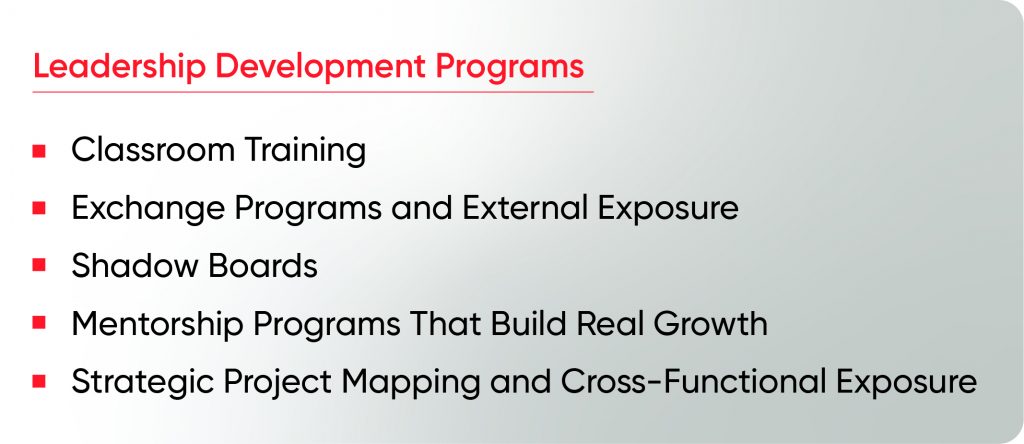
The most effective Leadership Development Programs are not standalone initiatives. They are built through a combination of learning, exposure, and real-world responsibility.
1. Classroom Training
Classroom training still has a role, but only when it goes beyond theory. This is the most traditional kind of training program that not only provides knowledge but also changes behaviour. These are structured meetings focused on roles, responsibilities, strategic thinking, and emotional intelligence of an individual. Now, these sessions can be conducted in different forms and capacities.
a. Tie-ups with External Programs (Sending People Out)
Organizations can partner with institutions or curated learning experiences to expose employees to:
- New perspectives
- Structured leadership frameworks
- Cross-industry insights
Employees are made aware of the industry’s best practices, structures framework, and a lot of other things that they can take back to their organization and implement in phases. Here, the real value does not lie in attending the sessions but in the post-learning application.
b. Bringing in External Experts
The other form of classroom can be inviting external experts into the organization, which allows learning to be:
- Contextual to business challenges
- Scalable across teams
- Interactive and discussion-led
The major benefit of this form of training is that your employees will be able to gain outside perspective and knowledge. This will prepare them to deal with industry-related concerns.
c. Focus on Behavioural Capabilities
Modern leadership is behavioural, not just technical. Leadership today is about managing complexity, not just executing plans. The programs do not only focus on the skills required by an individual based on his or her job roles, but also on other basic skills that are required for leadership, such as:
- Agility – navigating constant change
- Resilience – sustaining performance under pressure
- AI-readiness – understanding how technology impacts decisions and teams
2. Exchange Programs and External Exposure
Leadership expands with exposure. Building a healthy pipeline requires exposure beyond your internal practices. Learning from experiencing how other people and organizations operate can lead to a different perception for your people, and this is how a company grows.
a. Attending External Events
Encouraging employees to attend industry events helps them understand emerging trends, learn from peers, and build external networks. This exposure often translates into fresh ideas internally.
Also Read: How Levels of Leadership Shape Workplace Culture
Great Place To Work is committed to bringing these experiences to you in the form of our biggest event, For All Summit, which takes place every year in February. Not only this, but we also conduct The Great Connects in different cities like Pune, Bangalore, Chennai, Delhi, and Ahmedabad to make networking more accessible for you.
b. Sending Employees as Speakers
This is a powerful leadership accelerator. When employees represent the organization externally, they build confidence, refine their thinking, and develop executive presence. It also signals trust, which in itself builds leadership behaviour.
3. Shadow Boards
A shadow board is a group of high-potential employees who work alongside senior leadership. This is one of the most impactful leadership development programs. The loop starts with identifying critical talent and bringing them into important conversations.
By involving employees in key meetings, organizations enable them to understand strategic decision-making, see real business challenges, and contribute fresh perspectives. This is leadership development in its most authentic form, which is not simulated, not theoretical, but real.
4. Mentorship Programs That Build Real Growth
Mentorship programs are often practiced and seen as real growth builders. Companies often implement such programs but rarely optimize them to achieve the best outcome.
a. Relatable Mentors and Coaches
Before scheduling any mentorship program, the organization must decide on the group of people who will attend this program and what the intended outcome is. For example, if most of the people who’ll be attending this program are from the sales and marketing department, then the mentor should be a chief marketing officer or someone who has already served in a higher position in marketing. This is crucial because effective mentorship depends on alignment. Similarly, if the group attending the session is leaders from across the organization, then the mentor can be someone who can help them with critical thinking and decision making. The brownie point will be if he has worked in diverse industries at different positions, so that he is capable of guiding the people of different departments.
Also Read: What Great Managers Do Differently?
Moreover, a mentor should be approachable, experienced in relevant challenges, and capable of providing honest and actionable feedback. This could include internal leaders or external coaches.
b. Combining Mentorship with Coaching
Mentorship provides direction, and coaching builds self-awareness. Together, they help individuals reflect on behaviors, improve decision-making, and grow consistently over time. Leadership can’t be taught; it can be developed through reflection and feedback.
5. Strategic Project Mapping and Cross-Functional Exposure
Nothing builds leadership like responsibility. High-potential employees can be mapped to strategic initiatives, cross-functional projects, and business-critical challenges. This helps them understand the organization holistically, collaborate across teams, and make decisions with broader impact. This is where leadership capability becomes visible. Because leadership is not learned in isolation, it is learned through everyday action.
What Makes Leadership Development Programs Truly Effective?
Many organizations implement some of these initiatives. But effectiveness depends on how they are connected. Strong leadership development programs are:
Continuous
Leadership is built over time, not in isolated sessions. Therefore, one session will not do the needful; you’ll have to plan a series of sessions, which can be a mix of the above-mentioned programs as per your requirement.
Experience-Led
Real-world exposure matters more than theoretical knowledge. Therefore, you should consider external exposure and exchange programs as part of your L&D strategy for leaders.
Behaviour-Focused
Leadership is about how individuals show up, not just what they know. These training programs will not focus on an individual’s specific skill sets but on overall behaviour.
Aligned with Culture
Leadership development must reflect the organization’s values and expectations. Such programs should be designed to align with the organization’s culture because leaders are also culture makers.
Reinforcing Leadership Through Recognition
Leadership development does not end with programs. It is reinforced through everyday behaviours. Leaders repeat what organizations recognize. When behaviours such as:
- Inclusion
- Collaboration
- Ownership
- Innovation
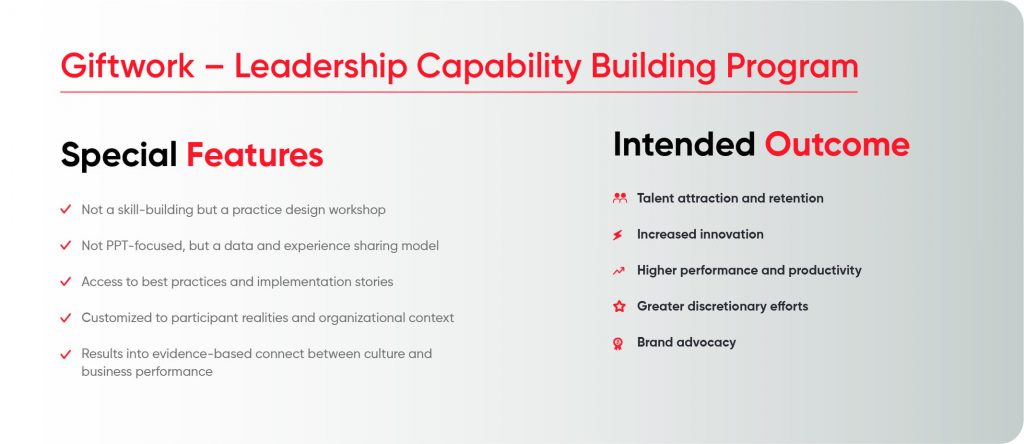
are consistently recognized, they become embedded in culture. This is where leadership capability-building programs like Giftwork® play a critical role. By enabling real-time, value-based recognition, organizations can reinforce leadership behaviours at scale, build a culture of appreciation, and make leadership visible across levels. Because leadership is not just developed in structured programs. It is strengthened in everyday moments.
Conclusion
Leadership development programs that actually work are not about sending employees to training. They are about building an ecosystem where leadership can grow. Organizations that succeed are the ones that identify potential early, provide meaningful exposure, create opportunities to lead, and reinforce the right behaviours consistently. Because leadership is not created overnight, it is built through experience, trust, and culture.
Therefore, organizations that invest in building leaders don’t just strengthen their pipelines. They build great workplaces where people and performance thrive together.
Frequently Asked Questions
1. What are Leadership Development Programs?
They are structured initiatives designed to build leadership capability, behaviour, and mindset within an organization.
2. Who should be part of Leadership Development Programs?
Next-in-line managers and high-potential critical talent should be prioritized for leadership development programs.
3. What makes leadership development effective?
In order to ensure the effectiveness of leadership development, there should be a combination of learning, real-world exposure, mentorship, and continuous feedback.
4. How can organizations build future leaders internally?
Future-ready leaders can be built by providing structured opportunities, strategic exposure, and reinforcing leadership behaviours through culture.