
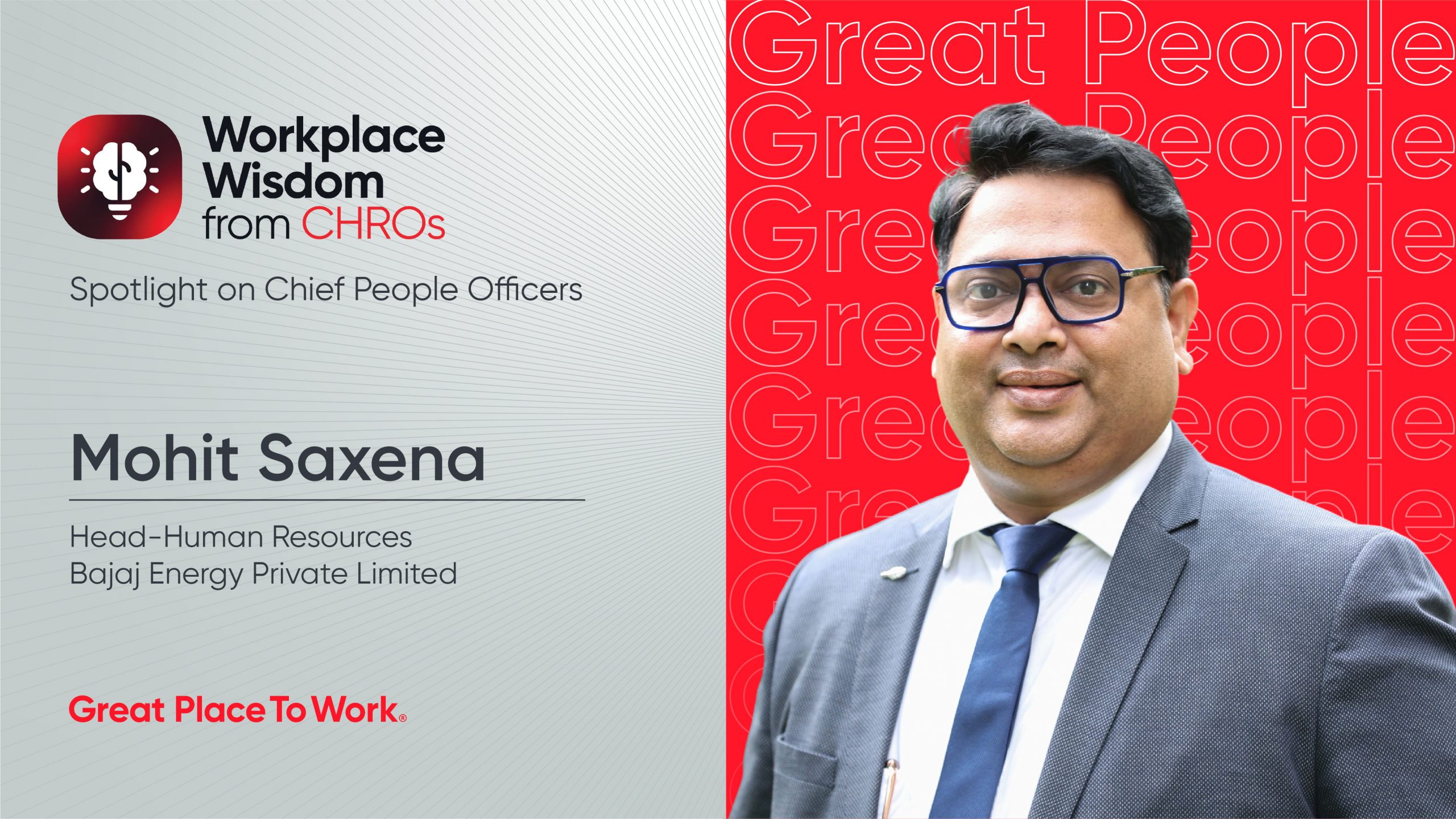
Mohit Saxena brings over 25 years of rich experience across leading organizations such as Sterlite Technologies and Sterlite Power (Vedanta Group), Ola Electric and now Bajaj Energy. His journey reflects deep reflection, authenticity and a steadfast belief in the transformative power of HR. Shaped by diverse milestones and continuous learning, Mohit has cultivated a leadership style rooted in purpose, culture-building and business alignment.
He champions the idea that organizations thrive when people feel trusted, respected and connected to a larger purpose. At Bajaj Energy, he plays a pivotal role in shaping people practices that not only drive organizational success but also create a broader societal impact. Bajaj Energy continues to strengthen its workplace culture with a sustained focus on people, leadership and trust reinforcing its position as an organization committed to building a meaningful, high-performing and purpose driven environment. Bajaj Energy is a Great Place To Work CertifiedTM and ranked in Top 100 India’s Best Companies To Work For 2025 among many other prestigious recognitions
Q1. With 25+ years of HR experience, what personal leadership lessons have shaped your approach as CHRO?
Over the last 25 years, I have had the opportunity to work across manufacturing, telecom, technology, infrastructure and now the power sector. Each industry taught me something different, but one lesson has remained constant: Organizations succeed when people feel trusted, respected and connected to a larger purpose.
Early in my career, I believed leadership was largely about having the right answers. Experience taught me that leadership is often about asking the right questions and listening carefully. Some of the most valuable insights I have received have come from employees working on the shop floor, in power plants, and at project sites.
Another lesson is that credibility is earned during difficult times. Employees observe leadership actions far more closely than leadership communication. (During Covid-19, our Group chairman wrote personalised letters to spouses of each and every employee of Bajaj Group assuring them of Job Security , timely salary payout and complete medical support to the family which ensured zero Attrition and not a single fatality in the company) Being transparent, accessible and consistent, especially during challenging situations, helps build trust that lasts much longer than any policy or announcement.
Q2. What are the key people’s priorities shaping Bajaj Energy’s growth and transformation journey?
Bajaj Energy has always played an important role in supporting India’s energy requirements through reliable power generation. Today, as the energy landscape evolves, we are focused on strengthening operational excellence across our existing assets while also preparing for future opportunities in emerging energy segments.
From a people perspective, our priority is ensuring that we have the leadership pipeline and technical capabilities required to support this evolution. The future energy workforce will need a blend of engineering expertise, digital skills, safety consciousness and adaptability.
Equally important is preserving the culture that has helped us build a stable and committed workforce. In an industry where plants operate 24×7 and many employees spend a significant part of their careers in plant locations, engagement, welfare, development and trust become critical differentiators.
Q3. How do you define a “great workplace,” and how does that definition shape the people strategy at Bajaj Energy?
A great workplace, in my view, is not created by policies, benefits, or workplace awards. Those are outcomes. The real test is whether employees trust the organization enough to give their best every day and whether they feel proud telling others where they work.
In the power sector, particularly at large generating stations, many employees spend years away from metropolitan cities, working round the clock to keep the lights on for millions of people. For them, the workplace becomes a second home. Therefore, creating a culture of trust, respect, fairness, and belonging is not just an HR objective—it is a business imperative.
At Bajaj Energy, we have consciously focused on building that culture. Our efforts around employee wellness, financial security, recognition, leadership accessibility, and capability development are all aimed at reinforcing one simple message: our people matter. We want every employee, whether in a plant, township, or corporate office, to feel valued and connected to a larger purpose.
Our Great Place To Work journey has never been about earning a Certification. It has been about creating an organization where people feel respected, leaders remain approachable, contributions are recognized, and employees can build meaningful careers while contributing to India’s energy security and growth. When employees trust the organization and believe their voice matters, exceptional performance naturally follows.
Q4. With decades of legacy, how does Bajaj Energy keep its cultural values relevant and meaningful for today’s employees, whose expectations around work, growth and purpose are rapidly evolving?
Legacy organizations often struggle to balance tradition with changing employee expectations. At Bajaj Energy, we believe the answer lies not in changing our values, but in keeping them relevant.
The principles that have defined the Bajaj Group for decades—integrity, respect for people, nation-building, and long-term stewardship remain unchanged. What has evolved is the way we engage with our workforce. Today’s employees seek transparency, continuous learning, faster growth opportunities, meaningful work, and a greater voice in shaping the organization.
Our focus has therefore been on modernizing the employee experience while staying true to our core values. Whether through wellness initiatives, leadership accessibility, recognition programs, career development opportunities, or open communication platforms, we strive to create an environment where employees feel valued and heard.
As we pursue future growth through expansion projects and new opportunities in India’s evolving energy landscape, our success will depend on our ability to combine a strong legacy with a progressive mindset. For us, culture remains relevant when employees see a clear connection between the organization’s purpose, their personal growth, and the contribution they make to the nation’s development.
Q5. What future skills will be critical for the energy business in the next 3–5 years?
At Bajaj Energy, we believe the future will belong to professionals who can combine deep technical expertise with digital capability and a strong commitment to safety and compliance.
The power sector is becoming increasingly data driven. Skills related to predictive maintenance, automation, AI-enabled monitoring, analytics and reliability engineering will become increasingly important.
However, technical capability alone will not be sufficient. The energy sector requires leaders who can manage complex operations, lead diverse teams and take decisions
with a long-term perspective. In highly regulated sectors such as power generation, discipline, accountability and continuous learning will remain non-negotiable.
Q6. How do you see AI and analytics shaping HR decision making in the next five years?
At Bajaj Energy, I see AI and analytics becoming powerful enablers of better and faster people decisions. The real opportunity is not automation for its own sake, but freeing HR teams from routine administrative work so they can spend more time on talent, capability building, and business partnership.
What excites me most is the ability to move from reactive decision-making to predictive insights. Instead of looking at what happened, we will be able to identify workforce trends early, anticipate skill requirements, assess talent readiness for future roles, and proactively address retention and capability gaps.
AI will also help us create a far more personalized employee experience. Career paths, learning interventions, succession planning, and development opportunities can be tailored to an individual’s aspirations, strengths, and potential rather than following a one-size-fits-all approach.
As Bajaj Energy prepares for future growth, including expansion into new areas of the energy sector, access to quality data and predictive analytics will enable us to make more objective, metric-driven decisions. Ultimately, the success of HR will be measured not by processes completed, but by tangible employee and business outcomes delivered with greater precision, speed, and impact.
Q7. How is data and employee feedback used to drive actionable change and decision making at Baja Energy?
At Bajaj Energy, HR is not viewed as a support function; it is a strategic partner in driving business performance and organizational sustainability.
Our role begins with ensuring that the right talent is available across critical functions and that employees have opportunities to continuously upgrade their skills. We focus extensively on succession planning, leadership development and capability building to ensure that the organization remains future-ready.
Culture is equally important. Through transparent communication, employee engagement initiatives, wellness programs, recognition platforms and leadership accessibility, we work to create an environment where employees feel valued and motivated to contribute their best.
Sustainability, in our context, is not limited to environmental responsibility. It also means building a resilient organization with strong leadership pipelines, high employee engagement, robust governance and a culture that can sustain performance over the long term.
Ultimately, HR contributes by helping create a workforce that is engaged, capable and aligned with the organization’s purpose and business goals.
Q8. How is the HR function enabling performance, culture and long-term sustainability at Bajaj Energy?
At Bajaj Energy, we believe the best people decisions are made when leadership actively listens to employees. Feedback is therefore not limited to annual surveys; it is gathered continuously through AI-enabled chatbots, digital feedback platforms, townhalls, leadership interactions, employee connect sessions, and regular engagement with teams across our plants and offices.
We use these insights to understand employee sentiment on areas such as wellness, learning and development, workplace environment, rewards, and overall employee experience. The feedback helps us identify emerging trends, address concerns proactively, and refine our policies and practices. We also regularly benchmark ourselves against leading organizations to ensure that our people practices remain contemporary and relevant.
An important aspect of our culture is the active participation of employees through various social and welfare clubs. These forums provide valuable grassroots feedback while strengthening employee engagement and fostering a sense of belonging among employees and their families.
What matters most is converting feedback into action. This approach has helped us maintain attrition below 6%, strengthen trust in leadership, and create a workplace where employees feel heard, respected, and motivated to contribute their best every day.
Q9. How do you see the role of people managers in energy sector shaping employee experience?
I often tell managers that employees may join an organization for its brand or opportunities, but they stay because of their immediate leaders.
In a company like Bajaj Energy, where employees from different generations work together and operations run continuously, managers play a critical role in shaping employee experience. They are expected to drive performance while also coaching, mentoring and developing future leaders.
The best managers are those who remain open to learning. Today’s younger workforce brings digital fluency and fresh perspectives, while experienced employees bring operational wisdom and institutional knowledge. Great managers create an environment where both can learn from each other.
I strongly believe, most successful managers are those who combine technical competence with humility, adaptability, and a genuine commitment to developing people. Ultimately, great workplaces are built not by policies, but by leaders who inspire trust, encourage growth, and bring out the best in their teams.
Q10. What advice would you give to young HR professionals aspiring to reach leadership positions?
If I were to give one piece of advice to young HR professionals, it would be this: never stop learning.
HR leadership is not built by staying within the comfort of one specialization. Be willing to take on difficult assignments, work across industries, functions and business environments, and expose yourself to situations that challenge your thinking.
Some of my most valuable learning came from assignments that initially felt unfamiliar or uncomfortable. Those experiences helped me understand business better and shaped my perspective as a leader.
At the same time, invest time in understanding technology, AI, analytics and automation. The future HR leader will need to combine human understanding with data-driven decision making.
Most importantly, stay grounded. Titles change over time, but credibility, integrity and the ability to build trust remain the foundations of lasting leadership.
Q11. What role will human capital play in India’s energy transition and energy security journey?
India’s energy transition is often discussed in terms of technology, infrastructure and investments, but ultimately it will be enabled by people.
Whether it is thermal power, renewables, transmission infrastructure or emerging technologies such as nuclear energy, success will depend on having a highly skilled workforce capable of operating increasingly sophisticated systems safely and efficiently.
Organizations therefore need to invest not only in assets but also in capability building, leadership development and knowledge transfer. The energy sector is entering a period where reskilling and continuous learning will become strategic priorities.
At Bajaj Energy, we believe that developing future-ready talent is essential to supporting India’s long-term energy security and economic growth. The organizations that succeed will be those that combine technological advancement with strong people practices and a culture of continuous learning.