
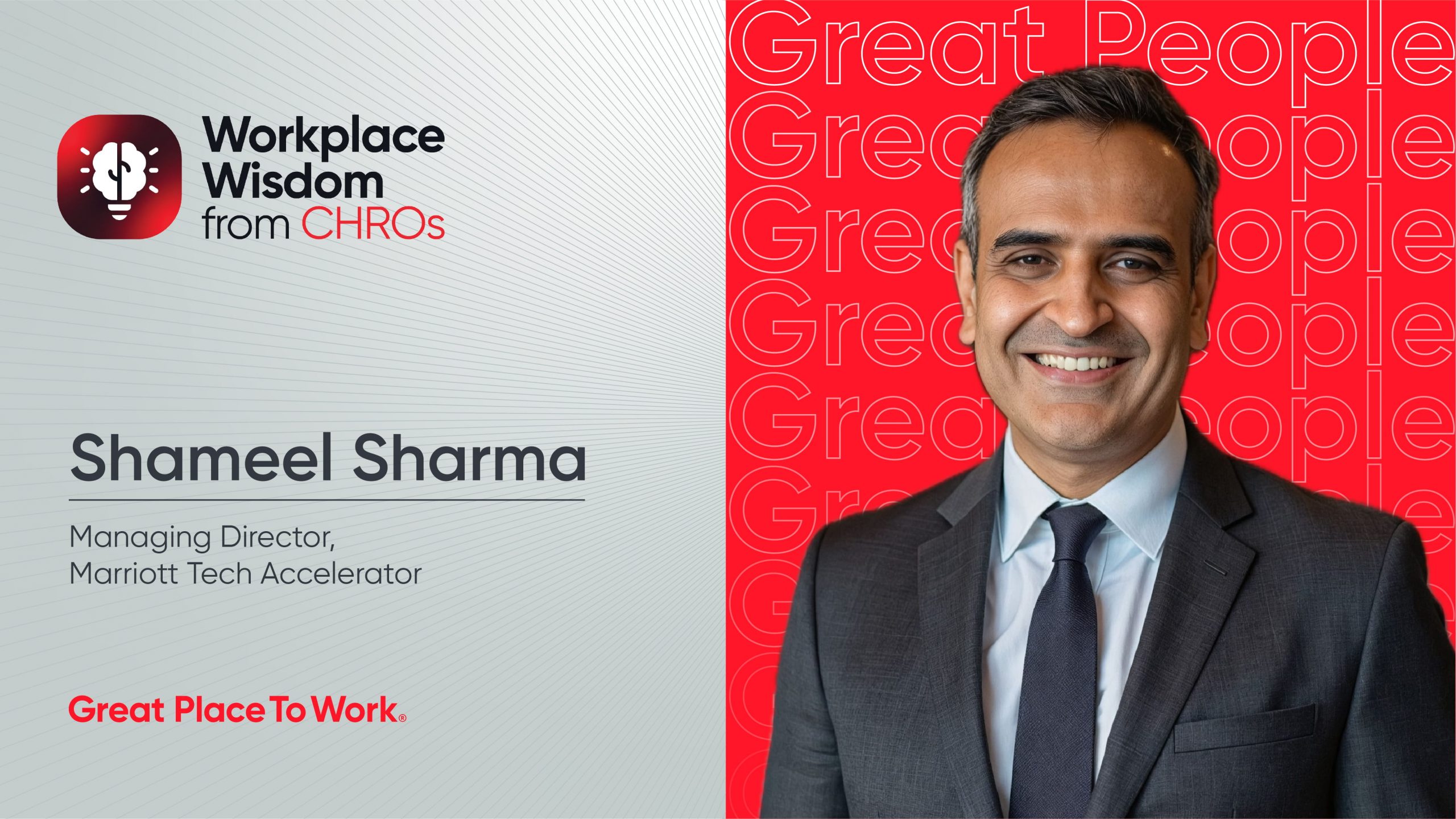
Shameel Sharma, Managing Director at Marriott Tech Accelerator, is building a culture anchored in trust, belonging, and growth as GCCs evolve into talent and innovation hubs.
In its very first year, the organization earned the Great Place To Work® Certification with strong scores—reflecting a thoughtfully designed, people-first workplace.
Q1. Marriott Tech Accelerator has been Certified for the first time as a great workplace in 2026. How do you leverage this recognition, and what impact has it had on talent attraction, employee pride, and leadership credibility?
Being Certified ™ by Great Place To Work for the first time, and in our first year is a milestone we are incredibly proud of — and equally, it is a responsibility. We have deliberately used this recognition as a platform for storytelling, both internally and externally. Internally, it has energized our teams and validated the efforts of every associate who contributed to the culture we have built. There is a visible sense of pride — people share the certification on their profiles, speak about it in interviews, and refer colleagues to join us. Externally, it has strengthened our employer brand significantly. We are seeing stronger inbound interest from candidates who specifically cite the certification as a reason they want to work with us. For leadership, it lends credibility to the people agenda and reinforces that creating a great workplace is not just the right thing to do — it is good business.
Q2. How do you personally define a “great place to work,” and how does that definition shape your people strategy at Marriott Tech Accelerator?
For me, a great place to work is one where people feel genuinely seen, heard, and valued — not just as employees, but as individuals. It’s a place where there is psychological safety to speak up, take risks, and grow, and where the organization’s values are lived daily rather than displayed on a wall. At Marriott Tech Accelerator, this definition is at the heart of everything we do. We build our people’s strategy around three pillars: trust, belonging, and growth. Whether it’s how we design our onboarding experience, how leaders communicate, or how we approach performance conversations, each decision is filtered through the question: does this make our people feel they truly belong here? We are intentional about creating spaces where people can speak openly, collaborate without hierarchy, and feel ownership of outcomes. Culture isn’t a by-product for us—it’s a deliberate design choice.
Q3. What are the top three key people/ engagement metrics you consistently monitor, and how do they help you make informed decisions about your people strategy?
The three metrics I keep a close eye on are: Trust Index scores (from the Great Place To Work survey), attrition rate, and internal mobility rate. The Trust Index gives us a direct pulse on how employees perceive leadership, fairness, camaraderie, and pride in their work — it is our most honest mirror. Attrition tells us whether people are choosing to stay, and it helps us identify which teams or functions may need more attention. Internal mobility is perhaps the most underrated metric; when people are growing and moving within the organization, it signals that they see a future here. Together, these three metrics shapes where we invest our energy, where we course-correct, and how we have conversations with the business about people risk.
Q4. What’s one initiative or practice you’ve led that had a measurable impact on workplace culture and business performance?
One initiative I am particularly proud of is our inclusive reward and recognition program, designed to celebrate impact without the constraints of hierarchy or title. It is open to every associate, irrespective of grade or level, and allows for nominations in all directions—upwards, downwards, lateral—and even self-nominations. The intent is simple: great work and the right behaviors should never go unnoticed, no matter where they originate.
Each nomination is thoughtfully evaluated by an independent, cross-functional rewards committee, ensuring fairness, objectivity, and a consistent focus on meaningful impact rather than visibility or proximity to leadership. Once recognized, we don’t treat it as a quiet acknowledgment, we amplify it. From cash awards and citations across our internal channels to beautifully crafted certificates that people genuinely cherish, we celebrate in a way that makes the moment memorable.
More importantly, this program is about reinforcing culture. By consistently celebrating behaviors such as collaboration, ownership, innovation, and empathy, we are shaping everyday actions across the business. It sends a clear message: this is what good looks like here.
Q5. As Gen Z enters the workforce, how is Marriott Tech Accelerator adapting its culture and policies to align with their expectations, values, and workstyles?
Gen Z is not a challenge to be managed — they are a catalyst for evolution. At Marriott Tech Accelerator, we have been intentional about listening to what this generation values: purpose-driven work, transparency, flexibility, and rapid growth. We have revisited our communication channels to be more digital-first and conversational. We have introduced flexible work arrangements and results-oriented performance conversations rather than time-driven assessments. We have also strengthened our focus on learning and development, offering micro-learning pathways and mentoring opportunities because Gen Z wants to grow fast and often. Perhaps most importantly, we have been transparent about our business goals and how each person’s work connects to the bigger picture — that sense of meaning matters deeply to them. We also conduct a number of pulse surveys across organizations to understand and correct but also ensure that our associates are part of the decision-making process around processes, infrastructure, team engagement activities and more.
Q6. What role does leadership play in creating and modelling inclusive behaviors at Marriott Tech Accelerator, especially towards women?
Culture takes its cues from the top and leadership sets the tone when it comes to inclusion. At Marriott Tech Accelerator, we hold our leaders accountable for modelling inclusive behaviors, not just endorsing them in policy documents. This means ensuring women have equal representation especially when it comes to compensation, grade or benefits. In fact the workforce is over caring and supportive of the women, especially during the stages of pre-pregnancy when they need the added support. The MTA team constantly looks out for and supports each other, and this has a lot to do with our corporate values of Serve our World, People First and Integrity. For us, inclusion is more than an HR programme, it is a leadership responsibility, and we are committed to upholding that standard at every level.
Q7. Over the next 3 years, what emerging leadership or workforce trends (e.g., AI, hybrid work, reskilling) do you see reshaping the talent profile and people strategy in the GCC industry?*
Three trends stand out as transformative for GCCs over the next three years. First, AI-augmented work is already redefining job roles — GCCs will need to invest in reskilling programmes that help employees work alongside AI rather than be displaced by it. The talent profile is shifting from “domain expert” to “domain expert who can leverage technology.” Second, the evolving hybrid work model will continue to test our ability to build culture and connection in a distributed environment. Leaders who can create belonging across screens will be at a premium. Third, I see a growing emphasis on outcome-based talent models — where skills, project contributions, and agility matter more than traditional career ladders. GCCs that can design flexible, skills-first talent frameworks will have a significant competitive advantage in attracting and retaining the best people.
Q8. What’s one story or feedback you’ve received that stayed with you and continues to guide your decisions?
A few years ago, a mid-level engineer came up to me after a town hall and said, “This is the first job where I feel like the leadership actually knows my name and my story.” It was a simple sentence, but it has never left me. In another case, a women colleague who had another offer in a company told me that she can’t leave as her father will never allow that. Her father had my phone number from the days of her pre-induction and knew he could always call me if there was a problem. No other organization would give that level of personal connection and safety. These comments reminded me that our most powerful people practice simply paying attention and being there— remembering someone’s career aspiration from a conversation six months ago, checking in when a team goes through a tough sprint, acknowledging achievements in front of peers. These moments cost nothing but mean everything. Every time I am about to make a systemic policy decision, I ask myself: would this enhance the experience or is this just a number.
Q9. Looking ahead, what is one skill or mindset you believe the next generation of HR leaders must develop to be future-ready?
The era of HR as a purely administrative or welfare function is long over. The next generation of HR leaders must be fluent in the language of the business: revenue, productivity, risk, and innovation. When you can walk into a leadership conversation and say “our attrition in this team is costing us X in productivity and Y in re-hiring costs, and here is what we can do about it,” you earn a seat at the table. Equally important is a data-first mindset — using people analytics not just to report what happened, but to predict and influence what happens next. The HR leaders who will make the greatest impact are those who are as comfortable with a business dashboard as they are with an empathy-driven conversation. They also need to be aware of all aspects of human resource operations, from sourcing, acquisition, lifecycle management, compensation and benefits, talent management and more.
Q10. If you had to describe your journey with Great Place to Work in just one word, what would it be, and why?
Awakening. The Great Place To Work process is not simply a survey or a certification — it is a mirror. It holds up a reflection of your culture that you cannot look away from. It awakened us to strengths we had not celebrated loudly enough, and to blind spots we needed to address with urgency and humility. It awakened our leaders to the profound impact they have on everyday employee experience. And it awakened our people to the fact that their voices genuinely matter and lead to real change. That awakening has made us better — and I believe it will continue to do so as we use these insights to build something even more extraordinary in the years ahead.