
Middle managers, the indispensable power core of the organization, represent 21% of the workforce across industries like IT (12%), BFSI (27%) and Manufacturing (25%). They drive execution, striking a balance between leadership and the frontline. As they convert strategy into action, and vision into performance, they make sure teams stay aligned and motivated to work. Yet they are often underappreciated and the employee engagement data reveals a growing strain for them.
You are sandwiched between being a manager of a team and a subordinate to a senior manager of the company. You manage multiple projects, attend countless meetings, and serve as a translator of strategy. Yet, you are uncertain about your growth and career trajectory, your leaders are not easily accessible, and you struggle to maintain a work-life balance. The sentiment drops further if you are a female middle manager.
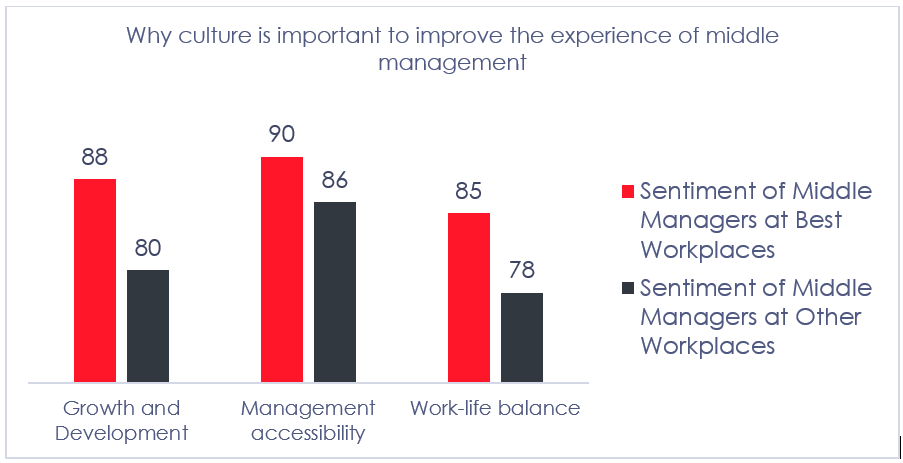
The culture of a company plays a pivotal role in the experience of middle management, The Trust Index™ Grand Mean for middle managers at Best Workplaces™ stands at 88%, as compared to 83% at the other companies.
Middle managers play a pivotal and paradoxical role in business today. They hold the organization together, but who holds and supports them? The expectations are high, but is the support? This article unveils differences in expectations of and from middle managers, and strategic practices Best Workplaces use to ensure their middle managers have a great experience.
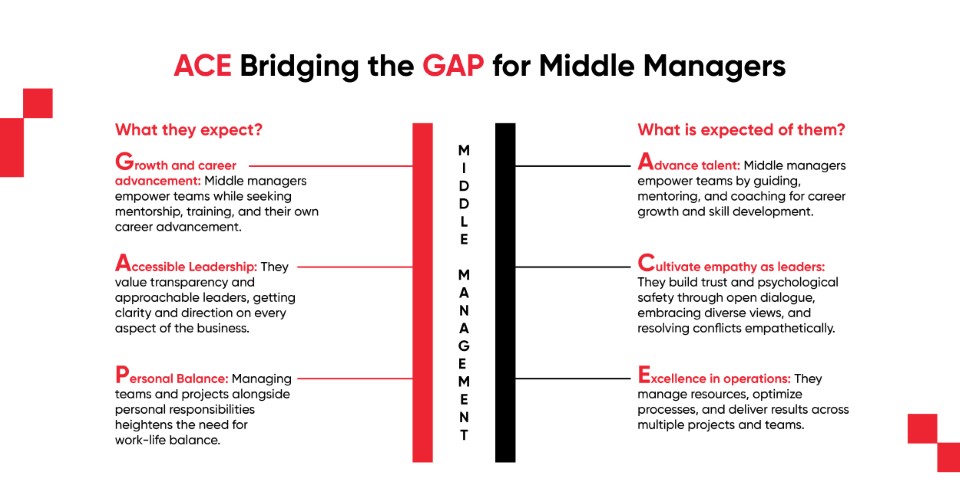
The expectation appears similar, but the direction diverges. Middle managers seek support and guidance from their senior managers and are expected to provide the same to their teams at the same time. This makes the dynamic complex; thus, aligning them becomes crucial for organizational success.
Redesigning the Middle: How to turn their pressure to power
Best Workplaces work towards enabling their middle managers, besides merely managing them. Three of their best practices are:
01 Build learning labs and not just leadership lectures:
Instead of traditional classroom learning, Best Workplaces adopt high-impact leadership development programs like:
- Personalized coaching: The Future Fit Manager Certification Program 101 and 201 by Indegene Limited is a detailed intervention to identify training needs by Focused group discussions conducted by the leader. Unlike traditional training, it uses role plays for sensitive conversations, case studies, and cross-functional collaboration exercises.
- Mentorship: H&R Block Private Limited’s Choose Your Mentor initiative reverses the concept of being assigned a mentor to guide you and provides the autonomy to choose a mentor based on personal interests and preferences.
- Career Development: Brigade Enterprises Limited’s BrigHT Career Accelerator Program focuses on exceptional performers for the past 3 years and helps create a leadership pipeline by drafting career roadmaps and personalized training after a detailed assessment of the individuals’ capability and personality.
02 Driving middle management to be better problem-solvers:
Middle managers sit at the centre of most organizational challenges, balancing pressures from both leaders and teams. This makes strong problem-solving skills essential to aid them in providing an effective response.
Best Workplaces invest in:
- Training in Emotional Intelligence: To build empathy and resilience, middle managers must learn to handle sensitive conversations and make balanced decisions under pressure.
- Manager-led collaboration forums: Supervision sessions as a platform for managers to access their leaders to gain guidance on solutioning, or brainstorm together.
- Reducing over-dependence on managers: Clearly defined processes and self-service tools can free managers to focus more on strategic problem solving and people leadership.
- Cross-functional collaboration: Ensure cross-functional collaboration across teams to strengthen solving complex challenges across the organization.
03 Deciding priorities and drawing boundaries
Setting boundaries and saying ‘no’ in accordance is the key to balancing work and life. Some key practices to achieve this, without compromising operational excellence, are:
- Workload transparency: Create a system or dashboard that shows employees’ current and upcoming commitments, enabling fair distribution of responsibilities and helping set healthy boundaries to prevent excessive work.
- Disconnect to reconnect: Encourage middle managers to disconnect and recharge to maintain a healthy work–life balance. Even short breaks boost focus and energy. For example, H&R Block India’s annual ‘Reboot’ program gives all employees about a week off each year to reset as a team.
- Training on time management and boundary setting: Training managers on prioritization and time management as well as setting boundaries by saying no and managing expectations.
- Focus Days: Designate specific days each week or month as no-meeting days across the organization, giving employees uninterrupted time to concentrate on important work and close key tasks.
Strengthen the Middle, Elevate the Whole
Middle management in the company plays a critical role in the growth of the organization. The divergent expectations demonstrate a disconnect between what middle manager want and what they expect, showcasing it as a strategic risk. When the middle managers believe that the company is a great workplace, the organization sees a ripple effect of growth, retention, motivation, discretionary effort and a lot more.
When middle managers feel that the organization is a great workplace, they report:
67%
More on Workplace motivation
64%
More on intent to stay
48%
More on Pride in being a part of the organization.
For HR leaders, senior executives, and middle managers themselves, the message is clear: invest in the middle, and you elevate the whole.
Frequently Asked Questions
What are some immediate steps that can be taken to support middle management better?
Understanding your middle management in-depth is the key. A focused group discussion (FGD) to get a better view of their grievances and choosing the right initiative to solve can be helpful.
How to engage and retain my middle managers?
Engage and retain middle managers by investing in their growth through personalized learning and mentorship, fostering trust with accessible leadership and collaboration forums, and supporting work-life balance with transparent workloads and boundary-setting initiatives.
How do I bridge the gap between managerial expectations and delivering on those expectations?
Bridge the managerial expectation divide by:
- Listening deeply to employee experience to understand their needs.
- Prioritizing their development and growth in the organization.
- Providing empathetic leadership to equip managers with problem-solving skills
- Helping middle managers set boundaries and help them out with providing operational excellence to the company.
How can technology help in reducing the pressure on middle managers?
Leverage technology in the following ways:
- Enhancing the use of self-service HR and workflow tools to reduce the administrative work of middle managers.
- Use AI-driven dashboards for workload transparency and predictive analytics for resource planning.
- Enable virtual collaboration platforms for easy access to leadership and peers.
How can we measure if our initiatives to support middle managers are effective?
Here are some methods to track engagement and performance metrics to gauge the overall culture and specifically for middle managers:
- Manager eNPS (Employee Net Promoter Score) – Metrics to measure middle managers recommending the organization to others.
- Retention rates – Measuring voluntary attrition among middle managers.
- Career progression data – Tracking promotions and internal mobility.