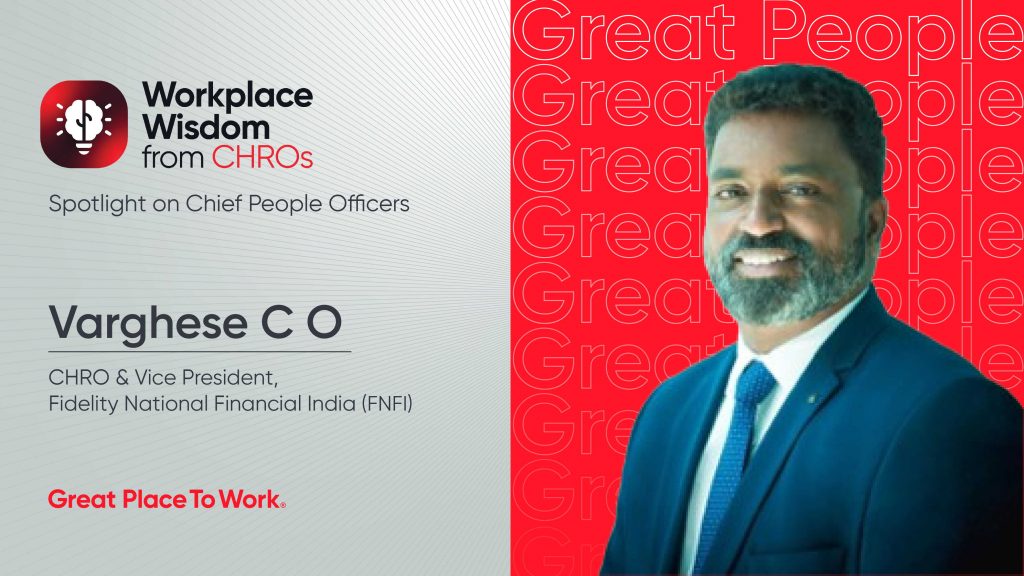

Varghese C O, Chief Human Resources Officer and Vice President at Fidelity National Financial India (FNF India), is a strategic HR leader with over two decades of experience shaping people-first cultures in the financial services sector. He has championed initiatives that embed shared leadership, empathy, and co‑creation into organizational DNA, driving trust, engagement, and resilience across a hybrid workforce. Under his leadership, FNF India has consistently strengthened its standing as a Great Place to Work®, with 6 years of continuous CertificationTM and recognition as a Best Workplace in IT & IT-BPM 2025.
Varghese unpacks his perspectives:
Q1. At FNF India, culture has been framed as a shared leadership responsibility rather than an HR-led initiative. What mindset shifts were required among leaders and how did you personally influence that transition?
At FNF India, the biggest mindset shift was moving from culture is important to “owning culture” We made it explicit that culture isn’t siloed within HR; but it’s a shared leadership responsibility, and intent only matters when it becomes deliberate design and shared ownership.
The turning point came when leaders began treating culture the way they treat business outcomes, something to build intentionally, measure consistently, and refine continuously, and not something to hope for.
The Architect Program helped translate that intent into a practical blueprint by enabling a cross-functional group of “Culture Architects” to co-create solutions, anchored in a deep-dive audit of people practices and employee focus groups. My role as CHRO was to shift the center of gravity: from HR “driving” culture to leaders owning it through operating rhythms, forums like Hi-Fidelity townhalls, LearnTube, ChaiTalks, Leadership Podcast and by reviewing patterns coming through HRBP connects so leaders could respond early to cultural signals, not late to attrition.
Because, ultimately, culture doesn’t scale through aspiration it scales through consistency and accountability.
Q2. What are the top three key people/ engagement metrics you consistently monitor, and how do they help you make informed decisions about your people strategy?
At FNFI, we focus on three interconnected signals that together provide both foresight and diagnosis:
First, Trust/Engagement sentiment as a leading indicator especially our Great Place To Work® partnership and Trust IndexTM direction, because it captures whether people feel credibility, respect, fairness, pride, and camaraderie in day-to-day experience. Our journey with Great Place To Work has been long-term, and the 2026 survey outcome (94% saying it’s a great place to work) is a powerful “heartbeat” measure of culture.
Second, retention and the “story” behind exits, not just attrition numbers but exit reasons and high-achiever retention signals. We also institutionalized direct leadership connects with high performers who chose to resign, because the learnings are disproportionately valuable for shaping the employee experience.
Third, relationship depth through listening and HRBP connect coverage, the quantity of 1:1 connects and, more importantly, the themes (what’s improving, what’s stuck, what’s emerging). When HRBP connects are treated as culture sensors—with dashboards and pattern reviews—it becomes an engine for proactive people strategy rather than reactive firefighting.
Together, these metrics ensure that our people strategy is not retrospective—it is forward-looking and evidence-based.
Q3. The Architect Program became a defining moment by inviting employees to co-create the culture they wanted to work in. What did this process teach you about trust—especially the balance between letting go of control and protecting the organisation’s core values?
The Architect Program taught me that trust grows fastest when leadership is willing to share ownership but anchor values.
We learned to “let go of control” in the how, while holding steady on the why and the core values. The program began with a deep audit of people practices and employee Focus Group Discussions (FGDs), which surfaced four foundational pillars—Communication, Development, Celebration, Collaboration and then empowered employees to co-create initiatives within those pillars.
What changed for us was the internal belief that employees are not just recipients of culture, they are architects of it. When people see their ideas become real practices, trust stops being a sentiment and becomes an experience: “my voice shapes this place.”
At the same time, protecting the organization’s core values required clarity. We kept returning to the values leaders are expected to embody, integrity, accountability, respect, transparency and empathy, so that co-creation didn’t become chaos; it became alignment with a human center.
Because trust is not built through messaging, but it is built when people see that their voice has been listen to and cared for.
Q4. FNFI has seen a 16-point rise in Trust Index scores over five years, culminating in 90% of employees calling it a great workplace. Which one people practice do you believe created the strongest ripple effect across trust, pride, and collaboration—and why?
If I had to pick one practice with the strongest ripple effect, it would be All Ideas Matter (AIM) because it operationalized ownership. AIM empowered employees to turn ideas into impact, and it created a visible proof point that initiative is welcomed, not punished. AIM translated intent into action by giving employees a credible platform to contribute, experiment, and implement ideas. It removed hesitation and replaced it with ownership.
The “ripple” was real: employees began stepping up with ideas beyond role boundaries. One powerful example was an employee-initiated volunteering movement that grew into structured community projects, tutoring government school students and building a rural library, mobilizing employees across levels and functions. That kind of cross-level collaboration doesn’t happen because HR asks for participation; it happens because people believe the culture belongs to them.
The real shift was psychological. People no longer asked, “Will this be accepted?”, they believed, “This can make a difference.”
In my experience, trust rises when people see follow–through, pride rises when they see meaning, and collaboration rises when they see shared purpose. AIM created all three by giving employees genuine platform and then celebrating the outcomes.
Q5. With nearly three-fourths of the workforce operating remotely, sustaining emotional connection becomes complex. How did your HRBP check-ins and first-responder manager model evolve from being administrative touchpoints to audits of cultural and emotional health?
With currently 60% of our workforce working remotely, we had to reimagine connection. In the early days, check-ins can easily become transactional, status updates, policy queries, quick fixes. What changed at FNFI is that the HRBP connects were redesigned as a structured listening system to capture employee sentiment, identify emerging themes, and provide actionable insights to leadership.
With over 95% coverage through HRBP 1:1 connects, this approach enabled us to move from anecdotal feedback to pattern recognition at scale.
In parallel, through the Lean On program, FNFI strengthens psychological safety by equipping managers as certified first-line responders, equipping them to recognize early signs of stress and ensuring employees feel respected, heard, and supported during moments of emotional vulnerability.
Lean On reinforces a culture of care and trust, where mental well-being is treated as a shared leadership commitment and support is offered with empathy, dignity, and timely action
This combination, HRBPs as listening sensors and managers as first-line responders, shifted the system from administrative touchpoints into audits of emotional and cultural health, with pattern reviews and course correction.
Q6. Empathy emerges as a recurring leadership theme in FNFI’s journey.
Can you share a moment where leading with empathy required you to choose people outcomes over short-term business convenience?
One defining moment for me was when we faced a period of workforce pressure and it would have been “easier” to take a purely cost-driven route. Instead, we chose a people-anchored path: internal redeployments instead of layoffs, we focused capability realignment, investing in reskilling and enabling transitions into roles where employees could continue to contribute meaningfully.
This required extra work, reskilling, role mapping, manager alignment, and change management. But it reinforced a core cultural message: at FNFI, people are long-term partners, not expendable resources. The organization successfully transitioned significant numbers of employees across years, and that continuity strengthens trust far more than any internal campaign ever could.
Empathy, in that moment, wasn’t softness, it was strategic humanity. It meant choosing stability and dignity for employees, even when short-term business convenience might have argued otherwise. In the long run, the trust it builds continues to pay dividends in ways that are both cultural and organizational advantage.
Q7. Culture leaders often shape safe spaces for others—while carrying significant responsibility themselves. What has this journey taught you about your own growth as a leader, especially during moments of uncertainty or inflection?
This journey taught me that culture work requires stamina more than slogans and humility more than certainty. The most important growth for me has been learning to hold two things at once: the need for performance in a demanding environment, and the need for people to feel cared for, heard, and secure.
Uncertainty has also deepened my belief in authentic communication. I’ve learned that a word spoken from the heart can carry disproportionate power because it signals that leadership sees people as humans, not headcount. In remote and hybrid contexts, that authenticity becomes a bridge across distance.
Finally, I’ve grown into a rhythm of listening. Whether through employee voice systems, HRBP connects, or leadership forums, the discipline is the same: listen early, act visibly, and follow through consistently. Culture is built by “small, consistent, everyday leadership choices” not only the “big moments” of strategy.
Q8. Looking ahead, as FNFI continues to scale and mature, what is the biggest cultural risk you are consciously guarding against, and how are you preparing leaders to protect the culture they helped build?
The biggest cultural risk in scaling is dilution, when growth adds layers, distance, and process, and the employee experience becomes inconsistent across teams. In hybrid environments, that risk multiplies because culture is less “caught” informally and more dependent on leadership behaviour and system design.
Our response has been to build culture the way we build capability: through leadership development and operating mechanisms. Programmes like Embark , Apex, Base Camp reinforce leadership alignment and strengthen the pipeline to lead with empathy, accountability, and clarity.
Equally, we are protecting culture through listening systems (Voice of Employee, Echobox), leadership accessibility forums, and HRBP connects that create early warning signals. The goal is simple: as we scale, we don’t rely on legacy of “how it used to be”; we institutionalize the behaviors and systems that make the culture real today.
Q9. What role do you believe future leaders must play in protecting a culture they may not have personally built—but are responsible for carrying forward?
Future leaders must become stewards, not just operators. They may not have personally built every practice, but they are responsible for protecting the underlying intent: trust, respect, fairness, pride, camaraderie and the lived experience of “People First, Purpose Led.”
This requires three things:
01 Accessibility by staying accessible and building real listening loops,
02 Accountability by treating culture signals (sentiment, themes from connects, exit narratives) as seriously as business KPIs, and
03 Consistency by maintaining the discipline of follow-through so employees see action, not just acknowledgement.
Most importantly, future leaders must protect co–creation. The Architect mindset is a safeguard against cultural decay: when employees remain active shapers of culture, the culture stays alive, current, and owned, regardless of who is in the leadership chair.
Q10. What is the most common yet powerful myth about your role/ industry that you want to break?
A common myth is that HR’s job is primarily policy, process, and compliance—and that culture is “soft.” My lived experience is quite the opposite: culture is one of the most strategic levers a business can build. When people feel trusted, supported, and connected, you don’t just get better morale, you get stronger ownership, better quality, faster problem-solving, and resilient performance.
Another myth is that in a compliance-driven, customer-centric industry, employee experience must be sacrificed for execution. We’ve learned that the most sustainable execution happens when employees feel safe, respected, and empowered—and when leaders model transparency and empathy as operating principles, not occasional gestures.
Q11. What’s one story or feedback you’ve received that stayed with you and continues to guide your decisions?
One piece of feedback that has stayed with me deeply is how employees distinguish between a policy and a lived experience. Policies promise intent, but it is lived experience that determines whether that intent is truly felt. I recall an employee sharing how she was supported to work from home during both her pre- and post-pregnancy phases, not as an exception, but as an act of care grounded in trust. In another instance, during a medical emergency, leaders went beyond formal protocols: they personally visited an employee’s home, nearly 250 kilometers away, to ensure the family received emotional and practical support. These moments went far beyond flexibility or compliance.
What they captured was something more profound, trust, empathy, and the assurance that the organization sees people as whole human beings, not just employees. When leaders step in with humanity, employees don’t remember the policy clause; they remember how they were made to feel. That is when culture becomes real. It is not defined by what is written in handbooks or slides, but by what people experience in moments that matter most. Those experiences become the real “truth” of culture, the stories employees carry with them long after documents are forgotten.
I also hold close the feedback that listening is only meaningful when it turns into action, which is why mechanisms like Echobox and structured employee voice reviews matter. When employees believe their voice is safe and can lead to positive actions, trust becomes self-reinforcing.
If you’re a People Leader managing a High-Trust High-Performance work environment, and are interested to be interviewed with Great Place To Work India, feel free to write in to in_researchandinsights@greatplacetowork.com